 Hyundai Venue
All generations, specs and history
Published Sources (6) Report an error
By Sarah Whitmore, Senior Automotive Writer
- Built
- 2019–present
- Generations
- 2
Timeline
Venue generations
Click a generation for its own page
- Venue I (QX) 2019–2025 · SUV
- Venue II Current 2025–now · SUV
Newest first · 2 generations since 2019
All generations by year: Venue II (2025–now) · Venue I (QX) (2019–2025)
Which one is mine?
Pick the year of first registration to see which generation it is.
Check by VINThe Hyundai Venue is an affordable small crossover from the Hyundai Motor Company, positioned below the Kona as the most compact and least expensive SUV in the range. It made its world debut at the New York International Auto Show in April 2019 and was unveiled in India at almost the same time - fittingly, because Hyundai's Indian engineering team played a major part in its development. The Venue was designed mainly for city driving, with the occasional trip out of town on rough roads.
In short
- Revealed in New York in April 2019 and launched in India on 21 May 2019; built in South Korea, India, Vietnam, Taiwan and Nepal.
- It shares its platform with the fifth-generation Hyundai Accent and is front-wheel drive only.
- Engines depend on the market: a 90 kW (123 PS) 1.6 in North America, and a 1.2, a 88 kW (120 PS) 1.0 T-GDi and 1.4/1.5 diesels in India.
- India received a facelift in 2022 and an all-new second generation on 4 November 2025.
Specs by version
Engines
| Version | Engine | Gearbox | Drive | Production years |
|---|---|---|---|---|
| QX · 2019–2025 | ||||
| QX · 1.6 L 4 cyl Automatic (AV-S1) · 2024 (EPA) | 1.6 l · 4 cyl 1,600 cc | CVT | Front-wheel drive | 2024 |
| QX · 1.6 L 4 cyl Automatic (AV-S1) · 2023 (EPA) | 1.6 l · 4 cyl 1,600 cc | CVT | Front-wheel drive | 2023 |
| QX · 1.6 L 4 cyl Automatic (AV-S1) · 2022 (EPA) | 1.6 l · 4 cyl 1,600 cc | CVT | Front-wheel drive | 2022 |
| QX · 1.6 L 4 cyl Automatic (AV-S1) · 2021 (EPA) | 1.6 l · 4 cyl 1,600 cc | CVT | Front-wheel drive | 2021 |
| QX · 1.6 L 4 cyl Automatic (variable gear ratios) · 2020 (EPA) | 1.6 l · 4 cyl 1,600 cc | CVT | Front-wheel drive | 2020 |
| QX · 1.6 L 4 cyl Manual 6-spd · 2020 (EPA) | 1.6 l · 4 cyl 1,600 cc | 6-sp Manual | Front-wheel drive | 2020 |
| Venue II · 1.6 L 4 cyl Automatic (AV-S1) · 2026 (EPA) | 1.6 l · 4 cyl 1,600 cc | CVT | Front-wheel drive | 2026 |
| Venue II · 1.6 L 4 cyl Automatic (AV-S1) · 2025 (EPA) | 1.6 l · 4 cyl 1,600 cc | CVT | Front-wheel drive | 2025 |
Performance
Show all 8 versions
| Version | Fuel consumption |
|---|---|
| QX · 2019–2025 | |
| QX · 1.6 L 4 cyl Automatic (AV-S1) · 2024 (EPA) | 7.6 l/100 km30.9 mpg US · 37.2 mpg UK |
| QX · 1.6 L 4 cyl Automatic (AV-S1) · 2023 (EPA) | 7.6 l/100 km30.9 mpg US · 37.2 mpg UK |
| QX · 1.6 L 4 cyl Automatic (AV-S1) · 2022 (EPA) | 7.6 l/100 km30.9 mpg US · 37.2 mpg UK |
| QX · 1.6 L 4 cyl Automatic (AV-S1) · 2021 (EPA) | 7.6 l/100 km30.9 mpg US · 37.2 mpg UK |
| QX · 1.6 L 4 cyl Automatic (variable gear ratios) · 2020 (EPA) | 7.4 l/100 km31.8 mpg US · 38.2 mpg UK |
| QX · 1.6 L 4 cyl Manual 6-spd · 2020 (EPA) | 7.8 l/100 km30.2 mpg US · 36.2 mpg UK |
| Venue II · 1.6 L 4 cyl Automatic (AV-S1) · 2026 (EPA) | 7.6 l/100 km30.9 mpg US · 37.2 mpg UK |
| Venue II · 1.6 L 4 cyl Automatic (AV-S1) · 2025 (EPA) | 7.6 l/100 km30.9 mpg US · 37.2 mpg UK |
Verified Manufacturer and type-approval data from our catalog · Sources and methodology
Safety
-
QX · NHTSA 2021
US NCAP (NHTSA)
Stars from different years and organisations are not directly comparable: test protocols change every few years.
Hyundai Venue at a glance
Hyundai designed the Venue as a modern, functional small SUV with an eye-catching front and rear and plenty of decorative detail. The body is a compact, boxy shape with crisp detailing, and the Indian-market version is shorter in length and wheelbase than the Korean one so that it stays under 4 metres. A facelift with redesigned front and rear ends and a digital instrument cluster arrived in India in June 2022, followed by a sporty N Line. The second generation, revealed in India in November 2025, moved to the K1 platform shared with the Kia Syros and gained twin 12.3-inch curved screens. More of the brand's range is in our Hyundai catalogue, and its larger sibling is covered in Hyundai Kona Electric.
Exterior
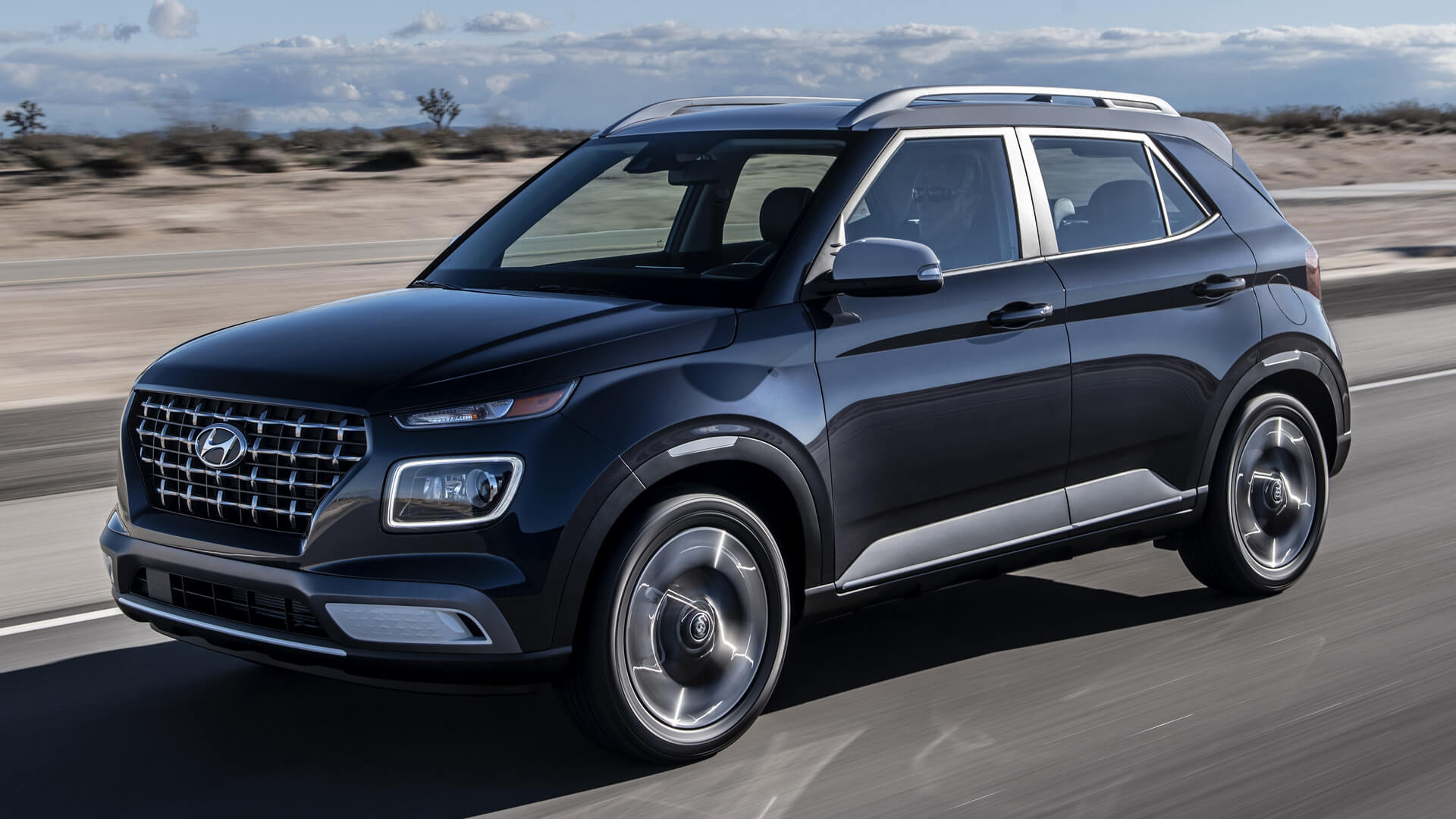
Darkened A-pillars make the body look more substantial, and the tail lights use several geometric elements to create a sense of depth. The roof and various body accents can be finished in contrasting colours, such as space grey or bright acid yellow. These bold design touches help the Venue stand out among city crossovers and appeal to younger buyers.
The front is short but solid, with a wide windscreen, ribbed sculpting on the bonnet and a two-tier lighting layout: slim upper lights, and main headlights below with LED accents around them. Position lights sit on each side of a distinctive grille with large cells, and the wide lower bumper, in line with Hyundai's corporate style, has decorative inserts and tough plastic cladding. More expensive versions add fog lights.
The side view is modest and restrained, with roof rails on the almost flat roof, simple side glazing, compact mirrors and several ribbed accents. Protective cladding runs around the lower body. Wheels range from 15-inch alloys to optional 16- and 17-inch wheels, depending on the market. At the rear there is a large rear window, a high tailgate with the model name and horizontal sculpting, and square tail lights. The bumper has fog lights on better-equipped versions, towing eyes and protective trim, and the exhaust is hidden under the boot floor.
Interior and practicality
Given its low price, the cabin is kept simple. It looks smart, but hard plastics and cloth upholstery give away its budget nature; higher trims combine cloth and leather. The seats are simple, with light side support and manual adjustment. The driver has a three-spoke multifunction steering wheel that adjusts for height and reach, and a classic instrument cluster with large analogue dials and a 3.5-inch information display in the centre.
An 8-inch infotainment system with Blue Link connected services, Apple CarPlay and Android Auto is impressive for the money. The climate controls are neatly designed: two side knobs do the adjusting, while a round central display that looks like a knob shows the settings. The tunnel is compact, with a small connectivity panel, the parking brake, cupholders and a simple armrest. The rear bench offers no extras - not even a pocket on the front seat backs - and space is limited by the compact body. The rear seat folds 60/40, and with it folded the load space reaches 903 litres measured to the roof. Materials are not lavish, but for its price the Venue is well made.
Engines and transmissions
| Market | Engine | Power (kW / PS) | Torque | Gearboxes |
|---|---|---|---|---|
| North America, Australia | 1.6 Smartstream petrol | 90 kW / 123 PS | 151–153 Nm | 6-speed manual, IVT (CVT) or 6-speed automatic |
| India | 1.2 Kappa petrol | 61 kW / 83 PS | 115 Nm | 5-speed manual |
| India | 1.0 T-GDi turbo petrol | 88 kW / 120 PS | 172 Nm | 6-speed manual, iMT, 7-speed DCT |
| India (to 2020) | 1.4 diesel | 66 kW / 90 PS | 230 Nm | 6-speed manual |
| India (from 2020) | 1.5 diesel | 74 kW / 100 PS | 240 Nm | 6-speed manual |
The North American 1.6 is a naturally aspirated four-cylinder from the Smartstream Gamma family with multi-point injection, also used in several other small Hyundai and Kia models. With it, the Venue reaches 100 km/h in about 11.2 seconds and has a top speed of around 181 km/h, according to published figures. The manual gearbox was dropped in the US for 2021 because of low demand. In India, the 1.0 T-GDi can be ordered with a seven-speed dual-clutch transmission or, from July 2020, the iMT "intelligent manual" with an automatic clutch. All-wheel drive is not available.
Chassis
The Venue has a simple suspension layout: MacPherson struts at the front and a torsion beam at the rear. Better-equipped versions have a drive-mode selector with Normal, Eco and Sport modes and Snow, Mud and Sand traction modes, which adjust the traction control to help on slippery surfaces. Steering is rack-and-pinion with electric assistance. The brakes are 279 mm ventilated discs at the front and simple 203 mm drums at the rear. In normal driving the Venue is lively and stable, but the engine becomes noisy under hard acceleration.
Safety
Despite its low price, the Venue offers a good level of safety. Depending on the version, it has six airbags, automatic emergency braking, blind-spot monitoring, lane-keeping assistance and rear cross-traffic warning. In ANCAP's 2019 test it scored 91% for adult occupant protection and 81% for child occupant protection, and in the US it received four stars overall from NHTSA. The most basic versions have only two airbags, front electric windows, ABS with EBD, parking sensors, central locking with automatic locking on the move, belt pretensioners, child-seat anchorages and electric power steering.
Strengths and weaknesses
The Venue is a bold, compact, stylish and modern crossover that seems aimed at young buyers. Its prices and equipment are attractive compared with rivals, the cabin is pleasant and well assembled, the engines are responsive enough and safety is good for the class. On the downside, materials are hard and simple, the rear seat is basic and tight, the engine is noisy when worked hard, and there is no all-wheel drive. Rivals include the Nissan Kicks, Ford EcoSport, Renault Duster and Suzuki Vitara.
Hyundai Venue in our rankings
- No. 109 of 256 · Most economical cars (7.4 l/100 km · top 44%)
- No. 42 of 77 · Most economical SUVs and crossovers (7.4 l/100 km · top 55%)
- No. 532 of 912 · Longest-running car nameplates (7 years · top 60%)
- No. 194 of 305 · Oldest car models still on sale (7 years · top 67%)
- No. 453 of 557 · Biggest engines: cars (1,600 cc · top 85%)
- No. 107 of 125 · Biggest engines: SUVs and crossovers (1,600 cc · top 87%)
More economical than 56% of ranked cars in the 1CARS catalog (No. 109 of 256).
FAQ
When was the Hyundai Venue launched?
It debuted at the New York International Auto Show in April 2019, and sales in India began on 21 May 2019.
What engine does the Hyundai Venue have?
It depends on the market: a 90 kW (123 PS) 1.6 in North America and Australia, and 1.2, 1.0 T-GDi and diesel engines in India.
Is the Hyundai Venue all-wheel drive?
No. It is front-wheel drive only, but some versions have Snow, Mud and Sand traction modes.
Is the Hyundai Venue smaller than the Kona?
Yes. It sits below the Kona as Hyundai's smallest and most affordable SUV.
Is there a new Hyundai Venue?
Yes. The second generation was unveiled in India on 4 November 2025, using the K1 platform shared with the Kia Syros.
Data sources
Data checked by an editor against the sources below.
- Wikipedia - Hyundai Venue
- US EPA fueleconomy.gov - 46864.shtml
- US EPA fueleconomy.gov - 45608.shtml
- US EPA fueleconomy.gov - 44135.shtml
- US EPA fueleconomy.gov - 42662.shtml
- NHTSA 5-Star Safety Ratings (US NCAP) — U.S. Government work, public domain