 Plymouth Prowler
Specs, engines and history
Published Sources (4) Report an error
By Sarah Whitmore, Senior Automotive Writer
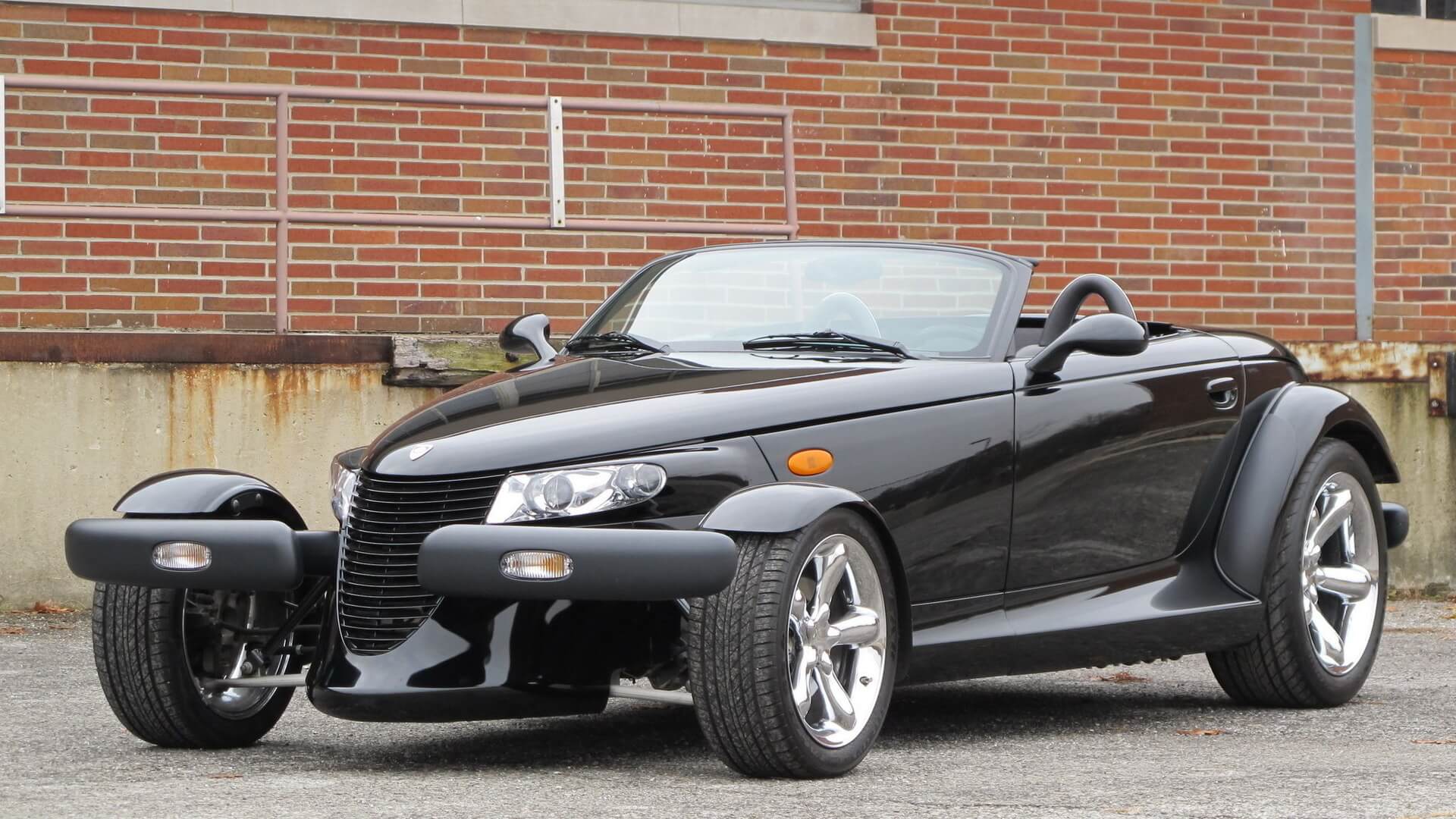
The Plymouth Prowler is a two-seat retro roadster built by Chrysler Corporation in the style of a classic American hot rod. Based on a 1993 concept car of the same name, it was produced for the 1997 model year and again from 1999 to 2002 - there was no 1998 model. After the Plymouth brand was discontinued in 2001, the car was sold as the Chrysler Prowler for its final two years. Its extravagant styling made it one of the most unusual production cars of the 1990s.
In short
- Two-seat open roadster with exposed front wheels, inspired by 1930s and 1940s hot rods.
- 3.5-litre V6: 160 kW (214 hp) in 1997, 189 kW (253 hp) with an aluminium block from 1999.
- Four-speed Autostick transmission mounted at the rear, aluminium-intensive construction and a kerb weight of about 1,270 kg.
- 11,702 built: 8,532 as Plymouths and 3,170 as Chryslers.
Specs by version
Engines
| Version | Engine | Gearbox | Drive | Production years |
|---|---|---|---|---|
| 3.5 L 6 cyl Automatic (S4) · 2001 (EPA) | 3.5 l · 6 cyl 3,500 cc | 4-sp Automatic | Rear-wheel drive | 2001 |
| 3.5 L 6 cyl Automatic 4-spd · 2000 (EPA) | 3.5 l · 6 cyl 3,500 cc | 4-sp Automatic | Rear-wheel drive | 2000 |
| 3.5 L 6 cyl Automatic 4-spd · 1999 (EPA) | 3.5 l · 6 cyl 3,500 cc | 4-sp Automatic | Rear-wheel drive | 1999 |
Performance
Show all 3 versions
| Version | Fuel consumption |
|---|---|
| 3.5 L 6 cyl Automatic (S4) · 2001 (EPA) | 13.8 l/100 km17.0 mpg US · 20.5 mpg UK |
| 3.5 L 6 cyl Automatic 4-spd · 2000 (EPA) | 13.1 l/100 km18.0 mpg US · 21.6 mpg UK |
| 3.5 L 6 cyl Automatic 4-spd · 1999 (EPA) | 13.1 l/100 km18.0 mpg US · 21.6 mpg UK |
Verified Manufacturer and type-approval data from our catalog · Sources and methodology
Plymouth Prowler at a glance
The Prowler is a front-engined, rear-wheel-drive roadster, hand-assembled at Chrysler's Conner Avenue plant in Detroit, with bodies produced in Shadyside, Ohio. Its design is credited to Chrysler design chief Tom Gale's team. The name means someone who roams or prowls. More Chrysler models are listed in our Chrysler catalogue.
History
According to published figures, the idea began in May 1990 at an "ideas fair" held at Chrysler's Pacifica design studio in California, where among the many proposals was a small 3-by-5-inch card with a sketch of a hot rod. In November of that year Chrysler president Bob Lutz, known for his adventurous approach, saw the drawing and backed it. The project was named Prowler the following year, approval for production followed, and the concept car was unveiled at the Detroit motor show in January 1993. Production versions arrived for 1997, and after a pause for 1998 the car returned for 1999 with a more powerful engine. Sold as a Plymouth until 2001 and as a Chrysler in 2001 and 2002, the Prowler was built in a total of 11,702 examples.
Exterior
The Prowler is hard to describe because it looks like nothing else on the road. At the front, oval halogen headlights flank a tall, narrow grille at the end of a long bonnet. In front of the wheels sit two plastic pods carrying the indicators, and the front wheels stand clear of the body with their own mudguards, exposing the suspension in true hot-rod fashion. The deep crease running along the side links the front wings to the strongly flared rear wheel arches, which stand out from the body. The mirrors are mounted on stalks, and there are side indicator repeaters.
Ground clearance is about 115 mm. The wheels are deliberately staggered: 17 × 7-inch wheels with 225/45 tyres at the front and much larger 20 × 10-inch wheels with 295/40 tyres at the rear, emphasising the hot-rod stance. At the rear, a rounded, raised boot lid sits between oval forms that house the narrow tail lights, and the rear bumper matches the front. Two large exhaust outlets exit below. Chrysler dealers also offered an optional trailer styled like the back of a Prowler, with its own 15-inch wheels, to make up for the car's tiny luggage space.
Interior
The cabin is as unconventional as the exterior. There are two seats with leather upholstery and limited side support, and space for the two occupants is reasonable. Getting in is not easy, however, because the doors open only to about 40 degrees. The driver faces a three-spoke steering wheel with five buttons and a single analogue rev counter mounted on the steering column; the other five analogue gauges are arranged in a row in the centre of the dashboard. A large vent sits at the top of the centre console, above a basic audio unit and a climate panel with three simple knobs. The tunnel carries a large gear selector with a thick chrome base, a single cupholder and a manual parking-brake lever. The boot is tiny - only about 50 litres.
Engine and transmission
| Years | Engine | Power (kW / hp) | Gearbox |
|---|---|---|---|
| 1997 | 3.5 V6, 24 valves | 160 kW / 214 hp at 5,850 rpm | 4-speed Autostick |
| 1999–2002 | 3.5 V6, aluminium block | 189 kW / 253 hp at 6,400 rpm | 4-speed Autostick |
The V6 has multi-point fuel injection and 24 valves; published figures give 346 Nm of torque for the later engine. Power goes to the rear wheels through a four-speed Autostick semi-automatic transmission mounted at the rear of the car rather than behind the engine, connected by a torque tube - a layout similar to that of the Chevrolet Corvette, which helps weight distribution. 0–60 mph takes just over 7 seconds, and published figures give a top speed of about 210 km/h. No manual gearbox was offered, a point some hot-rod purists criticised.
Chassis
The Prowler made extensive use of aluminium, much of it adhesively bonded, especially in the chassis - an advanced approach for the time that kept kerb weight to about 1,270 kg. Power steering is hydraulically assisted, the independent suspension uses multiple links at each corner, and all four wheels have disc brakes.
On the road the Prowler is happiest on smooth, straight roads. Despite repeated revisions to the suspension, dampers and arms, even late cars do not ride smoothly: the suspension feels nervous, harsh and rather stiff, and uneven roads are uncomfortable. The low ground clearance means routes need to be planned with care.
Key specifications
| Parameter | Value |
|---|---|
| Model years | 1997, 1999–2002 |
| Length | 4,199 mm |
| Width | 1,943 mm |
| Height | 1,293 mm |
| Wheelbase | 2,878 mm |
| Kerb weight | about 1,270 kg |
| Power | 160–189 kW (214–253 hp) |
| Built | 11,702 |
Strengths and weaknesses
The Prowler's strengths are its unique look, which makes it a rare sight even today, a lightweight aluminium structure, a well-balanced rear-transaxle layout and good performance for its era. Its weaknesses are a tiny boot, awkward entry through narrow-opening doors, a harsh ride, low ground clearance and the absence of a manual gearbox or V8. The Prowler is bought to stand out rather than for practicality or racing.
Plymouth Prowler in our rankings
- No. 242 of 557 · Biggest engines: cars (3,500 cc · top 44%)
- No. 25 of 49 · Biggest engines: convertibles and roadsters (3,500 cc · top 52%)
- No. 11 of 15 · Most economical convertibles and roadsters (13.1 l/100 km · top 74%)
- No. 647 of 912 · Longest-running car nameplates (5 years · top 77%)
- No. 215 of 256 · Most economical cars (13.1 l/100 km · top 84%)
Bigger engine than 56% of ranked cars in the 1CARS catalog (No. 242 of 557).
FAQ
How many Plymouth Prowlers were built?
11,702 in total: 8,532 badged as Plymouths and 3,170 as Chryslers.
What engine does the Plymouth Prowler have?
A 3.5-litre V6 with 160 kW (214 hp) in 1997 and 189 kW (253 hp) from 1999.
Why was there no 1998 Prowler?
Production paused after the 1997 model year and resumed for 1999 with the more powerful aluminium-block engine.
Why is it also called the Chrysler Prowler?
After the Plymouth brand was discontinued in 2001, the car was sold under the Chrysler name for 2001 and 2002.
Data sources
Data checked by an editor against the sources below.
- Wikipedia - Plymouth Prowler
- US EPA fueleconomy.gov - 16460.shtml
- US EPA fueleconomy.gov - 15616.shtml
- US EPA fueleconomy.gov - 14811.shtml