
Mercedes-Benz Vito vs VW Transporter: vans compared
Updated Report an error By Oleksandr Hnatiuk

Mercedes-Benz · 2014–present
Vito W447
- Power
- 140 kW190 PS
- Kerb mass
- -

Volkswagen · 2025–present
Transporter T7
- Power
- 125 kW170 PS
- Kerb mass
- 2,265 kg
Verdict Opinion
The Vito is the more versatile workhorse. It is the only one of the two with rear-wheel drive and four-wheel drive, diesels from 65 to 176 kW and three body lengths, and its 90 kWh eVito now claims up to 480 km.
The Transporter is the newer design. It adds a plug-in hybrid that Mercedes does not offer, electric versions of up to 210 kW and a wider body, and it shares its engineering with the Ford Transit Custom.
- Oleksandr Hnatiuk
The Volkswagen Transporter and the Mercedes-Benz Vito have shared Europe's mid-size van market for decades, but the newest Transporter is a very different vehicle from its predecessors. Volkswagen unveiled it, with the Caravelle passenger version, in August 2024. It was developed with Ford, shares its technology with the Ford Transit Custom and is built by Ford Otosan in Turkey; production started in February 2025. The Vito of the W447 generation has been built since 2014, mainly in Vitoria-Gasteiz in Spain, and was facelifted for 2020 and again in July 2023.
In short: the Vito offers the widest choice of drive layouts and the strongest diesels, while the Transporter brings a newer design, a plug-in hybrid and electric versions of up to 210 kW. Both are in our catalogue: Mercedes-Benz Vito and Volkswagen Transporter.
Mercedes-Benz Vito vs VW Transporter: engines, drive and space
A Volkswagen built on Ford technology
The Transporter that replaced the T6.1 is not on Volkswagen's own MQB platform; that is reserved for the Multivan. It is based on the Ford Transit Custom, and Volkswagen has not officially applied the T7 name to it. The Vito is a Mercedes-Benz design throughout and shares its body with the V-Class people carrier.
Diesel engines
The Transporter's 2.0-litre diesel comes in three outputs between 81 and 125 kW (110–170 PS). The Vito has a much wider spread. Since the 2020 update, front-wheel-drive versions use a 1.7-litre diesel such as the 110 CDI with 84 kW (114 PS) and 270 Nm or the 114 CDI with 100 kW (136 PS) and 330 Nm. Rear-wheel and four-wheel-drive versions use the 2.0-litre OM 654: the 116 CDI has 118 kW (160 PS) and 380 Nm, the 119 CDI 140 kW (190 PS) and 440 Nm, and the bi-turbo 124 CDI 176 kW (239 PS) and 500 Nm.
- Vito 110 CDI: 84 kW, 270 Nm, front-wheel drive
- Vito 119 CDI: 140 kW, 440 Nm, rear- or four-wheel drive
- Vito 124 CDI: 176 kW, 500 Nm
- Transporter 2.0 TDI: 81, 110 or 125 kW
- Transporter eHybrid: 171 kW
Plug-in hybrid and electric
Volkswagen offers a 2.5-litre eHybrid with 171 kW and a 16.5 kWh battery, and three electric e-Transporter outputs from 100 to 210 kW with a 63.8 kWh battery. Mercedes has no hybrid Vito. Its electric eVito started with an 84 kW motor and about 150 km of range; in March 2025 a 90 kWh battery was added with a stated range of 480 km. The eVito Tourer passenger version has a 150 kW motor, 90 kWh usable, 11 kW AC charging and a stated 421 km.
Size and load space
The Transporter comes in two lengths, 5.05 and 5.45 metres. Our catalogue lists 2,032 mm of width and a 3,100 mm wheelbase for the shorter van. The Vito is offered at 4,895, 5,140 and 5,370 mm on wheelbases of 3,200 or 3,430 mm. Its cargo volume is 5.5, 6.0 or 6.6 m³ depending on length, with interior load lengths of 2,568 to 3,061 mm and 1,685 mm of interior width.
Safety and equipment
The 2024 Vito received a 10.25-inch MBUX touchscreen, multibeam headlights and driver drowsiness detection, and scored 90% (Platinum) in ANCAP's commercial van rating. The V-Class body it shares scored 93% for adult occupants and 87% for children in its 2014 crash test, aligned with Euro NCAP.
Full specifications
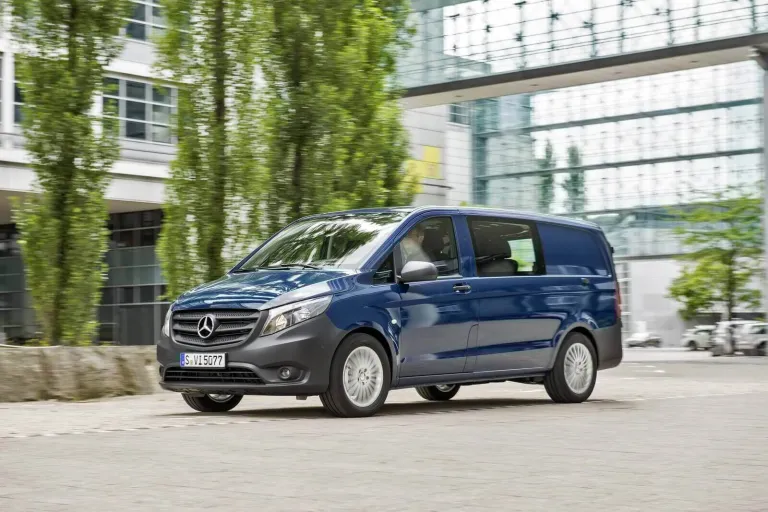
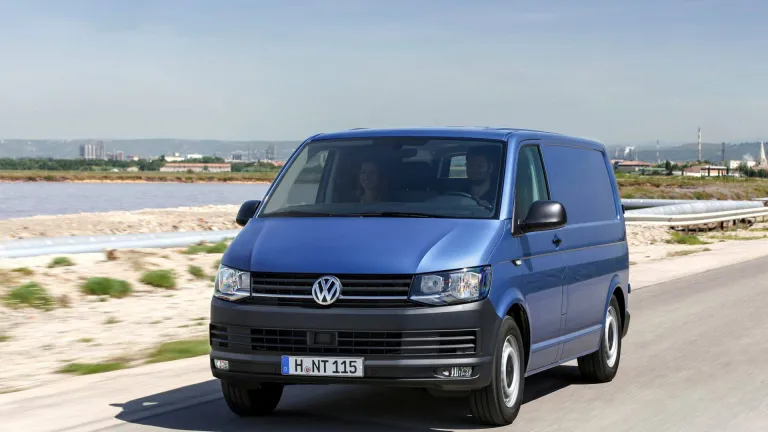
| Mercedes-Benz Vito | Volkswagen Transporter | |
|---|---|---|
| General | ||
| Version | Vito W447 · 2.1 · 140 kW (190 PS) | Transporter T7 · 2.0 TDI · diesel · 125 kW (170 PS) |
| Production years | 2014–present | 2025–present |
| Body | Minibus, Van | Van |
| Class | Van | Van |
| Country | Germany | Germany |
| Performance | ||
| Power Why it matters: More power means stronger acceleration and easier overtaking, especially with a full load. | 140 kW (190 PS) 188 hp Better | 125 kW (170 PS) 168 hp |
| Power, all versions | 65–160 kW (88–218 PS) 87–215 hp | 18–173 kW (24–235 PS) 24–232 hp |
| Power per tonne | No data | 55 kW/t 67 hp/ton calculated |
| Engine and transmission | ||
| Fuel | Diesel | Diesel |
| Engine | 2,100 cc 2.1 l | 2,000 cc · 4 cyl 2.0 l |
| Gearbox | No data | 8-speed automatic |
| Drive | No data | Front-wheel drive |
| Dimensions and weight | ||
| Length | No data | 5,050 mm 198.8 in |
| Width | No data | 2,032 mm 80.0 in |
| Height | No data | 1,984 mm 78.1 in † |
| Wheelbase | No data | 3,100 mm 122.0 in |
| Kerb weight Why it matters: A lighter car is usually more agile and uses less energy. | No data | 2,265 kg 4,993 lb |
| Economy and running costs | ||
| Fuel consumption Why it matters: Lower consumption cuts running costs and CO₂ emissions on every trip. | No data | 8.7 l/100 km 27.0 mpg US |
| CO₂ | No data | 227 g/km |
| Fuel cost per year | No data | €2,150/year estimated |
These cars do not differ in the data we have.
Equal rows hidden (3): Class, Country, Fuel.
Better marks the stronger figure - only for measurable specs (power, torque, 0–100 km/h, consumption, boot, weight).
Estimated at 15,000 km a year with fuel at €1.65/l diesel. † from another version of this generation.
In plain words
Mercedes-Benz Vito has more power: 140 kW (190 PS) against 125 kW (170 PS) for Volkswagen Transporter. Volkswagen Transporter is the older design (from 1950); Mercedes-Benz Vito arrived in 1996. Our catalog has no kerb mass for the Mercedes-Benz Vito yet, so some checks above leave it out.
Which one to choose
Choose the Mercedes-Benz Vito if you need rear-wheel drive or 4MATIC for towing and poor roads, a powerful 176 kW diesel, a compact 4,895 mm body or a long-range electric van.
Choose the Volkswagen Transporter if you want the latest generation with a plug-in hybrid option, electric outputs up to 210 kW, or a Volkswagen badge on Ford Transit Custom engineering.
For smaller vans see Citroën Berlingo vs Fiat Doblò.
Frequently asked questions
Is the new VW Transporter a Ford?
It is a joint development with Ford: the Transporter launched in 2024 is based on the Ford Transit Custom and built by Ford Otosan in Turkey. The Multivan remains on Volkswagen's own MQB platform.
Which has more powerful diesels?
The Vito. Its strongest diesel, the 124 CDI, has 176 kW (239 PS) and 500 Nm. The Transporter's 2.0 TDI tops out at 125 kW (170 PS).
Can you get rear-wheel drive?
Only in the Vito. Front-wheel drive is used with the 1.7-litre diesels, while the 2.0-litre versions drive the rear wheels or all four.
What is the range of the electric versions?
The eVito with the 90 kWh battery added in March 2025 has a stated range of 480 km. The e-Transporter has a 63.8 kWh battery and outputs from 100 to 210 kW; its range is not given in the sources used here.
How much cargo space does the Vito have?
5.5, 6.0 or 6.6 m³, depending on the body length of 4,895, 5,140 or 5,370 mm.