
Range Rover Velar vs Porsche Macan: style vs sport
Updated Report an error By Felix Hartmann

Land Rover · 2017–present
Range Rover Velar
- Power
- 132 kW179 PS
- Kerb mass
- 1,899 kg

Porsche · 2013–present
Macan I
- Power
- 185 kW252 PS
- Kerb mass
- 1,845 kg
At a glance
Who suits what, worked out from the catalog figures of the versions above.
Categories won: Range Rover Velar 2 Macan I 2
- Family Range Rover Velar Boot: 559 l vs 500 l
- City Macan I Length: 4,681 mm vs 4,797 mm
- Performance Macan I Power per tonne: 100 kW/t vs 70 kW/t
- Running costs Range Rover Velar Fuel per year: €1,730 vs €2,730 (estimated)
Verdict Opinion
The Macan is the sportier car in both its petrol and electric forms. Porsche's steering and chassis tuning, the strong V6 engines and the very fast electric Turbo make it the choice for drivers.
The Velar wins on design and comfort. Its clean lines and minimalist cabin are its main selling points, and it has offered diesel engines and a plug-in hybrid, neither of which is part of the current Macan range. For long, relaxed journeys and a distinctive look, the Velar is the more fitting choice.
— Felix Hartmann
The Porsche Macan showed in 2013 that a compact SUV could carry a sports-car badge. The production car appeared at the Los Angeles and Tokyo shows that year, and assembly began in February 2014 at Leipzig, alongside the Panamera. Its platform came from the first Audi Q5, but Porsche heavily modified the suspension.
Land Rover answered with design. The Range Rover Velar was unveiled at the London Design Museum on 1 March 2017 and launched at the Geneva show a week later. It is built at Solihull on the aluminium D7a platform shared with the Jaguar F-Pace, XE and XF, with a 2,874 mm wheelbase.
Range Rover Velar vs Porsche Macan: engines, EV and weight
A wide range at Land Rover
The Velar has been offered with four- and six-cylinder diesels from the D180 with 132 kW to the V6 D300 with 221 kW, and petrol engines from the P250 with 184 kW (250 PS) to the P400 straight-six with 294 kW (400 PS). From September 2020 the P400e plug-in hybrid added a 2.0-litre engine and an electric motor for 297 kW (404 PS); its 2023 battery has 19.2 kWh, 15.4 kWh of it usable. The rare SVAutobiography Dynamic Edition used a supercharged 5.0-litre V8 with 405 kW (550 PS).
Petrol Macan
The first Macan started with the 2.0-litre four-cylinder of 185 kW (252 PS) and V6 engines in the Macan S with 250 kW (340 PS), the GTS with 265 kW (360 PS) and the Turbo with 294 kW (400 PS), or 324 kW (440 PS) with the Performance Package. Diesel versions had 155 kW and 190 kW. So the strongest Velar has 81 kW more than the strongest petrol Macan.
The electric Macan
On 25 January 2024 Porsche revealed the second Macan, a battery-electric car on the Premium Platform Electric shared with the Audi Q6 e-tron. It has been built at Leipzig since May 2024, and the petrol Macan continued alongside it. The range runs from the rear-drive Macan with up to 264 kW (359 PS) to the Turbo with up to 470 kW (639 PS) and 1,130 N·m, which reaches 100 km/h in 3.3 seconds and 260 km/h. The Turbo Electric outpowers the V8 Velar by 65 kW.
Weight
The electric Macan weighs 2,330 kg in its basic and 4S forms and 2,405 kg as the Turbo. That is about 5.1 kg per kW for the Turbo and 7.8 kg per kW for the 300 kW Macan 4.
Race Stats side by side
Each figure is a 0–100 score from the catalog numbers, the same as on the 1CARS Race cards. PI is the overall performance index (100–999) and its class D–S.
| Stat | Range Rover Velar | Macan I |
|---|---|---|
| PI | C · 466 | B · 525 |
| Power | 39 | 50 |
| Grip | 44 | 36 |
| Handling | 45 | 48 |
| Top speed | 37 | 48 |
| Launch | 39 | 52 |
Grip and handling are estimates from drive type, weight, height and body (hover a figure to see where it comes from). 1CARS Race
Who wins a race?
Quarter-mile (402 m) drag from a standing start, dry road, no reaction time — the 1CARS Race physics on the catalog figures of these versions.
- 1 Macan IMacan I · 2.0 · petrol · 185 kW (252 PS) 14.78 sat 152 km/h
- 2 Range Rover VelarD180 · diesel · 132 kW (179 PS) 16.11 sat 133 km/h · +1.33 s
Size and weight
Side view to scale, all cars from the front bumper.
| Range Rover Velar | Macan I | |
|---|---|---|
| Length | 4,797 mm188.9 in | 4,681 mm184.3 in −116 mm −4.6 in −2.4% |
| Width | 1,933 mm76.1 in | 1,923 mm75.7 in −10 mm −0.4 in −0.5% |
| Height | 1,685 mm66.3 in | 1,624 mm63.9 in −61 mm −2.4 in −3.6% |
| Wheelbase | 2,874 mm113.1 in | 2,807 mm110.5 in −67 mm −2.6 in −2.3% |
| Kerb weight | 1,899 kg4,187 lb | 1,845 kg4,068 lb −54 kg −119 lb −2.8% |
| Boot | 559 l19.7 cu ft | 500 l17.7 cu ft −59 l −2.1 cu ft −10.6% |
| Fits a standard garage? | Too wide | Too wide |
Difference vs Range Rover Velar (±). Garage check: a standard single garage takes a car up to about 5.0 m (16 ft 5 in) long and 1.9 m (6 ft 3 in) wide (width as listed in the catalog; some makers include the mirrors). Leave about 0.6 m (2 ft) to open the doors.
Full specifications
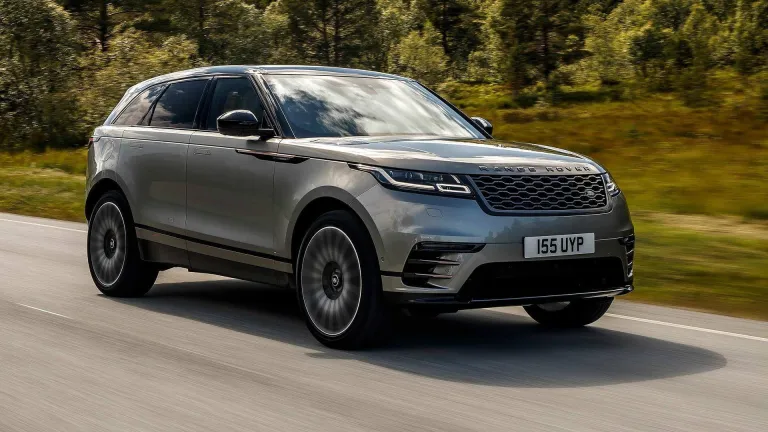
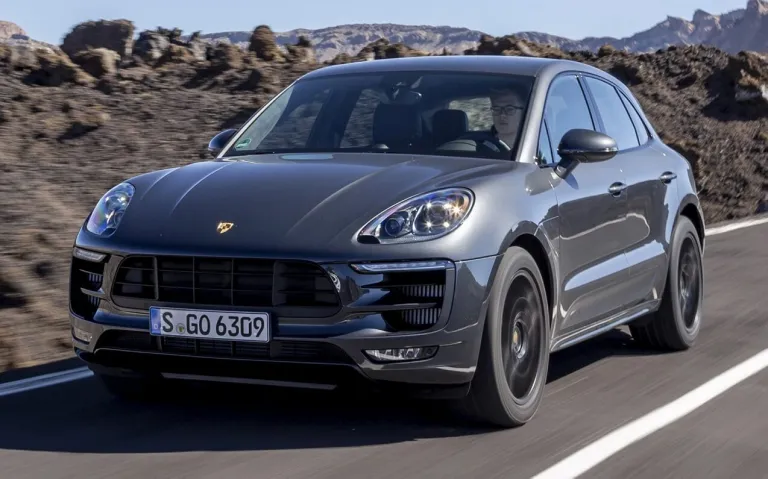
| Land Rover Range Rover Velar | Porsche Macan | |
|---|---|---|
| General | ||
| Version | D180 · diesel · 132 kW (179 PS) | Macan I · 2.0 · petrol · 185 kW (252 PS) |
| Production years | 2017–present | 2013–present |
| Body | SUV | SUV |
| Class | SUV / crossover | SUV / crossover |
| Country | United Kingdom | Germany |
| Performance | ||
| Power Why it matters: More power means stronger acceleration and easier overtaking, especially with a full load. | 132 kW (179 PS) 177 hp | 185 kW (252 PS) 248 hp Better |
| Power, all versions | 132–405 kW (179–551 PS) 177–543 hp | 177–470 kW (241–639 PS) 237–630 hp |
| Torque Why it matters: Torque is the pulling force you feel when accelerating from low revs, towing or climbing hills. | 430 Nm 317 lb-ft | No data |
| Power per tonne | 70 kW/t 85 hp/ton calculated | 100 kW/t 122 hp/ton calculated Better |
| Engine and transmission | ||
| Fuel | Diesel | Petrol |
| Engine | 4 cyl | 2,000 cc · 4 cyl 2.0 l |
| Gearbox | 8-speed automatic | 7-speed dual-clutch |
| Drive | All-wheel drive | No data |
| Dimensions and weight | ||
| Length | 4,797 mm 188.9 in | 4,681 mm 184.3 in |
| Width | 1,933 mm 76.1 in | 1,923 mm 75.7 in |
| Height | 1,685 mm 66.3 in | 1,624 mm 63.9 in |
| Wheelbase | 2,874 mm 113.1 in | 2,807 mm 110.5 in |
| Kerb weight Why it matters: A lighter car is usually more agile and uses less energy. | 1,899 kg 4,187 lb | 1,845 kg 4,068 lb Better |
| Boot Why it matters: A bigger boot fits more luggage, shopping or a pram. | 559 l 19.7 cu ft Better | 500 l 17.7 cu ft |
| Fuel tank Why it matters: A larger tank means more distance between fuel stops. | 92 l 24.3 gal US | No data |
| Economy and running costs | ||
| Fuel consumption Why it matters: Lower consumption cuts running costs and CO₂ emissions on every trip. | 7.0 l/100 km 33.6 mpg US Better | 10.4 l/100 km 22.6 mpg US |
| CO₂ | 183 g/km Better | 235 g/km |
| Fuel cost per year | €1,730/year estimated Better | €2,730/year estimated |
| Range on a full tank | 1,314 km 816 mi estimated | No data |
| Safety | ||
| Euro NCAP | ★★★★★ (2017) | ★★★★★ (2014) |
These cars do not differ in the data we have.
Equal rows hidden (2): Body, Class.
Better marks the stronger figure — only for measurable specs (power, torque, 0–100 km/h, consumption, boot, weight).
Estimated at 15,000 km a year with fuel at €1.65/l diesel, €1.75/l petrol.
In plain words
Porsche Macan has more power: 185 kW (252 PS) against 132 kW (179 PS) for Land Rover Range Rover Velar. Land Rover Range Rover Velar is 116 mm longer than Porsche Macan (4,797 mm vs 4,681 mm). Porsche Macan is lighter by 54 kg (1,845 kg vs 1,899 kg). Land Rover Range Rover Velar has the bigger boot: 559 l against 500 l. At 15,000 km a year, fuel would cost about €1,730 (Land Rover Range Rover Velar), €2,730 (Porsche Macan) (estimated). Porsche Macan is the older design (from 2013); Land Rover Range Rover Velar arrived in 2017. On the catalog figures, the Land Rover Range Rover Velar is the pick for family and running costs; the Porsche Macan is the pick for city and performance.
Which one to choose
Choose the Range Rover Velar if design matters most, if you want a diesel or a plug-in hybrid, or if you prefer comfort to sharp handling.
Choose the Porsche Macan if you want the most driver-focused SUV in this pair, the performance of a V6 petrol, or a fully electric SUV with up to 470 kW.
Used buyers should check the air suspension where fitted and the gearbox service history on both cars.
Frequently asked questions
Is the Porsche Macan electric?
The second-generation Macan, revealed in January 2024, is fully electric. The first-generation petrol Macan has been built alongside it at Leipzig.
Is there a plug-in hybrid Velar or Macan?
The Velar P400e plug-in hybrid has 297 kW (404 PS) and a 19.2 kWh battery in its 2023 form. The Macan range has no plug-in hybrid: the first generation uses combustion engines and the second is fully electric.
Which platform is the Velar based on?
The Velar uses the aluminium D7a (iQ[Al]) platform shared with the Jaguar F-Pace, XE and XF. It is 72 mm longer than the F-Pace.
Which is the most powerful version?
The Macan Turbo Electric with up to 470 kW (639 PS). The most powerful Velar, the SVAutobiography Dynamic Edition, has 405 kW (550 PS).