
Honda CR-V vs Toyota RAV4: hybrid SUVs compared
Updated Report an error By Sarah Whitmore

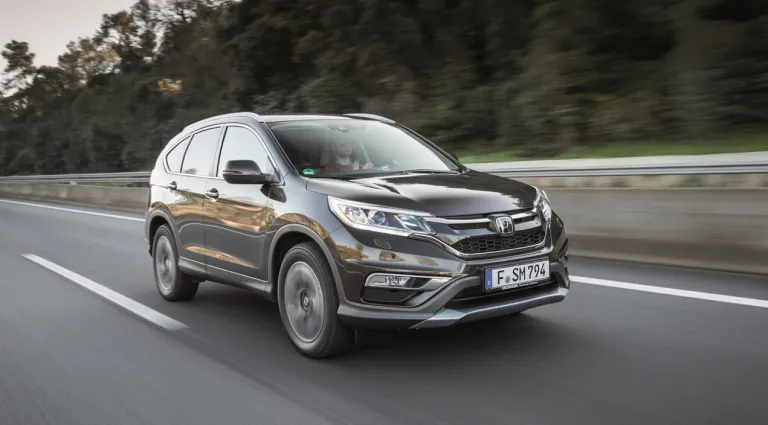
Honda · 2022–present
CR-V VI
- Power
- 135 kW184 PS
- 0–100 km/h
- 9.4 s
- Top speed
- 195 km/h
- Kerb mass
- 1,988 kg

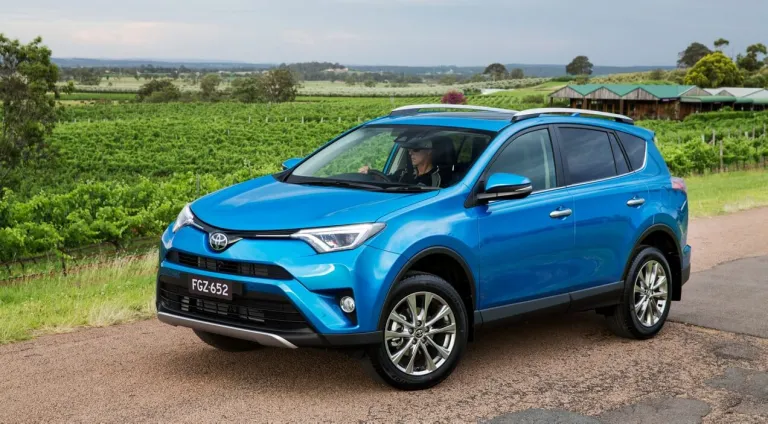
Toyota · 2018–2025
RAV4 XA50
- Power
- 160 kW218 PS
- 0–100 km/h
- 8.4 s
- Top speed
- 180 km/h
- Kerb mass
- 1,615 kg
At a glance
Who suits what, worked out from the catalog figures of the versions above.
Categories won: CR-V VI 2 RAV4 XA50 2
- Family Too close to call Boot: 617 l vs 580 l
- City RAV4 XA50 Length: 4,600 mm vs 4,694 mm
- Long trips CR-V VI Range: 5,875 km vs 1,222 km (estimated)
- Performance RAV4 XA50 Power per tonne: 99 kW/t vs 68 kW/t; 0–100 km/h: 8.4 s vs 9.4 s
- Running costs CR-V VI Fuel per year: €210 vs €1,180 (estimated)
- Off-road Too close to call Drive and body: Front-wheel drive · SUV vs Front-wheel drive · SUV
Verdict Opinion
The RAV4 is the safer default: a five-star Euro NCAP result, all-wheel drive with a dedicated rear motor, and the widest choice of hybrid and plug-in versions. It is also the more common car, which helps when looking for parts or a good used example.
The CR-V wins on room. The current car is longer and wider, its plug-in version keeps a large boot, and a used fifth-generation model is one of the few compact SUVs with an optional third row. Honda's hybrid also feels closer to an electric car in town, because the engine rarely drives the wheels directly.
— Sarah Whitmore
Few rivalries in the SUV world are as old or as evenly matched as this one. Toyota showed the first RAV4 in Japan and Europe in 1994; Honda started building the CR-V a year later. Both began as small, car-based off-roaders for people who did not need a ladder frame, and both have grown into mid-size family cars sold on almost every continent.
The RAV4 has become the best-selling SUV of all time, with more than 15 million built by 2025. The CR-V is not far behind in reputation: it was the second-best-selling SUV in the world in 2020. Our catalogue pages focus on the fourth-generation RAV4 (XA40, 2012–2018) and the fifth-generation CR-V (2016–2022). Most questions buyers ask today are about the hybrid and plug-in versions, so this guide covers those as well.
Honda CR-V vs Toyota RAV4: key differences
Two different hybrid philosophies
Toyota and Honda reached the same goal by different routes. The fifth-generation RAV4 (XA50, unveiled in New York in March 2018) pairs a 2.5-litre petrol engine with Toyota's power-split hybrid. In Europe the front-wheel-drive version has 160 kW (218 PS). The AWD-i version has 163 kW (222 PS) and a separate electric motor driving the rear axle. Honda's system, called i-MMD and later e:HEV, uses a 2.0-litre engine that mostly works as a generator, while a 135 kW (184 PS) electric motor drives the wheels. In Europe the CR-V hybrid arrived in February 2019; the fifth generation dropped diesel altogether and offered a 1.5 VTEC Turbo as the petrol choice.
Plug-in versions
The RAV4 plug-in hybrid has 225 kW (306 PS), an 18.1 kWh battery and a claimed electric range of 75 km. The sixth-generation CR-V e:PHEV, on sale in Europe since August 2023, has a 17.7 kWh battery and an electric range of 82 km. Toyota answers with the sixth-generation RAV4 (XA60), revealed in May 2025: its European plug-in hybrid has 197 kW (268 PS) with front-wheel drive or 224 kW (304 PS) with all-wheel drive.
Space and seats
The European RAV4 Hybrid of 2019 is 4,600 mm long on a 2,690 mm wheelbase and has a 580-litre boot. The current CR-V is the larger car: 4,694–4,703 mm long, 1,866 mm wide, on a 2,700 mm wheelbase; the plug-in version still offers 586 litres. The fifth-generation CR-V could also be ordered with seven seats outside North America, something the RAV4 never offered; the sixth generation is a five-seater in Europe.
Safety ratings
Euro NCAP tested the RAV4 Hybrid in 2019 and gave it five stars, with 93% for adult occupant protection. The sixth-generation CR-V was tested in spring 2024: four stars in standard form, five with the optional safety equipment.
Race Stats side by side
Each figure is a 0–100 score from the catalog numbers, the same as on the 1CARS Race cards. PI is the overall performance index (100–999) and its class D–S.
| Stat | CR-V VI | RAV4 XA50 |
|---|---|---|
| PI | C · 426 | C · 494 |
| Power | 38 | 50 |
| Grip | 26 | 39 |
| Handling | 44 | 51 |
| Top speed | 37 | 31 |
| Launch | 35 | 40 |
Grip and handling are estimates from drive type, weight, height and body (hover a figure to see where it comes from). 1CARS Race
Who wins a race?
Quarter-mile (402 m) drag from a standing start, dry road, no reaction time — the 1CARS Race physics on the catalog figures of these versions.
- 1 RAV4 XA50RAV4 XA50 · 2.5 Hybrid 2WD · 160 kW (218 PS) 16.22 sat 135 km/h
- 2 CR-V VICR-V VI · 2.0 e:PHEV · plug-in hybrid · 135 kW (184 PS) 16.80 sat 132 km/h · +0.58 s
Size and weight
Side view to scale, all cars from the front bumper.
| CR-V VI | RAV4 XA50 | |
|---|---|---|
| Length | 4,694 mm184.8 in | 4,600 mm181.1 in −94 mm −3.7 in −2.0% |
| Width | 1,866 mm73.5 in | 1,855 mm73.0 in −11 mm −0.4 in −0.6% |
| Height | 1,682 mm66.2 in | 1,685 mm66.3 in +3 mm +0.1 in +0.2% |
| Wheelbase | 2,700 mm106.3 in | 2,690 mm105.9 in −10 mm −0.4 in −0.4% |
| Kerb weight | 1,988 kg4,383 lb | 1,615 kg3,560 lb −373 kg −822 lb −18.8% |
| Boot | 617 l21.8 cu ft | 580 l20.5 cu ft −37 l −1.3 cu ft −6.0% |
| Fuel tank | 47 l12.4 gal US | 55 l14.5 gal US +8 l +2.1 gal US +17.0% |
| Fits a standard garage? | Tight | Tight |
Difference vs CR-V VI (±). Garage check: a standard single garage takes a car up to about 5.0 m (16 ft 5 in) long and 1.9 m (6 ft 3 in) wide (width as listed in the catalog; some makers include the mirrors). Leave about 0.6 m (2 ft) to open the doors.
Full specifications
| Honda CR-V | Toyota RAV4 | |
|---|---|---|
| General | ||
| Version | CR-V VI · 2.0 e:PHEV · plug-in hybrid · 135 kW (184 PS) | RAV4 XA50 · 2.5 Hybrid 2WD · 160 kW (218 PS) |
| Production years | 2022–present | 2018–2025 |
| Body | SUV | SUV |
| Class | SUV / crossover | SUV / crossover |
| Country | Japan | Japan |
| Performance | ||
| Power Why it matters: More power means stronger acceleration and easier overtaking, especially with a full load. | 135 kW (184 PS) 181 hp | 160 kW (218 PS) 215 hp Better |
| Power, all versions | 88–142 kW (120–193 PS) 118–190 hp | 91–225 kW (124–306 PS) 122–302 hp |
| 0–100 km/h Why it matters: A shorter 0–100 km/h time means quicker getaways and safer merging onto fast roads. | 9.4 s | 8.4 s Better |
| Top speed Why it matters: Top speed hints at how relaxed the car is at motorway speeds, even if you never reach it. | 195 km/h 121 mph Better | 180 km/h 112 mph |
| Power per tonne | 68 kW/t 83 hp/ton calculated | 99 kW/t 121 hp/ton calculated Better |
| Engine and transmission | ||
| Fuel | Plug-in hybrid | Hybrid |
| Engine | 4 cyl | 2,487 cc · 4 cyl 2.5 l |
| Gearbox | No data | CVT |
| Drive | Front-wheel drive | Front-wheel drive |
| Dimensions and weight | ||
| Length | 4,694 mm 184.8 in | 4,600 mm 181.1 in |
| Width | 1,866 mm 73.5 in | 1,855 mm 73.0 in |
| Height | 1,682 mm 66.2 in | 1,685 mm 66.3 in |
| Wheelbase | 2,700 mm 106.3 in | 2,690 mm 105.9 in |
| Kerb weight Why it matters: A lighter car is usually more agile and uses less energy. | 1,988 kg 4,383 lb | 1,615 kg 3,560 lb Better |
| Boot Why it matters: A bigger boot fits more luggage, shopping or a pram. | 617 l 21.8 cu ft Better | 580 l 20.5 cu ft |
| Fuel tank Why it matters: A larger tank means more distance between fuel stops. | 47 l 12.4 gal US | 55 l 14.5 gal US Better |
| Economy and running costs | ||
| Fuel consumption Why it matters: Lower consumption cuts running costs and CO₂ emissions on every trip. | 0.8 l/100 km 294.0 mpg US Better | 4.5 l/100 km 52.3 mpg US |
| CO₂ | 18 g/km Better | 102 g/km |
| Fuel cost per year | €210/year estimated Better | €1,180/year estimated |
| Range on a full tank | 5,875 km 3,651 mi estimated Better | 1,222 km 759 mi estimated |
| Electric | ||
| Battery Why it matters: A bigger battery usually gives more range, but takes longer to charge fully. | 18 kWh | No data |
| Electric range Why it matters: A longer range means fewer charging stops on long journeys. | 82 km 51 mi | No data |
| Energy use | 15.6 kWh/100 km | No data |
| Safety | ||
| Euro NCAP | ★★★★☆ (2024) | ★★★★★ (2019) Better |
These cars do not differ in the data we have.
Equal rows hidden (4): Body, Class, Country, Drive.
Better marks the stronger figure — only for measurable specs (power, torque, 0–100 km/h, consumption, boot, weight).
Estimated at 15,000 km a year with fuel at €1.75/l petrol.
In plain words
Toyota RAV4 is quicker: 0–100 km/h in 8.4 s against 9.4 s for Honda CR-V. Honda CR-V is 94 mm longer than Toyota RAV4 (4,694 mm vs 4,600 mm). Toyota RAV4 is lighter by 373 kg (1,615 kg vs 1,988 kg). Honda CR-V has the bigger boot: 617 l against 580 l. At 15,000 km a year, fuel would cost about €210 (Honda CR-V), €1,180 (Toyota RAV4) (estimated). Toyota RAV4 is the older design (from 1994); Honda CR-V arrived in 1995. On the catalog figures, the Toyota RAV4 is the pick for city and performance; the Honda CR-V is the pick for long trips and running costs.
Which one to choose
Choose the Toyota RAV4 if you want proven all-wheel drive, the top Euro NCAP rating without extra-cost packs and a plug-in hybrid with strong performance.
Choose the Honda CR-V if cabin and boot space come first, if you value the smooth, mostly electric drive of the e:HEV system, or if a used seven-seat fifth-generation car would suit your family.
For a long daily commute with charging at home, compare the electric range of the exact versions on offer. On paper the current CR-V e:PHEV goes slightly further than the XA50 RAV4 plug-in. Families weighing a third rival can also read our Kia Sportage vs Mitsubishi Outlander comparison.
Frequently asked questions
Which is bigger, the CR-V or the RAV4?
The current CR-V. It is 4,694–4,703 mm long on a 2,700 mm wheelbase, while the European RAV4 Hybrid of 2019 is 4,600 mm long on a 2,690 mm wheelbase.
Which has more boot space?
They are close. The 2019 RAV4 Hybrid has 580 litres; the sixth-generation CR-V e:PHEV has 586 litres despite its larger battery.
Is there a seven-seat CR-V or RAV4?
Only the CR-V: the fifth generation (2016–2022) was offered with seven seats in markets outside North America. The current CR-V in Europe has five seats, and no RAV4 has had a third row.
How do the hybrid systems differ?
Toyota's RAV4 uses a power-split hybrid with a 2.5-litre engine; the AWD-i version adds an electric motor on the rear axle. Honda's e:HEV uses its 2.0-litre engine mainly as a generator, with a 135 kW (184 PS) motor driving the wheels.
Which scored better in Euro NCAP?
The RAV4 Hybrid earned five stars in 2019. The sixth-generation CR-V received four stars in 2024 in standard form and five with the optional safety pack.