
Subaru Forester vs Toyota RAV4: boxer AWD vs hybrid
Updated Report an error By Sarah Whitmore

Subaru · 2018
Forester V
- Power
- 110 kW150 PS
- 0–100 km/h
- —
- Top speed
- —
- Kerb mass
- 1,656 kg

Toyota · 2018–2025
RAV4 XA50
- Power
- 160 kW218 PS
- 0–100 km/h
- 8.4 s
- Top speed
- 180 km/h
- Kerb mass
- 1,615 kg
At a glance
Who suits what, worked out from the catalog figures of the versions above.
Categories won: Forester V 2 RAV4 XA50 2
- Family RAV4 XA50 Boot: 580 l vs 509 l
- City Forester V Width: 1,815 mm vs 1,855 mm
- Performance RAV4 XA50 Power per tonne: 99 kW/t vs 66 kW/t
- Off-road Forester V Drive and body: All-wheel drive · SUV vs Front-wheel drive · SUV
Verdict Opinion
The RAV4 is the stronger and more economical choice for most buyers. Its hybrid system gives more power with less fuel, and the plug-in version adds real electric commuting.
The Forester appeals to people who drive on snow, gravel or forest roads. Permanent all-wheel drive and X-Mode suit rural life, and the boxer engine gives the car a low centre of gravity. It is the more specialised tool, while the RAV4 is the better all-rounder.
— Sarah Whitmore
The Subaru Forester and the Toyota RAV4 are two Japanese answers to the same need: a practical family car with more ground clearance and grip than a hatchback. They reach it in different ways. Subaru uses a horizontally opposed engine and permanent all-wheel drive; Toyota relies on its hybrid system and, in most versions, an electric rear axle.
The fifth Forester was presented at the New York show on 28 March 2018 on the Subaru Global Platform, and a sixth followed at Los Angeles on 16 November 2023. The fifth-generation RAV4 (XA50) was unveiled in March 2018 and was replaced by the XA60 in 2025.
Forester vs RAV4: all-wheel drive, power and hybrids
Two kinds of all-wheel drive
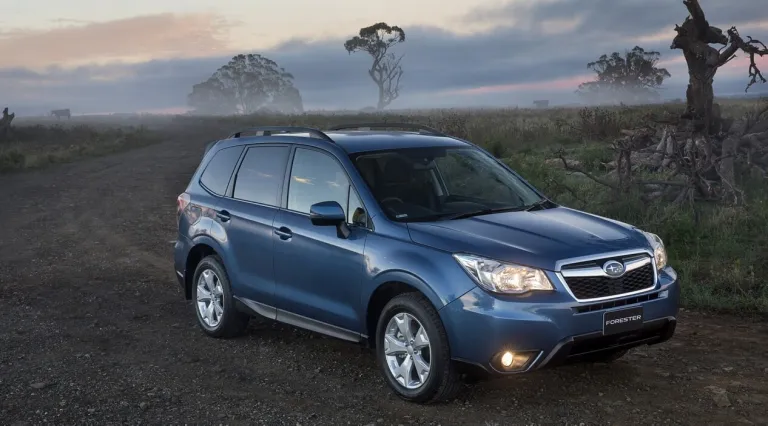
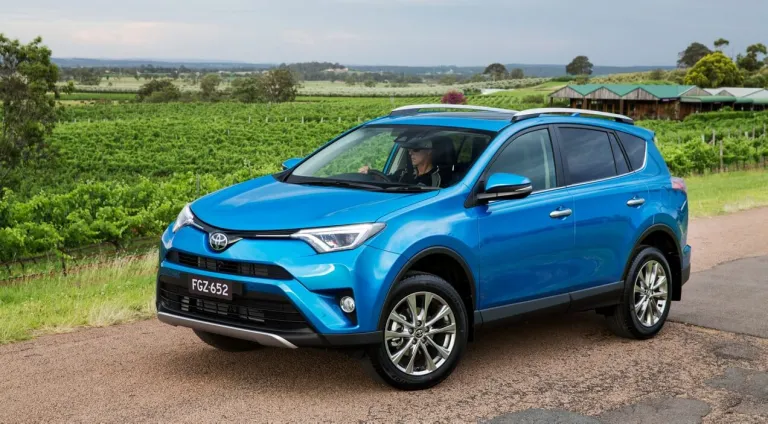
Every fifth-generation Forester has Symmetrical All-Wheel Drive with a nominal 60:40 front-to-rear split, and higher trims add X-Mode with hill descent control. The RAV4 hybrid is front-wheel drive in its basic form; in AWD-i form a separate electric motor drives the rear axle.
Power and electrification
In Europe the Forester switched to the e-Boxer in 2019. Its 2.0-litre FB20 engine gives 110 kW (150 PS) and works with a 12.3 kW electric motor; the battery sits above the rear axle. North America kept a 2.5-litre FB25 with 136 kW (185 PS) and 239 N·m, always with a CVT. The RAV4 XA50 hybrid is far stronger: 160 kW (218 PS) with front drive and 163 kW (222 PS) as AWD-i. The plug-in RAV4 reaches 225 kW (306 PS) and covers up to 75 km on its 18 kWh battery. Even if the e-Boxer's engine and motor peaks were simply added, the Subaru would remain about 38 kW behind the basic RAV4 hybrid.
Dimensions
The fifth Forester has a 2,670 mm wheelbase, 30 mm longer than before, and up to 2,155 litres of luggage space with the rear seats folded. Its tailgate opening is 1,300 mm wide. Toyota's XA50 measures 4,600 mm and puts 2,690 mm between its axles, 20 mm more than the Subaru, with 580 litres behind the rear seats in the front-drive hybrid.
Performance figures
Toyota quotes 8.4 seconds from 0 to 100 km/h and 180 km/h for the front-drive RAV4 hybrid. The fourth-generation Forester offered a turbocharged 2.0XT, which in Japanese tune made 206 kW (280 PS) – a version that has no equivalent in today's line-ups.
Race Stats side by side
Each figure is a 0–100 score from the catalog numbers, the same as on the 1CARS Race cards. PI is the overall performance index (100–999) and its class D–S.
| Stat | Forester V | RAV4 XA50 |
|---|---|---|
| PI | C · 466 | C · 494 |
| Power | 37 | 50 |
| Grip | 47 | 39 |
| Handling | 49 | 51 |
| Top speed | 34 | 31 |
| Launch | 38 | 40 |
Grip and handling are estimates from drive type, weight, height and body (hover a figure to see where it comes from). 1CARS Race
Who wins a race?
Quarter-mile (402 m) drag from a standing start, dry road, no reaction time — the 1CARS Race physics on the catalog figures of these versions.
- 1 RAV4 XA50RAV4 XA50 · 2.5 Hybrid 2WD · 160 kW (218 PS) 16.22 sat 135 km/h
- 2 Forester VForester V · 2.0 e-Boxer · petrol · 110 kW (150 PS) 16.34 sat 131 km/h · +0.12 s
Size and weight
Side view to scale, all cars from the front bumper.
| Forester V | RAV4 XA50 | |
|---|---|---|
| Length | 4,625 mm182.1 in | 4,600 mm181.1 in −25 mm −1.0 in −0.5% |
| Width | 1,815 mm71.5 in | 1,855 mm73.0 in +40 mm +1.6 in +2.2% |
| Height | 1,730 mm68.1 in | 1,685 mm66.3 in −45 mm −1.8 in −2.6% |
| Wheelbase | 2,670 mm105.1 in | 2,690 mm105.9 in +20 mm +0.8 in +0.7% |
| Kerb weight | 1,656 kg3,651 lb | 1,615 kg3,560 lb −41 kg −90 lb −2.5% |
| Boot | 509 l18.0 cu ft | 580 l20.5 cu ft +71 l +2.5 cu ft +13.9% |
| Fits a standard garage? | Yes | Tight |
Difference vs Forester V (±). Garage check: a standard single garage takes a car up to about 5.0 m (16 ft 5 in) long and 1.9 m (6 ft 3 in) wide (width as listed in the catalog; some makers include the mirrors). Leave about 0.6 m (2 ft) to open the doors.
Full specifications
| Subaru Forester | Toyota RAV4 | |
|---|---|---|
| General | ||
| Version | Forester V · 2.0 e-Boxer · petrol · 110 kW (150 PS) | RAV4 XA50 · 2.5 Hybrid 2WD · 160 kW (218 PS) |
| Production years | 2018 | 2018–2025 |
| Body | SUV | SUV |
| Class | SUV / crossover | SUV / crossover |
| Country | Japan | Japan |
| Performance | ||
| Power Why it matters: More power means stronger acceleration and easier overtaking, especially with a full load. | 110 kW (150 PS) 148 hp | 160 kW (218 PS) 215 hp Better |
| Power, all versions | 108–206 kW (147–280 PS) 145–276 hp | 91–225 kW (124–306 PS) 122–302 hp |
| 0–100 km/h Why it matters: A shorter 0–100 km/h time means quicker getaways and safer merging onto fast roads. | No data | 8.4 s |
| Top speed Why it matters: Top speed hints at how relaxed the car is at motorway speeds, even if you never reach it. | No data | 180 km/h 112 mph |
| Power per tonne | 66 kW/t 81 hp/ton calculated | 99 kW/t 121 hp/ton calculated Better |
| Engine and transmission | ||
| Fuel | Petrol | Hybrid |
| Engine | 4 cyl | 2,487 cc · 4 cyl 2.5 l |
| Gearbox | No data | CVT |
| Drive | All-wheel drive | Front-wheel drive |
| Dimensions and weight | ||
| Length | 4,625 mm 182.1 in | 4,600 mm 181.1 in |
| Width | 1,815 mm 71.5 in | 1,855 mm 73.0 in |
| Height | 1,730 mm 68.1 in | 1,685 mm 66.3 in |
| Wheelbase | 2,670 mm 105.1 in | 2,690 mm 105.9 in |
| Kerb weight Why it matters: A lighter car is usually more agile and uses less energy. | 1,656 kg 3,651 lb | 1,615 kg 3,560 lb Better |
| Boot Why it matters: A bigger boot fits more luggage, shopping or a pram. | 509 l 18.0 cu ft | 580 l 20.5 cu ft Better |
| Fuel tank Why it matters: A larger tank means more distance between fuel stops. | No data | 55 l 14.5 gal US |
| Economy and running costs | ||
| Fuel consumption Why it matters: Lower consumption cuts running costs and CO₂ emissions on every trip. | No data | 4.5 l/100 km 52.3 mpg US |
| CO₂ | 185 g/km | 102 g/km Better |
| Fuel cost per year | No data | €1,180/year estimated |
| Range on a full tank | No data | 1,222 km 759 mi estimated |
| Safety | ||
| Euro NCAP | ★★★★★ (2019) | ★★★★★ (2019) |
These cars do not differ in the data we have.
Equal rows hidden (4): Body, Class, Country, Euro NCAP.
Better marks the stronger figure — only for measurable specs (power, torque, 0–100 km/h, consumption, boot, weight).
Estimated at 15,000 km a year with fuel at €1.75/l petrol.
In plain words
Toyota RAV4 has more power: 160 kW (218 PS) against 110 kW (150 PS) for Subaru Forester. Subaru Forester is 25 mm longer than Toyota RAV4 (4,625 mm vs 4,600 mm). Toyota RAV4 is lighter by 41 kg (1,615 kg vs 1,656 kg). Toyota RAV4 has the bigger boot: 580 l against 509 l. Toyota RAV4 is the older design (from 1994); Subaru Forester arrived in 1997. On the catalog figures, the Toyota RAV4 is the pick for family and performance; the Subaru Forester is the pick for city and off-road. Our catalog has no 0–100 km/h for the Subaru Forester yet, so some checks above leave it out.
Which one to choose
Choose the Subaru Forester if you live where winters are hard, drive on unpaved roads or need permanent all-wheel drive on every version.
Choose the Toyota RAV4 if fuel economy and power matter more, if you want a plug-in hybrid, or if most of your driving is on paved roads.
For used buyers, a fourth-generation Forester 2.0XT is the enthusiast's pick, while a RAV4 XA50 hybrid is the sensible one.
Frequently asked questions
Is the Subaru Forester a hybrid?
European Foresters since 2019 use the e-Boxer, a mild hybrid with a 110 kW engine and a 12.3 kW electric motor. In February 2025 a Forester Hybrid with a 2.5-litre engine went on sale in the USA.
Which is more powerful, the Forester or the RAV4?
The RAV4. Its hybrid produces 160–163 kW and the plug-in 225 kW, while the European Forester e-Boxer engine makes 110 kW.
Do all Foresters have four-wheel drive?
Yes. Every fifth-generation Forester uses Symmetrical All-Wheel Drive. The RAV4 hybrid is also sold with front-wheel drive only.
Which of the two carries more luggage?
The front-drive RAV4 XA50 hybrid offers 580 litres with the seats up. Subaru quotes 2,155 litres for the fifth Forester with the rear seats folded; the two figures are measured differently, so compare them in the showroom.