
Kia Sportage vs Mitsubishi Outlander: SUV rivals compared
Updated Report an error By Sarah Whitmore

Kia · 2010–2015
Sportage SL
- Power
- 85 kW116 PS
- 0–100 km/h
- 12.3 s
- Top speed
- 173 km/h
- Kerb mass
- 1,490 kg

Mitsubishi · 2021–present
Outlander GN
- Power
- 188 kW256 PS
- 0–100 km/h
- —
- Top speed
- —
- Kerb mass
- 2,179 kg
At a glance
Who suits what, worked out from the catalog figures of the versions above.
Categories won: Sportage SL 1 Outlander GN 2
- City Sportage SL Length: 4,440 mm vs 4,709 mm; Width: 1,855 mm vs 1,897 mm
- Performance Outlander GN Power per tonne: 86 kW/t vs 57 kW/t
- Running costs Outlander GN Fuel per year: €210 vs €1,310 (estimated)
Verdict Opinion
The Outlander is the choice for space and long electric range: it is bigger, it has offered seven seats in the past and its current plug-in hybrid has the larger battery. The Sportage is the more compact, more versatile all-rounder, with the wider choice of engines and hybrid systems, a recent five-star Euro NCAP result and the longer European warranty.
For most families the deciding questions are how much room they need and whether they can charge at home.
— Sarah Whitmore
The Kia Sportage and the Mitsubishi Outlander have competed in the family SUV class since the Outlander reached Europe in 2003. Today both are car-based crossovers with front- or all-wheel drive, and both lean heavily on electrified versions.
The Sportage is the older nameplate, launched in 1993 and now in its fifth generation (NQ5, from 2021); since 2016 it has been Kia's best-selling model worldwide. The Outlander arrived in 2001 and is in its fourth generation (GN, revealed in 2021), which shares its platform with the Nissan X-Trail. The comparison below covers how the two families differ and which buyer each suits.
Engineering, design and everyday use
Engineering and powertrains
Mitsubishi was early with plug-in technology: the Outlander PHEV went on sale in Japan in 2013, using a 2.0-litre petrol engine and two 60 kW electric motors, one per axle, with a 12 kWh battery. The current European Outlander PHEV has a 22.7 kWh battery, a quoted system output of 225 kW (306 PS) and a WLTP electric range of up to 87 km (54 mi).
The current Sportage offers a broader menu in Europe: 1.6 T-GDI mild hybrids with 110 or 132 kW (150 or 180 PS), a full hybrid with 169 kW (230 PS), a plug-in hybrid with 195 kW (265 PS) and a 13.8 kWh battery, and a 1.6 CRDi diesel.
Size and practicality
The Outlander is the larger car. The European Outlander PHEV measures 4,719 mm (185.8 in) on a 2,704 mm (106.5 in) wheelbase, with at least 495 L (17.5 cu ft) of boot space and five seats in Europe; the third generation also offered seven seats. The current European Sportage is 4,515 mm (177.8 in) long on a 2,680 mm (105.5 in) wheelbase, with up to 591 L (20.9 cu ft) seats up and 1,780 L (62.9 cu ft) folded.
Safety and ownership
Both have strong recent crash results. The Sportage earned five Euro NCAP stars in 2010 and again in 2022. The third-generation Outlander scored five stars in 2012, the PHEV in 2013; the current GN has no Euro NCAP rating of its own, but scored five stars from ANCAP in 2022. Kia gives a seven-year, 150,000 km warranty in Europe; Mitsubishi quotes five years or 100,000 km in Germany and eight years or 100,000 miles in the UK.
Race Stats side by side
Each figure is a 0–100 score from the catalog numbers, the same as on the 1CARS Race cards. PI is the overall performance index (100–999) and its class D–S.
| Stat | Sportage SL | Outlander GN |
|---|---|---|
| PI | C · 407 | C · 495 |
| Power | 33 | 45 |
| Grip | 32 | 40 |
| Handling | 55 | 38 |
| Top speed | 28 | 47 |
| Launch | 22 | 49 |
Grip and handling are estimates from drive type, weight, height and body (hover a figure to see where it comes from). 1CARS Race
Who wins a race?
Quarter-mile (402 m) drag from a standing start, dry road, no reaction time — the 1CARS Race physics on the catalog figures of these versions.
- 1 Outlander GNOutlander GN · 2.4 PHEV · plug-in hybrid · 188 kW (256 PS) 14.93 sat 145 km/h
- 2 Sportage SLSportage SL · 1.7 · diesel · 85 kW (116 PS) 18.10 sat 121 km/h · +3.17 s
Size and weight
Side view to scale, all cars from the front bumper.
| Sportage SL | Outlander GN | |
|---|---|---|
| Length | 4,440 mm174.8 in | 4,709 mm185.4 in † +269 mm +10.6 in +6.1% |
| Width | 1,855 mm73.0 in | 1,897 mm74.7 in † +42 mm +1.7 in +2.3% |
| Height | 1,635 mm64.4 in | 1,745 mm68.7 in † +110 mm +4.3 in +6.7% |
| Wheelbase | 2,640 mm103.9 in | 2,705 mm106.5 in † +65 mm +2.6 in +2.5% |
| Kerb weight | 1,490 kg3,285 lb | 2,179 kg4,804 lb +689 kg +1,519 lb +46.2% |
| Fits a standard garage? | Tight | Tight |
Difference vs Sportage SL (±). Garage check: a standard single garage takes a car up to about 5.0 m (16 ft 5 in) long and 1.9 m (6 ft 3 in) wide (width as listed in the catalog; some makers include the mirrors). Leave about 0.6 m (2 ft) to open the doors. † from another version of this generation.
Full specifications
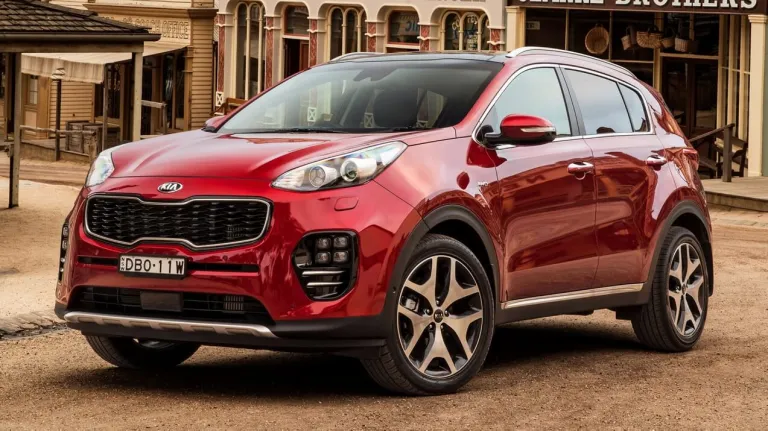
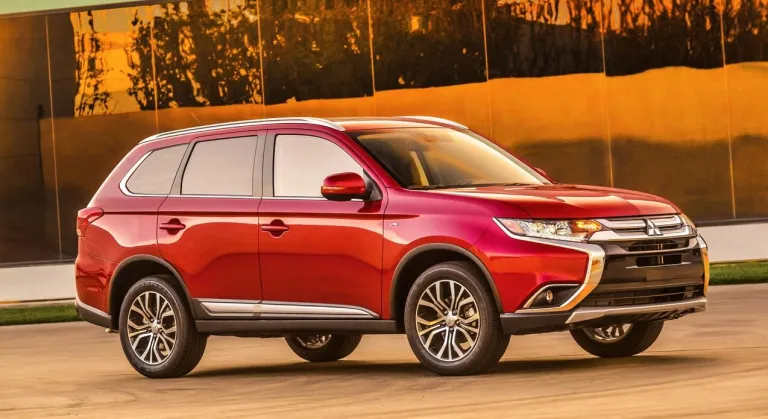
| Kia Sportage | Mitsubishi Outlander | |
|---|---|---|
| General | ||
| Version | Sportage SL · 1.7 · diesel · 85 kW (116 PS) | Outlander GN · 2.4 PHEV · plug-in hybrid · 188 kW (256 PS) |
| Production years | 2010–2015 | 2021–present |
| Body | SUV, Convertible | SUV |
| Class | SUV / crossover | SUV / crossover |
| Country | South Korea | Japan |
| Performance | ||
| Power Why it matters: More power means stronger acceleration and easier overtaking, especially with a full load. | 85 kW (116 PS) 114 hp | 188 kW (256 PS) 252 hp Better |
| Power, all versions | 61–195 kW (83–265 PS) 82–261 hp | 60–225 kW (82–306 PS) 80–302 hp |
| Torque Why it matters: Torque is the pulling force you feel when accelerating from low revs, towing or climbing hills. | 260 Nm 192 lb-ft | 450 Nm 332 lb-ft Better |
| 0–100 km/h Why it matters: A shorter 0–100 km/h time means quicker getaways and safer merging onto fast roads. | 12.3 s | No data |
| Top speed Why it matters: Top speed hints at how relaxed the car is at motorway speeds, even if you never reach it. | 173 km/h 107 mph | No data |
| Power per tonne | 57 kW/t 69 hp/ton calculated | 86 kW/t 105 hp/ton calculated Better |
| Engine and transmission | ||
| Fuel | Diesel | Plug-in hybrid |
| Engine | 1,700 cc 1.7 l | 2,360 cc · 4 cyl 2.4 l |
| Engine code | No data | 4B12 |
| Gearbox | 6-speed manual | No data |
| Drive | Front-wheel drive | All-wheel drive |
| Dimensions and weight | ||
| Length | 4,440 mm 174.8 in | 4,709 mm 185.4 in † |
| Width | 1,855 mm 73.0 in | 1,897 mm 74.7 in † |
| Height | 1,635 mm 64.4 in | 1,745 mm 68.7 in † |
| Wheelbase | 2,640 mm 103.9 in | 2,705 mm 106.5 in † |
| Kerb weight Why it matters: A lighter car is usually more agile and uses less energy. | 1,490 kg 3,285 lb Better | 2,179 kg 4,804 lb |
| Boot Why it matters: A bigger boot fits more luggage, shopping or a pram. | 465 l 16.4 cu ft | No data |
| Fuel tank Why it matters: A larger tank means more distance between fuel stops. | 58 l 15.3 gal US | No data |
| Economy and running costs | ||
| Fuel consumption Why it matters: Lower consumption cuts running costs and CO₂ emissions on every trip. | 5.3 l/100 km 44.4 mpg US | 0.8 l/100 km 294.0 mpg US Better |
| CO₂ | 139 g/km | 19 g/km Better |
| Fuel cost per year | €1,310/year estimated | €210/year estimated Better |
| Range on a full tank | 1,094 km 680 mi estimated | No data |
| Electric | ||
| Battery Why it matters: A bigger battery usually gives more range, but takes longer to charge fully. | No data | 20 kWh |
| Electric range Why it matters: A longer range means fewer charging stops on long journeys. | No data | 87 km 54 mi |
| Energy use | No data | 23.4 kWh/100 km |
| Safety | ||
| Euro NCAP | ★★★★★ (2010) | No data |
These cars do not differ in the data we have.
Equal rows hidden (1): Class.
Better marks the stronger figure — only for measurable specs (power, torque, 0–100 km/h, consumption, boot, weight).
Estimated at 15,000 km a year with fuel at €1.65/l diesel, €1.75/l petrol. † from another version of this generation.
In plain words
Mitsubishi Outlander has more power: 188 kW (256 PS) against 85 kW (116 PS) for Kia Sportage. Mitsubishi Outlander is 269 mm longer than Kia Sportage (4,709 mm vs 4,440 mm). Kia Sportage is lighter by 689 kg (1,490 kg vs 2,179 kg). At 15,000 km a year, fuel would cost about €1,310 (Kia Sportage), €210 (Mitsubishi Outlander) (estimated). Kia Sportage is the older design (from 1993); Mitsubishi Outlander arrived in 2001. On the catalog figures, the Kia Sportage is the pick for city; the Mitsubishi Outlander is the pick for performance and running costs. Our catalog has no 0–100 km/h for the Mitsubishi Outlander yet, so some checks above leave it out.
Which one to choose
Choose the Kia Sportage if you want a mid-size SUV with a choice of mild-hybrid, full-hybrid, plug-in and diesel versions, a large boot for its length and a seven-year warranty in Europe.
Choose the Mitsubishi Outlander if you want a bigger car and a plug-in hybrid with a long electric range, or a used third-generation car if you need seven seats.
Frequently asked questions
Which is bigger, the Sportage or the Outlander?
The Outlander. The current European Outlander PHEV is 4,719 mm long on a 2,704 mm wheelbase; the current European Sportage is 4,515 mm long on a 2,680 mm wheelbase.
Do both offer a plug-in hybrid?
Yes. The Outlander PHEV pioneered the idea in 2013; the current one has a 22.7 kWh battery and up to 87 km of WLTP electric range. The current Sportage PHEV has 195 kW (265 PS) and a 13.8 kWh battery.
Which has the longer warranty?
In Europe, Kia: seven years or 150,000 km. Mitsubishi quotes five years or 100,000 km in Germany and eight years or 100,000 miles in the UK.