
Honda CR-V vs Mazda CX-5: hybrid or Skyactiv?
Updated Report an error By Sarah Whitmore

Honda · 2022–present
CR-V VI
- Power
- 135 kW184 PS
- 0–100 km/h
- 9.4 s
- Top speed
- 195 km/h
- Kerb mass
- 1,988 kg

Mazda · 2012–2017
CX-5 KE
- Power
- 110 kW150 PS
- 0–100 km/h
- 9.2 s
- Top speed
- 202 km/h
- Kerb mass
- 1,390 kg
At a glance
Who suits what, worked out from the catalog figures of the versions above.
Categories won: CR-V VI 2 CX-5 KE 3
- Family Too close to call Boot: 617 l vs 503 l
- City CX-5 KE Length: 4,555 mm vs 4,694 mm
- Long trips CR-V VI Range: 5,875 km vs 1,217 km (estimated)
- Performance CX-5 KE Power per tonne: 79 kW/t vs 68 kW/t
- Running costs CR-V VI Fuel per year: €210 vs €1,140 (estimated)
- Off-road CX-5 KE Drive and body: All-wheel drive · SUV vs Front-wheel drive · SUV
Verdict Opinion
The CR-V is the more rational choice for buyers who want low fuel use in town and the option of daily electric driving. The plug-in version's 82 km range covers most commutes, and the cabin is designed around families.
The CX-5 is the driver's car of the two. Its steering and chassis tuning are part of Mazda's appeal, and the simple engines and a manual option attract people who prefer mechanical simplicity to complex hybrid systems.
— Sarah Whitmore
The Honda CR-V is one of the founders of the compact SUV class. It went on sale in Japan in October 1995 with a 2.0-litre B20B engine and reached North America in February 1997. Wikipedia ranks it as the world's second best-selling SUV of 2020.
The Mazda CX-5 is much younger, but it quickly became Mazda's most important car: it has been the brand's best-selling model worldwide since 2014, with a record 444,262 units in 2019 and about 3.5 million sold by March 2022. Our catalogue pages cover the first CX-5 (KE, 2012–2017) and the CR-V of 2016–2022, and the comparison below also covers the cars that replaced them.
Honda CR-V vs Mazda CX-5: powertrains, generations, space
Different answers to efficiency
Honda has bet on electrification. The sixth CR-V, unveiled in Los Angeles on 12 July 2022, is offered in Europe as the 2.0 e:HEV hybrid with 135 kW (184 PS) and as the e:PHEV plug-in hybrid. The plug-in has an 18 kWh battery (17.7 kWh) and an electric range of up to 82 km, and Honda quotes 586 litres of boot space for it.
Mazda kept faith with conventional engines for longer. The second CX-5 (KF), revealed at the Los Angeles show on 15 November 2016, uses 2.0- and 2.5-litre Skyactiv-G petrol engines and a 2.2-litre Skyactiv-D diesel. From the 2023 model year the petrol engines gained a 24-volt mild-hybrid system; the 2.0 with 121 kW (165 PS) also deactivates cylinders. In the USA, Australia and Japan a 2.5 turbo was added in November 2018 with 190 kW (250 hp) on premium fuel.
Earlier cars on the used market
Buyers of a first-generation CX-5 can choose a 2.0 petrol (121 kW, 210 N·m) or the 2.2 diesel in two outputs: 110 kW with 380 N·m, or 129 kW with 420 N·m. The fifth-generation CR-V (2016–2022) brought a 1.5-litre turbo petrol and, in markets outside North America, an optional seven-seat layout.
Gearboxes and drive
The KF CX-5 used a six-speed automatic or a six-speed manual, which is rare in this class today. Both offer all-wheel drive; in the USA, every CX-5 has been all-wheel drive since the 2022 model year.
What comes next
The third CX-5 was revealed on 10 July 2025. Its wheelbase is 75 mm longer, the boot is 50 mm longer and 25 mm higher, and Mazda has confirmed its own hybrid system with a new Skyactiv-Z engine for 2027.
Race Stats side by side
Each figure is a 0–100 score from the catalog numbers, the same as on the 1CARS Race cards. PI is the overall performance index (100–999) and its class D–S.
| Stat | CR-V VI | CX-5 KE |
|---|---|---|
| PI | C · 426 | C · 477 |
| Power | 38 | 43 |
| Grip | 26 | 34 |
| Handling | 44 | 56 |
| Top speed | 37 | 39 |
| Launch | 35 | 36 |
Grip and handling are estimates from drive type, weight, height and body (hover a figure to see where it comes from). 1CARS Race
Who wins a race?
Quarter-mile (402 m) drag from a standing start, dry road, no reaction time — the 1CARS Race physics on the catalog figures of these versions.
- 1 CX-5 KECX-5 KE · 2.2 Skyactiv-D 150 · diesel · 110 kW (150 PS) 16.62 sat 132 km/h
- 2 CR-V VICR-V VI · 2.0 e:PHEV · plug-in hybrid · 135 kW (184 PS) 16.80 sat 132 km/h · +0.18 s
Size and weight
Side view to scale, all cars from the front bumper.
| CR-V VI | CX-5 KE | |
|---|---|---|
| Length | 4,694 mm184.8 in | 4,555 mm179.3 in −139 mm −5.5 in −3.0% |
| Width | 1,866 mm73.5 in | 1,840 mm72.4 in −26 mm −1.0 in −1.4% |
| Height | 1,682 mm66.2 in | 1,670 mm65.7 in −12 mm −0.5 in −0.7% |
| Wheelbase | 2,700 mm106.3 in | 2,700 mm106.3 in |
| Kerb weight | 1,988 kg4,383 lb | 1,390 kg3,064 lb −598 kg −1,318 lb −30.1% |
| Boot | 617 l21.8 cu ft | 503 l17.8 cu ft −114 l −4.0 cu ft −18.5% |
| Fuel tank | 47 l12.4 gal US | 56 l14.8 gal US +9 l +2.4 gal US +19.1% |
| Fits a standard garage? | Tight | Yes |
Difference vs CR-V VI (±). Garage check: a standard single garage takes a car up to about 5.0 m (16 ft 5 in) long and 1.9 m (6 ft 3 in) wide (width as listed in the catalog; some makers include the mirrors). Leave about 0.6 m (2 ft) to open the doors.
Full specifications
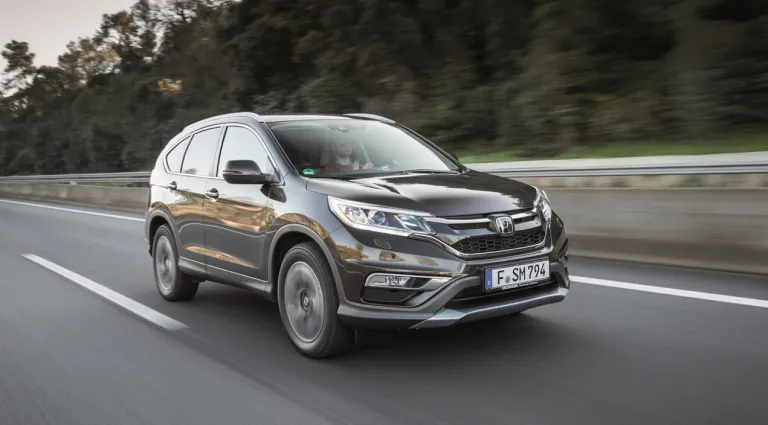
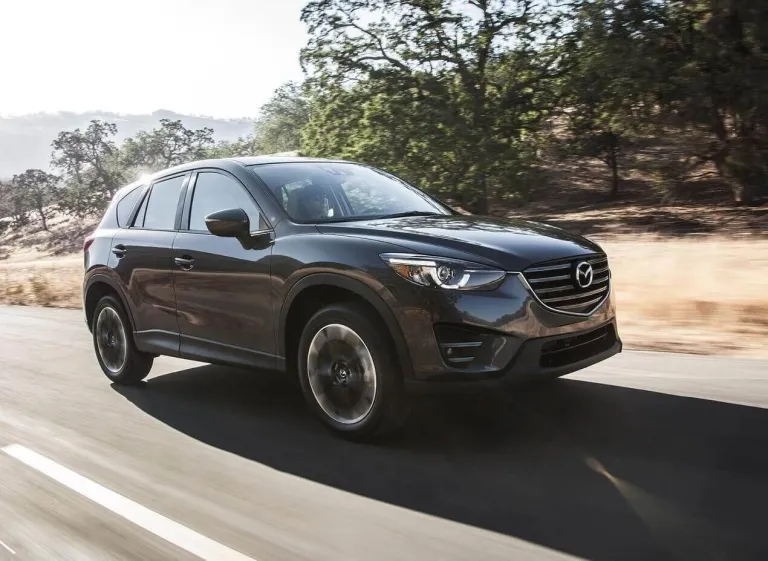
| Honda CR-V | Mazda CX-5 | |
|---|---|---|
| General | ||
| Version | CR-V VI · 2.0 e:PHEV · plug-in hybrid · 135 kW (184 PS) | CX-5 KE · 2.2 Skyactiv-D 150 · diesel · 110 kW (150 PS) |
| Production years | 2022–present | 2012–2017 |
| Body | SUV | SUV |
| Class | SUV / crossover | SUV / crossover |
| Country | Japan | Japan |
| Performance | ||
| Power Why it matters: More power means stronger acceleration and easier overtaking, especially with a full load. | 135 kW (184 PS) 181 hp Better | 110 kW (150 PS) 148 hp |
| Power, all versions | 88–142 kW (120–193 PS) 118–190 hp | 104–190 kW (141–258 PS) 139–255 hp |
| Torque Why it matters: Torque is the pulling force you feel when accelerating from low revs, towing or climbing hills. | No data | 380 Nm 280 lb-ft |
| 0–100 km/h Why it matters: A shorter 0–100 km/h time means quicker getaways and safer merging onto fast roads. | 9.4 s | 9.2 s |
| Top speed Why it matters: Top speed hints at how relaxed the car is at motorway speeds, even if you never reach it. | 195 km/h 121 mph | 202 km/h 126 mph Better |
| Power per tonne | 68 kW/t 83 hp/ton calculated | 79 kW/t 96 hp/ton calculated Better |
| Engine and transmission | ||
| Fuel | Plug-in hybrid | Diesel |
| Engine | 4 cyl | 2,191 cc · 4 cyl 2.2 l |
| Drive | Front-wheel drive | All-wheel drive |
| Dimensions and weight | ||
| Length | 4,694 mm 184.8 in | 4,555 mm 179.3 in |
| Width | 1,866 mm 73.5 in | 1,840 mm 72.4 in |
| Height | 1,682 mm 66.2 in | 1,670 mm 65.7 in |
| Wheelbase | 2,700 mm 106.3 in | 2,700 mm 106.3 in |
| Kerb weight Why it matters: A lighter car is usually more agile and uses less energy. | 1,988 kg 4,383 lb | 1,390 kg 3,064 lb Better |
| Boot Why it matters: A bigger boot fits more luggage, shopping or a pram. | 617 l 21.8 cu ft Better | 503 l 17.8 cu ft |
| Fuel tank Why it matters: A larger tank means more distance between fuel stops. | 47 l 12.4 gal US | 56 l 14.8 gal US Better |
| Economy and running costs | ||
| Fuel consumption Why it matters: Lower consumption cuts running costs and CO₂ emissions on every trip. | 0.8 l/100 km 294.0 mpg US Better | 4.6 l/100 km 51.1 mpg US |
| CO₂ | 18 g/km Better | 119 g/km |
| Fuel cost per year | €210/year estimated Better | €1,140/year estimated |
| Range on a full tank | 5,875 km 3,651 mi estimated Better | 1,217 km 756 mi estimated |
| Electric | ||
| Battery Why it matters: A bigger battery usually gives more range, but takes longer to charge fully. | 18 kWh | No data |
| Electric range Why it matters: A longer range means fewer charging stops on long journeys. | 82 km 51 mi | No data |
| Energy use | 15.6 kWh/100 km | No data |
| Safety | ||
| Euro NCAP | ★★★★☆ (2024) | ★★★★★ (2012) Better |
These cars do not differ in the data we have.
Equal rows hidden (4): Body, Class, Country, Wheelbase.
Better marks the stronger figure — only for measurable specs (power, torque, 0–100 km/h, consumption, boot, weight).
Estimated at 15,000 km a year with fuel at €1.75/l petrol, €1.65/l diesel.
In plain words
Mazda CX-5 is quicker: 0–100 km/h in 9.2 s against 9.4 s for Honda CR-V. Honda CR-V is 139 mm longer than Mazda CX-5 (4,694 mm vs 4,555 mm). Mazda CX-5 is lighter by 598 kg (1,390 kg vs 1,988 kg). Honda CR-V has the bigger boot: 617 l against 503 l. At 15,000 km a year, fuel would cost about €210 (Honda CR-V), €1,140 (Mazda CX-5) (estimated). Honda CR-V is the older design (from 1995); Mazda CX-5 arrived in 2012. On the catalog figures, the Mazda CX-5 is the pick for city, performance and off-road; the Honda CR-V is the pick for long trips and running costs.
Which one to choose
Choose the Honda CR-V if you mostly drive in town, can charge at home or need the seven-seat version of the 2016–2022 car.
Go for the Mazda CX-5 if driving enjoyment is high on your list, if a diesel or manual gearbox appeals, or if you prefer a naturally aspirated petrol engine without a high-voltage battery.
Used buyers will find many KE and KF CX-5s and fifth-generation CR-Vs; a full service history matters more than the badge.
Frequently asked questions
Does the Mazda CX-5 come as a hybrid?
Not as a full hybrid yet. Since the 2023 model year its petrol engines use 24-volt mild-hybrid assistance. Mazda has confirmed a full hybrid with the Skyactiv-Z engine for 2027.
Is the CR-V available as a plug-in hybrid?
Yes. Honda's e:PHEV version of the sixth CR-V carries an 18 kWh battery and an electric range of up to 82 km.
Can I get either car with a manual gearbox?
The CX-5. The KF generation was offered with a six-speed Skyactiv-MT manual in several markets; Australia dropped it in October 2022.
Is there a seven-seat CR-V?
The fifth-generation CR-V (2016–2022) had an optional seven-seat version outside North America, and the sixth generation offers five or seven seats depending on market.