
Ferrari 488 vs McLaren 720S: twin-turbo V8 rivals
Updated Report an error By Felix Hartmann

Ferrari · 2015–2020
488
Price from €212,653 (2015)
- Power
- 493 kW670 PS
- 0–100 km/h
- 3.0 s
- Top speed
- 330 km/h
- Kerb mass
- 1,470 kg

McLaren · 2017–2023
720S
Price from €237,946 (2017)
- Power
- 530 kW721 PS
- 0–100 km/h
- 2.9 s
- Top speed
- 341 km/h
- Kerb mass
- 1,419 kg
At a glance
Who suits what, worked out from the catalog figures of the versions above.
Categories won: 488 2 720S 1
- Family 488 Boot: 210 l vs 150 l
- City Too close to call Length: 4,568 mm vs 4,544 mm
- Performance 720S Power per tonne: 374 kW/t vs 335 kW/t; 0–100 km/h: 2.9 s vs 3.0 s
- Value 488 Price: €212,653 vs €237,946
Verdict Opinion
On numbers alone the McLaren 720S is the stronger car. It equals the 488 Pista's output and is the lightest car in this group. Its carbon tub and active hydraulic suspension were also a generation ahead when it appeared. The Ferrari 488 answers with a broader line-up, a more responsive low-rev torque delivery and a run of awards that shows how well the GTB was judged as a road car.
The choice is less about speed, where the two are close, than about character and which version you can find.
— Felix Hartmann
For a few years at the end of the 2010s the Ferrari 488 and the McLaren 720S were the two benchmark mid-engined supercars below the hypercar class. Both put a twin-turbocharged V8 behind the seats, drive the rear wheels through a seven-speed dual-clutch gearbox and were sold as a coupé and as a convertible.
The 488 was built in Maranello from 2015 to 2020. It replaced the naturally aspirated 458 Italia and was the first turbocharged mid-engined V8 Ferrari since the F40; the F8 Tributo took over in 2019. The 720S came two years later, in 2017, and stayed in production until 2023, when the 750S succeeded it. Because the 720S launched with as much power as Ferrari's track-focused 488 Pista, the fairest comparison sets it against both 488 versions, which is what this page does.
Ferrari 488 vs McLaren 720S: where they differ
Engines and performance
Ferrari's F154 V8 displaces 3,902 cc. In the 488 GTB it makes 493 kW (670 PS) at 8,000 rpm and 760 Nm at 3,000 rpm; the 488 Pista raises that to 530 kW (720 PS) and 770 Nm. McLaren's M840T is slightly larger at 3,994 cc and matches the Pista exactly on paper: 530 kW (720 PS) at 7,500 rpm and 770 Nm, although its torque peak arrives much later, at 5,500 rpm. Ferrari quotes 3.0 s to 100 km/h, 8.3 s to 200 km/h and 330 km/h for the GTB, and 2.85 s, 7.6 s and 340 km/h for the Pista. McLaren claims 7.8 s to 200 km/h and 341 km/h for the 720S. Independent tests have beaten the factory figure.
Chassis and weight
The two cars are built differently. The 720S sits on the MonoCage II carbon-fibre tub and uses Proactive Chassis Control II, a hydraulically interconnected active suspension that McLaren says is 16 kg lighter than the system it replaced. The 488 keeps an aluminium structure derived from the 458. Kerb weights reflect this: 1,419 kg for the 720S coupé against 1,470 kg for a European-specification 488 GTB and 1,500 kg for the Pista. Divide weight by power and the gap becomes clear: 2.7 kg per kW for the 720S, 2.8 kg for the Pista and 3.0 kg for the GTB. The McLaren is also marginally shorter (4,544 mm against 4,568 mm) but has a longer wheelbase (2,670 mm against 2,650 mm).
Recognition and variants
The 488 GTB was Top Gear's Supercar of the Year in 2015 and Motor Trend's Best Driver's Car in 2017, and the Pista was Jeremy Clarkson's supercar of 2019. Ferrari offered the 488 Spider from the start and later a Pista Spider. McLaren added the 720S Spider with a folding hard top in December 2018 and the lighter 765LT in 2020, limited to 765 coupés with 563 kW (765 PS).
Race Stats side by side
Each figure is a 0–100 score from the catalog numbers, the same as on the 1CARS Race cards. PI is the overall performance index (100–999) and its class D–S.
| Stat | 488 | 720S |
|---|---|---|
| PI | S · 840 | S · 858 |
| Power | 88 | 91 |
| Grip | 68 | 68 |
| Handling | 76 | 77 |
| Top speed | 88 | 93 |
| Launch | 88 | 89 |
Grip and handling are estimates from drive type, weight, height and body (hover a figure to see where it comes from). 1CARS Race
Who wins a race?
Quarter-mile (402 m) drag from a standing start, dry road, no reaction time — the 1CARS Race physics on the catalog figures of these versions.
- 1 720S720S · petrol · 530 kW (721 PS) 9.42 sat 294 km/h
- 2 488GTB · petrol · 493 kW (670 PS) 9.53 sat 290 km/h · +0.11 s
Size and weight
Side view to scale, all cars from the front bumper.
| 488 | 720S | |
|---|---|---|
| Length | 4,568 mm179.8 in | 4,544 mm178.9 in −24 mm −0.9 in −0.5% |
| Height | 1,213 mm47.8 in | 1,196 mm47.1 in −17 mm −0.7 in −1.4% |
| Wheelbase | 2,650 mm104.3 in | 2,670 mm105.1 in +20 mm +0.8 in +0.8% |
| Kerb weight | 1,470 kg3,241 lb | 1,419 kg3,128 lb −51 kg −112 lb −3.5% |
| Boot | 210 l7.4 cu ft | 150 l5.3 cu ft −60 l −2.1 cu ft −28.6% |
| Fits a standard garage? | Too wide | No data |
Difference vs 488 (±). Garage check: a standard single garage takes a car up to about 5.0 m (16 ft 5 in) long and 1.9 m (6 ft 3 in) wide (width as listed in the catalog; some makers include the mirrors). Leave about 0.6 m (2 ft) to open the doors.
Full specifications
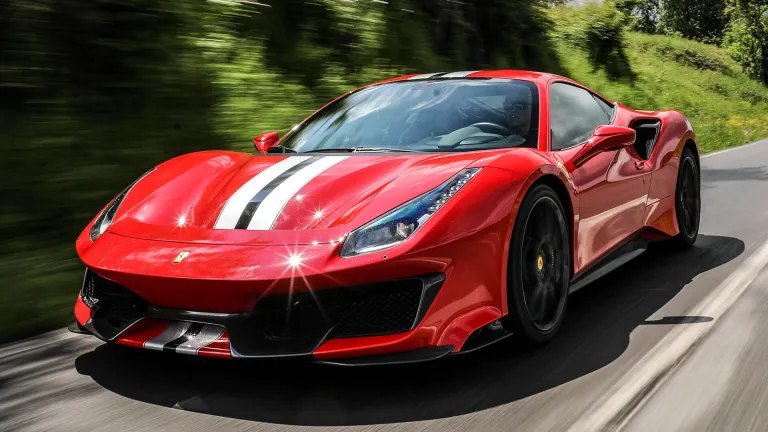
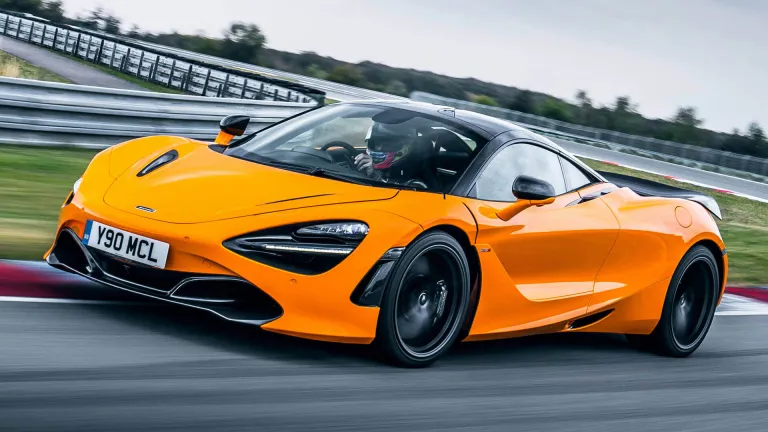
| Ferrari 488 | McLaren 720S | |
|---|---|---|
| General | ||
| Version | GTB · petrol · 493 kW (670 PS) | 720S · petrol · 530 kW (721 PS) |
| Production years | 2015–2020 | 2017–2023 |
| Body | Coupe | Coupe |
| Country | Italy | United Kingdom |
| Performance | ||
| Power Why it matters: More power means stronger acceleration and easier overtaking, especially with a full load. | 493 kW (670 PS) 661 hp | 530 kW (721 PS) 711 hp Better |
| Power, all versions | 493–530 kW (670–721 PS) 661–711 hp | 530 kW (721 PS) 711 hp |
| Torque Why it matters: Torque is the pulling force you feel when accelerating from low revs, towing or climbing hills. | 760 Nm 561 lb-ft | 770 Nm 568 lb-ft |
| 0–100 km/h Why it matters: A shorter 0–100 km/h time means quicker getaways and safer merging onto fast roads. | 3.0 s | 2.9 s Better |
| Top speed Why it matters: Top speed hints at how relaxed the car is at motorway speeds, even if you never reach it. | 330 km/h 205 mph | 341 km/h 212 mph Better |
| Power per tonne | 335 kW/t 408 hp/ton calculated | 374 kW/t 454 hp/ton calculated Better |
| Engine and transmission | ||
| Fuel | Petrol | Petrol |
| Engine | 3,902 cc · 8 cyl 3.9 l | 3,994 cc · 8 cyl 4.0 l |
| Gearbox | 7-speed dual-clutch | 7-speed dual-clutch |
| Drive | Rear-wheel drive | Rear-wheel drive |
| Dimensions and weight | ||
| Length | 4,568 mm 179.8 in | 4,544 mm 178.9 in |
| Width | 1,952 mm 76.9 in | No data |
| Height | 1,213 mm 47.8 in | 1,196 mm 47.1 in |
| Wheelbase | 2,650 mm 104.3 in | 2,670 mm 105.1 in |
| Kerb weight Why it matters: A lighter car is usually more agile and uses less energy. | 1,470 kg 3,241 lb | 1,419 kg 3,128 lb Better |
| Boot Why it matters: A bigger boot fits more luggage, shopping or a pram. | 210 l 7.4 cu ft Better | 150 l 5.3 cu ft |
| Economy and running costs | ||
| Fuel consumption Why it matters: Lower consumption cuts running costs and CO₂ emissions on every trip. | No data | 12.2 l/100 km 19.3 mpg US |
| CO₂ | 294 g/km | 276 g/km Better |
| Fuel cost per year | No data | €3,200/year estimated |
| Price | ||
| Price | from €212,653 (2015) Better | from €237,946 (2017) |
These cars do not differ in the data we have.
Equal rows hidden (4): Body, Fuel, Gearbox, Drive.
Better marks the stronger figure — only for measurable specs (power, torque, 0–100 km/h, consumption, boot, weight).
Estimated at 15,000 km a year with fuel at €1.75/l petrol.
In plain words
McLaren 720S is quicker: 0–100 km/h in 2.9 s against 3.0 s for Ferrari 488. Ferrari 488 is 24 mm longer than McLaren 720S (4,568 mm vs 4,544 mm). McLaren 720S is lighter by 51 kg (1,419 kg vs 1,470 kg). Ferrari 488 has the bigger boot: 210 l against 150 l. Ferrari 488 is the older design (from 2015); McLaren 720S arrived in 2017. On the catalog figures, the Ferrari 488 is the pick for family and value; the McLaren 720S is the pick for performance.
Which one to choose
Choose the Ferrari 488 GTB if you want a supercar for regular road use with strong mid-range pull, and the 488 Spider if open-air driving matters.
Choose the Ferrari 488 Pista if you want a track-focused Ferrari with the same 530 kW (720 PS) as the McLaren and a sharper set-up.
Choose the McLaren 720S if you want the lowest kerb weight, a carbon-fibre structure and active suspension, and Pista-level power without choosing a stripped-out track special.
Frequently asked questions
Which is more powerful, the Ferrari 488 or the McLaren 720S?
The 720S, against the 488 GTB: 530 kW (720 PS) against 493 kW (670 PS). The 488 Pista matches the McLaren at 530 kW (720 PS) and 770 Nm.
Which is lighter?
The McLaren. A 720S coupé weighs 1,419 kg at the kerb, a European-specification 488 GTB 1,470 kg and a 488 Pista 1,500 kg.
Which reaches the higher top speed?
The 720S, by a small margin: McLaren quotes 341 km/h, Ferrari 330 km/h for the 488 GTB and 340 km/h for the 488 Pista.
What replaced each car?
The Ferrari F8 Tributo replaced the 488 from 2019, and the McLaren 750S replaced the 720S in 2023.