
Charger Daytona vs Plymouth Superbird: winged warriors
Updated Report an error By Oleksandr Hnatiuk
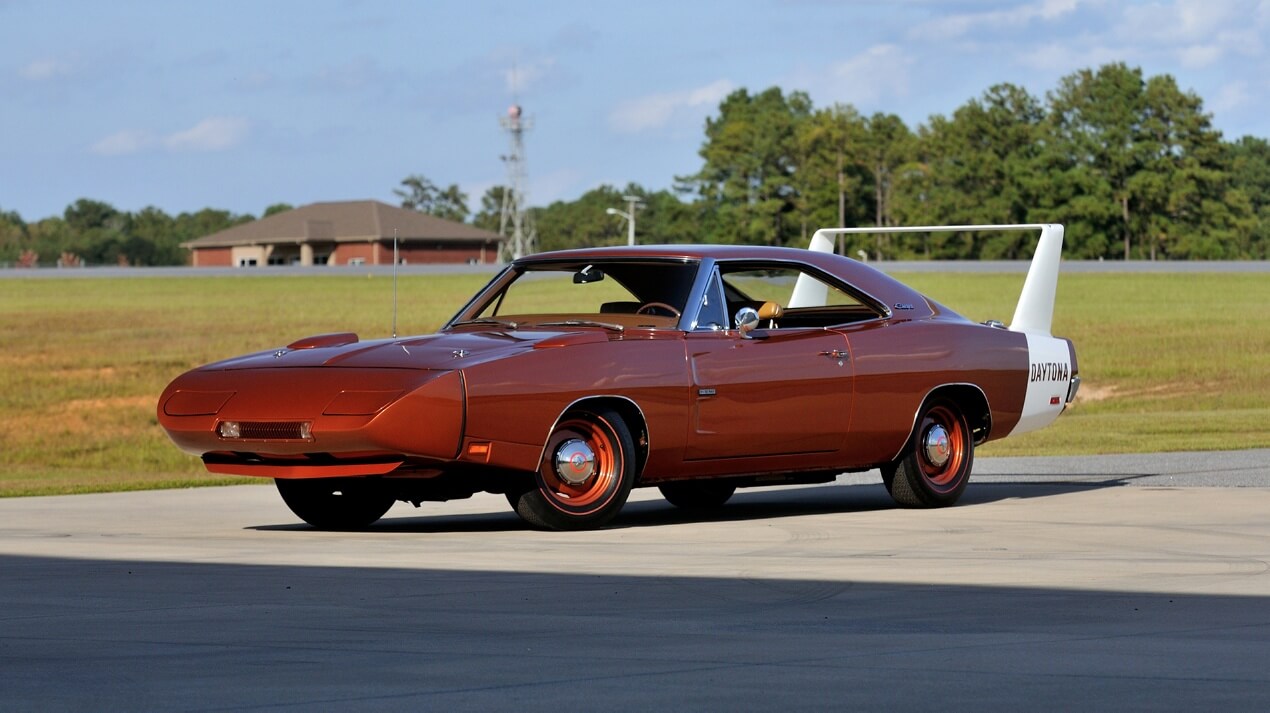
Dodge · 1969
Charger Daytona
- Power
- 280 kW381 PS
- Kerb mass
- —
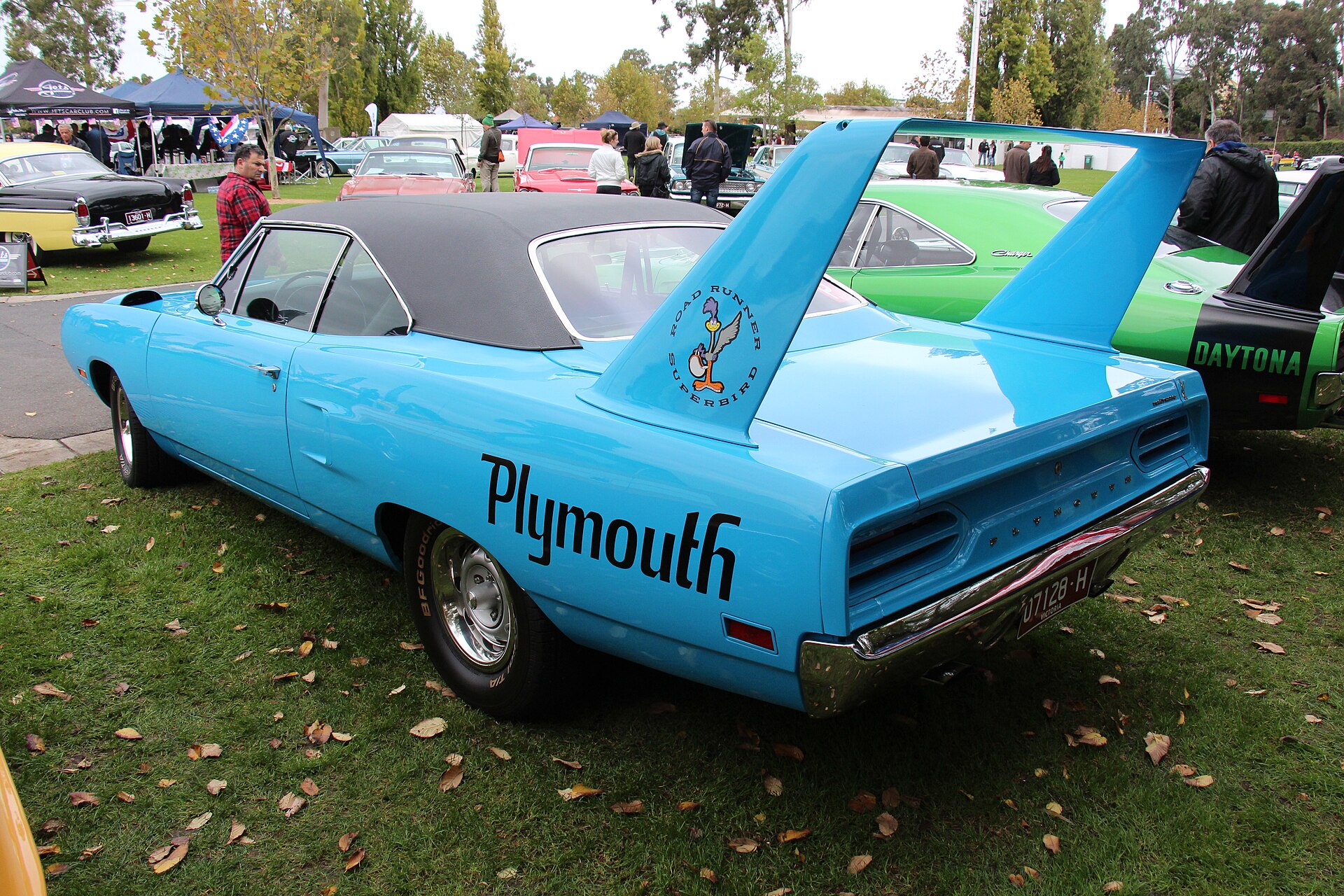
Plymouth · 1970
Superbird I
- Power
- 280 kW381 PS
- Kerb mass
- 1,742 kg
At a glance
Who suits what, worked out from the catalog figures of the versions above.
- Off-road Superbird I Drive and body: Rear-wheel drive · Coupe vs Rear-wheel drive · Coupe
Verdict Opinion
The Charger Daytona is the pioneer. It was first to the wing-and-nose formula, first past 200 mph in NASCAR, and its US run of 503 cars, only 70 with the Hemi, makes it the rarer collector car.
The Superbird is the more developed design. Plymouth refined the nose and body, offered three engines including the Six Barrel, and took eight wins in its only season, two more than the Daytona managed over two seasons. With roughly four times as many cars built, it is also the more realistic winged Mopar to find.
— Oleksandr Hnatiuk
The Dodge Charger Daytona and the Plymouth Superbird are Chrysler's two "aero cars", built for one purpose: to win at speed on NASCAR's superspeedways. Both carry a pointed nose cone and a towering rear wing, and both were sold to the public only because the rules demanded it. The Daytona came first, as a limited 1969 model, after the Charger 500 had failed to beat Ford on the track. The Superbird followed for 1970 only, on the Plymouth Road Runner body, and Wikipedia records the claim that it was built to bring Richard Petty back to Plymouth.
In short: the Daytona is the rarer car, with 503 built for the United States, and the one that first broke 200 mph in NASCAR. The Superbird is the refined second attempt, built in far larger numbers, and it won more races. Both are covered in our catalogue: Dodge Charger Daytona and Plymouth Superbird.
Charger Daytona vs Superbird: bodies, engines and race record
Same idea, different base cars
The Daytona is based on the 1969 Dodge Charger. Its sheet-metal nose cone replaces the upright grille and adds 18 inches (457 mm) to the front, and its stabiliser wing stands 23 inches (584 mm) above the rear deck. Rear fender scoops on the Daytona vented trapped air from the wheel arches.
The Superbird starts from the smaller Road Runner. Plymouth smoothed and refined both the body and the nose, and the nose with pop-up headlights adds nineteen inches to the Road Runner's length. Its rear fender scoops were cosmetic on road cars. The finished Superbird is 5,613 mm long and weighs 1,742 kg at the kerb.
Engines
Both cars used the same Chrysler big-blocks. The Daytona's standard engine was the 440 Magnum with 280 kW (375 hp) and 651 Nm (480 lb-ft); the 426 Hemi with 317 kW (425 hp) was fitted to only 70 of the 503 cars. The Superbird's base 440 Super Commando also had 280 kW (375 hp). Plymouth added the 440 Six Barrel with three two-barrel carburettors and 291 kW (390 hp), fitted to 716 cars by the most cited count, and the 426 Hemi, which went into about 135.
- Charger Daytona (1969): 503 US cars plus 40 for Canada, 70 with the Hemi
- Superbird (1970): about 1,935 for US dealers, 716 Six Barrels, about 135 Hemis
- Wing height: 23 inches on the Daytona
Why the numbers differ
NASCAR tightened its homologation rule for 1970. Instead of a few hundred cars, a maker had to build one car for every two of its dealers in the United States, which meant 1,920 Superbirds for Plymouth. The generally accepted figure is 1,935 shipped to US dealers. The styling proved too extreme for many buyers, and some Superbirds were still unsold on dealer lots in 1972.
On the track
An engineering Daytona was timed at 205 mph (330 km/h) at the Chelsea proving grounds in Michigan on 20 July 1969. On 24 March 1970 Buddy Baker became the first NASCAR driver to lap at more than 200 mph (322 km/h), at Talladega, in a Chrysler Engineering Daytona. The Daytona won six NASCAR races, two in 1969 and four in 1970. The Superbird won eight, all in 1970, and Richard Petty won 18 of the 40 races he entered that year.
The end of the aero cars
For 1971 NASCAR limited aero cars to engines of 305 cubic inches or forced them to carry extra weight, which made them uncompetitive. Rising emission rules and insurance costs also weighed on high-performance cars. Neither model returned.
Full specifications
| Dodge Charger Daytona | Plymouth Superbird | |
|---|---|---|
| General | ||
| Version | 7.2 · 280 kW (381 PS) | 440 Super Commando V8 (SAE gross) · petrol · 280 kW (381 PS) |
| Production years | 1969 | 1970 |
| Body | Coupe | Coupe |
| Class | Sports car | Sports car |
| Country | United States | United States |
| Performance | ||
| Power Why it matters: More power means stronger acceleration and easier overtaking, especially with a full load. | 280 kW (381 PS) 375 hp | 280 kW (381 PS) 375 hp |
| Power, all versions | 177–280 kW (241–381 PS) 237–375 hp | 280–317 kW (381–431 PS) 375–425 hp |
| Power per tonne | No data | 161 kW/t 196 hp/ton calculated |
| Engine and transmission | ||
| Fuel | No data | Petrol |
| Engine | 7,200 cc 7.2 l | 7,206 cc · 8 cyl 7.2 l |
| Drive | Rear-wheel drive | Rear-wheel drive |
| Dimensions and weight | ||
| Length | No data | 5,613 mm 221.0 in |
| Width | No data | 1,941 mm 76.4 in |
| Height | No data | 1,560 mm 61.4 in |
| Wheelbase | No data | 2,941 mm 115.8 in |
| Kerb weight Why it matters: A lighter car is usually more agile and uses less energy. | No data | 1,742 kg 3,840 lb |
These cars do not differ in the data we have.
Equal rows hidden (5): Body, Class, Country, Power, Drive.
In plain words
Dodge Charger Daytona is the older design (from 1969); Plymouth Superbird arrived in 1970. On the catalog figures, the Plymouth Superbird is the pick for off-road. Our catalog has no kerb mass for the Dodge Charger Daytona yet, so some checks above leave it out.
Which one to choose
Choose the Dodge Charger Daytona if rarity and history come first: it is the original aero Mopar, the car of the first 200 mph NASCAR lap, and one of only 503 US cars.
Choose the Plymouth Superbird if you want the more refined body, the option of the 440 Six Barrel, or the car linked with Richard Petty's 1970 season, with a larger pool of cars to choose from.
Two more muscle car extremes meet in Camaro ZL1 vs Challenger SRT Demon.
Frequently asked questions
What is the difference between the Charger Daytona and the Superbird?
The Daytona is a 1969 Dodge based on the Charger; the Superbird is a 1970 Plymouth based on the Road Runner. The Superbird has a refined nose and body, cosmetic fender scoops and was built in much larger numbers.
How many were built?
Dodge built 503 Daytonas for the United States plus 40 for Canada. The accepted Superbird figure is 1,935 shipped to US dealers, because the 1970 rule required one car for every two dealers.
Which engines were available?
Both used the 440 with 280 kW (375 hp) as standard and offered the 426 Hemi with 317 kW (425 hp). The Superbird also had the 440 Six Barrel with 291 kW (390 hp).
Which one won more races?
The Superbird, with eight NASCAR wins in 1970. The Daytona won six, two in 1969 and four in 1970.
Why were the winged cars dropped?
NASCAR rules for 1971 limited aero cars to 305 cubic inches or required much more weight. Emission rules and insurance costs also ended this kind of road car.