
Bugatti Chiron vs Veyron: two generations of the W16
Updated Report an error By Oleksandr Hnatiuk

Bugatti · 2016–2024
Chiron
Price from €2,856,000 (2016)
- Power
- 1,103 kW1,500 PS
- 0–100 km/h
- —
- Top speed
- 420 km/h
- Kerb mass
- 1,996 kg

Bugatti · 2005–2015
Veyron
Price from €1,160,000 (2005)
- Power
- 736 kW1,001 PS
- 0–100 km/h
- 2.5 s
- Top speed
- 408 km/h
- Kerb mass
- —
At a glance
Who suits what, worked out from the catalog figures of the versions above.
Categories won: Chiron 1 Veyron 2
- City Veyron Width: 1,998 mm vs 2,038 mm
- Off-road Chiron Drive and body: All-wheel drive · Coupe vs All-wheel drive · Coupe
- Value Veyron Price: €1,160,000 vs €2,856,000
Verdict Opinion
The Chiron is the better car by every measured number. It has 1,103 kW, 1,600 Nm, a higher limited top speed and, in Super Sport 300+ form, the 490.484 km/h run that took production cars close to 500 km/h. It was also built in larger numbers than the Veyron.
The Veyron is the car that started the story. It brought the W16, the four turbochargers and the 400 km/h class to the road in 2005, and it is about 100 kg lighter. For a collector the Veyron is the founding model; for a driver who wants the ultimate version of the idea, the Chiron is the answer.
— Oleksandr Hnatiuk
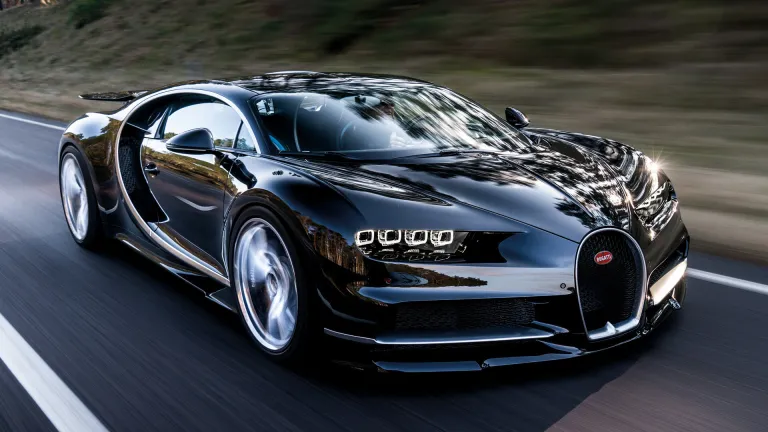
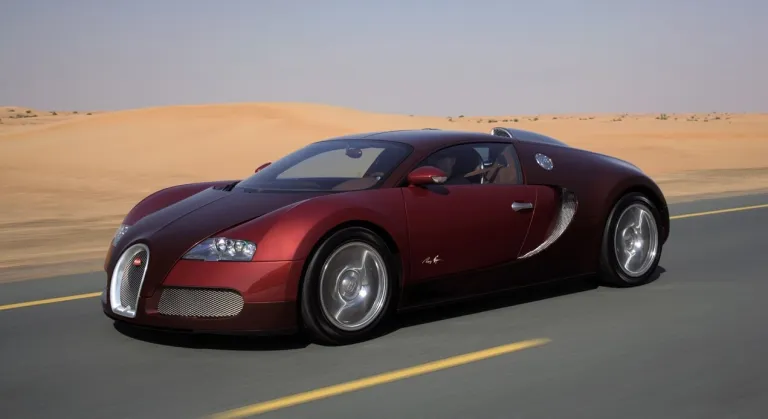
The Bugatti Veyron and the Bugatti Chiron are the two cars that defined the modern Bugatti. The Veyron, built from 2005 to 2015, combined 736 kW (1,001 PS) with a measured top speed of 408.47 km/h. The Chiron, revealed at the Geneva Motor Show on 1 March 2016, kept the formula of an 8.0-litre quad-turbo W16, all-wheel drive and a seven-speed dual-clutch gearbox, and pushed every figure further. Its final car, the Chiron L'Ultime, was built in May 2024.
In short: the Chiron has about 50% more power, 350 Nm more torque and a higher limited top speed, but it is also heavier and costs more than twice as much. The Veyron is the pioneer and, in Super Sport form, the record holder of 2010. Both are in our catalogue: Bugatti Chiron and Bugatti Veyron.
Chiron vs Veyron: power, speed, weight and production
The W16 engine, two stages
The Veyron's 7,993 cc W16 with four turbochargers produced 736 kW (1,001 PS) and 1,250 Nm, as certified by TÜV. It needed ten radiators to keep cool. The Chiron's quad-turbo W16 of the same displacement delivers 1,103 kW (1,500 PS) and 1,600 Nm in standard form. Both send their power to all four wheels through a seven-speed dual-clutch gearbox developed by Ricardo.
- Veyron 16.4: 736 kW, 1,250 Nm, 2.46 s to 100 km/h, 408.47 km/h measured
- Chiron: 1,103 kW, 1,600 Nm, 2.4 s to 100 km/h, limited to 420 km/h
- Veyron Super Sport: 882 kW, 1,500 Nm, 431.072 km/h in 2010
- Chiron Super Sport 300+: 1,177 kW, 490.484 km/h in 2019
Speed and records
On 19 April 2005 the Veyron averaged 408.47 km/h in official tests at Ehra-Lessien. The Veyron Super Sport raised the mark to 431.072 km/h in July 2010, although road cars were limited to 415 km/h. The standard Chiron is electronically limited to 420 km/h. In 2019 the Chiron Super Sport 300+ reached 490.484 km/h, a speed verified by TÜV.
Size and weight
The Chiron is the bigger car: 4,544 mm long against 4,462 mm, with a near-identical wheelbase of 2,711 mm against 2,710 mm. It is also heavier. Wikipedia gives an estimated 1,996 kg for the Chiron and 1,978 kg for the Chiron Sport, against 1,888 kg for the Veyron.
Production and versions
Bugatti built 450 Veyrons: 252 Veyron 16.4 coupés, 58 Grand Sport roadsters, 48 Super Sports and 92 Grand Sport Vitesses. Production of the Chiron was capped at 500 cars and included the Chiron Sport, Pur Sport, Super Sport 300+, Super Sport and the Profilée.
Launch prices in Germany
Our catalogue records a German list price of €1,160,000 including VAT for the Veyron at its 2005 launch, or €1 million before tax. For the Chiron in 2016 it records €2,856,000 including German VAT, or €2.4 million before tax. Wikipedia lists the Chiron Super Sport at €3.2 million and the Super Sport 300+ at €3.5 million net.
Race Stats side by side
Each figure is a 0–100 score from the catalog numbers, the same as on the 1CARS Race cards. PI is the overall performance index (100–999) and its class D–S.
| Stat | Chiron | Veyron |
|---|---|---|
| PI | S · 877 | S · 932 |
| Power | 100 | 100 |
| Grip | 74 | 83 |
| Handling | 65 | 79 |
| Top speed | 100 | 100 |
| Launch | 85 | 96 |
Grip and handling are estimates from drive type, weight, height and body (hover a figure to see where it comes from). 1CARS Race
Who wins a race?
Quarter-mile (402 m) drag from a standing start, dry road, no reaction time — the 1CARS Race physics on the catalog figures of these versions.
- 1 Veyron16.4 · petrol · 736 kW (1,001 PS) 8.56 sat 332 km/h
- 2 ChironChiron · petrol · 1,103 kW (1,500 PS) 9.78 sat 268 km/h · +1.22 s
Size and weight
Side view to scale, all cars from the front bumper.
| Chiron | Veyron | |
|---|---|---|
| Length | 4,544 mm178.9 in | 4,462 mm175.7 in −82 mm −3.2 in −1.8% |
| Width | 2,038 mm80.2 in | 1,998 mm78.7 in −40 mm −1.6 in −2.0% |
| Height | 1,212 mm47.7 in | 1,204 mm47.4 in −8 mm −0.3 in −0.7% |
| Wheelbase | 2,711 mm106.7 in | 2,710 mm106.7 in −1 mm −0.04 in −0.0% |
| Fits a standard garage? | Too wide | Too wide |
Difference vs Chiron (±). Garage check: a standard single garage takes a car up to about 5.0 m (16 ft 5 in) long and 1.9 m (6 ft 3 in) wide (width as listed in the catalog; some makers include the mirrors). Leave about 0.6 m (2 ft) to open the doors.
Full specifications
| Bugatti Chiron | Bugatti Veyron | |
|---|---|---|
| General | ||
| Version | Chiron · petrol · 1,103 kW (1,500 PS) | 16.4 · petrol · 736 kW (1,001 PS) |
| Production years | 2016–2024 | 2005–2015 |
| Body | Coupe | Coupe |
| Class | No data | Supercar |
| Country | France | France |
| Performance | ||
| Power Why it matters: More power means stronger acceleration and easier overtaking, especially with a full load. | 1,103 kW (1,500 PS) 1,479 hp Better | 736 kW (1,001 PS) 987 hp |
| Power, all versions | 1,103–1,177 kW (1,500–1,600 PS) 1,479–1,578 hp | 736–882 kW (1,001–1,199 PS) 987–1,183 hp |
| Torque Why it matters: Torque is the pulling force you feel when accelerating from low revs, towing or climbing hills. | No data | 1,250 Nm 922 lb-ft |
| 0–100 km/h Why it matters: A shorter 0–100 km/h time means quicker getaways and safer merging onto fast roads. | No data | 2.5 s |
| Top speed Why it matters: Top speed hints at how relaxed the car is at motorway speeds, even if you never reach it. | 420 km/h 261 mph Better | 408 km/h 254 mph |
| Power per tonne | 553 kW/t 672 hp/ton calculated | No data |
| Engine and transmission | ||
| Fuel | Petrol | Petrol |
| Engine | 7,993 cc · 16 cyl 8.0 l | 7,993 cc · 16 cyl 8.0 l |
| Gearbox | 7-speed dual-clutch | 7-speed dual-clutch |
| Drive | All-wheel drive | All-wheel drive |
| Dimensions and weight | ||
| Length | 4,544 mm 178.9 in | 4,462 mm 175.7 in |
| Width | 2,038 mm 80.2 in | 1,998 mm 78.7 in |
| Height | 1,212 mm 47.7 in | 1,204 mm 47.4 in |
| Wheelbase | 2,711 mm 106.7 in | 2,710 mm 106.7 in |
| Kerb weight Why it matters: A lighter car is usually more agile and uses less energy. | 1,996 kg 4,400 lb | No data |
| Economy and running costs | ||
| CO₂ | 506 g/km | No data |
| Price | ||
| Price | from €2,856,000 (2016) | from €1,160,000 (2005) Better |
These cars do not differ in the data we have.
Equal rows hidden (6): Body, Country, Fuel, Engine, Gearbox, Drive.
Better marks the stronger figure — only for measurable specs (power, torque, 0–100 km/h, consumption, boot, weight).
In plain words
Bugatti Chiron has more power: 1,103 kW (1,500 PS) against 736 kW (1,001 PS) for Bugatti Veyron. Bugatti Chiron is 82 mm longer than Bugatti Veyron (4,544 mm vs 4,462 mm). Bugatti Veyron is the older design (from 2005); Bugatti Chiron arrived in 2016. On the catalog figures, the Bugatti Veyron is the pick for city and value; the Bugatti Chiron is the pick for off-road. Our catalog has no 0–100 km/h for the Bugatti Chiron yet, so some checks above leave it out.
Which one to choose
Choose the Bugatti Chiron if you want the most powerful version of the W16 formula, the 420 km/h limit and the wider choice of variants from Pur Sport to Super Sport.
Choose the Bugatti Veyron if you value the original W16 car and its 2005 run at 408.47 km/h, the lower weight, the Grand Sport roadster body, or a historic Bugatti at less than half the Chiron's launch price.
The hybrid era of hypercars is compared in Ferrari LaFerrari vs McLaren P1.
Frequently asked questions
How much more powerful is the Chiron than the Veyron?
The standard Chiron has 1,103 kW (1,500 PS) and 1,600 Nm; the Veyron 16.4 has 736 kW (1,001 PS) and 1,250 Nm. That is about 50% more power.
Which one is faster?
The Chiron is limited to 420 km/h, while the Veyron averaged 408.47 km/h in its 2005 tests. The fastest versions are the Veyron Super Sport at 431.072 km/h and the Chiron Super Sport 300+ at 490.484 km/h.
Do they use the same engine?
They use the same layout: an 8.0-litre W16 with four turbochargers, all-wheel drive and a seven-speed Ricardo dual-clutch gearbox. The Chiron's version is far more powerful.
How many were built?
Bugatti built 450 Veyrons across four versions and 500 Chirons. The last Chiron, the L'Ultime, was completed in May 2024.
What did they cost new?
About €1 million before tax for the Veyron in 2005 and €2.4 million before tax for the Chiron in 2016; with German VAT that is €1,160,000 and €2,856,000.