
BMW 3 Series vs Tesla Model 3: petrol, plug-in or EV?
Updated Report an error By Felix Hartmann

BMW · 2018–present
3 Series G20
- Power
- 115 kW156 PS
- 0–100 km/h
- 8.4 s
- Top speed
- 223 km/h
- Kerb mass
- 1,565 kg

Tesla · 2016–present
Model 3
- Power
- 208 kW283 PS
- 0–100 km/h
- 6.1 s
- Top speed
- 201 km/h
- Kerb mass
- 1,765 kg
At a glance
Who suits what, worked out from the catalog figures of the versions above.
Categories won: 3 Series G20 1 Model 3 2
- City Too close to call Length: 4,709 mm vs 4,720 mm
- Long trips 3 Series G20 Range: 937 km vs 534 km (estimated)
- Performance Model 3 Power per tonne: 118 kW/t vs 74 kW/t; 0–100 km/h: 6.1 s vs 8.4 s
- Off-road Model 3 Drive and body: Rear-wheel drive · Sedan vs Rear-wheel drive · Sedan
Verdict Opinion
The 3 Series remains the more complete driver's car for people who cover long distances without planning charging stops, and its range of engines lets each buyer pick the right balance of cost and performance. The 330e is a sensible bridge for those who can charge at home but are not ready to give up petrol.
The Model 3 makes more sense when most journeys end at a home or workplace charger. Its electric range is in another league from the plug-in BMW, and its running costs depend mainly on electricity prices rather than fuel. It is also the more minimalist car inside, which suits some buyers and frustrates others.
— Felix Hartmann
For decades the BMW 3 Series was the default answer to the question of which compact executive saloon to buy. The Tesla Model 3 changed the conversation. Tesla unveiled it on 31 March 2016 and took refundable deposits the same day; limited production began at Fremont, California, in July 2017, and since December 2019 the car has also been built at the Shanghai plant.
BMW showed the current G20 3 Series to the public in Paris on 2 October 2018, and sales started in March 2019, with European cars coming from BMW's home plant in Munich. BMW facelifted the G20 in 2022, and Tesla announced its own refresh of the Model 3 on 1 September 2023. So the real choice today is between a refined combustion car that also comes as a plug-in hybrid, and a battery-electric saloon that never needs a fuel pump.
3 Series vs Model 3: drivetrains, range and size
Three kinds of power
BMW covers every fuel type except pure electric in Europe. The 318i makes 115 kW (156 PS), the 330i 190 kW (258 PS) and the six-cylinder M340i 285 kW (387 PS), which is good for 0–100 km/h in 4.6 seconds. Diesel buyers get the 320d with 140 kW (190 PS) or the 330d, whose mild-hybrid version from 2020 delivers 210 kW (286 PS) and 650 N·m. The 330e plug-in hybrid combines a two-litre petrol engine with an electric motor for 215 kW (292 PS).
The Model 3 is electric only. The refreshed rear-wheel-drive car has 170 kW (231 PS) and reaches 100 km/h in 6.1 seconds; the Performance version tops out at 262 km/h.
Electric range
This is where the two philosophies part. The 330e carries a 12 kWh battery (9.6 kWh usable) and covers up to 60 km on electricity, enough for most commutes but not for a motorway trip. Tesla quotes 534 km WLTP for the basic Model 3, 629 km for the dual-motor Premium AWD and 750 km for the Premium RWD. In China, BMW sells a long-wheelbase electric i3 saloon based on the 3 Series, but that car is not offered in Europe.
Size and weight
The two are almost the same size. The refreshed Model 3 is 4,720 mm long, 1,849 mm wide and 1,441 mm tall on a 2,875 mm wheelbase; the G20 measures 4,709 × 1,827 × 1,442 mm with a 2,851 mm wheelbase. That gives the Tesla 24 mm more between the axles. The BMW has a conventional 480-litre boot. Kerb weights overlap: the G20 ranges from 1,450 to 1,965 kg, while the rear-drive Model 3 weighs 1,765 kg, which works out at about 10.4 kg per kW.
Aerodynamics and safety
Both cars are slippery. A flat underbody brought the 320d down to a drag coefficient of 0.23, and Tesla lowered the Model 3 from 0.225 to 0.219 with the refresh. In Euro NCAP's 2019 tests the 3 Series earned five stars with 97% for adult occupants; the Model 3 scored 96% for adults and 94% for safety assistance in the same year.
Race Stats side by side
Each figure is a 0–100 score from the catalog numbers, the same as on the 1CARS Race cards. PI is the overall performance index (100–999) and its class D–S.
| Stat | 3 Series G20 | Model 3 |
|---|---|---|
| PI | B · 513 | B · 572 |
| Power | 40 | 55 |
| Grip | 40 | 45 |
| Handling | 67 | 63 |
| Top speed | 47 | 39 |
| Launch | 40 | 55 |
Grip and handling are estimates from drive type, weight, height and body (hover a figure to see where it comes from). 1CARS Race
Who wins a race?
Quarter-mile (402 m) drag from a standing start, dry road, no reaction time — the 1CARS Race physics on the catalog figures of these versions.
- 1 Model 3RWD (2023 refresh) · electric · 208 kW (283 PS) 14.45 sat 155 km/h
- 2 3 Series G203 Series G20 · 318i · petrol · 115 kW (156 PS) 16.03 sat 137 km/h · +1.58 s
Size and weight
Side view to scale, all cars from the front bumper.
| 3 Series G20 | Model 3 | |
|---|---|---|
| Length | 4,709 mm185.4 in | 4,720 mm185.8 in +11 mm +0.4 in +0.2% |
| Width | 1,827 mm71.9 in | 1,849 mm72.8 in +22 mm +0.9 in +1.2% |
| Height | 1,442 mm56.8 in | 1,441 mm56.7 in −1 mm −0.04 in −0.1% |
| Wheelbase | 2,851 mm112.2 in | 2,875 mm113.2 in +24 mm +0.9 in +0.8% |
| Kerb weight | 1,565 kg3,450 lb | 1,765 kg3,891 lb +200 kg +441 lb +12.8% |
| Fits a standard garage? | Yes | Yes |
Difference vs 3 Series G20 (±). Garage check: a standard single garage takes a car up to about 5.0 m (16 ft 5 in) long and 1.9 m (6 ft 3 in) wide (width as listed in the catalog; some makers include the mirrors). Leave about 0.6 m (2 ft) to open the doors.
Full specifications
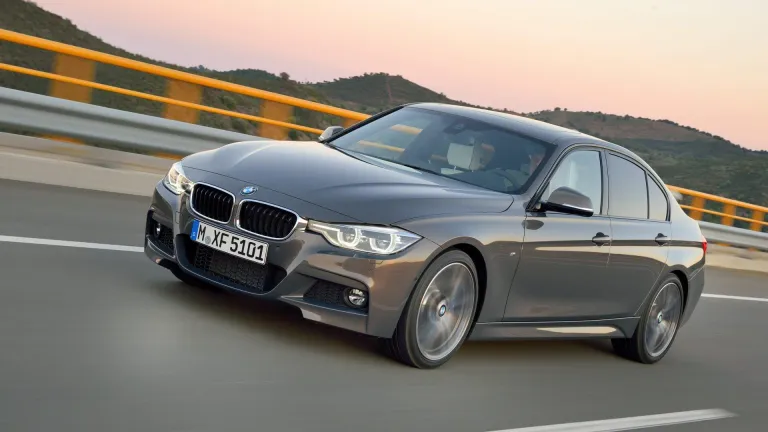
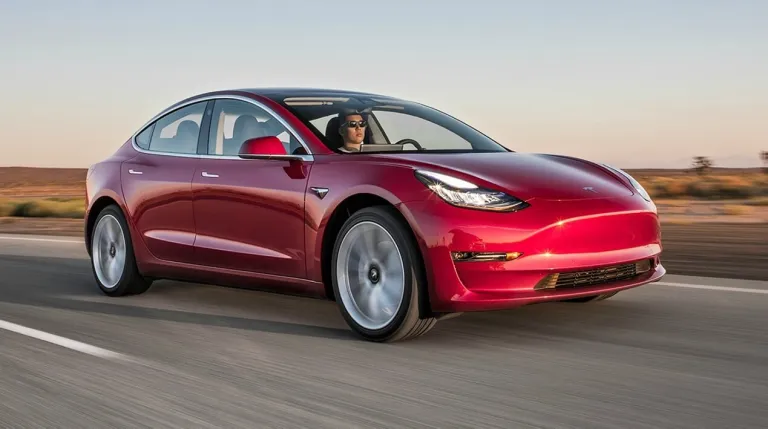
| BMW 3-Series | Tesla Model 3 | |
|---|---|---|
| General | ||
| Version | 3 Series G20 · 318i · petrol · 115 kW (156 PS) | RWD (2023 refresh) · electric · 208 kW (283 PS) |
| Production years | 2018–present | 2016–present |
| Body | Sedan | Sedan |
| Country | Germany | United States |
| Performance | ||
| Power Why it matters: More power means stronger acceleration and easier overtaking, especially with a full load. | 115 kW (156 PS) 154 hp | 208 kW (283 PS) 279 hp Better |
| Power, all versions | 85–317 kW (116–431 PS) 114–425 hp | 170–393 kW (231–534 PS) 228–527 hp |
| 0–100 km/h Why it matters: A shorter 0–100 km/h time means quicker getaways and safer merging onto fast roads. | 8.4 s | 6.1 s Better |
| Top speed Why it matters: Top speed hints at how relaxed the car is at motorway speeds, even if you never reach it. | 223 km/h 139 mph Better | 201 km/h 125 mph |
| Power per tonne | 74 kW/t 89 hp/ton calculated | 118 kW/t 143 hp/ton calculated Better |
| Engine and transmission | ||
| Fuel | Petrol | Electric |
| Engine | 1,998 cc · 4 cyl 2.0 l | No data |
| Gearbox | No data | single-speed |
| Drive | Rear-wheel drive | Rear-wheel drive |
| Dimensions and weight | ||
| Length | 4,709 mm 185.4 in | 4,720 mm 185.8 in |
| Width | 1,827 mm 71.9 in | 1,849 mm 72.8 in |
| Height | 1,442 mm 56.8 in | 1,441 mm 56.7 in |
| Wheelbase | 2,851 mm 112.2 in | 2,875 mm 113.2 in |
| Kerb weight Why it matters: A lighter car is usually more agile and uses less energy. | 1,565 kg 3,450 lb Better | 1,765 kg 3,891 lb |
| Boot Why it matters: A bigger boot fits more luggage, shopping or a pram. | 480 l 17.0 cu ft | No data |
| Fuel tank Why it matters: A larger tank means more distance between fuel stops. | 59 l 15.6 gal US | No data |
| Economy and running costs | ||
| Fuel consumption Why it matters: Lower consumption cuts running costs and CO₂ emissions on every trip. | 6.3 l/100 km 37.3 mpg US | No data |
| CO₂ | 142 g/km | No data |
| Fuel cost per year | €1,650/year estimated | No data |
| Range on a full tank | 937 km 582 mi estimated | No data |
| Electric | ||
| Electric range Why it matters: A longer range means fewer charging stops on long journeys. | No data | 534 km 332 mi |
| Safety | ||
| Euro NCAP | ★★★★★ (2019) | ★★★★★ (2025) |
These cars do not differ in the data we have.
Equal rows hidden (2): Body, Drive.
Better marks the stronger figure — only for measurable specs (power, torque, 0–100 km/h, consumption, boot, weight).
Estimated at 15,000 km a year with fuel at €1.75/l petrol.
In plain words
Tesla Model 3 is quicker: 0–100 km/h in 6.1 s against 8.4 s for BMW 3-Series. Tesla Model 3 is 11 mm longer than BMW 3-Series (4,720 mm vs 4,709 mm). BMW 3-Series is lighter by 200 kg (1,565 kg vs 1,765 kg). BMW 3-Series is the older design (from 1975); Tesla Model 3 arrived in 2016. On the catalog figures, the BMW 3-Series is the pick for long trips; the Tesla Model 3 is the pick for performance and off-road.
Which one to choose
Choose the BMW 3 Series if you drive long motorway stretches, want a diesel or a straight-six, or prefer physical controls and a traditional dealer service network.
Choose the Tesla Model 3 if you can charge at home, want the longest electric range in this pairing and like a minimalist cabin with few physical buttons.
Consider the 330e as a middle path: up to 60 km on electricity for daily trips, and a petrol engine for holidays.
Frequently asked questions
Is the Tesla Model 3 bigger than the BMW 3 Series?
Slightly. The refreshed Model 3 is 4,720 mm long with a 2,875 mm wheelbase, against 4,709 mm and 2,851 mm for the G20 3 Series. Width differs by 22 mm in Tesla's favour.
How far can the BMW 330e go on electricity?
Up to 60 km. Its battery holds 12 kWh, of which 9.6 kWh is usable, and the electric motor can add a temporary boost of up to 30 kW.
Which is faster, the M340i or the Model 3 Performance?
The M340i reaches 100 km/h in 4.6 seconds. Tesla quotes 2.9 seconds from 0 to 60 mph for the latest Model 3 Performance, so the electric car is quicker off the line.
Is there an electric BMW 3 Series?
Only in China. The i3 saloon, revealed in March 2022, is a long-wheelbase electric 3 Series built in Shenyang with up to 250 kW; Europe gets the 330e plug-in hybrid instead.
Where are these cars built?
European 3 Series saloons come from Munich. The Model 3 is built at Fremont in California and at Tesla's Shanghai factory.