
BMW 3 Series vs Mercedes C-Class: executive saloons
Updated Report an error By Felix Hartmann

BMW · 2018–present
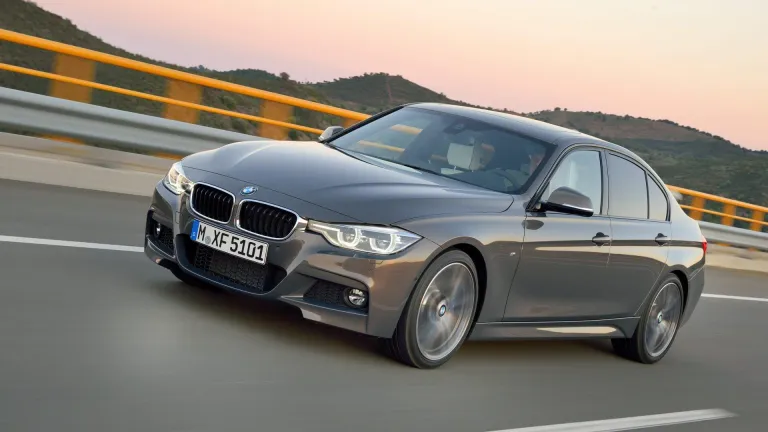
3 Series G20
- Power
- 115 kW156 PS
- 0–100 km/h
- 8.4 s
- Top speed
- 223 km/h
- Kerb mass
- 1,565 kg

Mercedes-Benz · 2021–present
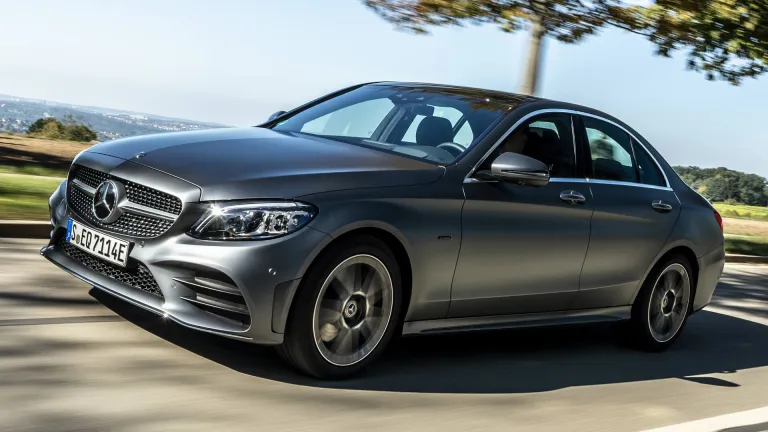
C-Class W206
- Power
- 150 kW204 PS
- 0–100 km/h
- —
- Top speed
- —
- Kerb mass
- 1,650 kg
At a glance
Who suits what, worked out from the catalog figures of the versions above.
Categories won: 3 Series G20 4 C-Class W206 1
- Family 3 Series G20 Boot: 480 l vs 455 l
- City 3 Series G20 Consumption: 6.3 l/100 km vs 6.5 l/100 km
- Long trips 3 Series G20 Range: 937 km vs 769 km (estimated)
- Performance C-Class W206 Power per tonne: 91 kW/t vs 74 kW/t
- Running costs 3 Series G20 Fuel per year: €1,650 vs €1,710 (estimated)
- Off-road Too close to call Drive and body: Rear-wheel drive · Sedan vs Rear-wheel drive · Sedan
Verdict Opinion
The 3 Series remains the better car to drive and the only one with a six-cylinder engine below the M3; the M340i is one of the most complete fast saloons on sale. Its 330e is a good plug-in hybrid if your daily trips are short.
The C-Class is the more comfortable and more luxurious-feeling saloon, with a slightly larger body, rear-axle steering and plug-in hybrids that can cover a typical commute on electricity alone. It suits drivers who value refinement over sharpness.
— Felix Hartmann
The BMW 3 Series and the Mercedes-Benz C-Class define the compact executive saloon in Europe. BMW launched the first 3 Series (E21) in 1975; Mercedes-Benz followed the 190 of 1982 with the first C-Class (W202) in 1993. Since then, each new generation of one has been measured against the other, usually with the same conclusion: BMW for the driver, Mercedes for the passengers.
The current rivals are the seventh-generation 3 Series (G20), unveiled at the Paris motor show on 2 October 2018 and facelifted in 2022, and the fifth-generation C-Class (W206). The Mercedes had its world premiere on 23 February 2021. Our catalogue covers the F30 3 Series and several C-Class generations; the facts below concentrate on the cars you can buy new or nearly new today.
BMW 3 Series vs Mercedes C-Class: the key differences
Dimensions
The W206 C-Class saloon is the longer car: 4,751 mm on a 2,865 mm wheelbase, 1,820 mm wide and 1,438 mm tall. The G20 3 Series measures 4,709 mm on a 2,851 mm wheelbase, 1,827 mm wide and 1,442 mm tall, with a 480-litre boot. Both are also sold as estates (Touring and Estate), and both have long-wheelbase saloons for China.
Engines: four against six
Every W206 uses a four-cylinder engine, assisted by a 15 kW (20 PS) starter-generator on a 48-volt system. The C 200 has 150 kW (204 PS) from its combustion engine, the C 220 d 147 kW (200 PS). BMW keeps a wider spread: the 318i with 115 kW (156 PS), the 320i with 125 kW (170 PS), the 330i with 190 kW (258 PS) and the 320d with 140 kW (190 PS). At the top of the regular range sits the M340i, with a straight-six and 285 kW (387 PS). If you want six cylinders below the full M and AMG models, only BMW offers them.
Plug-in hybrids
Mercedes took a big step with the W206: its plug-in hybrids use a 25.4 kWh battery and were designed for an electric range of about 100 km. The BMW 330e combines a petrol engine and electric motor for 215 kW (292 PS), with a 12 kWh battery and a maximum electric range of 60 km.
Chassis
Mercedes offers optional rear-axle steering on the C-Class, turning the rear wheels by up to 2.5 degrees and cutting the turning circle by 0.4 m to 10.6 m. BMW relies on rear-wheel drive with optional xDrive all-wheel drive, and the 3 Series has a long reputation for precise steering.
Safety
Both earned five Euro NCAP stars: the 3 Series in 2019 and the C-Class in 2022, when it scored 93% for adult occupant protection.
Race Stats side by side
Each figure is a 0–100 score from the catalog numbers, the same as on the 1CARS Race cards. PI is the overall performance index (100–999) and its class D–S.
| Stat | 3 Series G20 | C-Class W206 |
|---|---|---|
| PI | B · 513 | B · 563 |
| Power | 40 | 47 |
| Grip | 40 | 47 |
| Handling | 67 | 65 |
| Top speed | 47 | 54 |
| Launch | 40 | 48 |
Grip and handling are estimates from drive type, weight, height and body (hover a figure to see where it comes from). 1CARS Race
Who wins a race?
Quarter-mile (402 m) drag from a standing start, dry road, no reaction time — the 1CARS Race physics on the catalog figures of these versions.
- 1 C-Class W206C-Class W206 · C 200 · petrol · 150 kW (204 PS) 15.12 sat 148 km/h
- 2 3 Series G203 Series G20 · 318i · petrol · 115 kW (156 PS) 16.03 sat 137 km/h · +0.91 s
Size and weight
Side view to scale, all cars from the front bumper.
| 3 Series G20 | C-Class W206 | |
|---|---|---|
| Length | 4,709 mm185.4 in | 4,751 mm187.0 in +42 mm +1.7 in +0.9% |
| Width | 1,827 mm71.9 in | 1,820 mm71.7 in −7 mm −0.3 in −0.4% |
| Height | 1,442 mm56.8 in | 1,438 mm56.6 in −4 mm −0.2 in −0.3% |
| Wheelbase | 2,851 mm112.2 in | 2,865 mm112.8 in +14 mm +0.6 in +0.5% |
| Kerb weight | 1,565 kg3,450 lb | 1,650 kg3,638 lb +85 kg +187 lb +5.4% |
| Boot | 480 l17.0 cu ft | 455 l16.1 cu ft −25 l −0.9 cu ft −5.2% |
| Fuel tank | 59 l15.6 gal US | 50 l13.2 gal US −9 l −2.4 gal US −15.3% |
| Fits a standard garage? | Yes | Yes |
Difference vs 3 Series G20 (±). Garage check: a standard single garage takes a car up to about 5.0 m (16 ft 5 in) long and 1.9 m (6 ft 3 in) wide (width as listed in the catalog; some makers include the mirrors). Leave about 0.6 m (2 ft) to open the doors.
Full specifications
| BMW 3-Series | Mercedes-Benz C-Class | |
|---|---|---|
| General | ||
| Version | 3 Series G20 · 318i · petrol · 115 kW (156 PS) | C-Class W206 · C 200 · petrol · 150 kW (204 PS) |
| Production years | 2018–present | 2021–present |
| Body | Sedan | Sedan |
| Country | Germany | Germany |
| Performance | ||
| Power Why it matters: More power means stronger acceleration and easier overtaking, especially with a full load. | 115 kW (156 PS) 154 hp | 150 kW (204 PS) 201 hp Better |
| Power, all versions | 85–317 kW (116–431 PS) 114–425 hp | 55–270 kW (75–367 PS) 74–362 hp |
| 0–100 km/h Why it matters: A shorter 0–100 km/h time means quicker getaways and safer merging onto fast roads. | 8.4 s | No data |
| Top speed Why it matters: Top speed hints at how relaxed the car is at motorway speeds, even if you never reach it. | 223 km/h 139 mph | No data |
| Power per tonne | 74 kW/t 89 hp/ton calculated | 91 kW/t 111 hp/ton calculated Better |
| Engine and transmission | ||
| Fuel | Petrol | Petrol |
| Engine | 1,998 cc · 4 cyl 2.0 l | 1,496 cc · 4 cyl 1.5 l |
| Drive | Rear-wheel drive | Rear-wheel drive |
| Dimensions and weight | ||
| Length | 4,709 mm 185.4 in | 4,751 mm 187.0 in |
| Width | 1,827 mm 71.9 in | 1,820 mm 71.7 in |
| Height | 1,442 mm 56.8 in | 1,438 mm 56.6 in |
| Wheelbase | 2,851 mm 112.2 in | 2,865 mm 112.8 in |
| Kerb weight Why it matters: A lighter car is usually more agile and uses less energy. | 1,565 kg 3,450 lb Better | 1,650 kg 3,638 lb |
| Boot Why it matters: A bigger boot fits more luggage, shopping or a pram. | 480 l 17.0 cu ft Better | 455 l 16.1 cu ft |
| Fuel tank Why it matters: A larger tank means more distance between fuel stops. | 59 l 15.6 gal US Better | 50 l 13.2 gal US |
| Economy and running costs | ||
| Fuel consumption Why it matters: Lower consumption cuts running costs and CO₂ emissions on every trip. | 6.3 l/100 km 37.3 mpg US Better | 6.5 l/100 km 36.2 mpg US |
| CO₂ | 142 g/km Better | 147 g/km |
| Fuel cost per year | €1,650/year estimated Better | €1,710/year estimated |
| Range on a full tank | 937 km 582 mi estimated Better | 769 km 478 mi estimated |
| Safety | ||
| Euro NCAP | ★★★★★ (2019) | ★★★★★ (2022) |
These cars do not differ in the data we have.
Equal rows hidden (4): Body, Country, Fuel, Drive.
Better marks the stronger figure — only for measurable specs (power, torque, 0–100 km/h, consumption, boot, weight).
Estimated at 15,000 km a year with fuel at €1.75/l petrol.
In plain words
Mercedes-Benz C-Class has more power: 150 kW (204 PS) against 115 kW (156 PS) for BMW 3-Series. Mercedes-Benz C-Class is 42 mm longer than BMW 3-Series (4,751 mm vs 4,709 mm). BMW 3-Series is lighter by 85 kg (1,565 kg vs 1,650 kg). BMW 3-Series has the bigger boot: 480 l against 455 l. At 15,000 km a year, fuel would cost about €1,650 (BMW 3-Series), €1,710 (Mercedes-Benz C-Class) (estimated). BMW 3-Series is the older design (from 1975); Mercedes-Benz C-Class arrived in 1993. On the catalog figures, the BMW 3-Series is the pick for family, city, long trips and running costs; the Mercedes-Benz C-Class is the pick for performance. Our catalog has no 0–100 km/h for the Mercedes-Benz C-Class yet, so some checks above leave it out.
Which one to choose
Choose the BMW 3 Series if you enjoy driving, want a straight-six or a choice of petrol and diesel outputs, or need an efficient 320d for long distances.
Choose the Mercedes-Benz C-Class if you want a calm, plush cabin, a plug-in hybrid with an electric range of around 100 km, or the easier manoeuvring of rear-axle steering.
Frequently asked questions
Which is bigger, the 3 Series or the C-Class?
The C-Class, slightly. The W206 saloon is 4,751 mm long on a 2,865 mm wheelbase; the G20 3 Series is 4,709 mm long on a 2,851 mm wheelbase.
Does the C-Class have a six-cylinder engine?
No. All W206 C-Class models use four-cylinder engines with a 48-volt mild-hybrid system. The 3 Series offers a straight-six in the M340i.
Which plug-in hybrid has the longer electric range?
The C-Class. Its plug-in hybrids use a 25.4 kWh battery and were designed for about 100 km of electric driving; the BMW 330e has a 12 kWh battery and up to 60 km.
Are both rated five stars by Euro NCAP?
Yes. The 3 Series (G20) received five stars in 2019, the C-Class (W206) in 2022.
How much boot space does the 3 Series have?
The G20 saloon offers 480 litres.