
Tesla Model 3 vs Model Y: saloon or SUV?
Updated Report an error By Felix Hartmann

Tesla · 2016–present
Model 3
- Power
- 208 kW283 PS
- 0–100 km/h
- 6.1 s
- Top speed
- 201 km/h
- Kerb mass
- 1,765 kg
Tesla · 2020–present
Model Y I
- Power
- 324 kW441 PS
- 0–100 km/h
- —
- Top speed
- 217 km/h
- Kerb mass
- —
At a glance
Who suits what, worked out from the catalog figures of the versions above.
Categories won: Model 3 1 Model Y I 1
- City Model 3 Width: 1,849 mm vs 1,920 mm
- Off-road Model Y I Drive and body: All-wheel drive · SUV vs Rear-wheel drive · Sedan
Verdict Opinion
The Model 3 is the efficient choice. It goes further on a charge, weighs less and keeps a lower centre of gravity, which suits drivers who cover long motorway distances and do not need a tall load area.
The Model Y is the family choice. Its tailgate, higher seats and 2,158-litre maximum load space make daily life with children, prams or bicycles easier, and in 2023 the SUV was the world's best-selling vehicle, with about 1.2 million deliveries.
— Felix Hartmann
The Tesla Model 3 and the Tesla Model Y are closer relatives than almost any other pair on our comparison pages. Wikipedia puts the share of parts the SUV takes over from the saloon at 75 to 76 percent. The choice therefore comes down to body shape, space and price rather than to two different engineering ideas.
The saloon came first. It was unveiled on 31 March 2016 and has been built in Fremont, California, since July 2017. The Model Y followed with a reveal in March 2019 and Fremont production from January 2020. Each has had one big update since: the Model 3 in September 2023, the Model Y in January 2025. Shanghai builds both, and the plant at Grünheide near Berlin supplies many European Model Y buyers.
Tesla Model 3 vs Model Y: body, range, space and cost
One platform, two heights
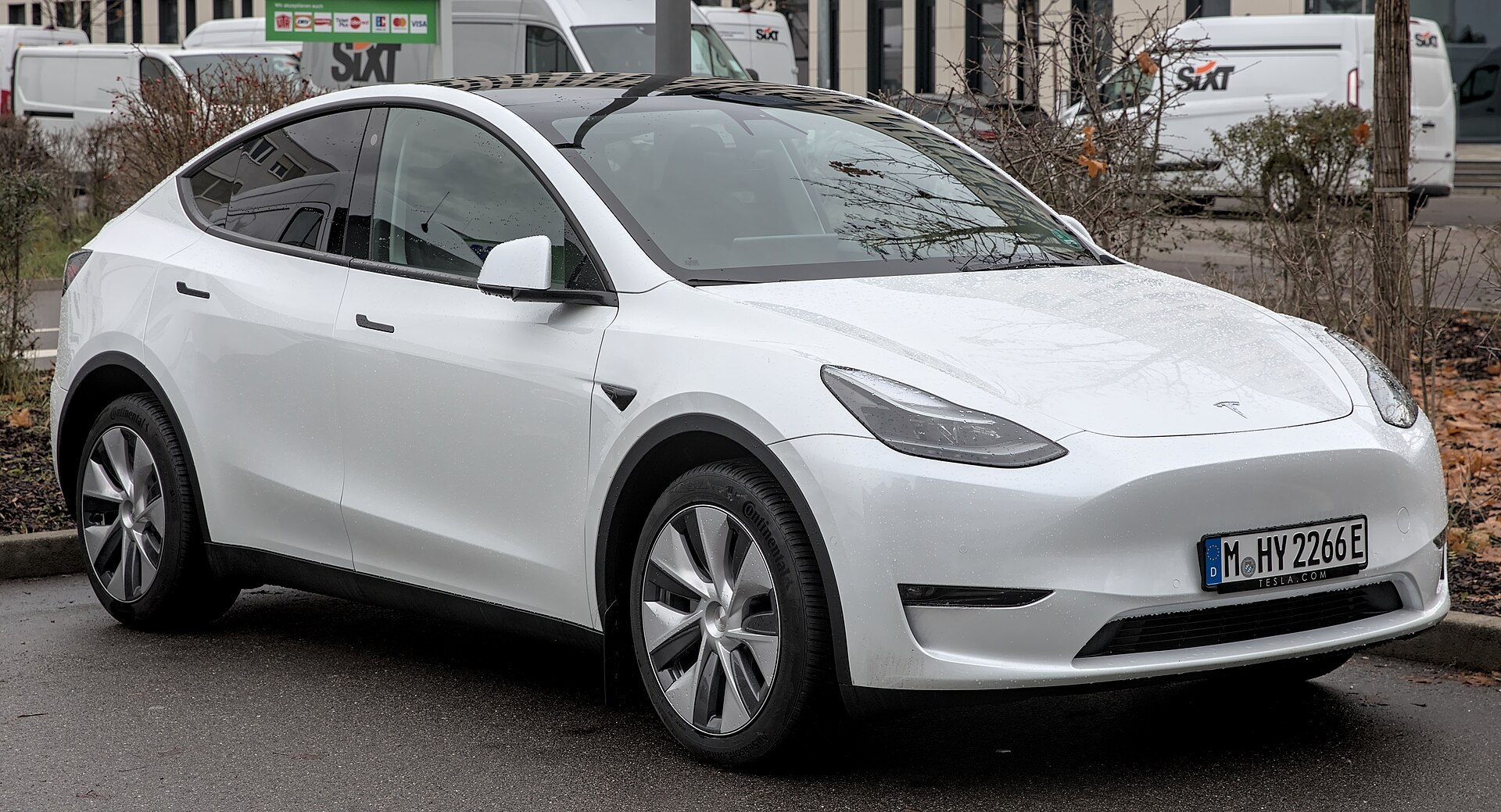
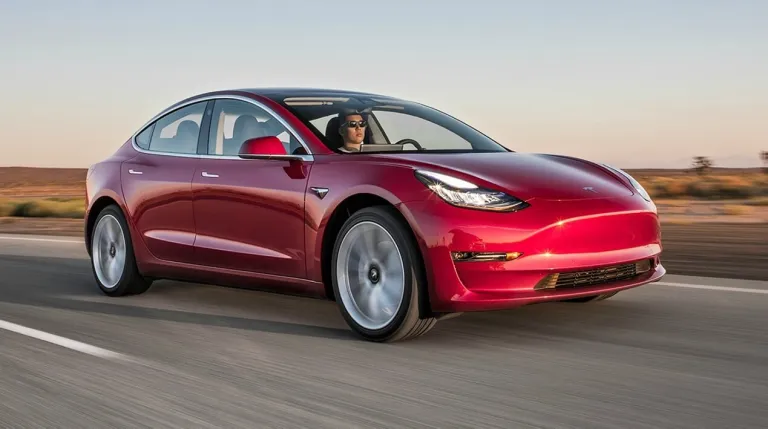
Footprints are almost identical. The facelifted Model 3 measures 4,720 mm in length on a 2,875 mm wheelbase; the Model Y of 2020–2025 was 4,751 mm long on 2,890 mm, and the 2025 refresh stretched it to 4,790 mm. Our size comparison tool draws both outlines over each other. The real gap is vertical: at 1,624 mm the SUV stands about 18 cm taller than the saloon, which sits roughly 1.44 m high. That extra height gives a higher seating position and an easier climb into the rear, but it also adds weight: the Model Y weighs 1,884–1,998 kg, the Model 3 1,611–1,836 kg.
Range and efficiency
Less frontal area and a drag coefficient of 0.219 after the 2023 facelift help the saloon go further on the same energy. The Model 3 Long Range on 19-inch wheels is rated at 629 km WLTP, the rear-wheel-drive version at 513–554 km. For the SUV, Tesla quotes 534 km for the 2025 Standard and up to 622 km for the Premium with rear-wheel drive; the earlier Long Range AWD was rated at 533 km. Its drag coefficient is 0.23. Both Long Range cars accept up to 250 kW at a Supercharger.
Boot space and seats
The saloon has 594 litres behind the rear seats and 88 litres under the bonnet, a total of 682 litres, but loads go in through a boot lid rather than a tall tailgate. The Model Y has a hatch and a flat floor, and with the rear seats folded its load space reaches 2,158 litres. Tesla also sold a Long Range with seven seats for a time, and China has a six-seat long-wheelbase Model Y L since 2025.
Power and acceleration
The facelifted Model 3 RWD has 170 kW (231 PS), needs 6.1 seconds to reach 100 km/h and is limited to 201 km/h. At 1,765 kg that works out to 10.4 kg per kW in our calculation. The Model Y Long Range AWD develops 286 kW (389 PS) with 510 Nm, and the Performance 340 kW (462 PS) and 674 Nm with a 250 km/h top speed. In the United States the latest Model 3 Performance reaches 60 mph in 2.9 seconds.
Prices and crash tests
Tesla changes prices without model-year steps, so dated figures matter. In Germany the Model 3 RWD was cut from €42,990 to €40,990 in April 2024, and the Model Y Standard started at €39,990 at its launch in October 2025. Euro NCAP gave the Model 3 five stars in 2019 with 96 % for adult occupants; the Model Y received five stars in 2022 and again under the stricter 2025 protocol.
Size and weight
Side view to scale, all cars from the front bumper.
| Model 3 | Model Y I | |
|---|---|---|
| Length | 4,720 mm185.8 in | 4,751 mm187.0 in +31 mm +1.2 in +0.7% |
| Width | 1,849 mm72.8 in | 1,920 mm75.6 in +71 mm +2.8 in +3.8% |
| Height | 1,441 mm56.7 in | 1,624 mm63.9 in +183 mm +7.2 in +12.7% |
| Wheelbase | 2,875 mm113.2 in | 2,890 mm113.8 in +15 mm +0.6 in +0.5% |
| Fits a standard garage? | Yes | Too wide |
Difference vs Model 3 (±). Garage check: a standard single garage takes a car up to about 5.0 m (16 ft 5 in) long and 1.9 m (6 ft 3 in) wide (width as listed in the catalog; some makers include the mirrors). Leave about 0.6 m (2 ft) to open the doors.
Full specifications
| Tesla Model 3 | Tesla Model Y | |
|---|---|---|
| General | ||
| Version | RWD (2023 refresh) · electric · 208 kW (283 PS) | Long Range AWD · electric · 324 kW (441 PS) |
| Production years | 2016–present | 2020–present |
| Body | Sedan | SUV |
| Class | No data | SUV / crossover |
| Country | United States | United States |
| Performance | ||
| Power Why it matters: More power means stronger acceleration and easier overtaking, especially with a full load. | 208 kW (283 PS) 279 hp | 324 kW (441 PS) 434 hp Better |
| Power, all versions | 170–393 kW (231–534 PS) 228–527 hp | 324 kW (441 PS) 434 hp |
| Torque Why it matters: Torque is the pulling force you feel when accelerating from low revs, towing or climbing hills. | No data | 510 Nm 376 lb-ft |
| 0–100 km/h Why it matters: A shorter 0–100 km/h time means quicker getaways and safer merging onto fast roads. | 6.1 s | No data |
| Top speed Why it matters: Top speed hints at how relaxed the car is at motorway speeds, even if you never reach it. | 201 km/h 125 mph | 217 km/h 135 mph Better |
| Power per tonne | 118 kW/t 143 hp/ton calculated | No data |
| Engine and transmission | ||
| Fuel | Electric | Electric |
| Gearbox | single-speed | No data |
| Drive | Rear-wheel drive | All-wheel drive |
| Dimensions and weight | ||
| Length | 4,720 mm 185.8 in | 4,751 mm 187.0 in |
| Width | 1,849 mm 72.8 in | 1,920 mm 75.6 in |
| Height | 1,441 mm 56.7 in | 1,624 mm 63.9 in |
| Wheelbase | 2,875 mm 113.2 in | 2,890 mm 113.8 in |
| Kerb weight Why it matters: A lighter car is usually more agile and uses less energy. | 1,765 kg 3,891 lb | No data |
| Electric | ||
| Electric range Why it matters: A longer range means fewer charging stops on long journeys. | 534 km 332 mi | No data |
| Safety | ||
| Euro NCAP | ★★★★★ (2025) | ★★★★★ (2025) |
These cars do not differ in the data we have.
Equal rows hidden (3): Country, Fuel, Euro NCAP.
Better marks the stronger figure — only for measurable specs (power, torque, 0–100 km/h, consumption, boot, weight).
In plain words
Tesla Model Y has more power: 324 kW (441 PS) against 208 kW (283 PS) for Tesla Model 3. Tesla Model Y is 31 mm longer than Tesla Model 3 (4,751 mm vs 4,720 mm). Tesla Model 3 is the older design (from 2016); Tesla Model Y arrived in 2020. On the catalog figures, the Tesla Model 3 is the pick for city; the Tesla Model Y is the pick for off-road. Our catalog has no 0–100 km/h for the Tesla Model Y yet, so some checks above leave it out.
Which one to choose
Pick the Model 3 if range per kWh, a lower price per kilometre and a sportier driving position matter most, or if your garage or car park has a height limit.
Pick the Model Y if you carry bulky things, want to sit higher, have a child seat to fit every day or need the option of more than five seats.
Used buyers should prefer facelifted cars: the September 2023 Model 3 rides more quietly and goes further, and a battery health check is worth more than a low odometer reading on either car.
Frequently asked questions
Is the Model Y just a taller Model 3?
Largely, yes. Wikipedia says 75 to 76 percent of the Model Y's parts are shared with the Model 3. The body, seating height, tailgate and load space are what differ.
Which goes further on one charge?
The Model 3. Its Long Range is rated at 629 km WLTP after the 2023 facelift, while the best Model Y figure is up to 622 km for the 2025 Premium with rear-wheel drive.
Which one is cheaper?
It depends on the date. In Germany the Model 3 RWD cost €40,990 after an April 2024 price cut, and the Model Y Standard was launched at €39,990 in October 2025.
Can a Model Y have seven seats?
A seven-seat Long Range AWD was offered for some years. In China the long-wheelbase Model Y L of 2025 has six seats in three rows.
Are both cars safe?
Euro NCAP awarded five stars to the Model 3 in 2019 and to the Model Y in 2022 and 2025.