
Audi e-tron vs Mercedes EQC: first German electric SUVs
Updated Report an error By Sarah Whitmore

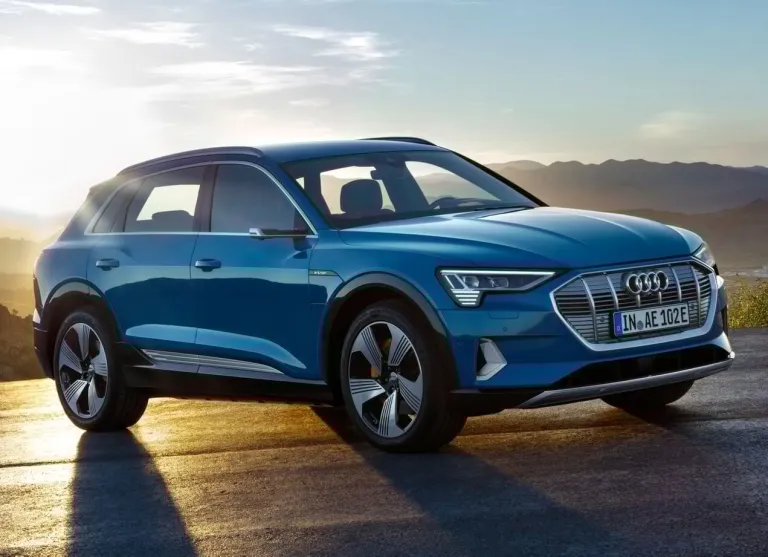
Audi · 2019–2025
e-tron
- Power
- 300 kW408 PS
- 0–100 km/h
- 5.7 s
- Top speed
- 200 km/h
- Kerb mass
- 2,565 kg

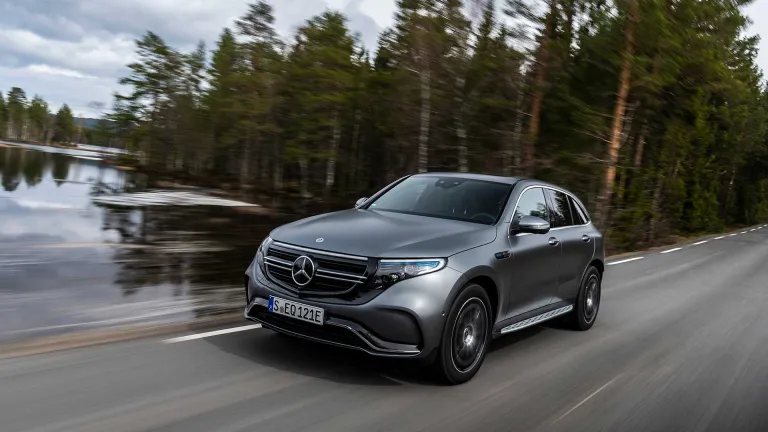
Mercedes-Benz · 2019–2023
EQC N293
- Power
- 300 kW408 PS
- 0–100 km/h
- 5.1 s
- Top speed
- 180 km/h
- Kerb mass
- 2,435 kg
At a glance
Who suits what, worked out from the catalog figures of the versions above.
Categories won: e-tron 2 EQC N293 3
- Family e-tron Boot: 600 l vs 500 l
- City EQC N293 Length: 4,761 mm vs 4,900 mm
- Performance EQC N293 Power per tonne: 123 kW/t vs 117 kW/t; 0–100 km/h: 5.1 s vs 5.7 s
- Running costs EQC N293 Fuel per year: €1,020 vs €1,100 (estimated)
- Off-road e-tron Drive and body: All-wheel drive · SUV vs All-wheel drive · Crossover
Verdict Opinion
The Audi e-tron is the better electric SUV for long journeys. It has the larger battery, the longer range after its update, faster DC charging at up to 150 kW and the bigger boot, and the Sportback and S versions widen the choice. It was also built for longer, until 2025, under the Q8 e-tron name.
The Mercedes EQC is the quicker and more compact car. Its 760 Nm and 5.1-second sprint beat the Audi, it is about 135 kg lighter, and its Euro NCAP scores for adult and child occupants are higher. As a used buy it suits drivers whose daily distances stay well within its 417 km WLTP range.
- Sarah Whitmore
The Audi e-tron and the Mercedes-Benz EQC were the first battery-electric SUVs from the two German premium brands, and they were revealed within two weeks of each other in 2018. Mercedes showed the production EQC in Sweden on 4 September 2018; Audi unveiled the e-tron in San Francisco on 17 September. Both made their public debut at the 2018 Paris Motor Show. The EQC ended production in the second half of 2023. The e-tron was renamed Q8 e-tron after a facelift revealed on 9 November 2022 and was built in Brussels until February 2025.
In short: the e-tron 55 has the bigger battery, faster DC charging and a larger boot. The EQC 400 has more torque, a quicker 0–100 km/h time and a lower kerb weight, but less range. Both cars are in our catalogue: Audi e-tron and Mercedes-Benz EQC.
Audi e-tron vs EQC: battery, charging, performance and size
Motors and performance
Both cars drive all four wheels and reach 300 kW (402 hp); the EQC uses two asynchronous motors, one on each axle. In the e-tron 55 quattro that figure is a boost-mode peak; the normal combined output is 265 kW, and boost torque is 664 Nm. Audi quotes 5.7 seconds from 0 to 100 km/h with boost. The EQC 400 4MATIC delivers 300 kW and 760 Nm, reaches 100 km/h in 5.1 seconds and is limited to 180 km/h. Audi also sold the e-tron 50 quattro with 230 kW and the e-tron S with 370 kW in boost mode.
- Audi e-tron 55: 300 kW boost, 664 Nm, 95 kWh (86.5 usable), 150 kW DC
- Mercedes EQC 400: 300 kW, 760 Nm, 80 kWh, 110 kW DC
- Euro NCAP: five stars for both in 2019
Battery, range and charging
The e-tron 55 uses a 95 kWh battery with 86.5 kWh usable. Its WLTP range was 358–417 km at launch and 365–436 km after an update. The e-tron 50 has 71 kWh and 276–336 km. The EQC has an 80 kWh pack with 384 cells, rated at 417 km WLTP and 354 km by the EPA. Audi's DC charging peaks at 150 kW, with 10–80% in about 30 minutes; the EQC charges at up to 110 kW and needs about 40 minutes for 10–80%. Audi also offered 22 kW AC charging as an option in Europe.
Size and weight
The e-tron is the larger car: 4,901 mm long and 1,935 mm wide on a 2,928 mm wheelbase. The EQC is based on the Mercedes GLC and shares its 2,873 mm wheelbase, with a length of 4,761 mm. The Audi weighs about 2,560 kg and the EQC 2,425 kg. Audi listed 660 litres of luggage space, later revised to 615 litres; the EQC has 500 litres.
Body styles and features
From early 2020 Audi added the e-tron Sportback with a coupé-style roof and a drag coefficient of 0.25, against 0.27 for the SUV. The e-tron was the second production car to offer optional camera-based virtual side mirrors. The EQC was sold as a single SUV body.
Euro NCAP
Both received five stars in 2019. The EQC scored 96% for adult occupants, 90% for children, 75% for vulnerable road users and 75% for safety assist. The e-tron 55 scored 91%, 85%, 71% and 76%.
Race Stats side by side
Each figure is a 0–100 score from the catalog numbers, the same as on the 1CARS Race cards. PI is the overall performance index (100–999) and its class D–S.
| Stat | e-tron | EQC N293 |
|---|---|---|
| PI | B · 525 | B · 547 |
| Power | 55 | 56 |
| Grip | 43 | 50 |
| Handling | 34 | 39 |
| Top speed | 38 | 31 |
| Launch | 58 | 63 |
Grip and handling are estimates from drive type, weight, height and body (hover a figure to see where it comes from). 1CARS Race
Who wins a race?
Quarter-mile (402 m) drag from a standing start, dry road, no reaction time - the 1CARS Race physics on the catalog figures of these versions.
- 1 EQC N293400 4MATIC · electric · 300 kW (408 PS) 13.58 sat 160 km/h
- 2 e-tron55 quattro · electric · 300 kW (408 PS) 14.10 sat 154 km/h · +0.52 s
Size and weight
Side view to scale, all cars from the front bumper.
| e-tron | EQC N293 | |
|---|---|---|
| Length | 4,900 mm192.9 in | 4,761 mm187.4 in −139 mm −5.5 in −2.8% |
| Width | 1,935 mm76.2 in | 2,096 mm82.5 in +161 mm +6.3 in +8.3% |
| Height | 1,616 mm63.6 in | 1,624 mm63.9 in +8 mm +0.3 in +0.5% |
| Wheelbase | 2,928 mm115.3 in | 2,873 mm113.1 in −55 mm −2.2 in −1.9% |
| Kerb weight | 2,565 kg5,655 lb | 2,435 kg5,368 lb −130 kg −287 lb −5.1% |
| Boot | 600 l21.2 cu ft | 500 l17.7 cu ft −100 l −3.5 cu ft −16.7% |
| Fits a standard garage? | Too wide | Too wide |
Difference vs e-tron (±). Garage check: a standard single garage takes a car up to about 5.0 m (16 ft 5 in) long and 1.9 m (6 ft 3 in) wide (width as listed in the catalog; some makers include the mirrors). Leave about 0.6 m (2 ft) to open the doors.
Full specifications
| Audi e-tron | Mercedes-Benz EQC | |
|---|---|---|
| General | ||
| Version | 55 quattro · electric · 300 kW (408 PS) | 400 4MATIC · electric · 300 kW (408 PS) |
| Production years | 2019–2025 | 2019–2023 |
| Body | SUV | Crossover |
| Class | SUV / crossover | SUV / crossover |
| Country | Germany | Germany |
| Performance | ||
| Power Why it matters: More power means stronger acceleration and easier overtaking, especially with a full load. | 300 kW (408 PS) 402 hp | 300 kW (408 PS) 402 hp |
| Power, all versions | 230–370 kW (313–503 PS) 308–496 hp | 210–300 kW (286–408 PS) 282–402 hp |
| Torque Why it matters: Torque is the pulling force you feel when accelerating from low revs, towing or climbing hills. | 664 Nm 490 lb-ft | 760 Nm 561 lb-ft Better |
| 0–100 km/h Why it matters: A shorter 0–100 km/h time means quicker getaways and safer merging onto fast roads. | 5.7 s | 5.1 s Better |
| Top speed Why it matters: Top speed hints at how relaxed the car is at motorway speeds, even if you never reach it. | 200 km/h 124 mph Better | 180 km/h 112 mph |
| Power per tonne | 117 kW/t 142 hp/ton calculated | 123 kW/t 150 hp/ton calculated Better |
| Engine and transmission | ||
| Fuel | Electric | Electric |
| Drive | All-wheel drive | All-wheel drive |
| Dimensions and weight | ||
| Length | 4,900 mm 192.9 in | 4,761 mm 187.4 in |
| Width | 1,935 mm 76.2 in | 2,096 mm 82.5 in |
| Height | 1,616 mm 63.6 in | 1,624 mm 63.9 in |
| Wheelbase | 2,928 mm 115.3 in | 2,873 mm 113.1 in |
| Kerb weight Why it matters: A lighter car is usually more agile and uses less energy. | 2,565 kg 5,655 lb | 2,435 kg 5,368 lb Better |
| Boot Why it matters: A bigger boot fits more luggage, shopping or a pram. | 600 l 21.2 cu ft Better | 500 l 17.7 cu ft |
| Economy and running costs | ||
| Fuel cost per year | €1,100/year estimated | €1,020/year estimated Better |
| Electric | ||
| Battery Why it matters: A bigger battery usually gives more range, but takes longer to charge fully. | 95 kWh Better | 80 kWh |
| Electric range Why it matters: A longer range means fewer charging stops on long journeys. | No data | 417 km 259 mi |
| Energy use | 24.5 kWh/100 km | 22.7 kWh/100 km Better |
| Safety | ||
| Euro NCAP | ★★★★★ (2019) | ★★★★★ (2019) |
These cars do not differ in the data we have.
Equal rows hidden (6): Class, Country, Power, Fuel, Drive, Euro NCAP.
Better marks the stronger figure - only for measurable specs (power, torque, 0–100 km/h, consumption, boot, weight).
Estimated at 15,000 km a year with fuel at €0.30/kWh electricity.
In plain words
Mercedes-Benz EQC is quicker: 0–100 km/h in 5.1 s against 5.7 s for Audi e-tron. Audi e-tron is 139 mm longer than Mercedes-Benz EQC (4,900 mm vs 4,761 mm). Mercedes-Benz EQC is lighter by 130 kg (2,435 kg vs 2,565 kg). Audi e-tron has the bigger boot: 600 l against 500 l. At 15,000 km a year, fuel would cost about €1,100 (Audi e-tron), €1,020 (Mercedes-Benz EQC) (estimated). On the catalog figures, the Audi e-tron is the pick for family and off-road; the Mercedes-Benz EQC is the pick for city, performance and running costs.
Which one to choose
Choose the Audi e-tron if you drive long distances, want faster DC charging and a bigger boot, or like the Sportback body or the 370 kW e-tron S.
Choose the Mercedes-Benz EQC if you want stronger acceleration, the higher Euro NCAP occupant scores and a GLC-sized SUV that is easier to park.
The e-tron also meets Tesla in Audi e-tron vs Tesla Model X, and the combustion-engined GLC faces BMW in BMW X3 vs Mercedes-Benz GLC.
Frequently asked questions
Which has more range, the e-tron or the EQC?
The updated e-tron 55, rated at 365–436 km WLTP with a 95 kWh battery. The EQC 400 is rated at 417 km WLTP with an 80 kWh battery.
Which charges faster?
The e-tron, at up to 150 kW DC and about 30 minutes for 10–80%. Mercedes quotes 110 kW and roughly 40 minutes for the same charge.
Which one is quicker?
The EQC 400, with 760 Nm and 5.1 seconds to 100 km/h. The e-tron 55 needs 5.7 seconds in boost mode.
Are both still in production?
No. EQC production ended in the second half of 2023. The e-tron, renamed Q8 e-tron in 2022, was built until February 2025.
Which has the bigger boot?
The e-tron, with 660 litres in Audi's first figure, later revised to 615 litres. The EQC has 500 litres.