
 Mercedes-Benz EQC
Specs, engines and history
Updated Published Sources (3) Report an error
By Felix Hartmann, Automotive Technology & EV Contributor Reviewed by Oleksandr Hnatiuk
- Built
- 2019–2023
- Top power
- 300 kW (408 PS)
Verdict: is a used EQC worth buying?
Our verdict · Felix Hartmann
The EQC is a quiet, comfortable electric SUV with the cabin of a modern Mercedes. Its weaknesses are the range of about 400 km in good conditions, the 110 kW charging limit and the high weight. For a buyer who charges at home and drives mostly within a region, it is a sensible used choice, especially as a car built after November 2020 with the 11 kW charger.
Before buying, check:
- Battery health: ask a Mercedes dealer for a state-of-health report.
- On-board charger: 7.4 kW or 11 kW, depending on the order date.
- Software and recalls: confirm that all campaigns have been completed.
- Tyres: the weight wears them quickly, so check the date codes and tread.
For longer trips, the EQE SUV or the newer electric GLC charge faster. The GLC page covers the combustion model the EQC was based on, and more electric models are in our electric cars section.
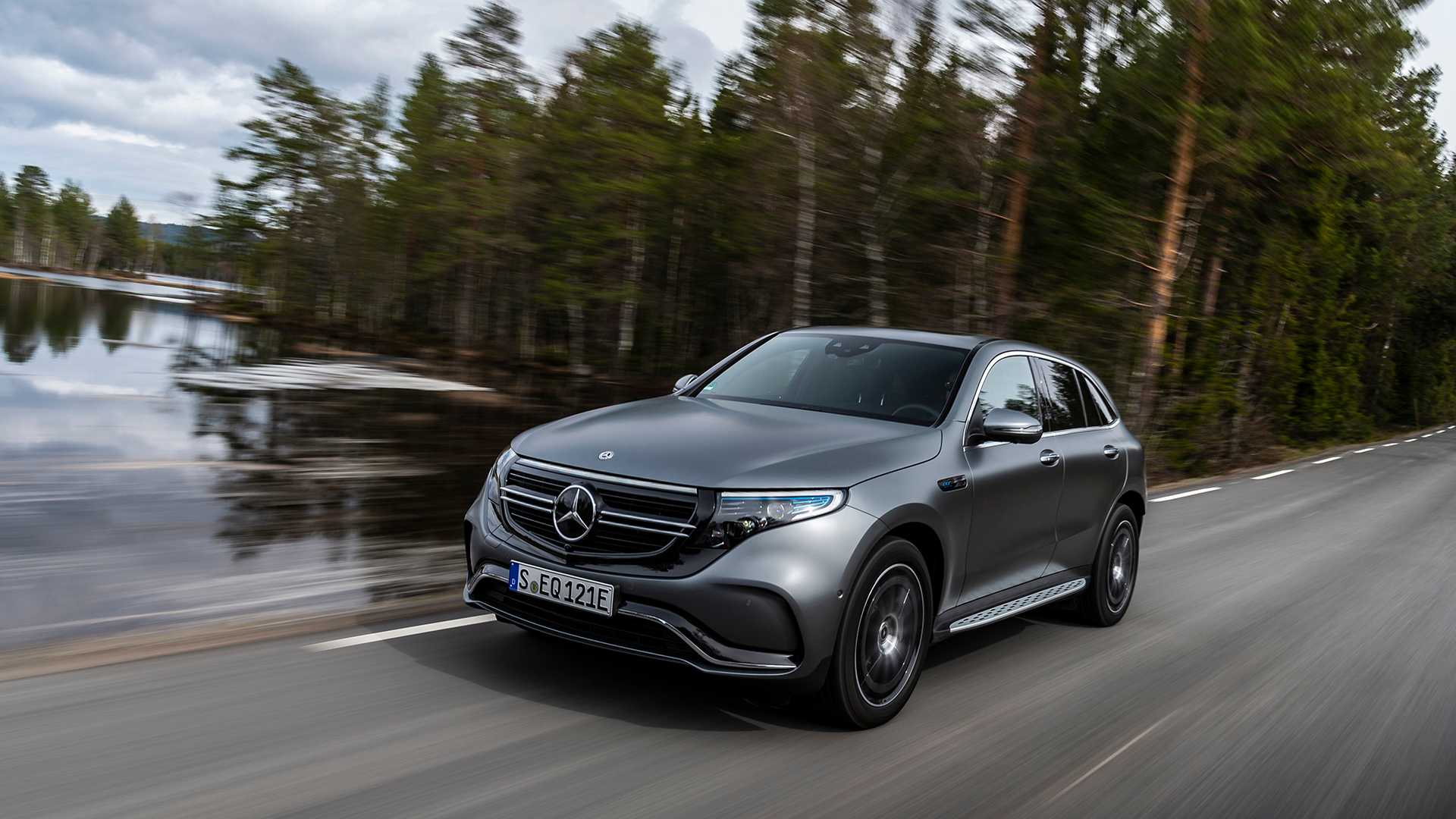
The Mercedes-Benz EQC is a mid-size electric SUV built from May 2019 to 2023 in Bremen and Beijing. Mercedes revealed it in Stockholm on 4 September 2018. The production EQC 400 4MATIC has two motors with 300 kW (408 PS) and an 80 kWh battery for 417 km of WLTP range. Sales stayed modest, and the EQE SUV took over in 2023.
In short
- Revealed 4 September 2018 in Stockholm; production from 6 May 2019 to 2023 in Bremen (Germany) and Beijing (China).
- EQC 400 4MATIC: two asynchronous motors, 300 kW, 760 Nm, 0–100 km/h in 5.1 s, 180 km/h limited.
- Battery 80 kWh (about 76 kWh usable), 110 kW DC charging, 417 km WLTP; five Euro NCAP stars in 2019.
- German launch price €71,281 (May 2019); the planned US launch was cancelled.

Size at a glance
Tesla Model X
The Mercedes-Benz EQC N293 is 275 mm shorter, 97 mm wider and 60 mm lower than the Tesla Model X.
| Dimensions | Mercedes-Benz EQC N293 | Tesla Model X | Difference |
|---|---|---|---|
| Length | 4,761 mm187.4 in | 5,036 mm198.3 in | −275 mm−10.8 in |
| Width | 2,096 mm82.5 in | 1,999 mm78.7 in | +97 mm+3.8 in |
| Height | 1,624 mm63.9 in | 1,684 mm66.3 in | −60 mm−2.4 in |
| Wheelbase | 2,873 mm113.1 in | 2,965 mm116.7 in | −92 mm−3.6 in |
| Boot | 500 L17.7 cu ft | - | - |
Specs by version
Engines
| Version | Engine | Power | Torque | Drive | Production years |
|---|---|---|---|---|---|
| EQC 400 4MATIC | Electric | 300 kW 408 PS402 hp | 760 Nm561 lb-ft | All-wheel drive | 2019–2023 |
Performance
Show all 1 versions
| Version | 0–100 km/h | Top speed | Fuel consumption | Range |
|---|---|---|---|---|
| EQC 400 4MATIC | 5.1 s 0–62 mph | 180 km/h112 mph | 22.7 kWh/100 km36.5 kWh/100 mi | 417 km259 mi |
Dimensions and weight
Show all 1 versions
| Version | Length | Width | Height | Wheelbase | Kerb weight | Boot | Battery |
|---|---|---|---|---|---|---|---|
| EQC 400 4MATIC | 4,761 mm187.4 in | 2,096 mm82.5 in | 1,624 mm63.9 in | 2,873 mm113.1 in | 2,435 kg5,368 lb | 500 l17.7 cu ft | 80 kWh |
Verified Manufacturer and type-approval data from our catalog · Sources and methodology
What Mercedes showed in 2018
Mercedes previewed its electric SUV as the Generation EQ concept at the 2016 Paris show. The production car followed two years later: the EQC was presented in Stockholm on 4 September 2018 and appeared at the Paris Motor Show a month later. The old version of this page, written in October 2018, reported the first photos, an expected price of about €70,000 and a production start in mid-2019. Those forecasts turned out close to what happened.

The EQC uses the GLC as its base. It shares the GLC's 2,873 mm wheelbase and much of its structure, with the battery in the floor and an electric motor on each axle. Internally it is called N293.
Mercedes-Benz EQC at a glance

| Item | Mercedes-Benz EQC |
|---|---|
| Segment | mid-size electric SUV, five seats |
| Production | May 2019 – 2023, Bremen and Beijing (BBAC) |
| Versions | EQC 400 4MATIC; EQC 350 4MATIC (Asian markets) |
| Power | 210–300 kW |
| Battery | 80 kWh, 384 cells, about 650 kg |
| Range | 415–417 km WLTP |
| Euro NCAP | five stars (2019) |
| Successor | EQE SUV; later the electric GLC |
Motors, battery and performance
Both motors are asynchronous units, one on each axle, so every EQC has all-wheel drive. Together they give the EQC 400 its 300 kW (408 PS) and 760 Nm. A cheaper EQC 350 4MATIC with 210 kW and 590 Nm was sold from June 2020, but only in Asian markets.

| Version | Power | Torque | 0–100 km/h | WLTP range | Market |
|---|---|---|---|---|---|
| EQC 400 4MATIC | 300 kW (408 PS) | 760 Nm | 5.1 s | 417 km | Europe, Asia and others |
| EQC 350 4MATIC | 210 kW (286 PS) | 590 Nm | 6.9 s | 415 km | Asia only |
The battery was assembled by Deutsche Accumotive in Kamenz, Germany. It has 384 pouch cells and weighs about 650 kg, around a quarter of the car's 2,425 kg kerb weight by our calculation. Of its 80 kWh nominal capacity, about 76 kWh are usable. The old European NEDC cycle gave more than 450 km and 22.2 kWh per 100 km; the US EPA estimate was 354 km.
Drivers could choose between five levels of energy recovery with paddles behind the steering wheel, including a fully automatic mode, and a Max Range mode for the longest distance.
Charging the EQC
| Charging type | Power | Time |
|---|---|---|
| AC, launch cars | 7.4 kW single-phase | - |
| AC, orders from November 2020 | 11 kW three-phase | about 7.5 h for 0–100 % |
| DC fast charging | up to 110 kW | about 40 min for 10–80 % |
The 110 kW DC limit was lower than the 150 kW of the Audi e-tron, so a fast-charging stop takes longer. At home the change to an 11 kW on-board charger in late 2020 made a real difference. You can estimate running costs against a petrol or diesel SUV with our fuel cost comparison tool.

Dimensions, cabin and boot
| Parameter | Metric | Imperial |
|---|---|---|
| Length | 4,761 mm | 187.4 in |
| Width | 1,884 mm | 74.2 in |
| Height | 1,624 mm | 63.9 in |
| Wheelbase | 2,873 mm | 113.1 in |
| Kerb weight | 2,425 kg | 5,346 lb |
| Boot | 500 l | 17.7 cu ft |
| Top speed | 180 km/h (limited) | 112 mph |
The cabin follows the layout of the 2018 A-Class, with two screens under one glass panel and the MBUX system with voice control. An AMG Line package gave the body sportier bumpers and trim. The old version of this page quoted a braked towing capacity of 1,800 kg.

Safety: five Euro NCAP stars
Euro NCAP tested the EQC in 2019 and gave it five stars. It scored 96 % for adult occupants, 90 % for child occupants, 75 % for pedestrians and 75 % for safety assist. ANCAP adopted the same rating for Australia.

Sales, the cancelled US launch and the end
The EQC went on sale in Germany at €71,281 when production started on 6 May 2019, and orders opened the same day. Sales were slower than Mercedes had hoped. Germany registered 548 cars in 2019 and 13,936 in total, according to German sources. Norway was the biggest market outside Germany, with about 3,600 registrations in 2020 and about 4,000 in 2021.

| Year | Event |
|---|---|
| 2016 | Generation EQ concept at the Paris show |
| September 2018 | EQC revealed in Stockholm |
| May 2019 | Production starts in Bremen and Beijing |
| June 2020 | EQC 350 4MATIC for Asian markets |
| November 2020 | 11 kW on-board charger for new orders |
| February 2021 | Cheaper base version in Germany, eligible for the state subsidy |
| 2023 | Production ends; the EQE SUV takes over |
Mercedes first postponed, then cancelled the US launch, partly because of low demand. German sources date the end of production to May 2023, and the news became public in 2024. The EQE SUV, launched a few months earlier, is about 10 cm longer. In size, the closer successor is the electric GLC.
Rivals: e-tron, I-Pace and Model X
| Model | Motors | Power | Battery | WLTP range (launch) |
|---|---|---|---|---|
| Mercedes-Benz EQC 400 | 2 | 300 kW | 80 kWh | 417 km |
| Audi e-tron 55 | 2 | 300 kW (boost) | 95 kWh | 417 km |
| Jaguar I-Pace | 2 | 294 kW | 90 kWh | 470 km |
| Tesla Model X | 2 | varies by version | 75–100 kWh | - |
On paper the Mercedes matched the Audi in power and range with a smaller battery, which points to better efficiency. The Jaguar went further on a charge. Our car comparison tool shows these models side by side.


Rivals
Compare with…
Compare Mercedes-Benz EQC with
- Tesla Model X quick spec comparison
-
EV
Ended 2026
- Years
- 2015–2026
- Body
- SUV
- Fuel
- Electric
- Power
- 190–760 kW (258–1,033 PS)

Mercedes-Benz EQC in our rankings
- No. 7 of 194 · Widest SUVs and crossovers (2,096 mm)
- No. 9 of 509 · Widest cars (2,096 mm)
- No. 31 of 391 · Heaviest cars (2,435 kg · top 8%)
- No. 24 of 171 · Most torque: SUVs and crossovers (760 Nm · top 15%)
- No. 70 of 485 · Most torque: cars (760 Nm · top 15%)
- No. 24 of 144 · Heaviest SUVs and crossovers (2,435 kg · top 17%)
Wider than 98% of ranked cars in the 1CARS catalog (No. 9 of 509).
Mercedes-Benz EQC photos 17


FAQ
When was the Mercedes-Benz EQC made?
From May 2019 to 2023. Production ran at the Bremen plant in Germany and at Beijing Benz Automotive in China. Mercedes revealed the car in Stockholm in September 2018.
What is the range of the Mercedes EQC?
The EQC 400 4MATIC has a WLTP range of 417 km from its 80 kWh battery. The older NEDC figure was over 450 km, and the US EPA estimate was 354 km.
How fast does the EQC charge?
Up to 110 kW at a DC fast charger, which takes about 40 minutes from 10 to 80 %. At home, cars ordered from November 2020 accept 11 kW AC instead of 7.4 kW.
Why was the Mercedes EQC discontinued?
Sales were lower than expected, the US launch was cancelled, and Mercedes moved to its dedicated EQ platform. The EQE SUV replaced it in 2023, and the electric GLC later took its size class.
Is the EQC related to the GLC?
Yes. It is based on the GLC of the time and shares its 2,873 mm wheelbase, but it has its own body, an electric drivetrain and an 80 kWh battery in the floor.
Data sources
Data checked by an editor against the sources below.
- The text of this article (1cars archive)
- Wikipedia - Mercedes Benz EQC
- EEA CO₂ monitoring (European Environment Agency, CC BY 4.0)


