
 Chevrolet Corsa
All generations, specs and history
Published Sources (2) Report an error
By Felix Hartmann, Automotive Technology & EV Contributor
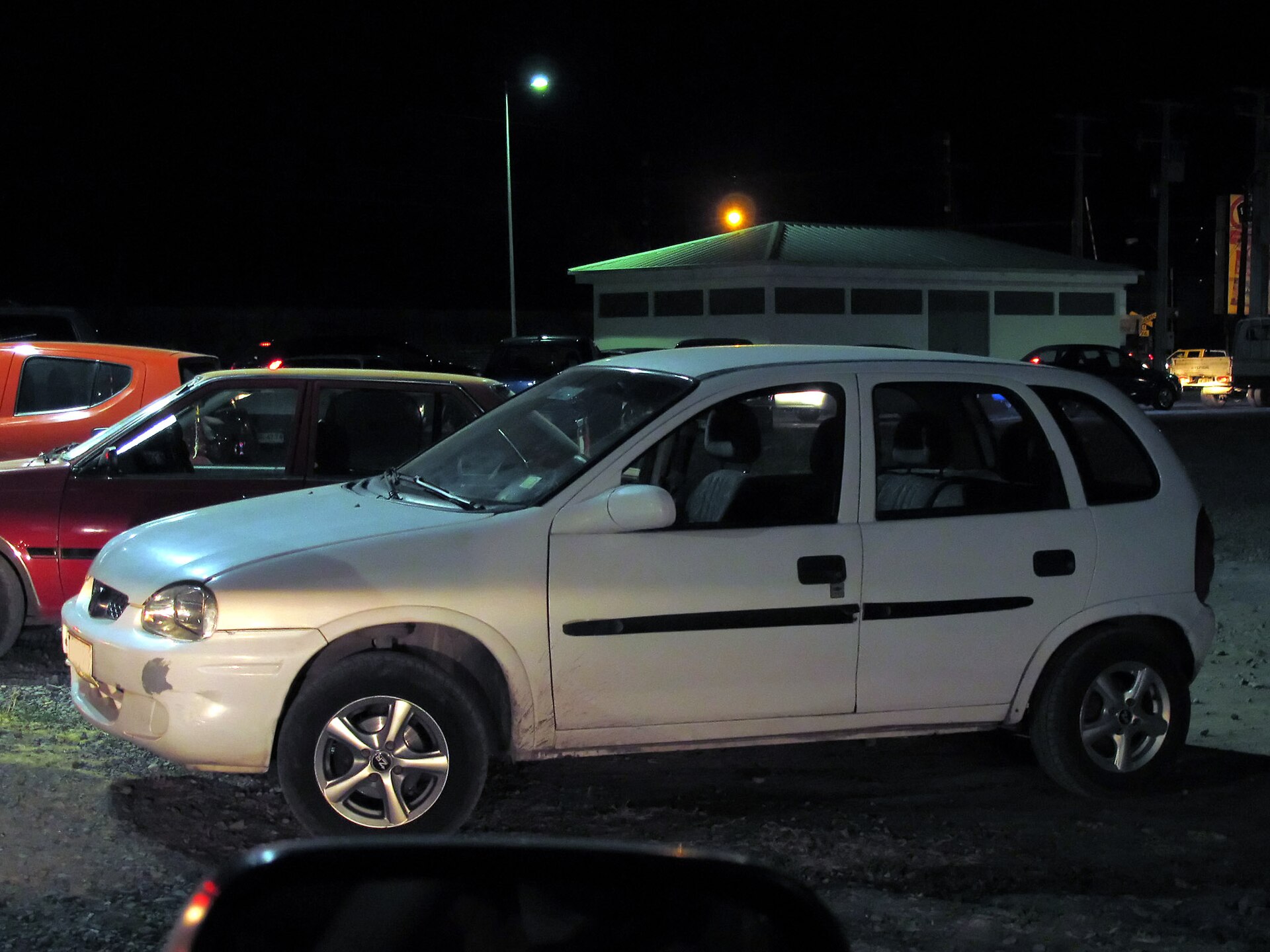
- Built
- 1994–2012
- Generations
- 2 · Corsa B to Corsa C
- Top power
- 84 kW (114 PS)
Timeline
Corsa generations
Click a generation for its own page

Corsa B and Corsa C overlapped in 2002–2010, so Corsa C sits on a second lane
- Corsa B-based 1994–2010 · Sedan, Hatchback · 37–80 kW (50–109 PS)
- Corsa C 2002–2012 · Sedan, Hatchback · 51–84 kW (69–114 PS)
Newest first · 2 generations since 1994
- 2002 Corsa C 2002–2012 · Sedan, Hatchback · 51–84 kW (69–114 PS) Corsa B and Corsa C overlapped in 2002–2010
-
1994
All generations by year: Corsa C (2002–2012) · Corsa B-based (1994–2010)
Which one is mine?
Pick the year of first registration to see which generation it is.
The Chevrolet Corsa is the Latin American version of the Opel Corsa, launched in Brazil on 10 January 1994 to replace the Chevette and sold as a hatchback, saloon, estate and pick-up. Two generations carried the name: the Corsa B-based car from 1994 and the Corsa C from 2002. The last Corsa hatchback left the Brazilian line on 26 July 2012.
In short
- Corsa Wind 1.0 of 1994: the first affordable car in Brazil with electronic fuel injection; Autoesporte Car of the Year in 1995 and 1996.
- Built in Brazil, Argentina, Mexico, Colombia, Venezuela, Ecuador and South Africa; sold in Mexico as the Chevy.
- Engines from a 1.0 with 37 kW (50 cv) to the 1.8 Flexpower with 84 kW (114 cv); a 1.7 diesel in Argentina.
- The saloon lived on as the Corsa Classic and Classic until October 2016; Latin NCAP rated it 1 star in 2011.
Specs by version
| Version | Engine | Power | Torque | Production years |
|---|---|---|---|---|
| Diesel · 1 version | ||||
| Corsa B · 1.7 Diesel 45 kW | Diesel | 45 kW 61 PS60 hp | - | 1999 |
| Petrol · 6 versions | ||||
| Corsa B · 1.0 EFI 37 kW | Petrol | 37 kW 50 PS50 hp | 76 Nm56 lb-ft | 1994–1996 |
| Corsa B · 1.6 MPFI 68 kW | Petrol | 68 kW 92 PS91 hp | 127 Nm94 lb-ft | 1996–2005 |
| Corsa B · 1.6 16V GSi 80 kW | Petrol | 80 kW 109 PS107 hp | 148 Nm109 lb-ft | 1994–1996 |
| Corsa C · 1.0 VHC 51 kW | Petrol | 51 kW 69 PS68 hp | 86 Nm63 lb-ft | 2003–2006 |
| Corsa C · 1.4 Econo.Flex 77 kW | Petrol | 77 kW 105 PS103 hp | 131 Nm97 lb-ft | 2007–2012 |
| Corsa C · 1.8 Flexpower 84 kW | Petrol | 84 kW 114 PS113 hp | 174 Nm128 lb-ft | 2006–2009 |
Verified Manufacturer and type-approval data from our catalog · Sources and methodology
Chevrolet Corsa at a glance
| Specification | Chevrolet Corsa |
|---|---|
| Years (Corsa name, Brazil) | 1994-2012; Classic saloon until 2016 |
| Generations | Corsa B-based (1994-2002, saloon to 2016), Corsa C (2002-2012) |
| Bodies | three- and five-door hatchback, saloon, estate, pick-up |
| Main plants | São Caetano do Sul and São José dos Campos (Brazil), Alvear and Rosario (Argentina), Ramos Arizpe (Mexico) |
| Platform | Opel Corsa B; Corsa C on GM Gamma |
| Petrol and flex engines | 1.0, 1.4, 1.6, 1.6 16V, 1.8 (Flexpower from 2004) |
| Diesel | 1.7 (Argentina) |
| Power | 37-84 kW (50-114 cv); GSi 1.6 16V 80 kW (109 cv) |
| Gearboxes | manual; 4-speed Aisin AS13-4 automatic (1.6 8V, 1997-2005); Autoclutch (Corsa C) |
| Safety | Latin NCAP 2011, Corsa Classic without airbags: 1 star adult, 1 star child |
| Price | Classic with airbags and ABS: BRL 31,900 in Brazil in 2012 |
Chevrolet Corsa generations and names by market
GM sold the Corsa B and Corsa C under many names outside Europe, and the dates differ from country to country.
| Generation | Market and name | Years | Plants |
|---|---|---|---|
| Corsa B | Brazil: Corsa, Corsa Classic, Classic | 1994-2016 | São Caetano do Sul |
| Corsa B | Argentina: Corsa, Corsa Classic, Classic | 1997-2016 | Alvear, Rosario |
| Corsa B | Mexico: Chevy | 1994 or 1995 to 2011-2012 | imported from Spain, then Ramos Arizpe from 1996 |
| Corsa B | South Africa: Corsa Lite, Corsa Classic | 1996-2007 | Port Elizabeth |
| Corsa B | China: Buick Sail, then Chevrolet Sail | 2001-2005, then from 2005 | Shanghai |
| Corsa B | Chile: Corsa Plus (Chinese-built Sail) | from 2006 | China |
| Corsa C | Brazil and South America: Corsa | 2002-2012 | São José dos Campos, Alvear, Quito |
| Corsa C | Mexico: Corsa, then Chevy C2 | 2003-2008 | imported from Brazil; Chevy C2 from 2004 |
| Corsa C | South Africa: Corsa Lite, Corsa Utility | to 2007 (saloon) | Port Elizabeth |
Other assembly points listed for the Corsa B include Bogotá in Colombia, Valencia in Venezuela, 6 October City in Egypt, Gurgaon in India and Rayong in Thailand. Wikipedia also gives Holden Barina as the Australian name from May 1994. Some of the dates above vary between sources; Spanish Wikipedia, for example, gives February 1993 for the Brazilian launch.
First-generation Chevrolet Corsa (1994-2002): Wind, GSi and the family
The Corsa arrived as a three-door hatchback in four versions: Wind 1.0, Wind Super 1.0, GL 1.4 and GSi 1.6 16V. It competed with the Volkswagen Gol and the Ford Escort. Fuel injection on a car as cheap as the Wind was new in Brazil, and Autoesporte named the Corsa its Car of the Year in 1995 and 1996.
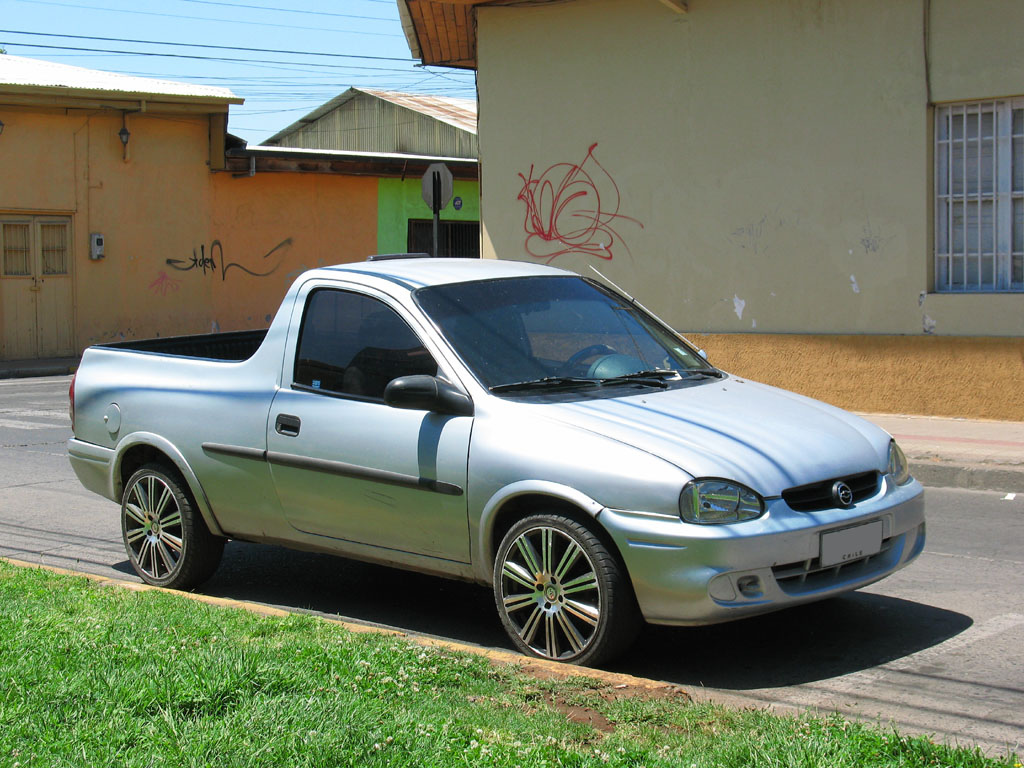
The range then grew quickly. A five-door hatchback and a 1.6 8V engine for the GL followed, then a pick-up with the 1.6 in 1995, a saloon in 1996 and an estate (Wagon) in 1997. The GSi, with 80 kW (109 cv), was built from February 1995 to August 1996 and ended in 1997 after roughly 2,500 to 3,000 cars, depending on the source. A yellow Piquet edition of 1,000 cars appeared in 1997, and the Millenium closed the hatchback's run from 2000 to 2002. Some GL, GLS and later Classic 1.6 8V cars had a four-speed Aisin AS13-4 automatic between 1997 and 2005.
In Argentina, production began in Rosario in 1997, and a 1.7-litre diesel with 45 kW (60 hp) was added in 1999. Mexico sold the car from the mid-1990s as the Chevy, first imported from Spain, then built at Ramos Arizpe from 1996.
In 2000 GM do Brasil recalled about 1.3 million Corsas built from 1994 to 1999 over the front seat belt fasteners; Portuguese Wikipedia links the defect to 25 accidents and two deaths.

Chevrolet Corsa engines and power
| Engine (years) | Power | Torque |
|---|---|---|
| 1.0 EFI (1994-1996) | 37 kW (50 cv) at 5,800 rpm | 76 Nm (7.8 kgfm) |
| 1.0 MPFI (1996-2002) | 44 kW (60 cv) at 6,000 rpm | 81 Nm (8.3 kgfm) |
| 1.0 16V MPFI (1999-2002) | 50 kW (68 cv) at 6,000 rpm | 90 Nm (9.2 kgfm) |
| 1.4 EFI (1994-1996) | 44 kW (60 cv) at 5,200 rpm | 109 Nm (11.1 kgfm) |
| 1.6 MPFI 8V (1996-2005) | 68 kW (92 cv) at 5,600 rpm | 127 Nm (13 kgfm) |
| 1.6 16V SFI, GSi (1994-1996) | 80 kW (109 cv) at 6,200 rpm | 145-148 Nm (14.8-15.1 kgfm) |
| 1.0 VHC (2003-2006) | 51 kW (70 cv) at 6,400 rpm | 86 Nm (8.8 kgfm) |
| 1.0 VHC-E Flexpower (2009-) | 57 kW (77-78 cv) at 6,400 rpm | 95 Nm (9.7 kgfm) |
| 1.4 Econo.Flex (2007-2012) | 73 kW (99 cv) petrol, 77 kW (105 cv) ethanol | 131 Nm (13.4 kgfm) |
| 1.8 MPFI (2002-2004) | 75 kW (102 cv) at 5,200 rpm | 165 Nm (16.8 kgfm) |
| 1.8 Flexpower (2006-2009) | 82-84 kW (112-114 cv) at 5,400 rpm | 174 Nm (17.7 kgfm) |
Figures are from Portuguese Wikipedia for Brazilian engines; where two outputs are given, the higher one is for ethanol. South African Corsa B models used 8-valve engines of 1.3 litres with 58 kW (79 PS), 1.4 litres with 65 kW (88 PS) and 1.6 litres with 75 kW (102 PS), and the South African Corsa C added a 1.8 with 79 kW (107 PS).
Second-generation Chevrolet Corsa (2002-2012): the Novo Corsa
The Corsa C, sold in Brazil as the Novo Corsa, went on sale in April 2002 as a five-door hatchback with 1.0 and 1.8 engines, followed by a saloon. It used GM's Gamma platform and was larger than the old car. The Corsa sold more than 130,000 units in Brazil in 2002, second only to the Volkswagen Gol, according to Auto+ TV.
Early cars offered a sunroof and the Autoclutch, a manual gearbox without a clutch pedal that GM dropped after poor sales. In 2004 the Joy, Maxx and Premium trims replaced Wind, Super and GL/GLS, and a sporty SS followed in 2005 or 2006, depending on the source. Flexpower engines for petrol and ethanol arrived between 2004 and 2008. The 1.0 ended in 2009 and the 1.8 a few months later, leaving the 1.4 Econo.Flex. Brazilian saloon production stopped in 2011, the hatchback on 26 July 2012.
In 2003 the Corsa pick-up gave way to the Chevrolet Montana, derived from the Corsa C, and the same Gamma chassis was used for the Meriva MPV. In Mexico, a locally designed Chevy C2 hatchback and saloon appeared in 2004 and was also sold in Colombia; the Corsa C left the Mexican market in June 2008, and Argentina dropped it in 2010.

Corsa Classic and the end of the Corsa name
To separate it from the new car, the old saloon became the Corsa Classic in 2002 and simply the Classic in April 2010, with a new front and rear. It was one of Brazil's best sellers and a common taxi, valued for its boot space. In 2012 Chevrolet offered airbags and ABS on the LS and Advantage versions, with a fully equipped car at BRL 31,900. Brazilian production ended in August 2013, and the car was imported from Argentina until production there ended in October 2016.
The Corsa platform also carried the Celta (2000-2015) and the Agile, of which Alvear built 347,054 from 2009 to 2016. Auto+ TV names the Spin, Agile, Chevrolet Onix and an Agile-based Montana as the cars that replaced the Corsa family. In Europe the name continues on the Opel Corsa.

Chevrolet Corsa safety rating
Latin NCAP tested an Argentinian-built Corsa Classic saloon without airbags in 2011 and gave it 1 star for adult occupants (2.28 of 16 points) and 1 star for children (9.16 of 49). The adult score was capped because the steering wheel posed a high risk of life-threatening head injury. Latin NCAP also found weak chest protection for the driver, hard structures behind the facia, a bodyshell that could not take further loading and footwell ruptures.
Chevrolet Corsa today: what to check when buying
Start with the seat belts on a 1994-1999 car: the recall of 2000 covered about 1.3 million cars, so ask whether the fasteners were replaced. Check whether a Classic from 2012 or later has the optional airbags and ABS, since the car Latin NCAP tested had neither. On a GSi, Portuguese Wikipedia quotes high prices for body parts, around BRL 3,000 for a bumper, and with only 2,500 to 3,000 built, originality matters.
For economy, Click Petróleo e Gás quotes approximate figures for the Classic 1.0 Flex from 2010: 12-14 km/l in town and 16-18 km/l on the highway on petrol, or about 8.3-7.1 and 6.3-5.6 L/100 km. The rest of the brand's range is in the Chevrolet catalogue.
Photo gallery

Chevrolet Corsa: first vs latest generation
| Spec | Corsa B-based | Corsa C | Change |
|---|---|---|---|
| Years | 1994–2010 | 2002–2012 | 8 years apart |
| Most powerful version | 80 kW (109 PS) | 84 kW (114 PS) | +4 kW (+5%) |
Oldest and newest generation in the 1cars catalog. Power is the strongest version of each; other rows are shown only when both generations have the figure.
Chevrolet Corsa in our rankings
- No. 141 of 191 · Most powerful hatchbacks (84 kW · top 74%)
- No. 99 of 132 · Most torque: hatchbacks (174 Nm · top 75%)
- No. 208 of 244 · Most powerful sedans (68 kW · top 86%)
- No. 659 of 755 · Most torque: cars (174 Nm · top 88%)
- No. 1164 of 1318 · Most powerful cars (84 kW · top 89%)
- No. 211 of 237 · Most powerful cars of the 2000s (84 kW · top 90%)
More powerful than 26% of ranked hatchbacks in the 1CARS catalog (No. 141 of 191).
FAQ
When was the Chevrolet Corsa made?
In Brazil the Chevrolet Corsa was built from January 1994 until 26 July 2012, when the last Corsa C hatchback was made. The old saloon, renamed Classic, continued in Brazil until 2013 and in Argentina until October 2016.
Is the Chevrolet Corsa the same as the Opel Corsa?
Yes, in origin. The first Chevrolet Corsa was based on the Opel Corsa B and the second on the Corsa C, but Brazil used its own engines, such as the 1.0 VHC and the Flexpower units for ethanol and petrol.
What engines did the Chevrolet Corsa have?
Petrol and flex engines of 1.0, 1.4, 1.6 and 1.8 litres, from 37 kW (50 cv) to 84 kW (114 cv) on ethanol. The GSi had a 1.6 16V with 80 kW (109 cv), and Argentina added a 1.7 diesel in 1999.
How safe is the Chevrolet Corsa?
Not very by modern standards. Latin NCAP tested a Corsa Classic saloon without airbags in 2011 and gave it 1 star for adults and 1 star for children, mainly because of the risk of head injury from the steering wheel.
What replaced the Chevrolet Corsa in Brazil?
According to Auto+ TV, the Spin, Agile, Onix and a new Agile-based Montana took over from the Corsa family. The Montana pick-up had already replaced the Corsa pick-up in 2003.
Data sources
Data checked by an editor against the sources below.
- Wikipedia - Opel Corsa
- Wikipedia - Chevrolet Corsa


