
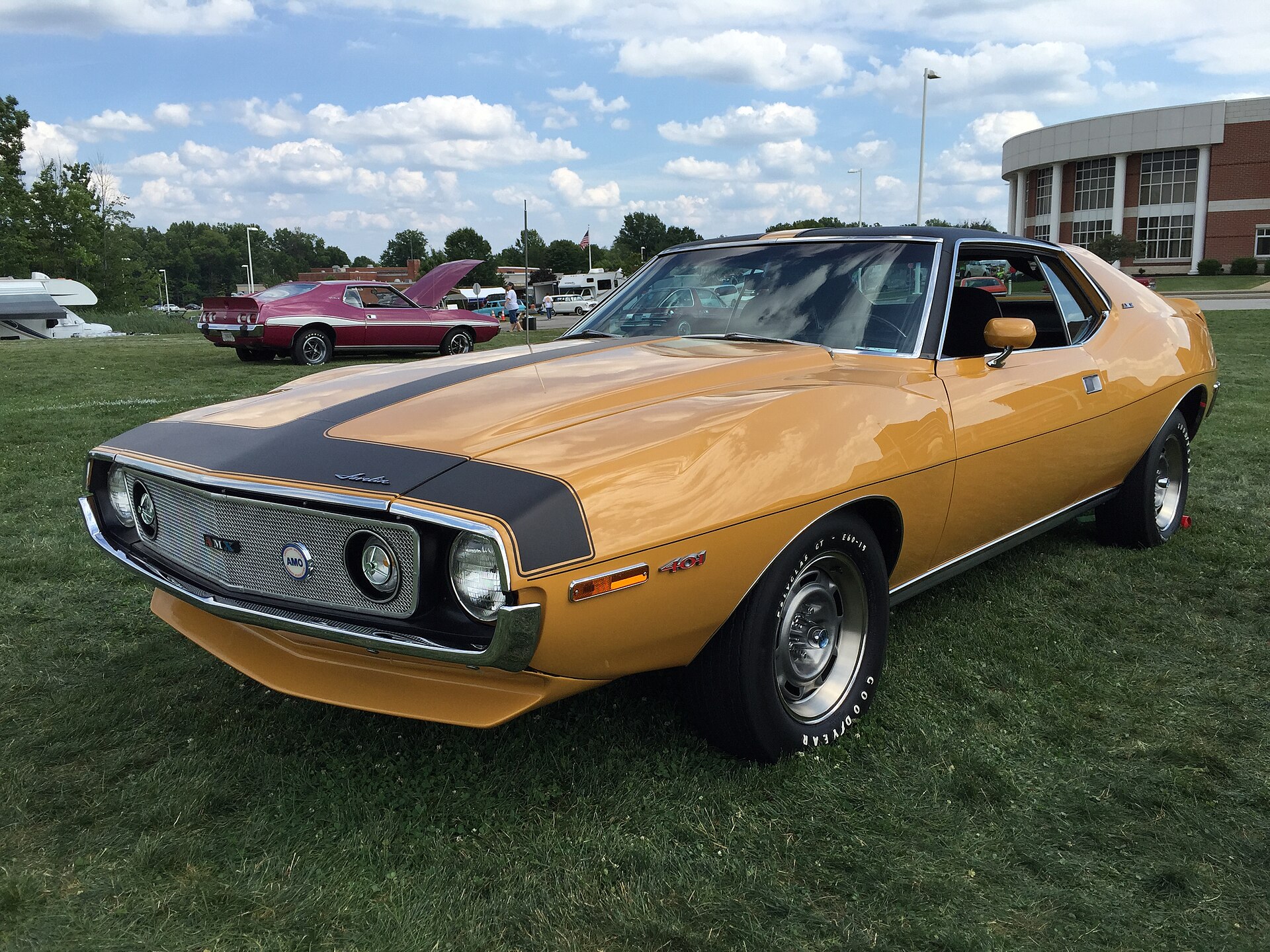
 AMC Javelin AMX
Specs, engines and history
Published Sources (3) Report an error
By Felix Hartmann, Automotive Technology & EV Contributor
- Built
- 1971–1974
- Top power
- 246 kW (334 PS)
The AMC Javelin AMX of 1971-1974 was the top trim of AMC's second-generation Javelin pony car, the name carried over after the two-seat AMX ended in 1970. Standard power was a 5.9 L (360 cu in) V8; the option that mattered was the 6.6 L (401 cu in) V8 with 246 kW (330 hp, SAE gross) in 1971. AMC built 2,054 AMXs in that first year.
In short
- Four-seat AMX on the 2,794 mm (110 in) Javelin body, model years 1971-1974, with a flush mesh grille requested by Mark Donohue.
- Standard fibreglass cowl induction bonnet and spoilers; Penske testing credited the rear spoiler with about 45 kg (100 lb) of downforce.
- Production: 2,054 (1971), 5,707 (1973) and 4,980 (1974), against 26,866 Javelins of all kinds in 1971.
- The Javelin won the SCCA Trans-Am manufacturers' title in 1971 and 1972; production ended in late 1974.
Specs by version
Engines
| Version | Engine | Power | Drive | Production years |
|---|---|---|---|---|
| AMX 304 V8 two-barrel (SAE net) | 5.0 l · 8 cyl · Petrol 4,982 cc | 112 kW 152 PS150 hp | Rear-wheel drive | 1974 |
| AMX 360 V8 two-barrel (SAE gross) | 5.9 l · 8 cyl · Petrol 5,896 cc | 183 kW 249 PS245 hp | Rear-wheel drive | 1971 |
| AMX 401 V8 four-barrel (SAE net) | 6.6 l · 8 cyl · Petrol 6,573 cc | 190 kW 258 PS255 hp | Rear-wheel drive | 1972–1974 |
| AMX 401 V8 four-barrel (SAE gross) | 6.6 l · 8 cyl · Petrol 6,573 cc | 246 kW 334 PS330 hp | Rear-wheel drive | 1971 |
Dimensions and weight
Show all 1 versions
| Version | Kerb weight |
|---|---|
| AMX 401 V8 four-barrel (SAE gross) | 1,471 kg3,243 lb |
Verified Manufacturer and type-approval data from our catalog · Sources and methodology
AMC Javelin AMX at a glance
| Specification | AMC Javelin AMX |
|---|---|
| Model years | 1971-1974 |
| Built | 2,054 (1971), not found for 1972, 5,707 (1973), 4,980 (1974) |
| Body | two-door hardtop, four seats |
| Platform | AMC Javelin, 2,794 mm (110 in) wheelbase, 4,884 mm (192.3 in) long |
| Engines | 5.9 L (360 cu in) V8 standard in 1971; 6.6 L (401 cu in) V8 optional; 5.0 L (304 cu in) V8 standard in 1974 |
| Power | 183 kW (245 hp) gross for the 360 two-barrel; 246 kW (330 hp) gross for the 1971 401; 190 kW (255 hp) net for the 401 from 1972 |
| Torque | 583 Nm (430 lb-ft) at 3,400 rpm, 1971 401 |
| Gearboxes | four-speed manual or three-speed automatic (both used in period tests); heavy-duty clutch standard |
| Weight | 1,471 kg (3,244 lb), 1971 AMX with the 401 |
| Quarter mile | 14.3 s at 98.8 mph (Sports Car Graphic, April 1971, 401 automatic) |
| Price new | 401 option USD 137 in 1971; Javelin from about USD 2,900 (base) and USD 3,000 (SST) in 1971 |
Why the AMX became a Javelin
The first AMX of 1968-1970 was a short-wheelbase two-seater, covered in the separate AMC AMX hub. Two-seat production stopped after 1970, and for 1971 AMC turned the name into the top version of the restyled Javelin, above the base car and the SST. It arrived in a shrinking market: Curbside Classic notes that pony car sales were slowing and that new Mustangs, Camaros and Firebirds were chasing the same buyers.
The 1971 body grew in every direction: one inch more wheelbase, 3.1 inches more length, 3.31 inches more width and a lower roof. Wikipedia credits Chuck Mashigan with leading the redesign, while Ate Up With Motor names stylists Jack Kenitz and Keith Goodnough. The car got high blisters over the front wheels, flared rear wings and a twin-canopy roof. Mark Donohue, who drove Penske's Javelins in the Trans-Am, asked for the AMX grille to sit flush with the bodywork for better airflow, and AMC fitted it with a stainless steel mesh.
What the AMX package included
The AMX came with the 360 V8, a heavy-duty clutch, engine-turned dashboard trim, a sports console, two door mirrors, a unique grille and a rear spoiler. Standard wheels were 14 x 6 in spoke-style steel wheels with E70x14 raised-white-letter tyres. A fibreglass full-width cowl induction bonnet and front and rear spoilers were marketed as aids to traction at speed. When Penske Racing tested the rear spoiler at Ontario Motor Speedway, it measured about 45 kg (100 lb) of downforce.
The Go Package turned the AMX into a full performance car. With the 360 or 401 four-barrel it added Rally-Pac instruments, a handling package, the Twin-Grip limited-slip differential, heavy-duty cooling, power front disc brakes, a T-stripe on the bonnet, a black tail panel and E60x15 Goodyear Polyglas tyres on 15 x 7 in slotted wheels. The functional cowl induction bonnet was part of the package until 1973. For 1974 the scoop on the AMX was for show, and some very late cars left the factory with flat steel bonnets when the cowled ones ran out.

The 401 and the switch to net ratings
The 6.6 L (401 cu in) V8 replaced the 390 for 1971, with a longer stroke, a forged steel crankshaft and forged connecting rods. Its 1971 rating was 246 kW (330 hp) gross and 583 Nm (430 lb-ft) at 3,400 rpm. From 1972 AMC quoted SAE net figures, and the 401 with 8.5:1 compression was listed at 190 kW (255 hp). Wikipedia says the drop came mostly from the new rating method.
| Engine | 1971 (gross) | 1972-1974 (net) |
|---|---|---|
| 304 V8 two-barrel | 157 kW (210 hp) | 112 kW (150 hp) |
| 360 V8 two-barrel | 183 kW (245 hp) | 130 kW (175 hp) |
| 360 V8 four-barrel | 213 kW (285 hp) | 145 kW (195 hp) 1972-1973; 164 kW (220 hp) 1974 |
| 401 V8 four-barrel | 246 kW (330 hp) | 190 kW (255 hp) |
The 401 cost USD 137 extra in 1971. Alabama's state police tested a 304 Javelin, found it too slow and then tried a vinyl-roofed AMX with the 401. The patrol bought 132 Javelins in 1971 and 1972 with the 401, the first pony cars in regular highway patrol service in the United States.


Javelin AMX performance in period road tests
Sports Car Graphic tested an AMX with the 401 and automatic in April 1971 and recorded 14.3 seconds at 98.8 mph over the quarter mile; it also noted oil pressure falling sharply on repeated runs. Other figures came from the 401 in lesser Javelins:
| Test | Car | Result |
|---|---|---|
| Sports Car Graphic, April 1971 | AMX 401, automatic | 14.3 s at 98.8 mph |
| period test cited by Wikipedia | 1971 AMX 401 | mid-14 s at 93 mph |
| period test cited by Wikipedia | 1973 Javelin 401 | 0-60 mph 7.7 s, 115.53 mph top speed |
| Road Test, 1973 | SST 401, four-speed | 15.5 s at 91 mph |
The car also reached Australian readers through Mel Nichols' "Javelin 401" test in Sports Car World in May 1973.
Trans-Am titles and the Pierre Cardin option
The second-generation body went racing straight away. In 1971 Donohue won seven rounds for Penske (sources count the season as 10 or 12 events) and AMC took its first Trans-Am manufacturers' championship; Javelins finished first, second and third at the final race. Penske moved to NASCAR for 1972, and Roy Woods Racing, with factory support, won AMC's second title. The racing story of the whole car is in the AMC Javelin hub, and Dodge's rival homologation special was the Challenger T/A.
The Pierre Cardin option went on sale on 1 March 1972 for USD 84.95. It covered the seats and headliner in pleated stripes of red, plum, white and silver on black nylon, and put the designer's crest on the front wings. AMC built 4,152 Cardin Javelins in 1972 and 1973.
Why the Javelin AMX ended
Production stopped in October or November 1974. Wikipedia lists the oil crisis, the 55 mph national limit, insurance costs and falling demand for performance cars; AMC also needed the line for the Pacer and faced about USD 12 million in engineering to meet 1975 bumper rules. The 1974 AMX was the last American Motors pony car.
Javelin AMX today: what to check when buying
With only 2,054 built in 1971, an early AMX is much rarer than a Javelin SST, so the trim needs checking: a real AMX has the flush mesh grille, engine-turned dash trim, console and rear spoiler. Go Package cars should still carry the Twin-Grip differential, front disc brakes and 15-inch slotted wheels. The bonnet tells part of the story too: a working cowl induction scoop belongs to a Go Package car up to 1973, a dummy scoop to 1974, and a flat steel bonnet can be correct on a very late 1974 car. Sports Car Graphic's oil pressure complaint in 1971 is a reason to check the lubrication system on any hard-driven 401. More AMC models are listed in the AMC catalogue.
AMC Javelin AMX in our rankings
- No. 74 of 793 · Biggest engines: cars (6,573 cc · top 10%)
- No. 56 of 262 · Biggest engines: coupes (6,573 cc · top 22%)
- No. 114 of 528 · Power-to-weight: cars (167 kW/t · top 22%)
- No. 43 of 165 · Most powerful cars of the 1970s (246 kW · top 27%)
- No. 204 of 668 · Most torque: cars (583 Nm · top 31%)
- No. 491 of 1223 · Most powerful cars (246 kW · top 41%)
Bigger engine than 90% of ranked cars in the 1CARS catalog (No. 74 of 793).
FAQ
What is the difference between the AMC AMX and the Javelin AMX?
The 1968-1970 AMX was a short-wheelbase two-seater. From 1971 to 1974 the AMX name marked the top version of the four-seat Javelin, with the 360 V8, a spoiler, a flush grille and its own trim.
How many Javelin AMXs were built?
AMC built 2,054 Javelin AMXs in 1971, 5,707 in 1973 and 4,980 in 1974. A separate 1972 AMX figure does not appear in the sources, so the known total for three model years is 12,741 cars.
How powerful was the 401 in the Javelin AMX?
In 1971 it was rated at 246 kW (330 hp, SAE gross) and 583 Nm (430 lb-ft). From 1972 AMC used net ratings, and the 401 was listed at 190 kW (255 hp).
Did the Javelin win the Trans-Am?
Yes. The Javelin won the SCCA Trans-Am manufacturers' title in 1971 with Penske and Mark Donohue and in 1972 with Roy Woods Racing, and again in 1976.
Data sources
Data checked by an editor against the sources below.
- Wikipedia - AMC Javelin
- Conceptcarz
- Ateupwithmotor


