
 AMC Pacer
Specs, engines and history
Published Sources (2) Report an error
By Sarah Whitmore, Senior Automotive Writer
- Built
- 1975–1980
- Top power
- 93 kW (126 PS)
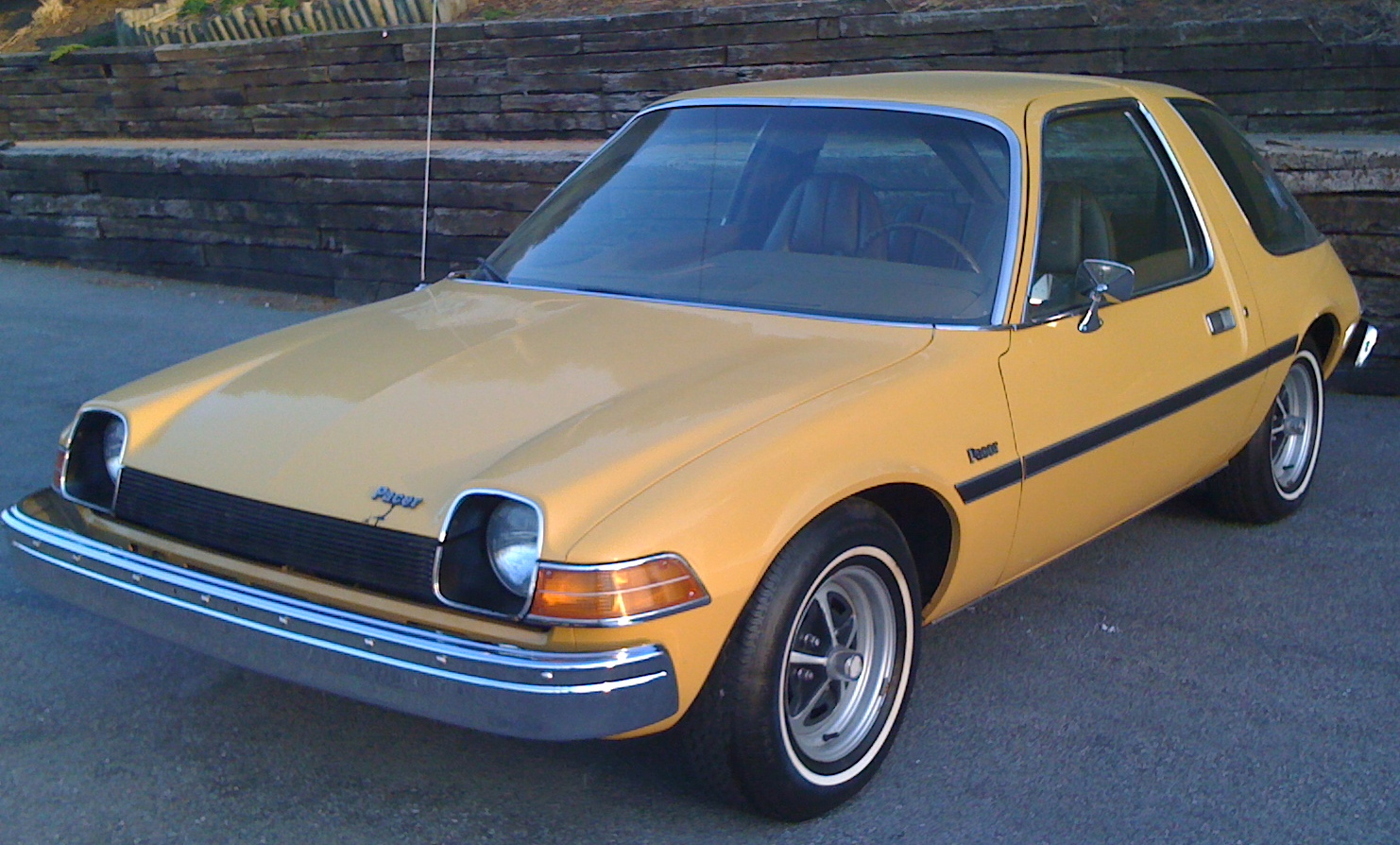
The AMC Pacer is the compact two-door hatchback, and from 1977 estate, that American Motors built in Kenosha, Wisconsin, for the 1975-1980 model years. Designed around a Wankel rotary engine that never arrived, it went on sale with AMC's 3.8-litre straight six instead. At 1,963 mm (77.3 in) it was as wide as a full-size car, and about 280,000 were built.
In short
- Unveiled on 13 January 1975, on sale from 28 February 1975; last car built in Kenosha on 3 December 1979.
- Engines: 232 and 258 cu in (3.8 and 4.2 L) straight sixes, 304 cu in (5.0 L) V8 in 1978-1979; 75 kW (100 hp) for the base six.
- 145,528 sold in the first model year, 1,746 in the last; about 280,000 in total according to Wikipedia.
- Price new: USD 3,299 in 1975 (Sports Car Market); a 1980 DL estate cost USD 5,558.
Size at a glance
| Dimensions | AMC Pacer I |
|---|---|
| Length | 4,364 mm171.8 in |
| Width | 1,963 mm77.3 in |
| Height | 1,341 mm52.8 in |
| Wheelbase | 2,540 mm100.0 in |
Specs by version
Engines
| Version | Engine | Power | Drive | Production years |
|---|---|---|---|---|
| 4.2 I6 estate | 4.2 l · 6 cyl · Petrol 4,228 cc | - | Rear-wheel drive | 1977–1980 |
| 3.8 I6 hatchback | 3.8 l · 6 cyl · Petrol 3,802 cc | 75 kW 102 PS101 hp | Rear-wheel drive | 1975–1979 |
| 5.0 V8 estate | 5.0 l · 8 cyl · Petrol 4,982 cc | 93 kW 126 PS125 hp | Rear-wheel drive | 1978–1979 |
Dimensions and weight
Show all 3 versions
| Version | Length | Width | Height | Wheelbase | Kerb weight |
|---|---|---|---|---|---|
| 4.2 I6 estate | 4,491 mm176.8 in | 1,963 mm77.3 in | - | 2,540 mm100.0 in | - |
| 3.8 I6 hatchback | 4,364 mm171.8 in | 1,963 mm77.3 in | 1,341 mm52.8 in | 2,540 mm100.0 in | 1,361 kg3,000 lb |
| 5.0 V8 estate | - | - | - | 2,540 mm100.0 in | - |
Verified Manufacturer and type-approval data from our catalog · Sources and methodology
AMC Pacer at a glance
| Specification | AMC Pacer |
|---|---|
| Years | Model years 1975-1980 |
| Production total | About 280,000 (Wikipedia); model-year sales tables in other sources add up to more |
| Plant | Kenosha, Wisconsin; VAM assembly in Mexico 1976-1979 |
| Body styles | Two-door hatchback coupé; two-door estate from 1977 |
| Designer | Dick Teague, from 1971 |
| Layout | Front engine, rear-wheel drive, rack-and-pinion steering |
| Engines | 3.8 L (232 cu in) and 4.2 L (258 cu in) I6; 5.0 L (304 cu in) V8 |
| Power | 75 kW (100 hp, SAE net) for the 232; about 93 kW (125 hp) for the V8 |
| Dimensions | Wheelbase 2,540 mm (100 in); length 4,364 mm coupé, 4,491 mm estate; width 1,963 mm |
| Kerb weight | About 1,361 kg (3,000 lb); Car and Driver's test car 1,554 kg (3,425 lb) |
| Drag coefficient | 0.43 |
| Price new | USD 3,299 (1975); USD 5,558 (1980 DL estate) |
Why the AMC Pacer was designed for a rotary engine
AMC began the Pacer in 1971, when its product chief Gerald C. Meyers and stylist Dick Teague set out to build what the company called "the first wide small car". The brief was a short car with the cabin width of a big one. Mac's Motor City Garage records that AMC analysed 36 different package layouts before choosing this one.
The engine was meant to be a Wankel. AMC took a licence for rotary technology from Curtiss-Wright in 1973 and then planned to buy rotary engines from General Motors, which was developing its own unit. GM cancelled that programme in 1974. AMC launched the Pacer anyway, reworked to take its existing straight six. The bill for the project reached about USD 60 million: USD 52 million in tooling and USD 8 million in other costs.
Glass, width and an asymmetric body
The finished car had a wheelbase of only 2,540 mm (100 in) and a length of 4,364 mm (171.8 in), but its width matched big American saloons. Glass made up 37 per cent of the body surface, about 3.6 square metres, and the drag coefficient was 0.43. The passenger door was 102 mm (4 in) longer than the driver's door, so rear passengers could climb in from the kerb side.
AMC advertised full-circle body protection, although Wikipedia notes that the bump across the roof was not a true roll bar. The company fitted energy-absorbing bumper mounts, a laminated windscreen and rack-and-pinion steering, which made the Pacer the second American production car after the Ford Pinto to use it. The tall glasshouse let Car and Driver call it the "Flying Fishbowl" in May 1976.

Engines and versions by year
| Model year | Sales | Engines | Changes |
|---|---|---|---|
| 1975 | 145,528 | 232 I6 | Launch; about half were Pacer X models |
| 1976 | 117,244 | 232 I6, 258 I6 | 258 six added |
| 1977 | 58,264 | 232 I6, 258 I6 | Estate added |
| 1978 | 21,331 | 232 I6, 258 I6, 304 V8 | Taller grille; 2,514 V8 cars |
| 1979 | 10,215 | 232 I6, 258 I6, 304 V8 | Production ended on 3 December 1979 |
| 1980 | 1,746 | 258 I6, 304 V8 | 405 DL coupés and 1,341 DL estates per Hagerty, built in late 1979 |
Sales figures from Sports Car Market's model-year table; Mac's Motor City Garage gives about 117,000 for 1976. The table sums to about 354,000, against Wikipedia's 280,000 built, so totals vary between sources.
The EPA rated the basic car at 16 mpg in town and 26 mpg on the highway (14.7 and 9.0 L/100 km), and a 258 with manual gearbox at 20 and 31 mpg (11.8 and 7.6 L/100 km). The estate of 1977 added 1,354 litres (47.8 cu ft) of load space, about 50 per cent more than the hatchback, for a weight penalty of 34 kg (76 lb). For 1978 AMC fitted its 5.0-litre V8, which Sports Car Market says struggled to make 93 kW (125 hp).

AMC Pacer road tests, rivals and film fame
Road & Track's April 1975 test liked the styling but criticised the engineering and the brakes. Car and Driver called the Pacer "our first real urban transporter" in February 1975, and Motor Trend praised the rear legroom and seats in August 1976. Consumer Reports rated it above the Pinto and the Chevrolet Vega. In California the 1975 Sundowner package listed at USD 3,599. More than 100 cars were converted to electric drive by Electric Vehicle Associates; its "Change of Pace" conversion cost USD 12,360 in 1978.
The Pacer shared showrooms with the older Hornet, the compact whose performance version is covered in our AMC Hornet SC/360 story, and the full brand range is in the AMC catalogue. Sales fell steeply after the first two years, and the last Pacers left Kenosha on 3 December 1979. In 1992 the film Wayne's World gave the car a second life; the film's "Mirthmobile" sold for USD 37,000 at Barrett-Jackson in 2016.

AMC Pacer today: what to check when buying
Rust is the main enemy. Sports Car Market lists the front wheel wells, floors, sills, lower door edges, rear quarter panels and the panel below the tailgate, and notes that the rear wheel arches had no splash shields. Glass is the second problem: apart from the windscreen, no new glass is available, so a broken side or rear window usually means a donor car.
The heater and ventilation controls are vacuum-operated and hard to repair once they fail. Original seat fabric is difficult to find. The sixes are durable but tend to leak oil and crack exhaust manifolds, ignition modules fail but are easy to replace, and the rack-and-pinion steering rarely gives trouble. The AMC Pacer Club, listed through Hemmings, helps with parts and contacts.
Values: oldcarsdata.com's auction tracker showed a median of USD 12,100 from four completed Pacer sales in 2026 up to November, about EUR 10,400 at 0.86 euro per dollar, after a USD 8,050 median from seven sales in 2024. Prices of single cars ranged from USD 6,333 to USD 22,000 in 2026. Other cars of the decade are in our classic cars section.
AMC Pacer in our rankings
- No. 1 of 29 · Biggest engines: station wagons (4,982 cc)
- No. 2 of 113 · Widest hatchbacks (1,963 mm)
- No. 2 of 25 · Widest station wagons (1,963 mm)
- No. 5 of 28 · Smallest station wagons (4,364 mm)
- No. 7 of 114 · Biggest engines: hatchbacks (3,802 cc)
- No. 87 of 636 · Widest cars (1,963 mm · top 14%)
Wider than 98% of ranked hatchbacks in the 1CARS catalog (No. 2 of 113).
FAQ
Why is the AMC Pacer so wide?
AMC designed it as "the first wide small car": a 2,540 mm wheelbase with the 1,963 mm (77.3 in) width of a full-size car, so that four adults had big-car shoulder room in a compact length of 4,364 mm.
Did the AMC Pacer have a rotary engine?
No. It was designed for a Wankel engine that AMC planned to buy from General Motors, but GM cancelled the rotary in 1974. AMC fitted its 3.8 and 4.2-litre straight sixes instead, and a 5.0-litre V8 from 1978.
How many AMC Pacers were made?
About 280,000 according to Wikipedia, built from 1975 to December 1979 in Kenosha. Sports Car Market's model-year sales table adds up to about 354,000, so figures vary. The first model year brought 145,528 sales.
Why is the Pacer's passenger door longer?
The right-hand door is 102 mm (4 in) longer than the driver's door, making it easier to reach the rear seat from the kerb side in countries that drive on the right.
How much is an AMC Pacer worth today?
Usually around USD 12,000. Oldcarsdata.com recorded a median of USD 12,100 (about EUR 10,400) from four auction sales in 2026, with single cars between USD 6,333 and 22,000, up from a USD 8,050 median in 2024.
Data sources
Data checked by an editor against the sources below.
- Wikipedia - AMC Pacer
- Sportscarmarket - 1975 1980 Amc Pacer


