
Car Dashboard Warning Lights: What Each Symbol Means and What to Do
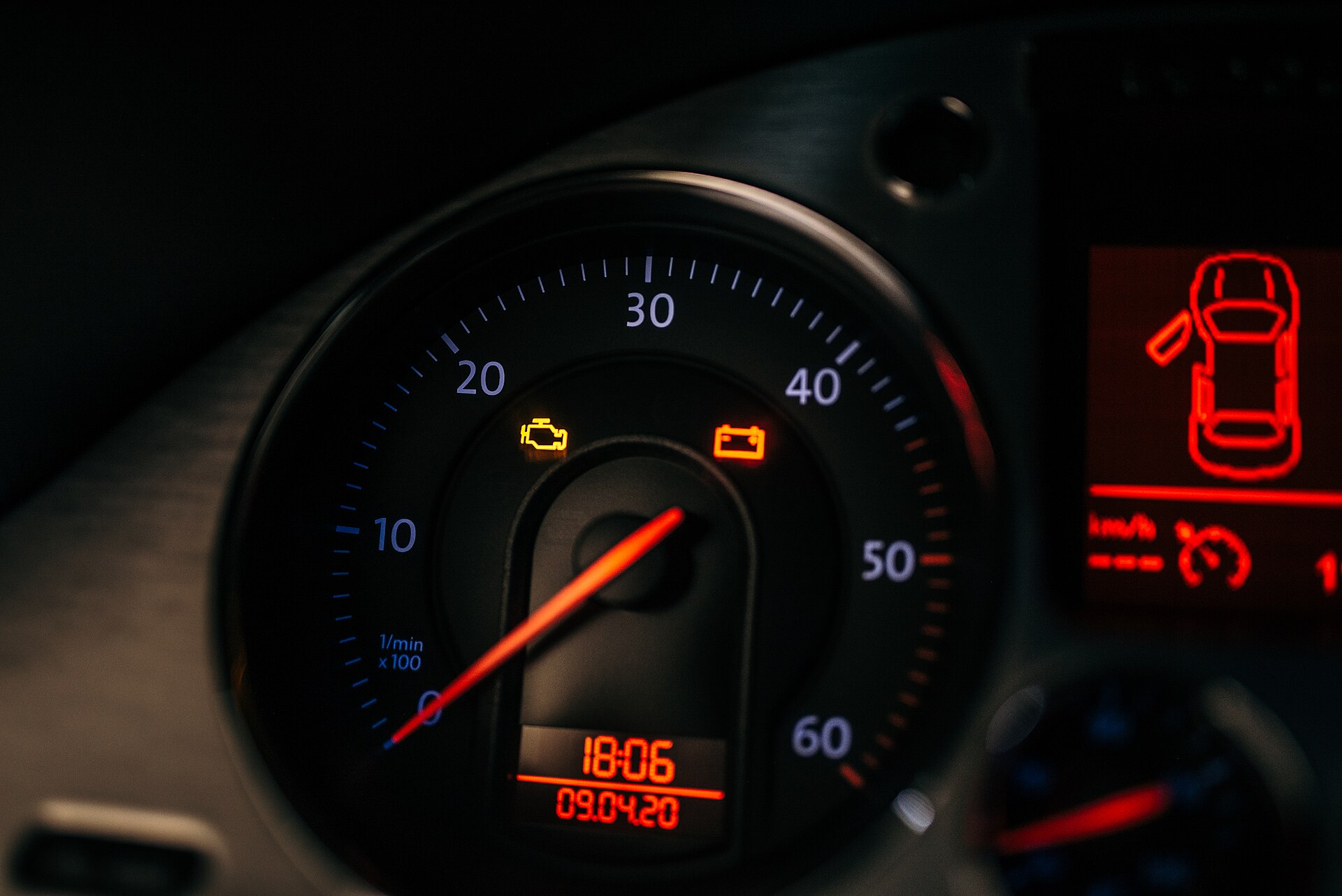
The colour of a dashboard warning light tells you how urgent it is. Red means danger or a risk of serious damage: stop as soon as it is safe and switch off. Amber or yellow means a fault or a system working outside its limits: drive on carefully and have it checked soon. Green and blue lights only confirm that something is switched on. The symbols follow the international standard ISO 2575, so most look the same across brands.
Key takeaways
- Red: stop when safe. Oil pressure, coolant temperature, charging and brake warnings can mean engine damage or a car that cannot stop.
- Amber: book a garage. Engine, ABS, airbag, glow plug and DPF warnings rarely need a tow, but they should not be ignored for weeks.
- Green or blue: information only, for example dipped beam, indicators or main beam.
- A light that does not come on for a second or two when you switch on the ignition is a fault in itself.
- ABS, airbag, ESC, power steering and tyre pressure warnings showing a fault are major defects in the UK MOT.
What the colours mean
ISO 2575, the standard for symbols on controls, indicators and tell-tales in road vehicles, is now in its ninth edition, published in September 2021. Clause 5 sets out what each colour means, and carmakers follow it closely.
| Colour | ISO 2575 meaning | What you do |
|---|---|---|
| Red | Immediate or imminent danger to people, or serious damage to the vehicle | Stop as soon as it is safe, switch off, read the handbook |
| Yellow or amber | Caution: a system outside its normal limits, a malfunction, or a condition that may become a hazard | Drive on carefully, book a garage soon |
| Green | A system is on and working normally | Nothing |
| Blue | Reserved for specific lights, mainly main beam | Dip the beam for other road users |
| White | Used where no other colour fits, often for driver-assistance systems | Nothing, or read the message |
The standard also uses colour inside one symbol: on heating and cooling indicators, red means hot and blue means cold. That is why many cars show a blue thermometer after a cold start and a red one when the engine overheats.
Some warnings change colour as they become more urgent. Volkswagen's AdBlue warning starts amber and turns red once the range runs out, according to the RAC's guide to Volkswagen warning lights (October 2026). A few brands also show the engine light in red for severe faults, so always read the colour you actually see, not the one you expect.
The most common warning lights and what to do
Symbols below are described in words, as they appear on most European cars. Exact shapes and colours differ slightly by brand; your handbook has the final word. "Stop now" means pull over as soon as it is safe, switch off and do not restart until you know the cause.
| Symbol (described) | Usual colour | Meaning | What to do |
|---|---|---|---|
| Oil can with a drip | Red | Oil pressure too low | Stop now. Check the level after a few minutes. If low, do not restart; top up or call for help |
| Thermometer in liquid waves | Red | Coolant too hot or level too low | Stop now. Let the engine cool before checking the level |
| Thermometer in liquid waves | Blue | Engine still cold | Drive gently until it goes out |
| Battery outline with + and - | Red | Alternator not charging | Stop when safe. The car runs only on battery power; call for help |
| Exclamation mark in a circle between brackets | Red | Brake fluid low or brake system fault (or parking brake applied) | If the parking brake is off, stop now and call for help |
| ABS in a circle | Amber | Anti-lock braking fault; normal brakes still work | Drive carefully to a garage. With the red brake light too, stop now |
| Circle with dashed brackets | Amber | Brake pads at wear limit | Garage within days |
| P in a circle (electric parking brake) | Amber | Parking brake fault | Garage soon; use a wheel chock or gear when parked |
| Steering wheel with exclamation mark | Red or amber | Power steering fault, steering may turn heavy | Red: stop now. Amber: restart once, then drive slowly to a garage |
| Seated person with a ball in front | Red or amber | Airbag or belt tensioner fault | Garage soon; airbags may not fire in a crash |
| Seated person with a seat belt | Red | Belt not fastened | Fasten belts |
| Car outline with an open door | Red | Door, bonnet or boot not closed | Stop and close it |
| Engine outline | Amber | Engine or emissions fault | Steady: garage soon. Flashing: drive gently to a garage straight away |
| EPC letters | Amber | Throttle or engine electronics fault (VW group) | Garage soon; expect reduced power |
| Car with skid lines | Amber | Flashing: ESC working. Steady: ESC off or faulty | Flashing: slow down. Steady: switch on again or see a garage |
| Horseshoe tyre section with exclamation mark | Amber | Tyre pressure low or TPMS fault | Check all tyres at once; do not drive on a flat |
| Coil spring shape | Amber | Diesel glow plugs preheating | Steady: wait until it goes out. Flashing: glow plug or engine fault, garage soon |
| Box with dots inside | Amber | Diesel particulate filter loaded with soot | Drive about 10 minutes above 65 km/h; if it stays on, garage |
| Fluid drop with AdBlue text or bars | Amber, then red | AdBlue running low | Refill soon; at red the engine may not restart |
| Fuel pump | Amber | Low fuel | Refuel |
| Windscreen with spray jet | Amber | Washer fluid low | Top up with screenwash |
| Snowflake | Amber or white | Outside temperature near freezing | Expect black ice |
| Bulb with exclamation mark | Amber | A bulb has failed | Replace it; a dead brake or headlight bulb is a test failure |
| Headlamp with straight beams | Blue | Main beam on | Dip for oncoming traffic |
| Arrows, dipped beam lamp, speedometer symbol | Green | Indicators, lights or cruise control on | Nothing |
Red warnings: stop as soon as it is safe
Oil pressure
TÜV Nord's advice (September 2026) is to switch off, wait a few minutes and check the dipstick. If the oil is low, top up with the grade in the handbook. If the level is correct and the light stays on, the oil pump or sensor may have failed: do not keep driving, because an engine without oil pressure can seize within minutes.
Coolant temperature
Switch off and let the engine cool. Never open the expansion tank or radiator cap while hot: the system is pressurised and the coolant can scald. If the level is fine and the light returns, call for recovery.
Charging
A red battery light while driving means the alternator is not charging. TÜV Nord warns that a broken drive belt can be the cause, and on many engines the same belt also drives the water pump, so overheating may follow. Leave the traffic flow and call for help.
Brakes
If the parking brake is fully released and the red brake light stays on, brake fluid may be low or the system faulty. Do not drive on. Pad wear is a separate amber light and is covered in our guide to brake pads and discs.

Amber warnings: drive on carefully and book a garage
An amber engine light is the most common of these, and it has its own guide: check engine light on explains fault codes, steady versus flashing and what to do. The same logic applies to the others.
ABS
Normal braking still works, but wheels can lock in an emergency stop. The RAC advises keeping extra distance and getting it checked; if the red brake light comes on at the same time, stop and call for help. ABS problems often also switch off ESC.
Airbag
The car drives normally, but airbags and belt tensioners may not fire in a crash. Have it diagnosed promptly and do not try to work on the system yourself.
ESC and TPMS
A flashing ESC light means the system is catching a slide: ease off. A steady light means it is off or faulty. A tyre pressure light needs a stop at the next fuel station to check all four tyres against the figures on the door pillar or fuel flap; many indirect systems then need resetting through the car's menu.
Diesel lights
A glow plug lamp that stays lit for a few seconds after you switch on is normal preheating. A flashing one usually means a fault. Auto Zeitung (February 2025) puts glow plug replacement at about €150-250 at a workshop in 2025, depending on the engine. The DPF lamp asks for a steady, faster drive; the full procedure and repair options are in our blocked DPF guide. For the AdBlue countdown, see AdBlue explained: once it reaches zero, the engine will not restart until you refill.
EPC
Found on Volkswagen, Audi, Skoda and Seat petrol cars, this lamp points to the throttle or engine electronics. The RAC says the car may go into a reduced-power safe mode; it is usually drivable, but have the code read straight away.
When a light flashes, stays on or never appears
A flashing light is usually more urgent than the same light lit steadily. A flashing engine light warns of misfires that can overheat the catalytic converter; a flashing ESC light means the system is working right now; a flashing glow plug light means a fault.
Every warning lamp should light briefly during the bulb check when you switch on the ignition, then go out. If the airbag, ABS or engine light never comes on at all, the bulb may have failed or been removed, which hides faults. It is a classic trick on used cars, and a reason to insist on a diagnostic scan before you buy.
Text messages on newer cars give more detail than the symbol alone. Our guide to the on-board computer explains where to find them.
Warning lights and roadworthiness tests
Several lamps decide a test result on their own. In the UK MOT inspection manual, an ABS warning lamp showing a malfunction, an ESC lamp showing a malfunction, an airbag or SRS lamp showing a malfunction, an electronic power steering lamp showing a malfunction and an electronic parking brake lamp showing a malfunction are all major defects, which means an automatic fail. The tyre pressure monitoring system is checked on passenger cars first used from 1 January 2012, and a TPMS that is malfunctioning or obviously not working is a major defect too. A lit engine light fails petrol cars first used from July 2003 and diesels first used from July 2008.
Other European tests treat lit warning lamps in a similar way. The German HU, French contrôle technique and Spanish ITV are compared in our guide to roadworthiness tests in Europe.
FAQ
Which warning lights mean I must stop immediately?
Red oil pressure, coolant temperature and brake system warnings mean stop as soon as it is safe and switch off. A red charging light also calls for a stop soon, because the car is running on battery power alone and the drive belt may have failed.
Can I drive with the ABS light on?
Yes, carefully and only to a garage. Normal braking still works, but the wheels can lock in an emergency stop and ESC may also be disabled. If the red brake warning lights up at the same time, stop and call for assistance.
What does a flashing warning light mean?
A flashing light usually signals a more urgent condition than a steady one. A flashing engine light warns of misfires that can damage the catalytic converter, a flashing glow plug light shows a preheating fault, and a flashing ESC light means the system is correcting a skid.
Why do all the warning lights come on when I start the car?
That is the bulb check. Each lamp lights for a second or two when the ignition is switched on to show that it works, then goes out. A lamp that stays on after the engine starts, or never lights at all, needs checking.
Are warning light symbols the same on every car?
Mostly. ISO 2575 defines the symbols and colours, and European carmakers follow it. Some lights are brand-specific, such as Volkswagen's EPC lamp, and newer cars add text messages, so the handbook remains the final reference.
Sources
- ISO 2575:2021 Road vehicles: Symbols for controls, indicators and tell-tales (9th edition, catalogue entry and preview, clause 5 colours) (accessed 5 Nov 2026)
- TÜV NORD: Kontrollleuchten im Auto (01.09.2026) (accessed 5 Nov 2026)
- RAC: Volkswagen dashboard warning lights and what they mean (22.10.2026) (accessed 5 Nov 2026)
- Auto Express: What do dashboard warning lights mean? (25.02.2026) (accessed 5 Nov 2026)
- GOV.UK: MOT inspection manual, section 1 Brakes (ABS 1.6, EPB 1.1.6) (accessed 5 Nov 2026)
- GOV.UK: MOT inspection manual, section 2 Steering (EPS 2.6) (accessed 5 Nov 2026)
- GOV.UK: MOT inspection manual, section 5 Tyres (TPMS 5.2.3) (accessed 5 Nov 2026)
- GOV.UK: MOT inspection manual, section 7 Other equipment (SRS 7.1.6, ESC 7.12) (accessed 5 Nov 2026)
- GOV.UK: MOT inspection manual, section 8 Nuisance (engine MIL dates) (accessed 5 Nov 2026)
- Auto Zeitung: Defekte Glühkerzen erkennen, Kosten und Wechsel (24.02.2025) (accessed 5 Nov 2026)
- The AA: Diesel particulate filters (10 minutes above 40 mph) (accessed 5 Nov 2026)
Found a mistake? Report an error


