Used Car Paperwork: Every Document You Need When Buying
Used car paperwork decides whether you can register, insure and later sell the car. When you buy, take at least six things away with it: the original registration certificate (both parts where your country uses two), a signed contract or invoice, the latest roadworthiness certificate, the service book with invoices, every key, and a copy of the seller's ID matching the registered holder. For a car from another country, add the certificate of conformity (COC) and proof of its VAT status. Missing papers are the most common reason a bargain cannot be registered.
Key takeaways
- The EU registration certificate has one or two parts, depending on the country. To re-register a car in another EU country you must hand in the original, and both parts if it has two.
- In the UK, the V5C logbook records the registered keeper; vehicle tax is not transferred to the buyer.
- An EC certificate of conformity is valid in all EU countries and makes registering an import far easier.
- A verbal deal is legally binding in Germany, ADAC says, but only a written contract proves the mileage, accident status and extras you were promised.
The 10-document checklist
| No. | Document | Why you need it | What to check |
|---|---|---|---|
| 1 | Registration certificate, Part I | Shows the car is registered; carried when driving | VIN, make and model match the car |
| 2 | Registration certificate, Part II (where used) | Often treated as the ownership document | Original, not a copy; not held by a bank |
| 3 | Purchase contract or invoice | Proof of ownership and of what was agreed | Total mileage, accident status, extras, date and time |
| 4 | Seller's ID | Links the seller to the registered holder | Name and address match the certificate |
| 5 | Roadworthiness certificate | Proves the last periodic test was passed | Date of the next test, mileage recorded |
| 6 | Service book and invoices | Maintenance proof and mileage timeline | Invoices carry the VIN, date and mileage |
| 7 | Certificate of conformity (COC) | Needed to register many imports | VIN and version match the car |
| 8 | All keys and the locking wheel nut key | Replacement keys can be expensive | Count matches what the contract says |
| 9 | Owner's manual and tools | Needed for the spare wheel or repair kit | Present in the car |
| 10 | Country extras | For example Belgium's Car-Pass mileage record or the UK MOT history | Readings fit the timeline |
The registration certificate explained
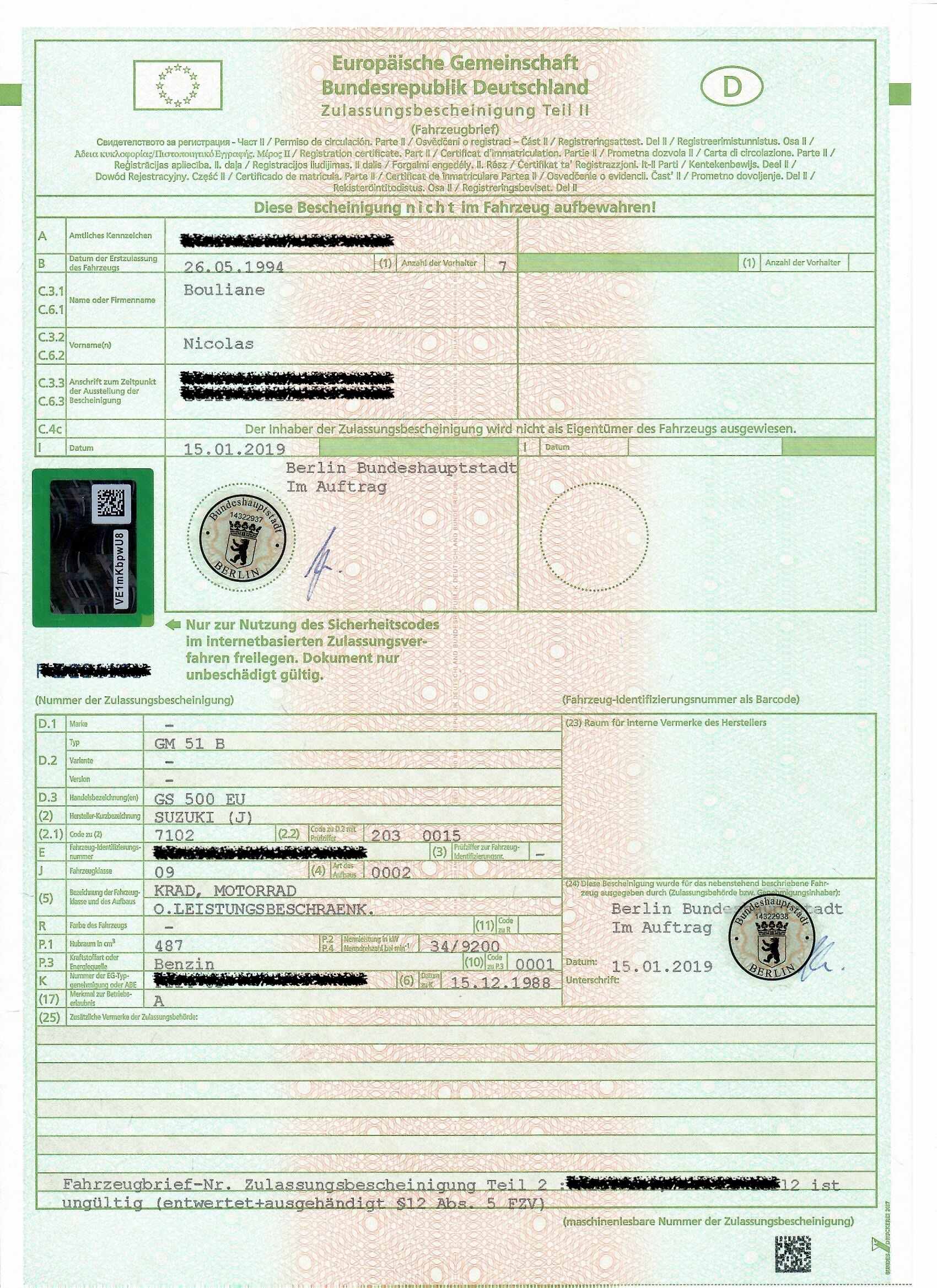
Registration certificates in the EU, Iceland, Liechtenstein and Norway follow Directive 1999/37/EC. They carry the registration number, the registered person's details, the VIN, engine data and emissions information. National rules decide whether the certificate comes in one part or two.
- Part I identifies the car and its holder. Your Europe, the EU's official guide, notes that Part I is enough to carry when you drive, including abroad.
- Part II, where it exists, stays at home. In Germany it is the Zulassungsbescheinigung Teil II, the successor of the old Fahrzeugbrief. When a car is leased or financed, the lender often keeps it: ADAC notes that with leasing, the leasing company keeps Part II while the driver is registered as holder in Part I.
Your Europe also says that other EU countries must recognise the certificate. When you re-register a car abroad you hand in the original, both parts if there are two. A seller who offers only Part I, or only copies, cannot give you a car you can register.
While you have the certificate in your hand, compare the VIN with the number on the car itself. Then check it with our VIN decoder, and compare the decoded version with the specification on our specs pages. ADAC also advises checking the number of previous owners recorded in the registration document.
UK buyers: the V5C logbook
In the UK the registration certificate is the V5C, commonly called the logbook. It is issued by the DVLA and names the registered keeper, who is not necessarily the legal owner. GOV.UK explains the sale:
- the seller tells the DVLA online or by post, and the DVLA sends the new V5C to the buyer;
- a buyer who did not receive a logbook must apply for one with form V62;
- vehicle tax is not transferred: you must tax the car before driving it, or declare it off the road (SORN).
Check the MOT history online with the registration number before you travel. It shows the result and the mileage of every test since 2005.
The purchase contract: what to write in it
ADAC points out that a verbal agreement, or one made by WhatsApp, is already a binding contract in Germany. That is a reason to put everything in writing, not a reason to skip the paperwork. Motoring clubs publish free templates. Whichever you use, make sure it contains:
- full names, addresses and ID numbers of seller and buyer;
- make, model, VIN, registration number and date of first registration;
- the total mileage, not just the odometer reading. ADAC says that if this figure turns out to be false, the buyer can withdraw from the purchase;
- the accident status, in the seller's words ("accident-free", or a description of known damage);
- the number of keys and any extras included, such as a second set of wheels;
- the price, the payment method, and the date and exact time of handover, which settles who is liable for fines and damage afterwards;
- for a private sale, any liability exclusion the seller wants, in plain words. ADAC notes that a private seller may exclude liability for hidden defects, but must still disclose accident damage they know about;
- both signatures.
Sign only after the inspection and test drive, and only once the seller's identity and the ownership are clear.
Service history: stamps are not enough
A full stamped service book sounds reassuring, but ADAC warns that "scheckheftgepflegt" (a stamped book) does not prove every job was done. If a dealer cannot hand over the original service book, the dealer must say so, otherwise it counts as a defect; if the dealer cannot prove the inspections were carried out, you can ask for a lower price.
Invoices are better evidence than stamps, because they list the work, the date, the mileage and the VIN. Put the readings in order: they must always rise. If they fall, read our guide to spotting mileage fraud before going further.
Extra papers for an imported car
Buying abroad adds three documents to the list.
- Certificate of conformity. Issued by the manufacturer, it confirms the car meets EU safety and environmental standards. Your Europe states that an EC certificate is valid in all EU countries, and authorities cannot ask for further technical documents unless the car has been modified. Belgium's Car-Pass recommends getting the COC with the car; if it is missing, the brand's importer in your country can usually supply one.
- Proof of VAT status. Authorities may check that VAT was paid correctly. Dealer invoices should show the dealer's VAT number. For VAT purposes, a car counts as new if it has covered no more than 6,000 km or was supplied within six months of first registration, and VAT on a new car is due in the country where you register it.
- Proof of roadworthiness from the export country. Your Europe says this is recognised even when the owner changes, although many countries still carry out their own technical check before registration.
Temporary plates are not harmonised across the EU, so plan the journey home before you pay.
Paperwork red flags
- Copies instead of originals, or a Part II "still at the bank".
- A seller whose name is not on the registration certificate, or who is "selling for a friend". ADAC warns that some dealers sell cars on behalf of the previous owner to avoid warranty obligations; ask the owner directly whether the sale is authorised.
- A VIN that differs by one character between the car and the papers.
- A duplicate certificate issued shortly before the sale, with no clear reason.
- A service book full of stamps and no invoices.
- A seller who will not write accident status or total mileage into the contract.
Any of these is a reason to pause. If you are still choosing a car, start with ones whose history is easy to prove: our car finder filters by body, fuel and size, and the cost of ownership calculator shows what overdue servicing adds to the yearly bill.
Try our calculator
Cost of ownership calculatorFAQ
Is the registration certificate proof of ownership?
Not always. It proves registration and names the holder or keeper, who may not be the owner. Your Europe notes that you may be asked to prove legal ownership separately, for example with the purchase invoice. In countries with a two-part certificate, Part II is usually treated as the ownership document, so make sure you receive the original.
What is a certificate of conformity and do I need one?
It is a manufacturer's document confirming that the car matches an EU type approval. You rarely need it for a car already registered in your own country, but it makes registering an import much simpler, because an EC certificate is valid in every EU country.
What if the seller has lost the V5C?
In the UK, the buyer can apply for a new registration certificate with form V62. Treat a missing logbook as a warning, though: ask why it is missing, check the MOT history and run a history check before you pay.
Do I need a written contract for a private car sale?
Legally, a verbal agreement can be binding, as ADAC notes for Germany. In practice you need a written contract, because it is your only proof of the mileage, accident status and extras the seller promised, and of the time the car changed hands.
Can I drive a used car home straight after buying it?
Only if it is insured for you and legally registered and, in the UK, taxed in your name, because tax does not transfer with the car. For a car bought abroad you usually need temporary plates or transport on a trailer, since temporary plates are not recognised everywhere in the EU.
Sources
- Your Europe (European Union): Car registration documents and formalities (accessed 22 Oct 2026)
- Your Europe (European Union): VAT when buying or selling a car (accessed 22 Oct 2026)
- Your Europe (European Union): Buying and leasing a car in another EU country (accessed 22 Oct 2026)
- Wikipedia: Vehicle registration certificate (Directive 1999/37/EC, UK V5C) (accessed 22 Oct 2026)
- GOV.UK: Tell DVLA you've sold, transferred or bought a vehicle (accessed 22 Oct 2026)
- GOV.UK: Check the MOT history of a vehicle (accessed 22 Oct 2026)
- ADAC: Auto gebraucht kaufen, worauf Sie achten sollten (contract, service book, agency sales) (accessed 22 Oct 2026)
- ADAC: Leasing, so funktioniert die Auto-Miete auf Zeit (Part II kept by the leasing company) (accessed 22 Oct 2026)
- Car-Pass: Importing a vehicle from abroad, useful tips when purchasing (accessed 22 Oct 2026)
Found a mistake? Report an error