AdBlue Explained: What It Is, How Much You Use and the Warning Lights
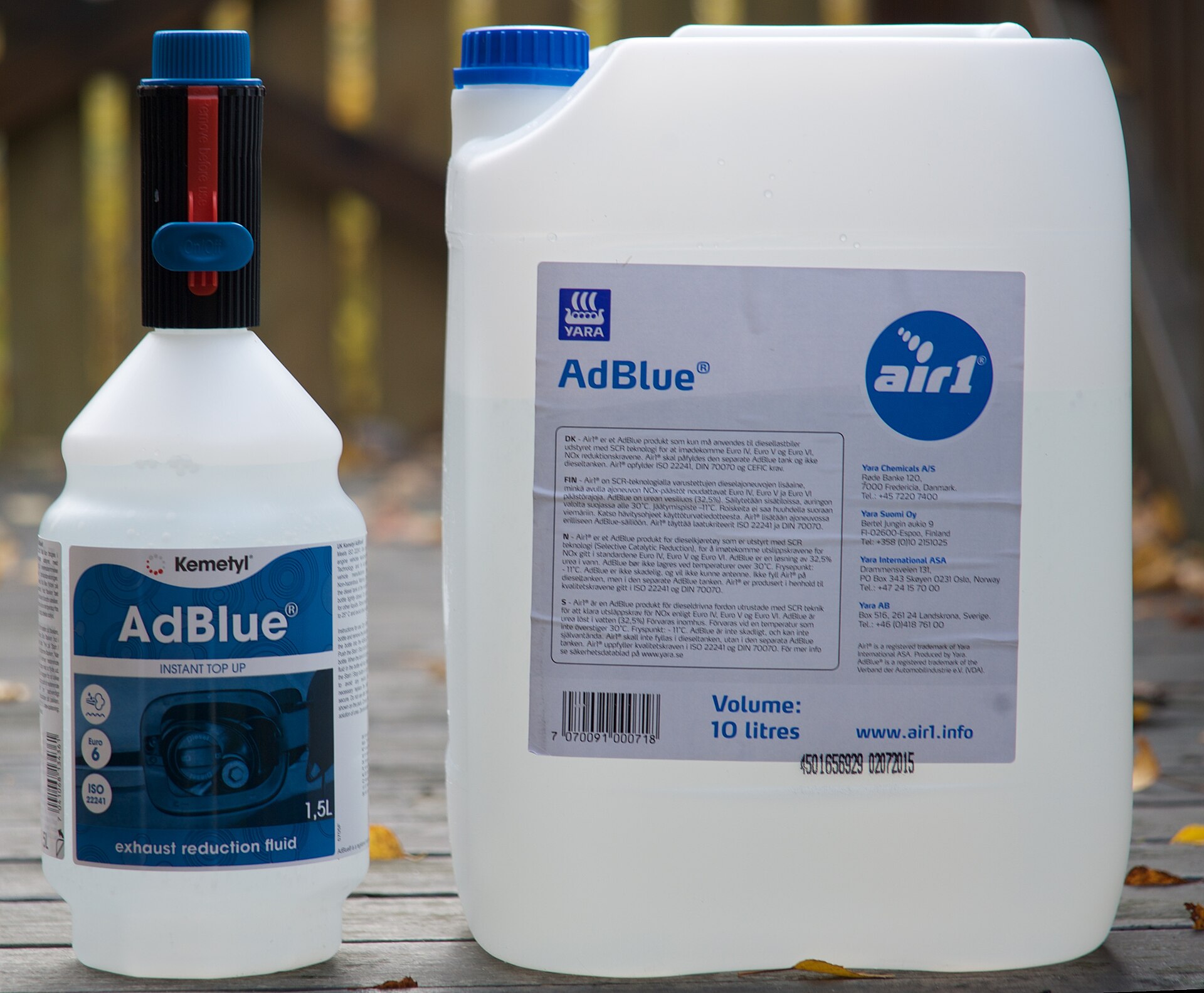
AdBlue is a clear liquid made of 32.5 % urea and 67.5 % deionised water that modern diesel cars inject into the exhaust to cut nitrogen oxides (NOx). It goes into its own tank, usually behind a blue cap next to the fuel filler or in the boot, never into the diesel tank. A car uses about 2 to 6 % as much AdBlue as diesel, which works out at roughly 1 to 3 litres per 1,000 km for a typical car. The warnings start early, but if the tank runs dry the engine will not restart until you refill it.
Key takeaways
- AdBlue is a registered trademark of the German automotive industry association VDA; the standard name is AUS 32, defined in ISO 22241.
- Consumption is typically 2 to 6 % of diesel use, so most cars need a refill every 5,000 to 15,000 km.
- Volkswagen shows a white warning at about 2,400 km of AdBlue range and an amber one at about 1,600 km; at the red stage the car will not restart once switched off.
- AdBlue freezes at −11 °C, but EU Euro 6 rules require the system to work within 20 minutes after a cold start at −15 °C.
What AdBlue is and why diesels need it
Diesel engines burn with excess air and produce nitrogen oxides, which the strict Euro 6 limits do not allow in large amounts. Most modern diesels therefore use selective catalytic reduction (SCR). The car sprays a measured amount of AdBlue into the exhaust ahead of a special catalyst.
In the hot exhaust, the urea breaks down into ammonia and carbon dioxide. In the catalyst, the ammonia reacts with nitrogen oxides and turns them into nitrogen and water. The reaction works best at about 200 to 350 °C, which is one reason SCR systems control dosing carefully.
| Property | AdBlue (AUS 32) |
|---|---|
| Composition | 32.5 % urea, 67.5 % deionised water |
| Standard | ISO 22241 |
| Trademark | AdBlue, registered by VDA |
| Freezing point | −11 °C |
| Decomposes from | About 60 °C |
| Typical dosing | 2 to 6 % of diesel consumption |
AdBlue is not a fuel additive. It never mixes with the diesel and it does not affect power. If it runs out, the car simply refuses to restart; Volkswagen describes this as a required feature of the system, not a fault.

How much AdBlue does a car use?
Wikipedia puts dosing at typically 2 to 6 % of diesel consumption, depending on the system; the rental company Enterprise quotes 3 to 5 % for its fleet. Your own figure depends on the system and on how much diesel the car burns.
Here is what that means per 1,000 km, worked out from the 2 to 6 % range:
| Diesel consumption | Diesel per 1,000 km | AdBlue at 2 % | AdBlue at 6 % |
|---|---|---|---|
| 4.5 l/100 km (small car) | 45 litres | 0.9 litres | 2.7 litres |
| 6 l/100 km (family car) | 60 litres | 1.2 litres | 3.6 litres |
| 8 l/100 km (large SUV or van) | 80 litres | 1.6 litres | 4.8 litres |
Tank sizes vary a lot. Enterprise lists 8 to 33 litres across its rental cars, which is why some cars need AdBlue every 5,000 km and others go 15,000 km or more. Your handbook gives the tank size; the trip computer usually shows the remaining AdBlue range.
To see how fuel itself compares on cost, use the fuel cost calculator with your real consumption figure.
AdBlue warning lights: what each stage means
Every brand uses its own symbols and thresholds, so check the handbook. Volkswagen's UK owner pages give a clear example of how the stages work:
| Stage (Volkswagen) | When it appears | What to do |
|---|---|---|
| White message | About 1,500 miles (about 2,400 km) of AdBlue range left; repeats every 62 miles (about 100 km) | Plan a refill |
| Amber warning | About 1,000 miles (about 1,600 km) left; repeats every 31 miles (about 50 km) with a tone | Refill soon |
| Red warning | Amber warnings ignored, range used up | The car will not restart after switching off until it is topped up |
Volkswagen stresses that the red stage "is not a fault, but a required feature of the system". It also says the system then needs a full top-up before the car will restart, so carry enough to fill the tank, not just a few litres.
A different message, such as "AdBlue system fault" or "check emissions system" with a full tank, points to a technical problem rather than an empty tank. Have the fault codes read by a garage before the countdown to the no-start stage runs out.
How to refill AdBlue
- Find the right filler. It is usually a blue cap next to the diesel filler or under the boot floor. The handbook shows the location.
- Use fluid to ISO 22241. Containers and pumps carry the AdBlue name or the AUS 32 marking with the standard number.
- Fill up properly. Volkswagen says a full top-up is needed after the red warning, and the handbook gives the tank size.
- Wipe up spills. Urea corrodes aluminium, so do not leave it on metal parts.
- Check the display. If the warning does not clear after a full top-up, ask a garage to read the fault memory.
AdBlue is sold at fuel stations and in canisters at DIY stores, car accessory shops and garages, and sometimes at discount stores, according to Enterprise.
Storage, freezing and contamination
- Freezing: AdBlue freezes at −11 °C. Cars thaw it with coolant or electric heaters, and Euro 6 rules under Regulation (EC) No 692/2008 require the fluid to be available within 20 minutes when starting at −15 °C with a frozen tank.
- Heat: it starts to decompose at around 60 °C. Store canisters in a cool, dry, ventilated place out of direct sunlight, not in a hot boot all summer.
- Containers: because urea corrodes aluminium, keep AdBlue in its original plastic or stainless container.
- Cleanliness: as a precaution, use the canister's own spout rather than a funnel or can used for fuel or oil.
If you accidentally pour AdBlue into the diesel tank, or diesel into the AdBlue tank, do not start the engine. Call your breakdown service or dealer and have the tank drained.
Which cars use AdBlue?
Not every diesel uses SCR, so check the handbook. A second filler cap marked AdBlue, or an AdBlue range in the trip computer, tells you the car has it. Petrol cars, hybrids with petrol engines and electric cars do not use it.
If you are choosing between fuel types, AdBlue is a small extra running cost on top of diesel, servicing and the particulate filter that every modern diesel also has. Our petrol vs diesel fuel cost comparison shows when the lower fuel consumption still pays off, and the diesel car pages list the models in the catalogue.
Try our calculator
Fuel cost calculatorFuel cost comparisonFAQ
What happens if AdBlue runs out?
The engine keeps running until you switch off, but it will not restart until the tank is refilled. Volkswagen calls this a required feature of the system, not a fault. Warnings appear well before that point, starting at about 2,400 km of range on Volkswagen models.
How often do I need to refill AdBlue?
Most cars need a refill every 5,000 to 15,000 km, depending on tank size and driving. Typical use is about 1 to 3 litres per 1,000 km for a car using 5 to 6 litres of diesel per 100 km.
Where can I buy AdBlue?
At fuel stations and in canisters at DIY stores, car accessory shops and garages. Look for the AdBlue name or the AUS 32 marking with ISO 22241 on the container.
Does cold weather affect AdBlue?
AdBlue freezes at −11 °C, but cars thaw it with heaters, and Euro 6 rules require the fluid to be available within 20 minutes after a start at −15 °C.
Can I drive without AdBlue?
No. Once the range reaches zero, the car will not restart after you switch it off. Refill before the red warning so you are never stranded.
Sources
- Wikipedia: Diesel exhaust fluid (accessed 23 Oct 2026)
- Volkswagen UK: Recharge AdBlue warning light (white) (accessed 23 Oct 2026)
- Volkswagen UK: Recharge AdBlue warning light (amber) (accessed 23 Oct 2026)
- Enterprise Switzerland: AdBlue help centre (accessed 23 Oct 2026)
Found a mistake? Report an error