
Engine Temperature Warning: Safe Steps, Causes and Head Gasket Signs
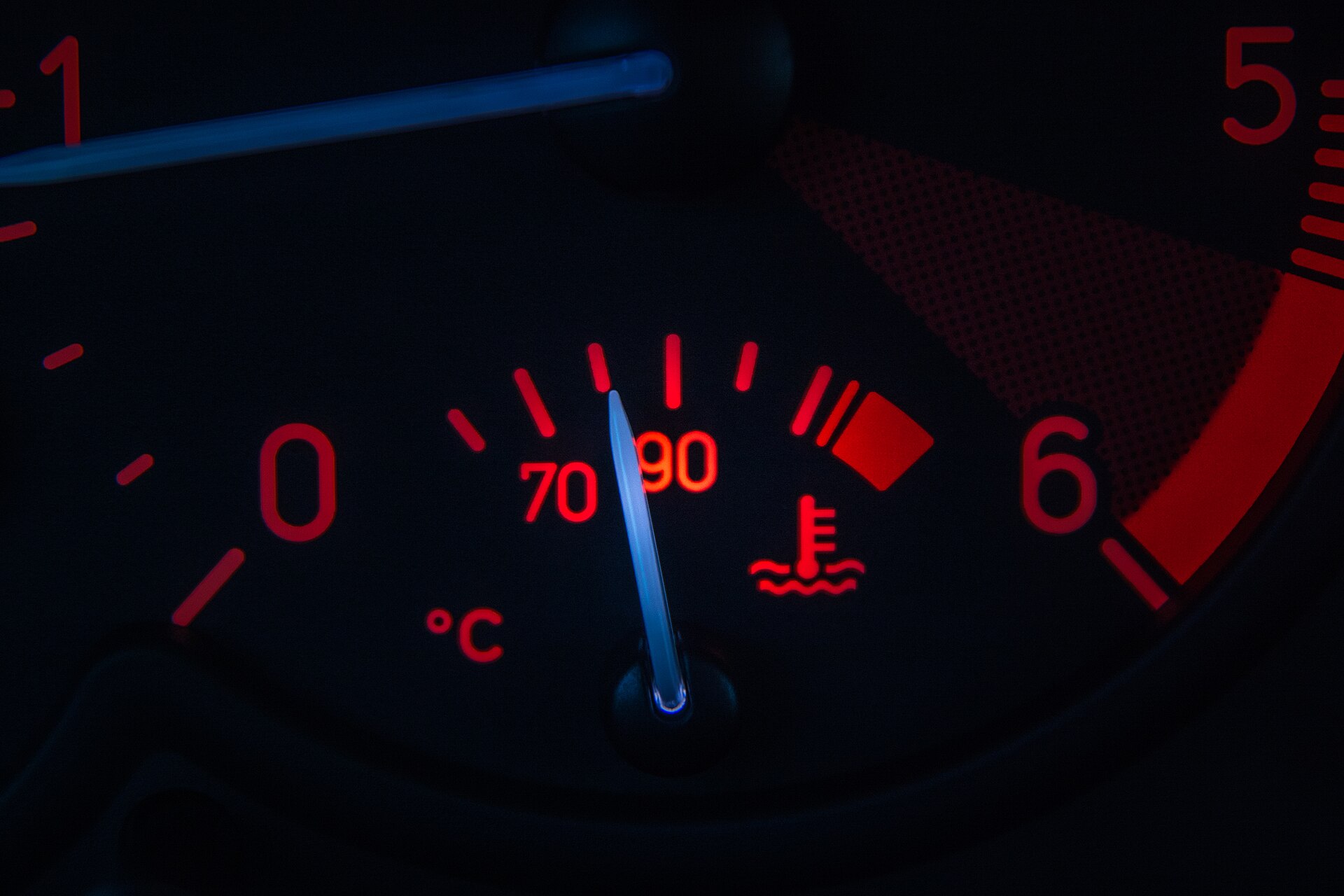
If the engine temperature warning comes on, pull over as soon as it is safe, switch the engine off and let it cool for at least 30 minutes before touching anything under the bonnet. Never open the coolant cap on a hot engine: the system is under pressure and can spray scalding coolant. Most overheating comes from coolant loss, a stuck thermostat, a failed water pump or cooling fan, and the cheapest repair is the one done before the head gasket goes.
Key takeaways
- A red coolant temperature light means stop: the ADAC advises not to drive on until the cooling system has been checked (June 2026).
- Wait at least 30 minutes, better an hour or more, before opening the bonnet fully or the expansion tank (RAC, February 2026).
- Check the level only on a cold engine; it should sit between the MIN and MAX marks.
- A thermostat costs EUR 150-500 to replace at a garage (Auto Bild, May 2026); a head gasket EUR 500-1,500 at an independent and up to EUR 2,500 at a dealer (Auto Bild, December 2025).
- White exhaust smoke, bubbles in the expansion tank or a coolant level that keeps dropping with no visible leak point to the head gasket.
What to do when the temperature warning comes on
Modern cars often have no temperature gauge, only a warning light or a message, so treat any coolant warning seriously. Follow this order:
- Ease off and look for a safe place to stop. On a motorway, take the next exit or a service area if the car still drives normally. If steam is pouring out or the engine loses power, stop on the hard shoulder or emergency lane.
- Hazard lights on, engine off. Put on a high-visibility vest before leaving the car and get all passengers out, away from traffic and behind a barrier where there is one. Set up the warning triangle where it is safe to do so.
- Open the bonnet only if there is no heavy steam, and protect your hand; the release and the bonnet edge can be very hot.
- Wait. The RAC's February 2026 advice is at least 30 minutes and ideally an hour or two before touching the cooling system.
- Check the coolant level once the engine is cold (see the next section), and look under the car for a puddle or drips.
- Decide whether to drive on or call for help (see the section on when to stop).
If the gauge creeps up in traffic but no warning has come on yet, switching the heater to full heat and full fan pulls some heat away from the engine. The RAC lists this as a temporary measure only; it buys a few minutes to reach a safe stopping place.
A warning light that comes back soon after the engine has cooled down points to a fault in the cooling system that needs a garage, according to the RAC.
How to check the coolant safely
The ADAC's June 2026 guide gives the rules: only check or top up coolant with the engine cold. When it is hot, the system is pressurised, and opening the cap can cause scalding. Pouring cold liquid into a hot engine can also crack components.
- Find the expansion tank. It is usually white or translucent plastic and carries a warning symbol for scalding.
- With the engine cold, read the level against the MIN and MAX marks. It should be between them.
- If you must open the cap, cover it with a thick cloth and turn it slowly to the first stop so any remaining pressure escapes before removing it.
- Top up with the coolant type specified in the handbook. The ADAC warns that coolants may only be mixed in a limited way and that G11 and G12 must not be mixed at all.
- In an emergency, if no suitable coolant is available, add water, ideally distilled, and have the mixture corrected later.
- If the level drops again soon after topping up, the ADAC says there is a defect; book a leak test.
A full system holds roughly 5 to 10 litres, and concentrate is normally mixed about 1:1 with distilled water, and the ADAC says frost protection should reach at least minus 25 °C in Central Europe (2026). A level above MAX also needs a check, because exhaust gas or oil entering the coolant can push it up.

Causes of overheating
The table lists the common causes, the signs that point to each one and the usual fix.
| Cause | Typical signs | What usually helps |
|---|---|---|
| Coolant leak (hoses, clamps, radiator, expansion tank) | Coloured drips under the car, sweet smell in the cabin, level keeps dropping | Find and fix the leak, refill and bleed the system |
| Thermostat stuck closed | Temperature rises quickly, top radiator hose stays cool while the engine is hot | Replace thermostat and refill |
| Water pump failure | Coolant weeping from the pump area, whine or grinding from the belt end of the engine, rapid overheating | Replace pump, often with the timing belt |
| Cooling fan not running | Overheats in traffic or at low speed, normal on the open road | Check fuse, relay, fan motor and temperature sensor |
| Blocked or damaged radiator | Overheats under load or in hot weather; bent fins, debris or internal deposits | Clean the front of the radiator or replace it |
| Air in the system after a repair | Temperature swings, gurgling, heater blowing cold | Bleed the system as the manufacturer specifies |
| Head gasket failure | White exhaust smoke, bubbles in the tank, coolant loss without drips, mayonnaise under the oil cap | Diagnosis and head gasket replacement |
Auto Bild's September 2026 guide names porous hoses, leaking clamps, a damaged radiator, a leaking expansion tank and a worn water pump as the main sources of coolant loss, with a failed head gasket as the rarer and more serious one. Marten chewing through hoses is a known cause in Germany, as the ADAC notes. Low engine oil can also make an engine run hotter, the RAC points out, so check the dipstick at the same stop.
On engines with a timing belt, the water pump is often driven by the belt and is replaced with it. The guide to timing belt vs timing chain explains how to tell which one your engine uses.

Head gasket signs and the test
Overheating is the main cause of head gasket failure, Auto Bild explained in December 2025, typically after a water pump failure, a low coolant level or a faulty thermostat. Driving on with an overheating engine can then damage the cylinder head itself, the bearings and the pistons.
Signs that the gasket has failed:
- white exhaust smoke with a sweet smell from burning coolant;
- coolant loss with no visible leak;
- bubbles in the expansion tank with the engine running;
- a milky, mayonnaise-like layer in the oil or foam in the coolant;
- rough running, a fan that runs constantly and repeated overheating.
A garage, or a careful owner, can confirm it with a combustion gas test. Auto Bild puts a block tester kit at about EUR 15-40 in 2025. A fluid held above the expansion tank changes colour, usually from blue to yellow or green, if exhaust gas is present in the coolant. A compression test or a cylinder leak-down test gives a second opinion. Mayonnaise under the oil filler cap alone is not proof: short trips in cold, damp weather can produce condensation that looks similar.
A failed head gasket should not be driven on. Coolant in the oil destroys the bearings, and each further overheat can warp the cylinder head, which raises the repair bill.
What repairs cost
Prices depend heavily on the engine and whether the timing belt has to come off.
| Repair | Typical cost | Source |
|---|---|---|
| Coolant change at a workshop | EUR 80-180 | Auto Bild, September 2026 |
| Thermostat, small car | EUR 150-250 | Auto Bild, May 2026 |
| Thermostat, mid-size car | EUR 200-350 | Auto Bild, May 2026 |
| Thermostat, large car or SUV | EUR 300-500 | Auto Bild, May 2026 |
| Water pump without timing belt | about EUR 300 | Auto Zeitung, October 2025 |
| Head gasket, independent garage | EUR 500-1,500 | Auto Bild, December 2025 |
| Head gasket, main dealer | EUR 1,000-2,500 | Auto Bild, December 2025 |
A new radiator cost a high three-digit sum in Auto Bild's September 2026 overview, and a water pump changed with the timing belt costs noticeably more than the pump alone, according to Auto Zeitung in October 2025. Head gasket parts are only about EUR 100-300 of the bill in 2025 figures; the rest is 5-15 hours of labour, plus machining if the head is warped.
When to drive on and when to call for help
The ADAC's June 2026 advice draws the line clearly. If the red coolant light is on, do not drive on. If the engine has overheated but there is still enough coolant in the tank once it has cooled, you may drive slowly at low revs to the nearest workshop, watching the gauge and warning lights all the time.
Call for roadside help and do not restart the engine when:
- the expansion tank is empty or the level falls again straight after topping up;
- the warning returns within a few minutes of restarting;
- there is heavy steam, white smoke from the exhaust or a smell of burning;
- the oil warning light comes on as well;
- the engine knocks, runs roughly or has lost power.
Driving on with an overheated engine risks the cylinder head, the crankshaft and camshaft bearings and, in the worst case, a seized piston (Auto Bild, September 2026). A tow costs far less than any of those repairs. The check engine light guide explains how to read other warning lights that may appear with overheating, such as a misfire or sensor fault.
How to prevent overheating
- Check the coolant level on a cold engine once a month and before long summer trips, as Auto Bild advises.
- Change coolant at the interval in the handbook. The ADAC considers a change sensible after about 100,000 km in any case, and many experts suggest every three to five years even with long-life coolant (Auto Bild, 2026).
- Use only the coolant specification the manufacturer approves and do not top up with plain water for long.
- Replace the water pump with the timing belt where the pump is belt-driven.
- Keep the front of the radiator free of leaves, insects and stone damage.
- Watch for drips under the car and a sweet smell in the cabin; both point to a leak.
- Have the cooling system pressure-tested at the next service if the level drops.
Coolant checks are part of the interim and full service items in the car service schedule. When buying a used car, the used car inspection checklist shows where to look for signs of an earlier overheat.
FAQ
Can I drive with the engine temperature warning on?
No, not with the red warning on. Stop safely, switch off and let it cool. If the coolant level is fine after cooling, the ADAC says you may drive slowly to a workshop while watching the gauge. If the warning returns, call for help.
How long should I wait before opening the coolant cap?
At least 30 minutes, and preferably an hour or two, the RAC advises. Even then, open it slowly with a thick cloth over the cap. Checking the level against the MIN and MAX marks on the tank does not require opening it at all.
Can I top up coolant with water?
In an emergency, yes. The ADAC suggests distilled water if no approved coolant is available. Plain water reduces frost and corrosion protection, so have the mixture corrected soon, and never pour cold water into a hot engine.
How do I know if the head gasket has gone?
Typical signs are white, sweet-smelling exhaust smoke, coolant loss without drips, bubbles in the expansion tank and a milky deposit in the oil. A combustion gas test on the coolant confirms it; a block tester kit cost about EUR 15-40 in 2025.
Why does my car overheat only in traffic?
Usually because the cooling fan is not switching on. At speed, air flowing through the radiator is enough, but in queues the engine depends on the fan. Check the fuse, the relay and the fan motor, then the temperature sensor.
Sources
- ADAC: Kuehlfluessigkeit kontrollieren und nachfuellen (12.06.2026) (accessed 5 Nov 2026)
- RAC Drive: What should I do if my car is overheating? (03.02.2026) (accessed 5 Nov 2026)
- Auto Bild: Kuehlmittel und Motorkuehlung beim Auto (08.09.2026) (accessed 5 Nov 2026)
- Auto Bild: Thermostat defekt, Motorprobleme und Kuehlung (01.05.2026) (accessed 5 Nov 2026)
- Auto Bild: Defekte Zylinderkopfdichtung pruefen und wechseln (05.12.2025) (accessed 5 Nov 2026)
- Auto Zeitung: Wasserpumpe im Auto, Funktion, Defekte und Wechsel (31.10.2025) (accessed 5 Nov 2026)
Found a mistake? Report an error


