Used Car Inspection Checklist: What to Check Before You Buy
A used car inspection comes down to 40 checks in six areas. They cover papers and identity, bodywork, tyres and brakes, the engine bay with the engine cold, and the interior and electronics. The last area is a test drive of at least 20 minutes. Work through them in that order, write down every fault, and use the list either to walk away or to negotiate the price. Anything you cannot judge yourself, such as the underbody or the fault memory, belongs to a professional check.
Key takeaways
- Arrange the viewing in daylight and ask the seller not to start the engine before you arrive.
- Papers first: if the VIN, the registration document and the seller's identity do not match, stop there.
- Wear on the pedals, steering wheel and driver's seat must fit the claimed mileage.
- A professional pre-purchase check cost from €89 to €259 at ADAC test centres in 2026, depending on depth and membership.
What to bring to the viewing
Take a torch, a small magnet or paint-thickness gauge, kitchen roll and gloves. A tread-depth gauge or a coin with a known border width helps with the tyres. Bring a second person, ideally one who knows cars, and this checklist on your phone.
An OBD diagnostic reader is worth taking if you have one. Cheap Bluetooth readers show stored fault codes that a cleared dashboard does not.
Papers and identity (checks 1–7)
- The VIN on the car (base of the windscreen, door pillar, stamped in the body) matches the registration document. Our VIN decoder shows what the number itself says about the car.
- The registration documents are originals, not copies; where your country uses two parts, ask to see both.
- The seller is the registered keeper, or can prove why not.
- The service book has stamps, dates and mileages that rise steadily; invoices back them up.
- Inspection reports (MOT, TÜV/HU, ITV, contrôle technique) show a mileage that never falls.
- The number of previous owners fits the car's age. ADAC advises asking questions when there were many or when someone kept the car only briefly.
- Two keys are present and both work; recalls and campaign work have been done.
Bodywork and glass (checks 8–15)
| Check | What to look for | Red flag |
|---|---|---|
| 8. Panel gaps | Even gaps around bonnet, doors and boot lid | Wide or uneven gaps: panel replaced or chassis repaired |
| 9. Paint | One shade, same gloss on all panels | Colour mismatch, overspray on rubber seals or glass |
| 10. Paint thickness | Similar readings on every panel | Much thicker readings: filler under the paint |
| 11. Rust | Sills, wheel arches, door bottoms, boot floor | Bubbling or soft metal in sills and jacking points |
| 12. Underbody | Dry, no fresh underseal patches | Fresh underseal hiding corrosion or welds |
| 13. Glass | Same brand and date code on all windows | Chips in the driver's view, mismatched glass |
| 14. Lights | Clear, matching headlights with no condensation | One new headlight: possible front-end impact |
| 15. Bolts | Untouched paint on wing and bonnet bolts | Spanner marks: panels have been removed |
Tyres, wheels and brakes (checks 16–20)
| Check | What to look for | Red flag |
|---|---|---|
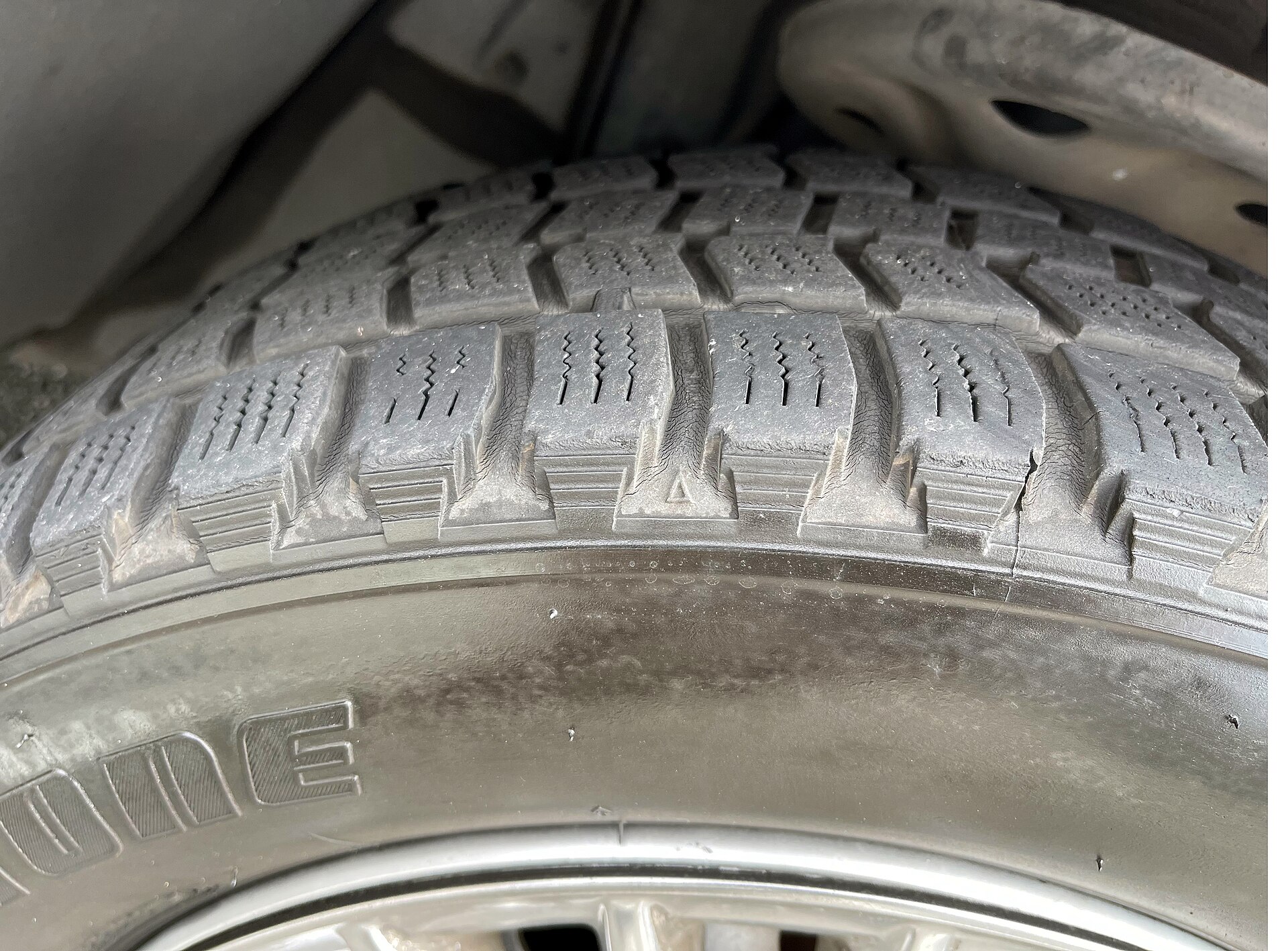
| 16. Tread depth | At least about 3 mm; 1.6 mm is the legal minimum in most of Europe | Wet grip falls off well before the legal limit: budget for new tyres |
| 17. Wear pattern | Even wear across each tyre | Wear on one edge: alignment, worn suspension or accident damage |
| 18. Brand and age | Matching brand and pattern per axle, tyres no older than about six years | DOT code (week and year on the sidewall) showing old rubber |
| 19. Brakes | Discs without a deep lip at the edge, pads with material left | Deep lip, scoring or vibration |
| 20. Wheels | Alloys free of cracks and heavy kerb damage, spare wheel or repair kit present | Cracked rim, missing kit |
If the car wears a non-standard tyre size, check the alternatives with our tyre size calculator.
Under the bonnet, engine cold (checks 21–28)
- The engine is cold to the touch. If it is warm, ask why.
- Oil level between the marks and oil that is not black sludge. The UK buyer's guide Carbuyer warns that white or light-brown, mayonnaise-like deposits under the oil cap can mean a failed head gasket.
- Coolant at the right level, clear and not oily.
- No fresh oil, coolant or gearbox fluid leaks on the engine or the ground beneath it.
- Belts free of cracks; check the service book for the timing belt change if the engine has one.
- A cold start without long cranking, rattles or clatter that lasts more than a few seconds.
- Exhaust smoke: a brief puff at start-up is normal; persistent blue (oil), white (coolant) or black (fuel) smoke is not.
- All warning lights come on with the ignition and go out once the engine runs.
Interior and electronics (checks 29–34)
- Wear on the steering wheel, gear knob, pedal rubbers and driver's seat bolster fits the mileage. carVertical, a vehicle history provider, lists pedal and steering wheel wear among the main signs of a rolled-back odometer.
- No damp carpets, musty smell or water marks in the boot: leaking seals or flood damage.
- Air conditioning blows cold within a minute; heater and fan work on every setting.
- Windows, mirrors, central locking, seat adjusters and infotainment all work.
- The mileage on the instrument cluster matches the last service record and any oil-change sticker.
- Airbag warning light behaves normally and the seat belts retract smoothly.
Test drive checklist (checks 35–40)
- The clutch bites in the middle of the pedal travel, without slipping when you accelerate in a high gear.
- Gear changes are clean on a manual; an automatic or dual-clutch box shifts smoothly, hot and cold, without jerks or delays. Our guide to ZF gearboxes explains how the main automatic types behave.
- The car runs straight, and the steering wheel is centred at speed.
- Braking from speed is straight and free of vibration through the pedal or wheel.
- No knocks over bumps, no droning that changes with speed (wheel bearings), no whine under load.
- After the drive: no new warning lights, no smell of hot oil or coolant, temperature gauge in the normal range. On a diesel, ask whether the car regularly makes longer runs; the AA notes that short trips stop the particulate filter from regenerating.
When to book a professional inspection
Some faults only show on a lift or a diagnostic tester. The TÜV-Report 2026 is based on 9.5 million German roadworthiness tests. It found that 21.5% of cars had significant defects, with lighting, brakes and drivetrain the most common problems. The defect rate climbs steeply with age. It ranges from 2.9–17.3% for cars up to three years old to 18.3–40.4% for cars up to 13 years old, depending on the model.
That makes an independent check worthwhile for any car with real money at stake. In 2026, ADAC test centres in Köln and Oberhausen charged from €139 (members) or €179 (non-members) for a basic check with fault memory readout. In 2026 a version with engine test, test drive and bodywork check cost from €169 or €199. The 2026 premium check with exhaust and oil analysis started at €219 or €259. Other ADAC centres priced it by vehicle class, from €89 to €149 for members in 2026.
Before you book, read the model's known weak points on its engine page and compare versions in the specs section. Then the inspector knows what to look for. If you are still choosing a model, start with our list of the most reliable used cars.
Walk-away signals
Some findings end the viewing, whatever the price. Skip it if the VIN, documents or seller's identity do not match. The same goes for mileage that falls between two records, or a service history with large unexplained gaps.
Fresh underseal, welding or filler in the sills or chassis legs is another reason to leave. So are overheating, mayonnaise under the oil cap or white smoke that does not clear. Finally, walk away from a seller who refuses an independent inspection or pushes for a quick deposit.
Try our calculator
Cost of ownership calculatorTyre size calculatorFAQ
How long does a used car inspection take?
Allow 45 to 60 minutes for your own checks and a 20-minute test drive. A professional check at a test centre usually takes about an hour, plus the time to read the report.
Should the engine be cold when I view a used car?
Yes. A cold engine shows starting problems, rattling timing chains, smoke and leaks that a warm engine can hide. If the bonnet is warm when you arrive, ask the seller why and consider coming back.
Can I check a used car myself, or do I need a mechanic?
You can do most of the 40 checks yourself and rule out bad cars early. For the car you intend to buy, a professional check adds the lift inspection, fault-memory readout and a written report you can use in negotiation.
What tread depth is acceptable on a used car?
The legal minimum is 1.6 mm in most European countries. Plan to replace tyres at about 3 mm, because braking in the wet suffers below that. Also check the tyre age code: rubber hardens with time even when the tread looks fine.
Which faults should stop me buying immediately?
Mismatched identity numbers, clocked mileage, structural rust or hidden accident repairs, and signs of a failed head gasket. These are either illegal, unsafe or so expensive that no discount covers the risk.
Sources
- ADAC: Auto gebraucht kaufen, worauf Sie achten sollten (accessed 21 Oct 2026)
- Carbuyer: Used car buying checklist, simple checks for used car buyers (accessed 21 Oct 2026)
- TÜV Rheinland: TÜV-Report 2026 press release (accessed 21 Oct 2026)
- ADAC Nordrhein: Technische Prüfzentren, Gebrauchtwagen-Check prices (accessed 21 Oct 2026)
- carVertical: How to detect an odometer rollback (accessed 21 Oct 2026)
- The AA: Diesel particulate filters, cleaning and problems (accessed 21 Oct 2026)
Found a mistake? Report an error