When to Replace Tyres: Tread Depth, Tyre Age and the DOT Code
Replace summer tyres at about 3 mm of tread and winter or all-season tyres at about 4 mm, well before the legal minimum of 1.6 mm that applies across the EU. Replace any tyre with cuts, bulges or deep cracks straight away. Plan new tyres once they reach about 10 years old for summer tyres and 8 years for winter tyres, even if tread remains, as the German automobile club ADAC recommends. The production date is in the four-digit DOT code on the sidewall: 2319 means week 23 of 2019.
Key takeaways
- Legal minimum: 1.6 mm in the main grooves for cars in the EU and the UK; several countries require 3–4 mm for winter use.
- ADAC recommends at least 3 mm for summer tyres and 4 mm for winter and all-season tyres.
- In an ADAC test, a winter tyre worn to 4 mm began to aquaplane at 63 km/h, against 87 km/h when new.
- There is no legal age limit for car tyres, but rubber hardens with time; check the DOT date when you buy.
Legal limits and recommended tread depth
New car tyres usually have 7 to 9 mm of tread, and new winter tyres up to 10 mm. As they wear, grip on dry roads changes little, but the grooves that pump water and bite into snow get shallower, and that is where worn tyres lose most.
| Tread depth | Status | What it means in practice |
|---|---|---|
| 7–10 mm | New | Full water drainage and snow grip |
| 4 mm | ADAC limit for winter and all-season tyres | Legal minimum for winter use in Austria, the Czech Republic, Croatia and Latvia |
| 3 mm | ADAC limit for summer tyres | Legal minimum for winter use in Sweden, Finland, Slovenia, Slovakia, Estonia, Lithuania and, in season, Norway |
| 1.6 mm | Legal minimum for cars in the EU and the UK | Below this the car is not roadworthy |
The UK applies the 1.6 mm minimum across the central three quarters of the tread. In Austria and the Czech Republic a winter tyre with less than 4 mm counts as a summer tyre. It does not meet the winter tyre rule there, although it is still legal in summer.
Driving on tyres below the minimum is costly. In Germany, ADAC's 2026 guidance lists a fine of €60 and one penalty point. It rises to €75 if other road users are endangered and to €90 after an accident, about €120 in total with fees in 2026. Worn tyres can also reduce your insurance cover after a crash.
What worn tread does to grip
ADAC tested the same winter tyre in size 185/60 R14 new (about 8 mm), at 7.5 mm and at 4 mm, on dry, wet and snowy roads:
| Test | New tyre (about 8 mm) | Worn to 4 mm |
|---|---|---|
| Aquaplaning starts at | 87 km/h | 63 km/h |
| Snow braking from 30 km/h | Reference | 3.2 m longer |
| Snow traction | Reference | Less than half |
| Wet braking from 80 km/h | Reference | About 7% longer |
| Dry braking | Reference | Slightly shorter |
Even at 7.5 mm, barely worn, snow traction had fallen to about 60% of the new tyre's. The dry result surprises many drivers: flatter tread blocks move less, so a worn tyre can stop a little shorter on a dry road. That is why tread depth is mainly a wet and winter safety issue, and why a tyre that feels fine in summer can be dangerous in the first rain or snow of the season.
How to check tread depth: step by step
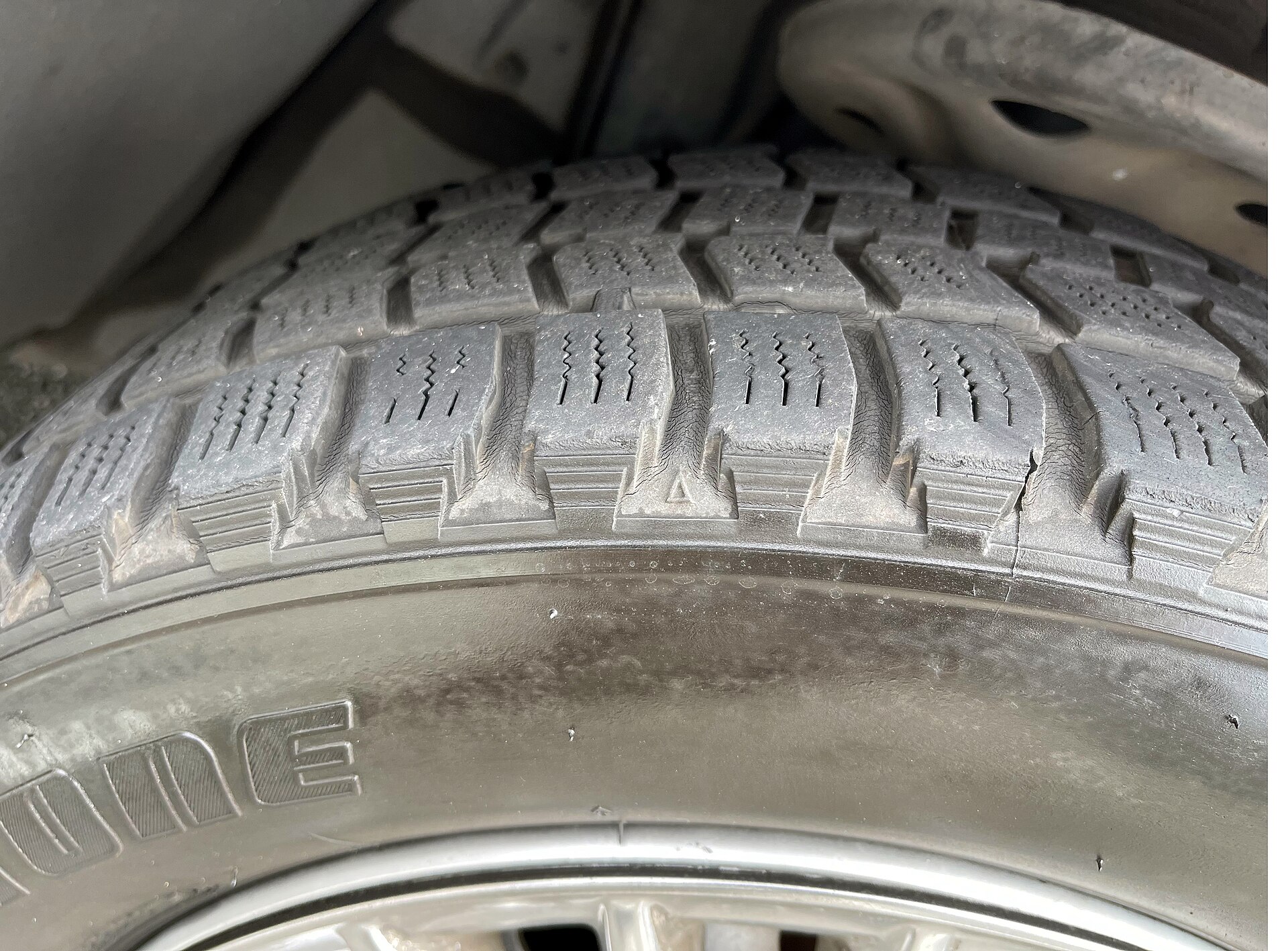
- Find the tread wear indicators (TWI). Small raised bars sit in the main grooves at six points around the tyre; small triangles or "TWI" on the shoulder show where. When the tread is level with the bars, the tyre has reached 1.6 mm.
- Measure with a tread depth gauge in the main grooves, next to the indicators, at several points across and around the tyre. Gauges are cheap and give a reading to the millimetre.
- Use a coin for a quick check. ADAC's tip: the gold rim of a 1-euro coin is just over 3 mm wide. If the rim disappears into the groove, the tread is deeper than 3 mm; if part of it shows, plan new summer tyres. UK drivers often use a 20p coin, whose outer band shows when the tread is near the legal limit.
- Look for uneven wear. If one part of the tread is much more worn than the rest, have the pressures and wheel alignment checked before fitting new tyres.
- Check several times a year, ADAC advises, and always before a long trip and before the winter season.
Tyre age and the DOT code
Rubber ages even when a tyre is not used: it hardens and becomes brittle, and cracks appear in the sidewall and between the tread blocks. There is no legal maximum age for car tyres in the EU, but ADAC recommends using winter tyres for no more than eight years and summer tyres for no more than 10 years.
The age is moulded into the sidewall at the end of the DOT code, usually in an oval:
| DOT code ending | Meaning |
|---|---|
| 2319 | Week 23 of 2019 |
| 0824 | Week 8 of 2024 |
| 4726 | Week 47 of 2026 |
| 489 (three digits) | Week 48 of a year ending in 9 — made before 2000; replace |
The code may be moulded on one side of the tyre only, so check the inside if you cannot find it. When buying new tyres, check the DOT code on delivery. Tyres that have been in a warehouse for a while are still new, but you want the most recent production you can get, especially for winter tyres that you will keep for several seasons. Our guide to choosing winter tyres covers the other sidewall markings.
Damage that means immediate replacement
Do not wait for the tread limit if you see:
- A bulge or bubble in the sidewall. The tyre's internal structure is damaged, often after hitting a kerb or pothole.
- Cuts or cracks deep enough to show cords.
- Deep cracking from age across the sidewall or tread base.
- Any damage you are unsure about. Have a tyre specialist inspect it; driving on a damaged tyre risks a sudden failure.
ADAC's rule is simple: a damaged tyre must be replaced, and new tyres should be fitted at least in pairs on the same axle.
Replacing tyres: which and how many?
| Situation | Recommendation |
|---|---|
| One tyre damaged, others nearly new | Replace the pair on that axle with the same model |
| Front tyres worn, rear tyres half worn | Replace the front pair; check the rear before winter |
| All four below 3 mm (summer) or 4 mm (winter) | Replace all four with the same model |
Fit the size, load index and speed rating listed in the car's papers. Changing size, for example to a smaller wheel for winter? Check the rolling diameter with our tyre size calculator and read our comparison of steel and alloy wheels before buying a second set.
Common mistakes
- Waiting for 1.6 mm. The legal limit is not a safety limit. ADAC's tests show the biggest losses on wet and snowy roads long before it.
- Buying "new" tyres that are years old. Check the DOT code before fitting.
- Keeping winter tyres too long. A tyre with 6 mm of tread but ten winters behind it has hardened rubber and much less grip on cold, wet roads.
- Ignoring pressures. Check them regularly against the label on the door pillar or fuel flap, with the tyres cold.
- Replacing a single tyre. ADAC advises at least two new tyres per axle, so that grip is even from side to side.
Try our calculator
Tyre size calculatorFAQ
What is the legal minimum tread depth in Europe?
1.6 mm for cars in the EU and the UK. Several countries set higher minimums for winter use: 4 mm in Austria, the Czech Republic, Croatia and Latvia, and 3 mm in Sweden, Finland, Slovenia, Slovakia, Estonia and Lithuania.
At what tread depth should I replace my tyres?
ADAC recommends replacing summer tyres at about 3 mm and winter and all-season tyres at about 4 mm. Its tests show grip on wet and snowy roads falling sharply as tread wears.
How old can tyres be before they must be replaced?
There is no legal age limit for car tyres. ADAC recommends using winter tyres for a maximum of eight years and summer tyres for a maximum of 10 years, and replacing any tyre with age cracks earlier.
How do I read the DOT date code?
Look for the four digits at the end of the DOT code on the sidewall. The first two are the week and the last two the year of production: 0824 means week 8 of 2024.
Can I replace just one tyre?
It is better to replace tyres in pairs on the same axle. ADAC recommends replacing at least two tyres on an axle, so that grip and wear are even from side to side.
Sources
- ADAC — Mindestprofiltiefe Reifen: Wann es gefährlich wird (tread tests, fines, tyre age) (accessed 22 Oct 2026)
- Europäisches Verbraucherzentrum Deutschland (EVZ) — Winterreifen in Europa (updated 25.09.2026) (accessed 22 Oct 2026)
- AUTODOC — Tyre DOT code and age explained (UK tread rule, DOT format) (accessed 22 Oct 2026)
Found a mistake? Report an error