 Nissan Primera P12
Specs, engines and history
Published Report an error
By Felix Hartmann, Automotive Technology & EV Contributor
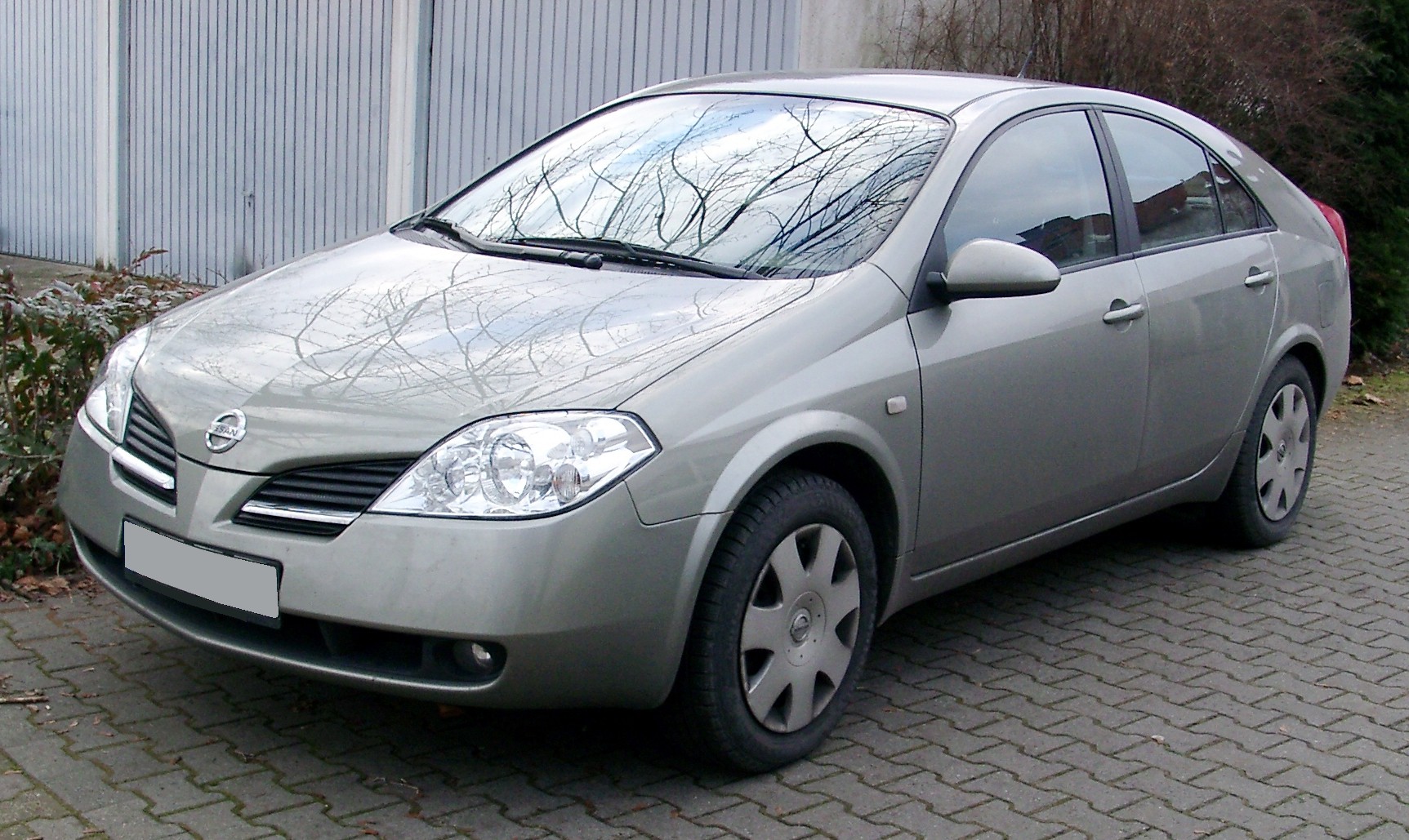
Which Primera P12 to choose
Our verdict · Felix Hartmann
- For simple, economical use: a 1.8 petrol, offered with the 2.0 for the whole European production run from 2002 to 2007.
- For long distances: a 2.2 dCi diesel, but check that the 2005 recall work on the engine control unit and boost sensor was done.
- For the full technology package: a tekna after the July 2004 facelift, with the colour reversing camera and navigation.
To compare the Primera with other used family cars, use our car comparison tool.
The Nissan Primera P12 is the third generation of Nissan's mid-size family car, launched in Japan in January 2001 and built until 2007 in Japan and in Sunderland, England. It was Nissan's first all-new car after the alliance with Renault, and its one-box "Monosilhouette" styling and screen-based dashboard were unusual for a family saloon. Sales fell short of expectations, and Nissan left the conventional mid-size class in Europe when it ended.
In short
- Japan launch 30 January 2001; European debut at the 2001 Frankfurt Motor Show; on sale in Germany from June 2002.
- Saloon, five-door hatchback and Traveller estate, front-wheel drive.
- European engines: 1.6, 1.8 and 2.0 petrol with 80–103 kW (109–140 PS); diesels with 88–102 kW, including a 1.9 dCi from Renault.
- Euro NCAP 2002: four stars for occupant protection. No direct successor in Europe; Nissan pointed to the Qashqai instead.
Primera P12 at a glance
| Specification | Nissan Primera P12 |
|---|---|
| Production | 2001–2007 |
| Plants | Kyushu, Japan; Sunderland (NMUK), United Kingdom |
| Class | large family car (D-segment) |
| Body styles | 4-door saloon, 5-door hatchback, 5-door estate (Traveller) |
| Layout | front engine, front-wheel drive |
| Power range (Europe) | 80–103 kW (109–140 PS) petrol, 88–102 kW diesel |
| Gearboxes | 5-speed manual, 6-speed manual, automatic, CVT |
| Designer | Stéphane Schwarz |
| Predecessor / successor | Primera P11 / none in Europe |
The Primera is listed with the rest of the brand's range in our Nissan catalogue. The company's background is told in the history of Nissan.
From P10 to P12: the Primera story
The Primera name started in 1990. The first generation, the P10, went on sale in Japan in February 1990 and in Britain in September 1990, where it replaced the Bluebird. It was built at Oppama (Japan), in Sunderland and in Taiwan, and in North America it was sold as the Infiniti G20. The second generation, the P11, arrived in Japan at the end of 1995 and in Europe in autumn 1996. In 1998 and 1999 a Primera won the manufacturers' and teams' titles of the BTCC, Britain's touring car championship.
The P12 followed in January 2001. It was the first all-new Nissan since the company had joined forces with Renault two years earlier.
Design: the Monosilhouette
Swiss designer Stéphane Schwarz developed the shape from the 2000 Fusion design study. His "Monosilhouette" idea smoothed out the classic three-box saloon profile into one flowing line. The production car stayed close to the study; the main differences were the front end and the interior. The design received a red dot award in 2002.
Three bodies were offered in Europe: a four-door saloon, a five-door hatchback and the Traveller estate, whose rear window was flatter and strongly curved. The estate was 4,675 mm long and 1,495 mm tall. Reviewers called the styling bold; some found the body awkward.

Interior and technology
The P12's most talked-about feature was inside. The standard N-FORM concept, first called the Easy Control System, placed a colour screen in the middle of the dashboard and operated audio and climate functions through a joystick-like controller. Testers found it simpler than BMW's iDrive of the same time. Higher trims had a rear-view camera above the number plate whose picture appeared on the dashboard screen when reverse was engaged; after the July 2004 facelift the image was in colour instead of black and white.
European trims were visia (six airbags and four electric windows), acenta (adding cruise control and a rain sensor) and tekna (adding xenon headlamps, navigation and an upgraded audio system), plus special editions visia-plus and acenta-plus.

Engines and gearboxes
| Engine | Code | Years | Power | Torque |
|---|---|---|---|---|
| 1.6 petrol 16V | QG16DE | 03/2003–03/2007 | 80 kW (109 PS) at 6,000 rpm | 144 Nm at 4,000 rpm |
| 1.8 petrol 16V | QG18DE | 04/2002–03/2007 | 85 kW (116 PS) at 5,600 rpm | 163 Nm at 4,000 rpm |
| 2.0 petrol 16V | QR20DE | 04/2002–03/2007 | 103 kW (140 PS) at 6,000 rpm | 192 Nm at 4,000 rpm |
| 2.2 di diesel | – | 2002–2003 | 93 kW (126 PS) | - |
| 1.9 dCi and 2.2 dCi common-rail diesels | – | 2003–2006 | 88–102 kW | - |
The 2.2 di with direct injection was the only diesel at the start. In spring 2003 it gave way to two common-rail engines from the Renault-Nissan alliance, a 1.9 dCi of Renault origin and a 2.2 dCi. Both met only the Euro 3 standard and were dropped in spring 2006 for lack of demand.
Petrol cars had a five-speed manual or an automatic; the diesels used a six-speed manual. The 2.0 with laser-guided adaptive cruise control came with a CVT that had a six-step manual mode.
Japanese versions
Japan had its own range with 2.0 and 2.5-litre engines and CVTs. The sportiest version, the Primera 20V, used the SR20VE Neo VVL engine with 150 kW (204 PS) at 7,200 rpm and 206 Nm at 5,200 rpm, combined with a six-speed manual. The 2.5-litre was not sold in Europe.

Key specifications: Primera P12 2.0
| Parameter | Metric | Imperial |
|---|---|---|
| Engine | 2.0-litre four-cylinder petrol (QR20DE) | 2.0-litre I4 |
| Power | 103 kW (140 PS) at 6,000 rpm | 103 kW (138 hp) |
| Torque | 192 Nm at 4,000 rpm | 142 lb-ft |
| Length (estate) | 4,675 mm | 184.1 in |
| Height (estate) | 1,495 mm | 58.9 in |
Safety: Euro NCAP 2002
Euro NCAP tested a left-hand-drive 1.8 hatchback with a kerb weight of 1,325 kg in 2002 and gave the Primera four stars. The body withstood the frontal impact reasonably, but the driver's head bottomed out the airbag and struck the steering wheel. The car did well in the side impact, although the head curtain airbag did not deploy fully. Pedestrian protection was above average for the time, yet just short of a two-star rating.
Common problems and criticism
In October 2005 diesel cars were recalled for faulty engine control units and boost pressure sensors. Reviewers criticised weak acceleration, high fuel consumption, uneven suspension and a notchy gearshift, and summed the car up as boldly styled but otherwise average.

End of production and the Primera name today
Sales stayed well below those of the P11. Nissan withdrew the Primera from the British market in November 2006, and left-hand-drive and Japanese production ended in 2007. There was no direct replacement: Nissan pointed to the success of the Qashqai crossover, described in our Nissan Qashqai article. In New Zealand, UK-built hatchbacks and estates were added to the range from 2006, and every New Zealand Primera had a CVT.
The name returned in an unexpected form: on 4 June 2026 Nissan unveiled a fourth-generation Primera in the Philippines, a battery-electric saloon based on the Nissan N7 sold in China. For Nissan's later mid-size saloons in Asia, see our article on the Nissan Teana generations.
Photo gallery

Nissan Primera P12 in our rankings
In production longer than 31% of ranked nameplates in the 1CARS catalog (No. 677 of 1082).
FAQ
What years was the Nissan Primera P12 made?
From 2001 to 2007. It was launched in Japan in January 2001 and reached German showrooms in June 2002.
Where was the Primera P12 built?
In Kyushu, Japan, and at Nissan's plant in Sunderland, England.
What engines did the Primera P12 have in Europe?
1.6, 1.8 and 2.0 petrol engines with 80–103 kW and diesels from 88 to 102 kW, including a 1.9 dCi from Renault.
How safe is the Nissan Primera P12?
It received four stars from Euro NCAP in 2002, with pedestrian protection just short of two stars.
What replaced the Nissan Primera?
In Europe nothing directly; Nissan pointed to the Qashqai. In 2026 the name returned in the Philippines on an electric saloon.