 Lexus CT
Specs, engines and history
Published Sources (2) Report an error
By Felix Hartmann, Automotive Technology & EV Contributor
- Built
- 2010–2022
- Top power
- 100 kW (136 PS)
Which CT to buy: verdict
Our verdict · Felix Hartmann
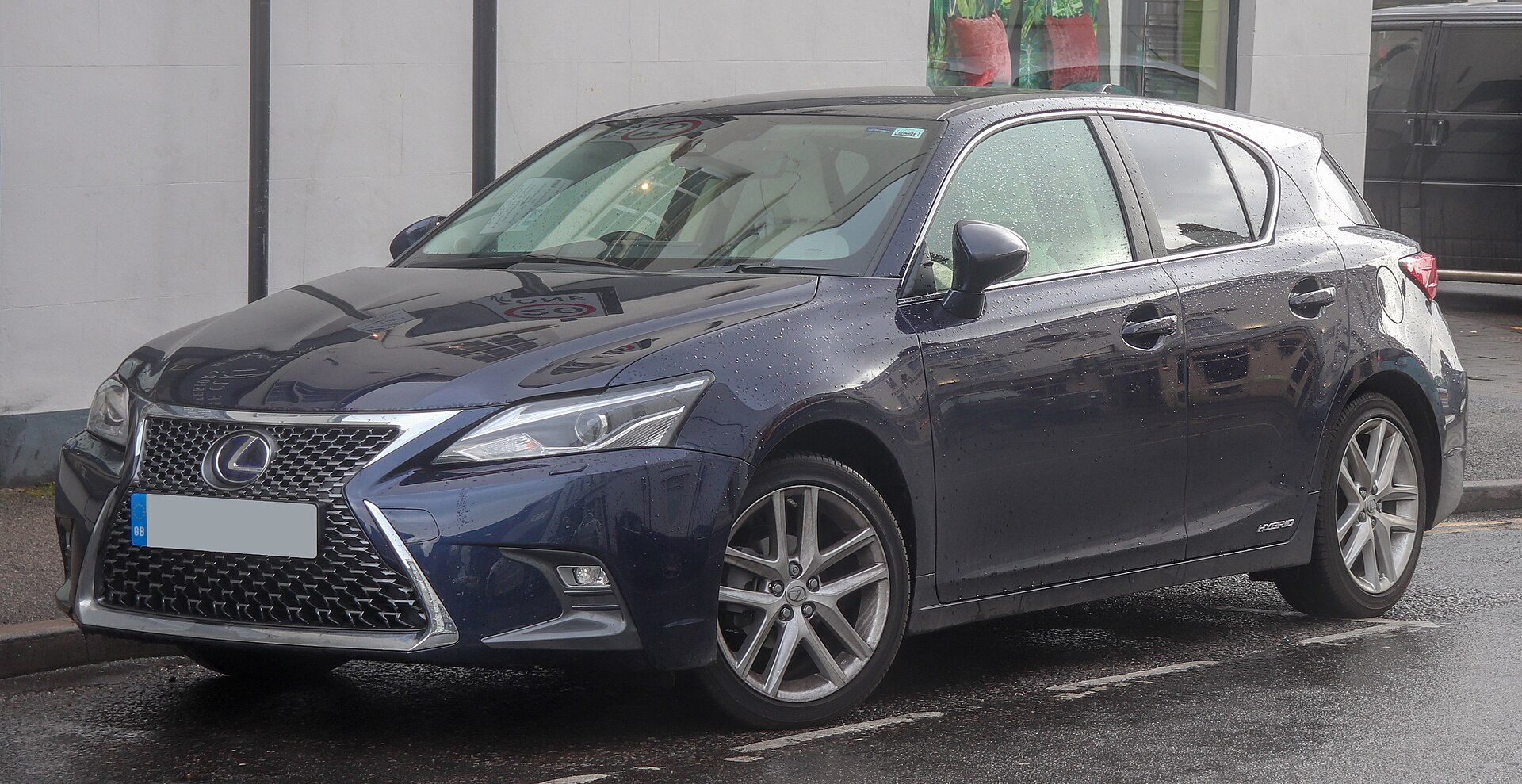
- Best value: a 2014-2017 first-facelift car, with the spindle grille and the same drivetrain as the last versions.
- Most modern: a 2018-on second-facelift car with the LED headlights and larger grille.
- Best looking: an F Sport, which adds body kit and sportier interior details without changing running costs.
- Who it suits: drivers who cover many short urban trips, where the hybrid system works best; motorway users will see consumption rise.
The Lexus CT is a five-door premium compact hatchback that was sold only as a full hybrid, the CT 200h. Toyota Motor Kyushu built it at Miyawaka, Japan, from December 2010 to October 2022, in a single generation (A10) with two facelifts, and Lexus sold about 380,000 by March 2022. Every CT uses the same 1.8-litre petrol-electric drivetrain with 100 kW (136 PS) and a continuously variable transmission.
In short
- C-segment premium hatchback, five doors, front-wheel drive, built in Japan from 2010 to 2022.
- One powertrain: 1.8-litre 2ZR-FXE petrol engine plus electric motor, 100 kW (136 PS) combined.
- Official NEDC consumption as low as 3.6 l/100 km and 82 g/km CO2 (2017 model, ADAC data).
- Facelifts in 2014 (spindle grille) and late 2017 (new LED lights, larger grille); F Sport trim throughout.
Size at a glance
| Dimensions | Lexus CT A10 |
|---|---|
| Length | 4,355 mm171.5 in |
| Width | 1,765 mm69.5 in |
| Height | 1,445 mm56.9 in |
| Wheelbase | 2,600 mm102.4 in |
| Boot | 375 L13.2 cu ft |
Running cost
Fuel · CT A10 CT 200h 1.8 Hybrid
about 950 EUR fuel a year at 15,000 km
3.6 l/100 km · petrol at 1.75 EUR/l · change mileage, fuel price or version
Specs by version
Engines
| Version | Engine | Power | Gearbox | Drive | Production years |
|---|---|---|---|---|---|
| CT 200h 1.8 Hybrid | 1.8 l · 4 cyl · Hybrid 2ZR-FXE | 100 kW 136 PS134 hp | CVT | Front-wheel drive | 2011–2022 |
Performance
Show all 1 versions
| Version | 0–100 km/h | Top speed | Fuel consumption | CO₂ |
|---|---|---|---|---|
| CT 200h 1.8 Hybrid | 10.3 s 0–62 mph | 180 km/h112 mph | 3.6 l/100 km65.3 mpg US · 78.5 mpg UK | 82 g/km |
Dimensions and weight
Show all 1 versions
| Version | Length | Width | Height | Wheelbase | Kerb weight | Boot | Fuel tank |
|---|---|---|---|---|---|---|---|
| CT 200h 1.8 Hybrid | 4,355 mm171.5 in | 1,765 mm69.5 in | 1,445 mm56.9 in | 2,600 mm102.4 in | 1,445 kg3,186 lb | 375 l13.2 cu ft | 45 l11.9 gal US |
Verified Manufacturer and type-approval data from our catalog · Sources and methodology
Lexus CT at a glance
| Specification | Lexus CT 200h |
|---|---|
| Segment | Premium compact (C-segment) hatchback |
| Model code | A10 (ZWA10) |
| Production | December 2010 to October 2022, Miyawaka plant, Fukuoka, Japan |
| Platform | Toyota MC, front engine, front-wheel drive |
| Body style | Five-door hatchback |
| Powertrain | 1.8 petrol full hybrid, eCVT |
| System output | 100 kW (136 PS) |
| Length | 4,320-4,355 mm |
| Boot | 375 l (985 l with seats folded) |
| Successor | Lexus UX (crossover) |
The CT was the smallest model in the Lexus catalogue for most of its life and the brand's first attempt at a premium hatchback for Europe, where cars of this size sell in large numbers.
Generations and facelifts
The CT never had a second generation. Lexus kept the A10 body for almost twelve years and refreshed it twice. ADAC's German catalogue splits the run into three phases:
| Generation | Code | Years | Body styles | Engines | Power (kW / hp) |
|---|---|---|---|---|---|
| CT 200h | A10 | 2011-2014 | 5-door hatchback | 1.8 hybrid | 100 kW (134 hp) |
| CT 200h, first facelift | A10 | 2014-2017 | 5-door hatchback | 1.8 hybrid | 100 kW (134 hp) |
| CT 200h, second facelift | A10 | 2017-2022 | 5-door hatchback | 1.8 hybrid | 100 kW (134 hp) |
The 2014 facelift, announced in 2013, brought Lexus's spindle grille to the CT. The 2017 update (2018 model year) added a new design of full-LED lighting as an option and made a larger version of the spindle grille standard on all models. Length grew slightly over the years, from 4,320 mm for the 2011 car to 4,355 mm for the 2017 version, according to ADAC.
Sales in the United States and Canada ran from March 2011 to the 2017 model year; Lexus announced the end of US sales in May 2017. Imports to the UK ended in 2020, German sales in 2021, and Australia dropped the car in November 2021 when stricter crash rules arrived. Global production ended in October 2022 with a Japanese special edition called Cherished Touring.

Hybrid drivetrain and performance
| Component | Output | Torque |
|---|---|---|
| 1.8-litre 2ZR-FXE petrol, 1,798 cc, four cylinders | 73 kW (99 PS) | 142 Nm |
| Electric motor | 60 kW (82 PS) | 207 Nm |
| Combined system | 100 kW (136 PS) | - |
| Battery | 1.3 kWh nickel-metal hydride | - |
The CT is a series-parallel hybrid: the petrol engine and the electric motor work through a planetary gear set that acts as a continuously variable transmission (eCVT). It cannot be charged from a socket. ADAC quotes 0-100 km/h in 10.3 seconds and a top speed of 180 km/h, and says the car can drive on electricity alone up to 45 km/h.
The F Sport version, available in most markets, did not change the drivetrain. It added sportier bumpers, side skirts, a larger rear spoiler, an F Sport steering wheel, sports pedals and, in North America, a different grille pattern and wheels.


Dimensions, space and boot
| Parameter | Metric | Imperial |
|---|---|---|
| Length | 4,320-4,355 mm | 170.1-171.5 in |
| Width (without mirrors) | 1,765 mm | 69.5 in |
| Height | 1,430-1,455 mm | 56.3-57.3 in |
| Wheelbase | 2,600 mm | 102.4 in |
| Kerb weight (EU) | 1,420-1,445 kg | 3,131-3,186 lb |
| Boot | 375 l | 13.2 cu ft |
| Boot, rear seats folded | 985 l | 34.8 cu ft |
| Fuel tank | 45 l | 11.9 US gal |
With 375 litres, the boot is in the range of a conventional compact hatchback, so the hybrid hardware costs little luggage space. At 4.3 m long and 1.77 m wide, the CT is a size that fits most city parking spaces and garages.

Fuel economy and running costs
Fuel economy was the CT's main selling point. ADAC lists NEDC combined consumption of 3.8 l/100 km and 87 g/km CO2 for the 2011 CT 200h, and 3.6 l/100 km and 82 g/km for the 2017 version. In Australia the official figure was 4.1 l/100 km. The tougher US EPA cycle gave 5.6 l/100 km combined (42 mpg US), which is closer to what drivers can expect on fast roads. ADAC gave the 2011 car five stars in its Ecotest. The fuel cost calculator turns these figures into annual costs.
Trims, equipment and prices
German list prices according to ADAC:
| Period | Version | Price |
|---|---|---|
| 2011-2014 | CT 200h (base) | EUR 29,400 (2011) |
| 2012-2014 | CT 200h F Sport | EUR 34,550 (2012) |
| 2011-2012 | CT 200h Impression | EUR 41,150 (2011) |
| 2017-2021 | CT 200h (base) | EUR 26,950 (2017) |
| 2017-2021 | CT 200h Executive | EUR 28,800 (2017) |
| 2017-2021 | CT 200h F Sport | EUR 35,950 (2017) |
| 2017-2021 | CT 200h Luxury | EUR 39,300 (2017) |
Lexus cut the entry price for the last facelift, so a 2017 base car cost EUR 2,450 less than in 2011. Standard equipment in most markets included dual-zone climate control, 17-inch alloy wheels, keyless SmartAccess, Bluetooth and a six-speaker audio system. A pre-collision system with radar cruise control was an option on earlier cars.
Safety
Euro NCAP published its CT 200h test in 2011, using a right-hand-drive Comfort grade car with a kerb weight of 1,410 kg; that result was obtained under the protocol of the time and cannot be compared directly with current ratings. All versions had stability control and eight airbags as standard. In Australia, ANCAP's tests from 2011, 2013 and 2017 gave 15.13 out of 16 points in the frontal offset test, the full 16 in the side impact test and 2 out of 2 in the pole test, with pedestrian protection rated "Adequate". Our safety section explains how crash ratings have changed since then.
Reliability and known issues
The CT uses a hybrid layout that Toyota has built in very large numbers, and the sources used here list no model-specific defect pattern. As with any older hybrid, a used buyer should check the service history and ask a dealer to test the hybrid battery. No breakdown statistics for the CT are published in ADAC's survey.
Sales
| Year | Europe | United States | Japan |
|---|---|---|---|
| 2011 | 16,980 | 14,381 | 20,704 |
| 2012 | 15,599 | 17,673 | 11,325 |
| 2013 | 9,406 | 15,071 | - |
| 2014 | 10,340 | 17,673 | - |
| 2015 | 10,235 | 14,657 | - |
Lexus had sold 267,000 CTs worldwide by March 2016 and 380,000 by March 2022. In 2011 the Union of Concerned Scientists ranked it top among luxury hybrids for environmental improvement, jointly with the Lincoln MKZ Hybrid.
Rivals
The CT competed with the Audi A3 Sportback, BMW 1 Series, Mercedes-Benz A-Class and Volvo V40, all of which offered a wide choice of petrol and diesel engines. The CT offered only one drivetrain, and its official rating of 82-87 g/km CO2 was its strongest argument. Its natural successor inside the brand is the UX crossover. The comparison tool shows the alternatives side by side.
Photo gallery

Lexus CT in our rankings
- No. 6 of 54 · Most economical hatchbacks (3.6 l/100 km)
- No. 7 of 297 · Most economical cars (3.6 l/100 km)
- No. 28 of 93 · Longest hatchbacks (4,355 mm · top 31%)
- No. 175 of 531 · Smallest cars (4,355 mm · top 33%)
- No. 360 of 1082 · Longest-running car nameplates (12 years · top 35%)
- No. 27 of 71 · Biggest boot: hatchbacks (375 l · top 39%)
More economical than 96% of ranked cars in the 1CARS catalog (No. 7 of 297).
FAQ
Is the Lexus CT 200h a plug-in hybrid?
No. It is a self-charging full hybrid with a 1.3 kWh nickel-metal hydride battery. It can drive on electricity alone only at low speed, up to 45 km/h according to ADAC.
How many generations of the Lexus CT were there?
One. The A10 was built from December 2010 to October 2022 and facelifted in 2014 and 2017.
What is the fuel consumption of the CT 200h?
Officially 3.6-3.8 l/100 km on the old NEDC cycle in Europe; the US EPA rating was 5.6 l/100 km combined.
How big is the boot of the Lexus CT?
375 litres with all seats in place and 985 litres with the rear seats folded, according to ADAC.
What replaced the Lexus CT?
Lexus did not build a direct successor hatchback. The UX compact crossover took its place as the brand's entry model.
Data sources
Data checked by an editor against the sources below.
- Wikipedia - Lexus CT
- ADAC