 Lexus GX
All generations, specs and history
Published Sources (1) Report an error
By Felix Hartmann, Automotive Technology & EV Contributor
- Built
- 2002–present
- Generations
- 3 · UZJ120 to J250
Timeline
GX generations
Click a generation for its own page


- GX I (UZJ120) 2002–2009 · SUV
- GX II (URJ150) 2009–2023 · SUV
- GX III (J250) Current 2023–now · SUV
Newest first · 3 generations since 2002
All generations by year: GX III (J250) (2023–now) · GX II (URJ150) (2009–2023) · GX I (UZJ120) (2002–2009)
Which one is mine?
Pick the year of first registration to see which generation it is.
- J250 2023–present
- URJ150 2009–2023
- UZJ120 2002–2009
The Lexus GX is a mid-size premium four-wheel-drive SUV with five or seven seats. Unlike most luxury SUVs, it keeps a separate ladder frame and a rigid rear axle, because it is closely related to the Toyota Land Cruiser Prado. According to Lexus, GX stands for "Grand Crossover", a name that reflects its place in the middle of the brand's SUV range.
In short
- Three generations: the GX 470 (2002), the GX 460 (J150, 2009) and the GX 550 (J250), shown on 8 June 2023.
- The GX 460 uses a 4.6-litre V8 with 224 kW (305 PS) and 446 Nm, a six-speed automatic and permanent four-wheel drive with a Torsen centre differential.
- It was facelifted twice, for the 2014 and 2020 model years; the second update added Lexus Safety System+ and an Off-Road package.
- Ground clearance is 215 mm, and the boot grows from 104 litres with seven seats to 1,934 litres with both rear rows folded.
Lexus GX at a glance
The GX story began in January 2002 at the North American International Auto Show in Detroit, where the GX 470 was presented as a 2003 model. Based on the Land Cruiser Prado, it filled a new place in the Lexus range and was powered by a 4.7-litre V8. The first generation lasted until 2009, when Lexus showed the second-generation GX 460.
The GX 460 was updated for the 2014 model year with the spindle grille and LED lights, and again for the 2020 model year, when it received a reshaped front end, an improved cabin, the Lexus Safety System+ package and an Off-Road package for difficult terrain; the engine stayed the same. In 2023 Lexus revealed the third generation, the GX 550, with a twin-turbo V6. More of the brand's range is in our Lexus catalogue, and its bigger brother is covered in our Lexus LX article.
Generations
| Generation | Years | Engine | Power |
|---|---|---|---|
| GX 470 (J120) | 2002–2009 | 4.7 V8 (2UZ-FE) | 175–201 kW / 235–270 hp |
| GX 460 (J150) | 2009–2023 | 4.6 V8 (1UR-FE) | 224 kW / 301 hp |
| GX 550 (J250) | from 2023 | 3.4 V6 twin-turbo (V35A-FTS) | 260 kW / 349 hp |
Exterior of the facelifted GX 460
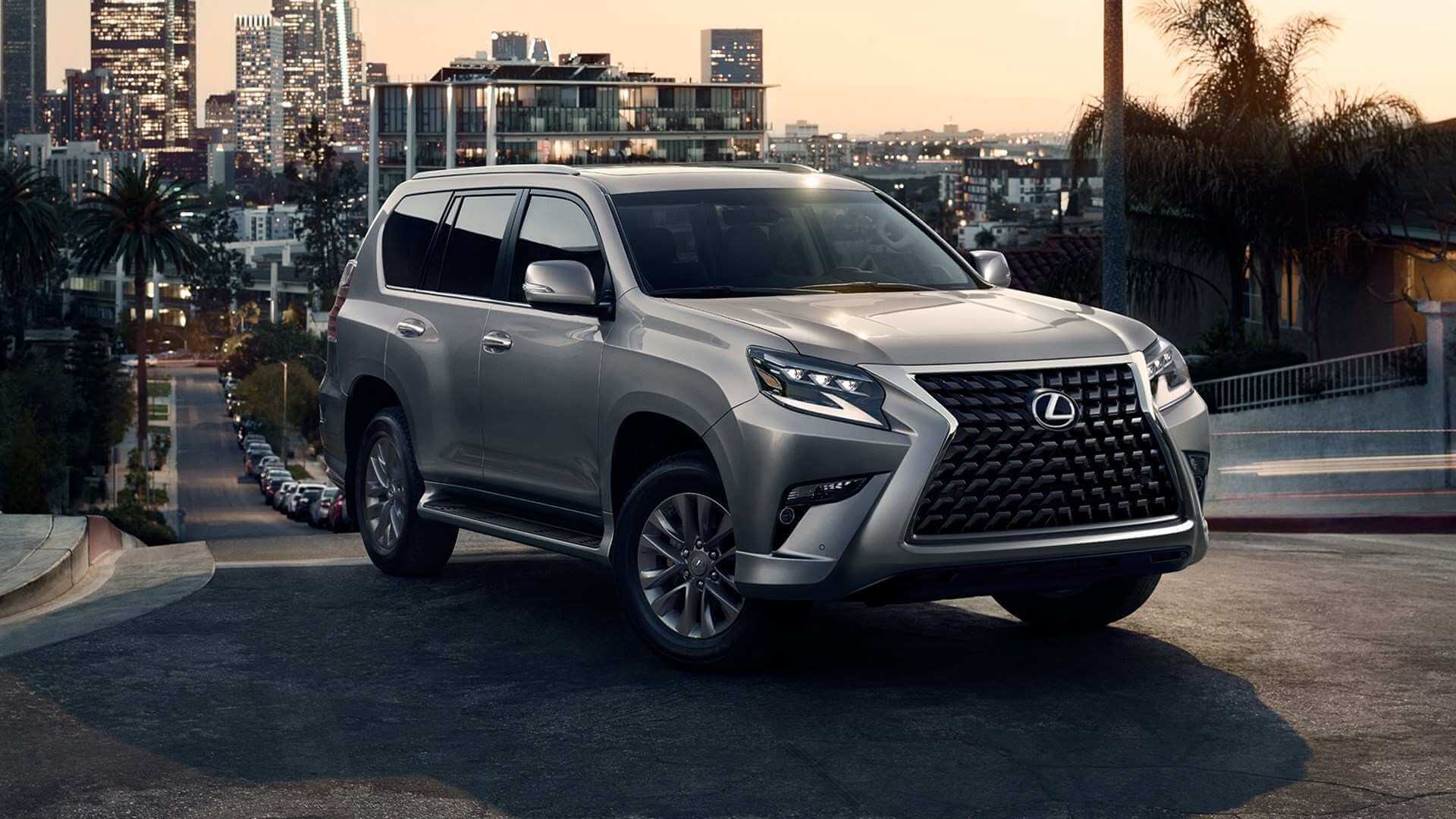
The GX already looked imposing, and the 2020 update made it even more powerful and stately. The front is dominated by an enormous hourglass-shaped spindle grille that takes up about 80% of the front end, flanked by complex triple-beam LED headlights, a monumental bumper and elegant round fog lights. The LED daytime running lights have three rectangular elements.
The side view was changed little and still looks massive, with nearly square wheel arches, large doors, an almost flat roof and big mirrors with indicator repeaters. Base versions have 18-inch alloy wheels, with 20-inch wheels optional. Ground clearance is 215 mm, so railway crossings, speed bumps and kerbs pose no problem. The door mouldings disappeared, and convenient running boards are built into the sills.
The rear has the familiar large tail lights, a neat bumper and a massive side-hinged tailgate with a large roof spoiler. The rear window has its own visor, the lights wrap slightly onto the sides, and the number plate sits in the centre of the tailgate inside a wide chrome trim. The exhaust is hidden under the body, and the low bumper makes loading easier. Buyers can choose from eight body colours.
Interior and practicality
The cabin changed relatively little, but it has everything needed for comfortable travel in any conditions. The dashboard is slightly more formal than in the Prado. The facelift brought a compact three-spoke multifunction steering wheel in place of the older four-spoke design, and the trim remains wood and leather, now also in a red "Rioja Red" leather and a grey wood and aluminium scheme. The instruments have two large dials for engine and road speed and a colour trip-computer screen that replaced the earlier monochrome one.
The front seats are heated and ventilated and offer many adjustments, with separately adjustable armrests; the centre armrest contains a cool box. A massive centre console gives the cabin a rugged, off-road feel. At the top are air vents, then an 8-inch infotainment screen that shows the surround-view cameras and navigation, and below it the climate controls and many physical buttons; a Remote Touch controller on the console makes the system easier to use. Two new USB ports were added. Some owners feel the cabin looks dated, as little has changed since 2009.
The second row is less comfortable than the front, transmitting more of the road surface, and it is best for two adults, although three can fit; more expensive versions have two captain's chairs. The third row has limited leg- and headroom and suits children and teenagers, and the seats fold electrically using buttons in the cabin or the boot. With seven seats in use, the boot holds just 104 litres; with the third row folded it holds 621 litres, and with both rear rows folded 1,934 litres.
Engine and transmission
| Parameter | Lexus GX 460 |
|---|---|
| Engine | 4.6-litre V8 petrol, 32 valves, dual VVT-i, chain-driven camshafts |
| Power | 224 kW / 305 PS |
| Torque | 446 Nm |
| Gearbox | 6-speed automatic |
| Drive | Permanent four-wheel drive, Torsen centre differential, low range |
| 0–100 km/h | about 8.3 s |
| Top speed | 175 km/h |
| Consumption | 17.7 l/100 km urban, 9.9 extra-urban, 12.8 combined |
The 4.6-litre V8 is smooth and strong but thirsty. Despite its weight and a drag coefficient of 0.35, the GX accelerates respectably. The Torsen centre differential normally sends 60% of the torque to the rear wheels, shifting to 70% in corners or to an even 50:50 split when the rear wheels slip, and it can be locked. The Off-Road package adds a fuel-tank guard and an extra transmission cooler, and the GX also offers Crawl Control, which maintains a low speed off-road, and Multi-Terrain Select, which adjusts the traction control for different surfaces.
Chassis
The GX 460 is built on a strong ladder frame, which increases rigidity and robustness. The front suspension is independent with double wishbones and an anti-roll bar, and the rear uses a rigid axle with links, height-adjustable air suspension and an anti-roll bar. The Kinetic Dynamic Suspension System (KDSS) hydraulically disconnects the anti-roll bars off-road to increase wheel articulation. Steering is rack-and-pinion with hydraulic assistance, and the brakes are ventilated discs all round, 338 mm at the front and 312 mm at the rear.
Safety and equipment
The GX has eight airbags including curtain airbags, cruise control, surround-view cameras, automatic high beam, Lexus Safety System+, LED headlights, parking sensors front and rear, tyre-pressure monitoring, a reversing camera, an immobiliser and central locking. Depending on the market, base versions include an electrically adjustable steering column, power-adjustable ventilated front seats, a heated steering wheel and windscreen, dual-zone climate control, leather upholstery, a sunroof, navigation, headlight washers, roof rails, rain and light sensors, rear air suspension and 18-inch wheels. Better-equipped versions add the third row, three-zone climate control, rear side airbags, heated rear seats, a Mark Levinson audio system, Multi-Terrain Select and Crawl Control.
Strengths and weaknesses
Owners praise the solid, imposing looks, generous equipment, good sound insulation, build quality and materials, as well as excellent off-road ability thanks to the high ground clearance, strong engine and four-wheel drive. The seating position gives a good view of the road, safety is high, and the seven-seat version suits large families. The downsides are the high price, heavy fuel consumption, expensive servicing and a dated centre console. Rivals include the Toyota Land Cruiser Prado, Range Rover Sport, Nissan Patrol, Mercedes-Benz G-Class, Volkswagen Touareg and Jeep Grand Cherokee.
Lexus GX evolution in numbers
Did you know?
- The Lexus GX has been around for 24 years: 3 generations in our catalog since 2002.
- The longest-running generation is the GX II (URJ150) (2009–2023): 14 years.
Image credits · Photos from Wikimedia Commons under free licences
- Lexus GX I (UZJ120) · Photo: Alexander Migl / Wikimedia Commons, CC BY-SA 4.0
- Lexus GX II (URJ150) · Photo: EurovisionNim / Wikimedia Commons, CC BY-SA 4.0
- Lexus GX III (J250) · Photo: Kevauto / Wikimedia Commons, CC BY-SA 4.0
Lexus GX in our rankings
- No. 120 of 912 · Longest-running car nameplates (24 years · top 14%)
- No. 80 of 305 · Oldest car models still on sale (24 years · top 28%)
- No. 180 of 345 · Cars with the most generations (3 generations · top 68%)
In production longer than 86% of ranked nameplates in the 1CARS catalog (No. 120 of 912).
FAQ
What does GX stand for in Lexus GX?
According to Lexus, GX stands for "Grand Crossover", reflecting its position in the middle of the brand's SUV range.
Is the Lexus GX based on the Toyota Land Cruiser Prado?
Yes. Every generation of the GX is closely related to the Land Cruiser Prado and uses a body-on-frame design.
What engine does the Lexus GX 460 have?
A 4.6-litre V8 with 224 kW (305 PS) and 446 Nm, paired with a six-speed automatic.
How many seats does the Lexus GX have?
Five or seven, depending on the version; some versions have two captain's chairs in the second row.
Is there a new Lexus GX?
Yes. The third-generation GX 550, with a 3.4-litre twin-turbo V6, was revealed on 8 June 2023.
Data sources
Data checked by an editor against the sources below.