
 GMC Suburban
Specs, engines and history
Published Report an error
By Felix Hartmann, Automotive Technology & EV Contributor
Which GMC Suburban to choose
Our verdict · Felix Hartmann
As a classic, the 1960s Carryall with the GMC 305 V6 is the most distinctly "GMC" Suburban, while the 1967–1972 models are the only three-door Suburbans. For regular use, the 1996–1999 GMT400 Suburbans with Vortec engines are the most practical: they have airbags, fuel injection and parts shared with GM's full-size pickups. The 7.4-litre Vortec has the most torque of the range (556 Nm), while the 6.5-litre turbodiesel reaches its 488 Nm at only 1,700–1,800 rpm. As with any old truck, check the body for rust as carefully as the drivetrain, and check that a four-wheel-drive system works in every mode. The 1cars comparison tool helps to set a Suburban against a Ford Excursion or a Yukon XL.
The GMC Suburban was GMC's version of the long station wagon built on General Motors' light-truck chassis, sold from 1937 to the 1999 model year. It shared its body with the Chevrolet Suburban but often had its own engines, trims and, for a time, its own name, the Carryall. For the 2000 model year GMC renamed it Yukon XL, while Chevrolet kept the Suburban name, which Wikipedia describes as the longest-produced automobile nameplate in the world.
In short
- GMC Suburban from 1937 to 1999, then renamed Yukon XL for the 2000 model year.
- Built on GM's half-ton and three-quarter-ton truck chassis; seats up to eight or nine.
- GMC-specific engines included a 228 cu in six (1941) and the 305 cu in V6 of the 1960s.
- The last generation (1992–1999) offered V8s up to the 7.4-litre Vortec with 216 kW (290 hp) and a 6.5-litre turbodiesel.
GMC Suburban at a glance
| Item | Details |
|---|---|
| Maker | GMC Truck (General Motors), USA |
| Production | 1937–1999 as GMC Suburban; Yukon XL from 2000 |
| Class | full-size SUV / truck-based station wagon |
| Body | two-door wagon and panel (to 1966), three-door wagon (1967–1972), four-door wagon (1973–1999) |
| Layout | front engine, rear-wheel drive; four-wheel drive from the late 1950s |
| Platform | GM light trucks: Advance Design, Task Force, C/K, GMT400 |
| Twin | Chevrolet Suburban |
| Successor | GMC Yukon XL (2000) |
GMC's current models are in the GMC catalogue on 1cars, and the Chevrolet twins are in the Chevrolet catalogue.
From Carryall to the longest-running nameplate
Chevrolet introduced its all-metal Carryall Suburban in 1935: a station wagon body on a half-ton truck chassis, with two passenger doors, three rows of seats for eight and either rear panel doors or a tailgate. GMC added its own version, the "Suburban Carryall", in 1937, and General Motors later shortened the name to Suburban. In the early 1960s GMC again used the Carryall name for its version before it was finally dropped with the 1967–1972 generation.
The Suburban was a working vehicle as much as a family car. Panel-door and tailgate models were built side by side, the 1941–1946 trucks were also produced as military transports during the Second World War, and later conversions such as the 15-seat Stageway stretched the body to a 4,343 mm (171 in) wheelbase.

Generations from 1937 to 1999
| Generation | Code | Years | Body styles | Engines | Power (kW / hp) |
|---|---|---|---|---|---|
| 1st | - | 1937–1940 | 2-door wagon, panel or tailgate | inline-six | - |
| 2nd | AK series base | 1941–1946 | 2-door wagon | 228 cu in I6 | - |
| 3rd | Advance Design | 1947–1955 | 2-door wagon | I6, Hydra-Matic from 1953 | - |
| 4th | - | 1955–1959 | 2-door wagon and panel | I6, Pontiac-based V8 | - |
| 5th | C/K | 1960–1966 | 2-door wagon (Carryall) | I6, V8, GMC 305 V6 | - |
| 6th | C/K | 1967–1972 | 3-door wagon, panel to 1970 | GMC 305 V6, I6, V8 up to 402 | - |
| 7th | C/K | 1973–1991 | 4-door wagon | I6, V8 up to 454, 6.2 diesel | - |
| 8th | GMT400 | 1992–1999 | 4-door wagon, 1500 and 2500 | 5.7 and 7.4 V8, 6.5 turbodiesel | 134–216 / 180–290 |
Power figures for the older generations are not given in the sources for the GMC versions.
The first two decades: 1937–1959
GMC's Suburbans used GMC's own truck engines, not Chevrolet's. In 1941 that meant a 228 cu in (3.7-litre) straight-six shared with the AK Series trucks. The 1947–1955 Advance Design generation brought a new, rounder body and, at GMC, the four-speed Hydra-Matic automatic from 1953.
The 1955–1959 generation offered V8 power for the first time. Chevrolet used its own small-block, while GMC's V8 was based on a Pontiac design. GMC also built a rare pickup with the Suburban name, the GMC 100 Suburban Pickup of 1955–1958, estimated at 300 or fewer a year. Wikipedia dates the first four-wheel-drive Suburbans to 1957, although another section of the same article places factory four-wheel drive in the 1960–1966 generation.
V6 power and the three-door body: 1960–1972
The GMC Carryall of 1960–1966 offered six-cylinder engines from 230 to 292 cu in, small-block V8s and GMC's own 305 cu in V6, which had plenty of torque but poor fuel economy. Transmissions were three- and four-speed manuals, the Powerglide and, from 1960 to 1962, GMC's dual-range Hydra-Matic.
The 1967–1972 generation moved to GM's new "Action-Line" trucks. The Suburban became a three-door station wagon, and the wheelbase grew from 115 in (2,921 mm) to 127 in (3,226 mm). The GMC 305 V6 remained the standard GMC engine until 1970, with options up to the 396 and 402 cu in big-block V8s. Production of the Suburban rose from about 6,200 in 1967 to about 27,000 in 1972. The panel van version ended after 1970.

Four doors and diesel: 1973–1991
The 1973 Suburban, on the rounded-line C/K trucks, was the first with four full passenger doors, plus a choice of rear panel doors or a tailgate. It stayed in production for 18 years. GMC trims were Custom, Super Custom and Sierra Grande, later Sierra Classic (from 1975) and Sierra (from 1981). Engines ranged from the 250 cu in six to the 454 cu in (7.4-litre) V8, with a 6.2-litre Detroit Diesel V8 from 1982 to 1991. The 700R4 four-speed automatic arrived in 1981 and the electronic 4L80-E in 1991. With three bench seats the Suburban carried up to nine people.
This generation shared its body and much of its engineering with GM's full-size pickups; the Chevrolet C/K story gives the pickup side of the family.
GMT400 and the end of the name: 1992–1999
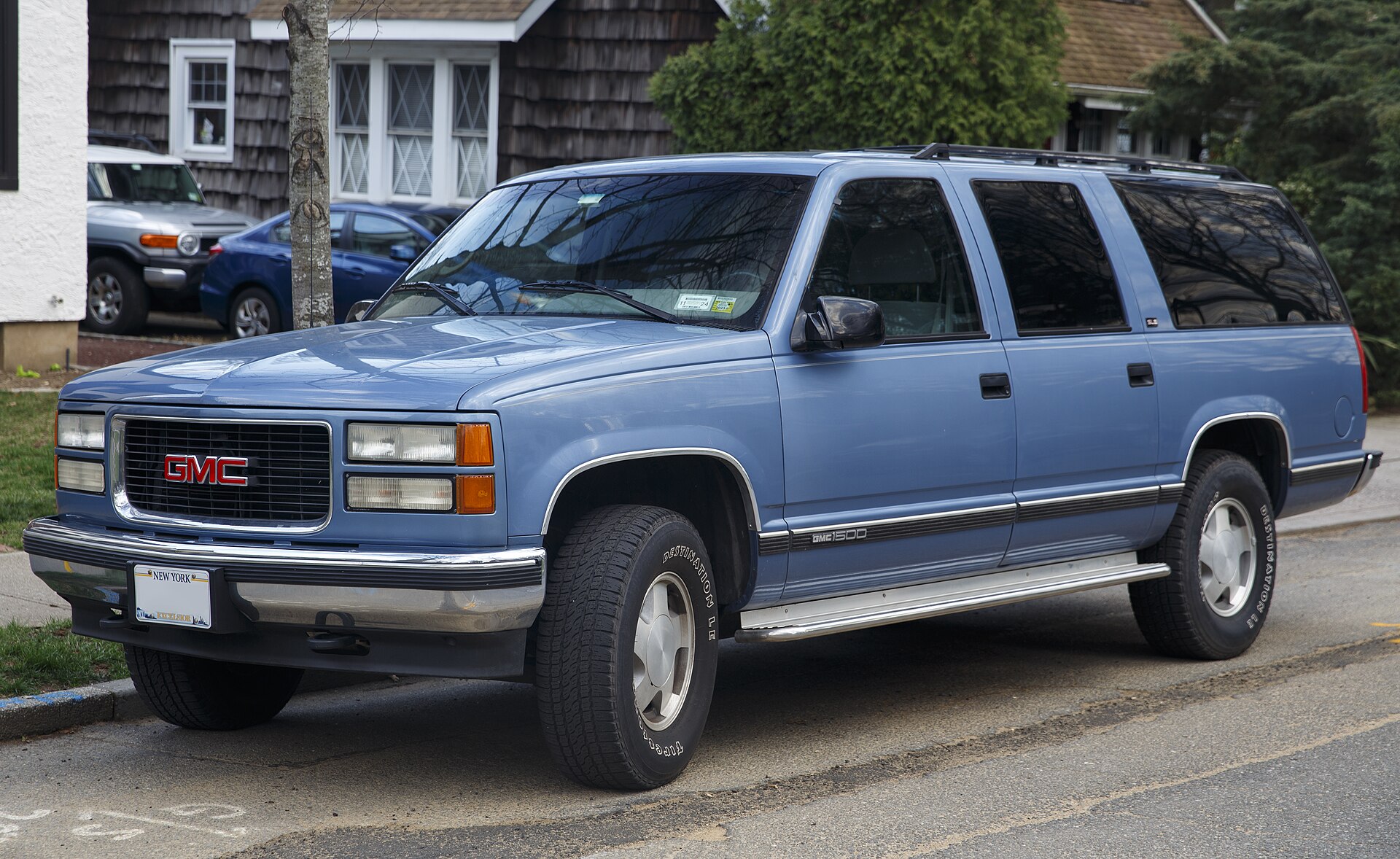
The final GMC Suburban arrived for the 1992 model year on the GMT400 platform. It was built as a 1500 (half-ton) and a 2500 (three-quarter-ton), each with rear-wheel or four-wheel drive. The 5.7-litre V8 was standard, the 7.4-litre V8 was offered on the 2500, and a 6.5-litre turbodiesel joined in 1994. For 1996 the petrol engines were replaced by the more powerful Vortec units. A driver's airbag arrived in 1995, daytime running lamps in 1996, dual airbags in 1997 and OnStar in 1998. In 1999 the shorter five-door body became the basis for the Yukon Denali and the Cadillac Escalade.
For the 2000 model year GMC moved to the GMT800 platform and renamed its long-wheelbase SUV the Yukon XL, on a 3,302 mm (130 in) wheelbase. The luxury GMC Yukon Denali continues that line today.
GMT400 engines and power
| Engine | Years | Power | Torque |
|---|---|---|---|
| 5.7 l V8 TBI (L05), light duty | 1992–1993 | 157 kW (210 hp) | 407 Nm (300 lb-ft) |
| 5.7 l V8 TBI (L05), light duty | 1994–1995 | 149 kW (200 hp) | 420 Nm (310 lb-ft) |
| 5.7 l Vortec 5700 (L31) | 1996–1999 | 190 kW (255 hp) | 447 Nm (330 lb-ft) |
| 7.4 l V8 | 1992–1993 | 190 kW (255 hp) | 549 Nm (405 lb-ft) |
| 7.4 l Vortec 7400 (L29) | 1996–1999 | 216 kW (290 hp) | 556 Nm (410 lb-ft) |
| 6.5 l turbodiesel V8 (L56) | 1994–1999 | 134 kW (180 hp) | 488 Nm (360 lb-ft) |
| 6.5 l turbodiesel V8 (L65), heavy duty | 1994–1997 | 142 kW (190 hp) | 522 Nm (385 lb-ft) |
Ratings are those of the GMT400 trucks; they depended on the gross vehicle weight rating (above or below 8,500 lb), so a 2500 could be rated lower than a 1500 with the same engine.
GMC versus Chevrolet Suburban
For most of its life the GMC Suburban was the same vehicle as the Chevrolet with a different grille, badges and trim names. The differences were largest before 1973, when GMC fitted its own engines: the 228 cu in six in 1941, the Pontiac-based V8 in the late 1950s and the 305 cu in V6 in the 1960s, as well as GMC's dual-range Hydra-Matic of 1960–1962. From 1973 the trims (Sierra, Sierra Classic, High Sierra) were the main way to tell them apart. Today the long GMC is sold as the Yukon XL, and Chevrolet's shorter SUV of the same family is the Chevrolet Tahoe.
Photo gallery


FAQ
When did GMC stop making the Suburban?
After the 1999 model year. From 2000 GMC sold the long-wheelbase model as the Yukon XL.
Is the GMC Suburban the same as the Chevrolet Suburban?
They share the body and platform. Before 1973 GMC often fitted its own engines, such as the 305 cu in V6.
Did the GMC Suburban have four-wheel drive?
Yes. Four-wheel drive was offered from the late 1950s or early 1960s, depending on the source, and on both 1500 and 2500 models of the GMT400.
What engines did the 1992–1999 GMC Suburban have?
A 5.7-litre V8, a 7.4-litre V8 on the 2500 and, from 1994, a 6.5-litre turbodiesel; Vortec versions of the V8s arrived in 1996.
How many people does a GMC Suburban seat?
Up to eight in the early two-door models and up to nine in the four-door generations with three bench seats.


