
GMC — General Motors' Truck Brand From Pontiac to the Hummer EV
GMC is the truck, van and SUV brand of General Motors, sold above Chevrolet and below Cadillac in North America. It grew out of the Rapid Motor Vehicle Company of Pontiac, Michigan, which General Motors took over in 1909, and the three letters have been on GM's commercial vehicles since 1912. Over the century that followed GMC built army trucks for two world wars, city buses, a front-drive motorhome and, since 2021, the electric Hummer.
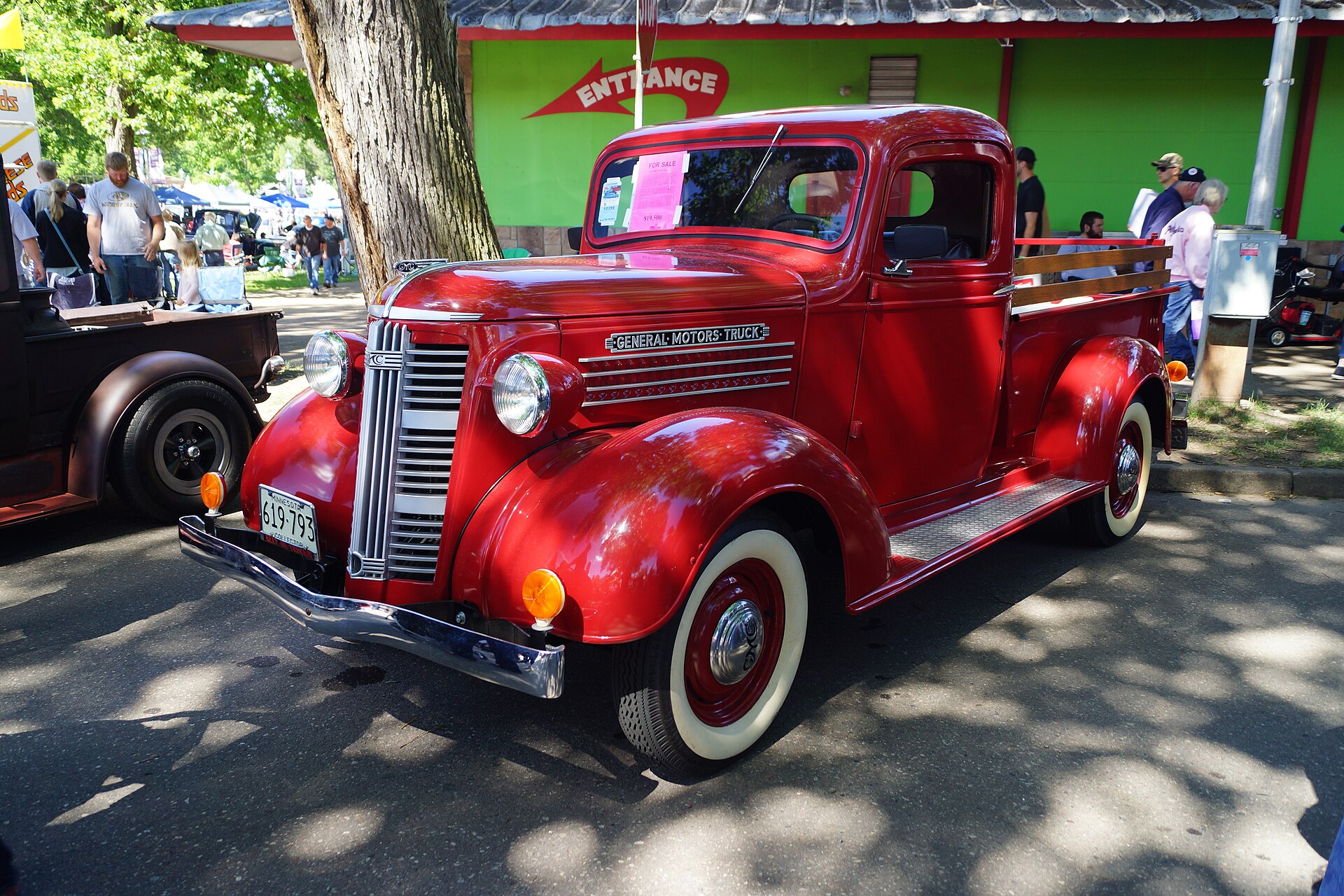
Key takeaways
- Roots in 1900–1902: Max and Morris Grabowsky's company in Detroit, renamed Rapid Motor Vehicle Company after moving to Pontiac.
- William C. Durant brought Rapid into General Motors in 1909; the GMC name replaced Rapid and Reliance in 1912.
- GMC built about 572,500 CCKW-family 6x6 trucks in the Second World War, part of 600,000 trucks for the US armed forces.
- Today's range: Sierra, Canyon and Hummer EV pickups, Yukon, Acadia and Terrain SUVs and the Savana van.
GMC at a glance
| Fact | Value |
|---|---|
| Origins | 1900 (Grabowsky Motor Company, Detroit), 1902 (Rapid Motor Vehicle Company, Pontiac) |
| Founders | Max Grabowsky (1874–1946) and Morris Grabowsky |
| GMC name | Since 1912 |
| Owner | General Motors |
| Headquarters | Detroit, Michigan |
| Position | Above Chevrolet, below Cadillac; trucks, SUVs and vans only in North America |
| Sub-brands | Denali, Hummer EV |
| Markets | North America, South Korea (from 2022), Middle East, Australasia (from 2025) |
Origins: the Grabowsky brothers and Rapid
The story starts with two brothers, Max and Morris Grabowsky, who founded the Grabowsky Motor Company in Detroit in 1900. In 1902 they moved to Pontiac, Michigan, and renamed the business the Rapid Motor Vehicle Company. Rapid built commercial vehicles rather than passenger cars.
The company caught the attention of William C. Durant, the founder of General Motors, who was busy buying up carmakers. Durant gained control of Rapid in 1909 and made it a GM subsidiary; that year Grabowsky's factory produced 300 vehicles. Durant had already bought the Reliance Motor Car Company in 1908. In 1911 GM formed the General Motors Truck Company and folded Rapid and Reliance into it, and in 1912 both old names were dropped in favour of GMC. All GM truck production was concentrated at the former Rapid Plant 1 in Pontiac. The wider story of Durant's group is told in the history of General Motors.

Trucks for two world wars
GMC's first big customer was the army. In the First World War the company supplied the Model 16, a 3/4-ton truck, and later one-ton troop carriers. By 1918 more than 90 percent of production was military, and GMC delivered 8,512 trucks to the US government during the war. Peacetime brought long-distance demonstrations: a GMC truck crossed from Seattle to New York in thirty days in 1916, and in 1926 a two-ton GMC drove from New York to San Francisco in five days and 30 minutes.
In 1925 General Motors bought a controlling interest in Yellow Coach, the Chicago bus and taxi maker founded by John D. Hertz. The business became the Yellow Truck & Coach Manufacturing Company, and GM's truck production moved under it. Plant 2 in Pontiac opened in 1928.
The Second World War made GMC a household name among soldiers. Its truck division produced 600,000 trucks for the US armed forces. The best known was the CCKW, a 2½-ton 6x6 cargo truck nicknamed "Jimmy" and often called the original "deuce and a half". Built from 1941 to 1945 in Pontiac and later also in Chevrolet's St. Louis plant, the CCKW family reached about 572,500 vehicles, including the DUKW amphibious truck. Its 4.4-litre GMC 270 straight-six is listed at 68 kW (91.5 hp) or 78 kW (104 hp) at 2,750 rpm, and the trucks were the backbone of the Red Ball Express, the convoys that supplied the Allied armies after the Normandy landings.
In 1943 GM bought the rest of Yellow Coach and renamed the operation the GMC Truck and Coach Division.

Pickups, motorhomes and the road to Denali
From 1920 GMC and Chevrolet light trucks shared platforms and body panels and differed mainly in grilles and badges. GMC sold to commercial buyers, Chevrolet to private owners, and from 1973 the two ranges became even more alike. The pattern still holds. The Sierra name first appeared on GMC trucks as a trim for the 1968 model year and became the name of GMC's full-size pickup with the GMT400 generation of 1988, while Chevrolet kept the C/K name for another generation. Today the Sierra and the Chevrolet Silverado share their body, chassis and mechanical parts, and the GMC usually costs more.
GMC also tried things no other GM brand did. Its motorhome, built from 1973 to 1978, was the only Class A recreational vehicle designed by a car manufacturer. It used the front-wheel-drive layout and 7.5-litre V8 of the Oldsmobile Toronado, an aluminium frame and glass-fibre lower body, and the front drive let the floor sit about 14 inches (35 cm) above the road. GM made 12,921 before production ended in July 1978. In the early 1990s came two performance oddities: the Syclone of 1991, a fast version of the Sonoma pickup, and the Typhoon of 1992–1993, based on the S-15 Jimmy.
The bus business ended in May 1987 and the division became GMC Truck. In 1996 GM merged it with Pontiac, and many dealers sold the two brands side by side. The Sierra, the Yukon and its luxury Yukon Denali became the core of the range, and Denali grew into a GMC sub-brand for the best-equipped versions; the Sierra received a Denali version in its 2014 generation. GMC marked its 100th anniversary in 2002, added the Acadia crossover in 2007 and the Terrain in 2009, and left the medium-duty truck market the same year.
The Hummer EV and GMC today
After the original Hummer brand was closed in 2010, GM brought the name back under GMC. The electric GMC Hummer EV pickup was revealed on 20 October 2020, and its first-year Edition 1 sold out within minutes of pre-orders opening. Production of the pickup began at Factory Zero in Detroit-Hamtramck on 17 November 2021, and the SUV followed on 30 January 2023. The Edition 1 has three electric motors and 746 kW (1,014 PS), and the largest battery holds 212.7 kWh of usable energy. By October 2024, 14,039 had been built. The model has also drawn criticism for its very high weight and efficiency. The earlier petrol models are covered in the history of Hummer.
GMC's current line-up has no passenger cars in North America: the Sierra, Canyon and Hummer EV pickups, the Yukon, Yukon XL, Acadia, Terrain and Hummer EV SUVs, and the Savana van. The brand is usually sold alongside Buick, and its headquarters are in Detroit. GMC arrived in South Korea in 2022 through GM Korea and in Australia, New Zealand and China in 2025; GM stopped importing GMC vehicles to China in May 2025. For every model see the GMC catalogue. Rival trucks are compared in the best pickup trucks.

GMC timeline
| Year | Event |
|---|---|
| 1900 | Max and Morris Grabowsky found the Grabowsky Motor Company in Detroit |
| 1902 | Renamed Rapid Motor Vehicle Company, production moves to Pontiac |
| 1909 | William C. Durant brings Rapid into General Motors |
| 1911 | General Motors Truck Company formed (Rapid + Reliance) |
| 1912 | The GMC name replaces Rapid and Reliance |
| 1925 | GM takes control of Yellow Coach |
| 1941–1945 | About 572,500 CCKW-family trucks built |
| 1943 | GMC Truck and Coach Division |
| 1973–1978 | GMC Motorhome, 12,921 built |
| 1987 | Bus production ends; GMC Truck Division |
| 1996 | GMC merged with Pontiac |
| 2002 | GMC's 100th anniversary |
| 2020 | GMC Hummer EV revealed |
| 2021 | Hummer EV pickup production starts at Factory Zero |
Landmark GMC models
| Model | Years | Why it matters |
|---|---|---|
| Model 16 | 1910s | 3/4-ton truck supplied in large numbers in the First World War |
| CCKW "Jimmy" | 1941–1945 | Standard US Army 2½-ton 6x6, about 572,500 in the family |
| Motorhome | 1973–1978 | Only Class A motorhome built by a car manufacturer |
| Syclone / Typhoon | 1991–1993 | Turbocharged performance pickup and SUV |
| Sierra | 1988–present | Full-size pickup, five generations, twin of the Chevrolet Silverado |
| Yukon Denali | 1998–present | Luxury full-size SUV that made Denali a GMC sub-brand |
| Hummer EV | 2021–present | Electric revival of the Hummer name under GMC |
FAQ
Who owns GMC?
General Motors. GMC has been a GM brand since 1909, when William C. Durant took control of the Rapid Motor Vehicle Company.
What does GMC stand for?
General Motors Truck Company, formed in 1911. The short form GMC replaced the Rapid and Reliance names in 1912.
Is a GMC the same as a Chevrolet?
GMC and Chevrolet trucks have shared platforms since 1920. GMC models usually differ in styling, equipment and price, and sit one step above the matching Chevrolet.
Does GMC make cars?
Not in North America. GMC sells only pickups, SUVs and vans there.
Why did GMC bring back the Hummer?
The Hummer brand closed in 2010. GM revived the name as an electric GMC model, revealed in October 2020 and built since November 2021.
Sources
- Wikipedia — GMC (automobile) (accessed 24 Oct 2026)
- Wikipedia — GMC CCKW 2½-ton 6×6 truck (accessed 24 Oct 2026)
- Wikipedia — GMC motorhome (accessed 24 Oct 2026)
- Wikipedia — GMC Hummer EV (accessed 24 Oct 2026)
- Wikipedia — GMC Sierra (accessed 24 Oct 2026)
Found a mistake? Report an error



