
 Fiat Ducato
Specs, engines and history
Published Report an error
By Felix Hartmann, Automotive Technology & EV Contributor
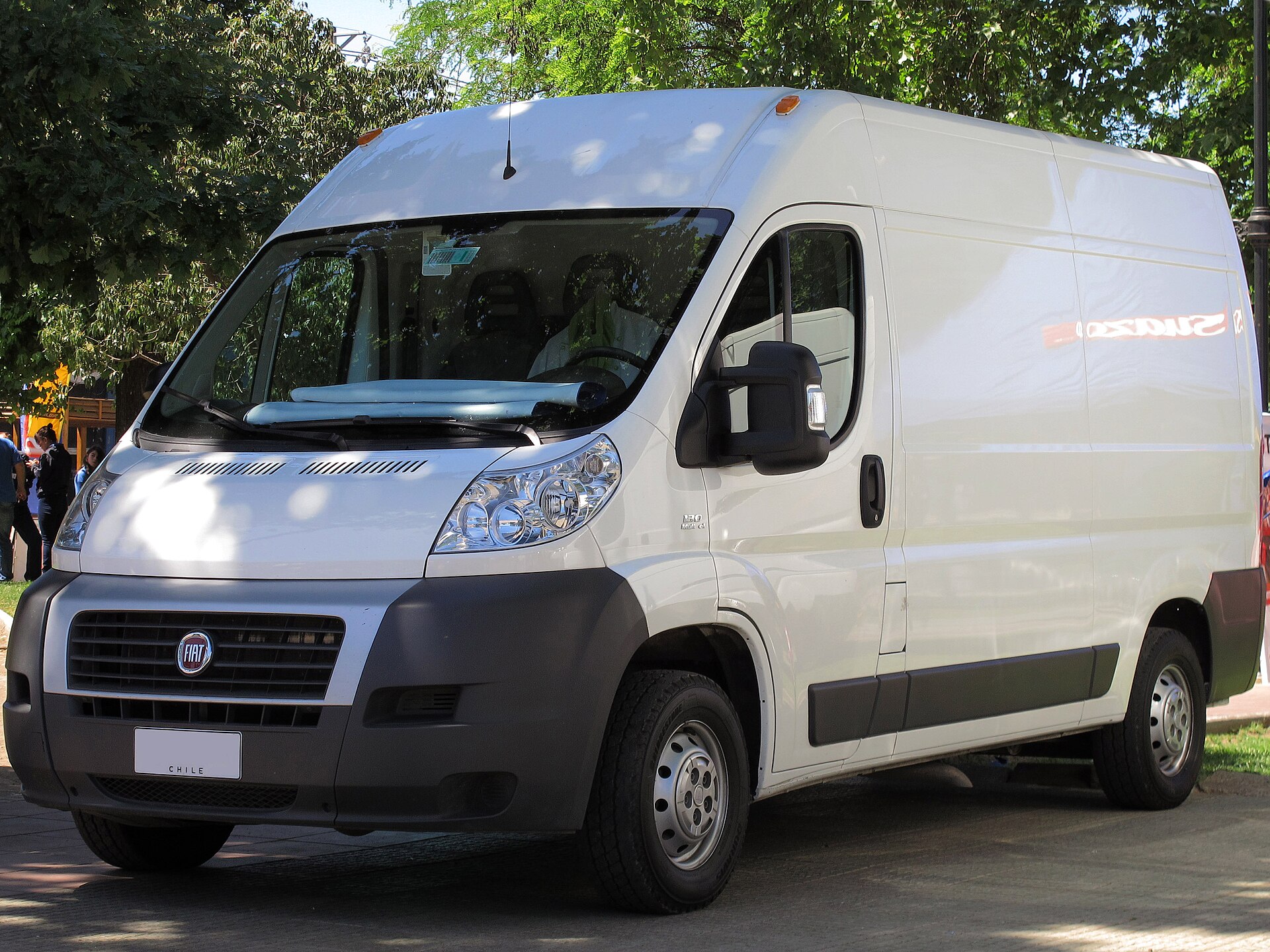
The Fiat Ducato is a large front-wheel-drive van that Fiat has built since 1981, together with Peugeot and Citroën, through the Sevel joint venture. Its twins have been sold as the Peugeot J5 and Boxer, the Citroën C25, Jumper and Relay, the Talbot Express and, in North America, the Ram ProMaster. More than 3.5 million Ducatos have been produced, mainly at Atessa in Italy, and the Ducato is the base of about two-thirds of all motorhomes in Europe.
In short
- Built since 1981 by Sevel (Fiat and PSA, today Stellantis), mainly at Sevel Sud in Atessa, Italy; over 3.5 million made.
- Generations of 1981, 1994 and 2006, with major updates in 2014 (X290), 2021 and 2024.
- Diesel engines from 1.9 litres in 1981 to today's 2.2 Multijet with 88–132 kW (120–180 PS); electric E-Ducato since 2021.
- Europe's most common motorhome chassis; sold as the Ram ProMaster in the US since 2013.
Fiat Ducato at a glance
| Specification | Fiat Ducato |
|---|---|
| Segment | large van / light commercial vehicle (about 2.5–4.0 t gross weight) |
| Production | since 1981 |
| Maker | Sevel (Fiat and PSA joint venture, today Stellantis) |
| Main plant | Sevel Sud, Atessa, Italy; others in Brazil, Mexico (Ram ProMaster), Poland (CKD) |
| Body styles | panel van, minibus, chassis cab, platform cab, dropside, motorhome base |
| Layout | front engine, front-wheel drive; 4x4 conversions by Dangel |
| Load volume | 8–17 m³ (third generation onwards) |
| Engines | diesel, petrol (early and Brazil), CNG, electric |
| Twins | Peugeot J5/Boxer, Citroën C25/Jumper/Relay, Talbot Express, Alfa Romeo AR6, Ram ProMaster, Opel/Vauxhall Movano (from 2021), Toyota Proace Max (from 2023) |
The Ducato is listed in our Fiat catalogue, next to its smaller stablemate described in the Fiat Doblo guide.
History: the Sevel joint venture
Development started in 1978, and in 1981 Fiat and PSA Peugeot Citroën founded the Sevel joint venture to build a common large van. The Ducato, named after the ducat coin, was produced at Atessa and Pomigliano d'Arco. The same vehicle was sold as the Peugeot J5, the Citroën C25, the Alfa Romeo AR6 (in Italy only, until Alfa Romeo left the commercial-vehicle business in 1986) and, in Britain, the Talbot Express.
The first Ducato came with 1.8- and 2.0-litre petrol engines and a 1.9-litre diesel, later a 2.5-litre turbodiesel. Payload versions were called Ducato 10, 13, 14 and Maxi 18, for loads of 1.0 to 1.8 tonnes. An electric Ducato Elettra appeared as early as August 1992. Production passed three million vehicles on 15 December 2005.

Fiat Ducato generations
| Generation | Code | Years | Body styles | Engines | Power (kW / hp) |
|---|---|---|---|---|---|
| First | - | 1981–1993 | van, minibus, chassis cab, camper | 1.8/2.0 petrol, 1.9 diesel, 2.5 TD | 51–70 kW (68–94 hp) |
| Second | - | 1994–2006 | van, minibus, chassis cab, camper | petrol, 1.9–2.8 diesel incl. 2.3 JTD | up to 107 kW (144 hp) |
| Third | - | 2006–2014 | van, minibus, chassis cab, platform cab, dropside, camper | 2.3 and 3.0 Multijet | up to 130 kW (175 hp) |
| Third, facelift | X290 | 2014–2024 | as above; electric from 2021 | Multijet diesels (Euro 6 from 2017); electric | E-Ducato 90 kW (121 hp) |
| Third, second facelift | X290 | from 2024 | as above | 2.2 Multijet (Euro 6e), electric | 88–132 kW (118–177 hp); E-Ducato 200 kW |
Wikipedia counts the 2014 X290 as a fourth generation; it is the same basic van as the 2006 model, heavily updated.
Second and third generation
The second Ducato arrived in 1994 (shown in 1993). Peugeot renamed its version Boxer and Citroën Jumper (Relay in the UK). Gross weight classes were now 29, 30, 33 and Maxi 35, from 2.9 to 3.5 tonnes, and a facelift followed in February 2002 with the 2.3 JTD common-rail diesel (81 kW, 110 PS).
The third generation was launched in 2006 for the 2007 model year. It came in three wheelbases (3,000, 3,450 and 4,035 mm), four lengths from 4,963 to 6,363 mm and three roof heights, with up to 4.0 tonnes gross weight (Maxi 40). The 3.0 Multijet diesel produced up to 130 kW (177 PS) and 400 Nm.
In October 2014 the facelifted X290 version appeared as a 2015 model, and Euro 6 engines followed in 2017. Updates in 2021 added driver-assistance systems. For 2022 Fiat redesigned the dashboard and added an optional nine-speed automatic gearbox. The second facelift was revealed on 23 October 2023 and brought Euro 6e engines in 2024.

Engines, transmissions and performance
| Engine | Period | Power | Torque |
|---|---|---|---|
| 1.8 petrol | first generation | 51 kW (69 PS) | 136 Nm |
| 2.0 petrol | first generation | 63 kW (86 PS) | 160 Nm |
| 2.5 TD diesel (Sofim) | first generation | 70 kW (95 PS) | 216 Nm |
| 2.3 JTD | 2002–2006 | 81 kW (110 PS) | 270 Nm |
| 2.8 JTD Power | second generation | 107 kW (146 PS) | 310 Nm |
| 3.0 Multijet 160 | third generation | 115 kW (157 PS) | 400 Nm |
| 3.0 Multijet Power 180 | third generation | 130 kW (177 PS) | 400 Nm |
| 2.2 Multijet (Pratola Serra) | from 2024 | 88 / 103 / 132 kW (120 / 140 / 180 PS) | - |
| Electric E-Ducato | 2021–2023 | 90 kW (122 PS) | 280 Nm |
| Electric E-Ducato | from 2024 | 200 kW (272 PS) | 410 Nm |
Second-generation goods vans had a five-speed manual or a four-speed automatic, and since 2022 a nine-speed automatic has been optional. In North America the Ram ProMaster uses the same body with a 3.6-litre Pentastar V6 petrol engine of 209 kW (280 hp).


The electric E-Ducato
Fiat announced the electric Ducato in 2019, and the E-Ducato went on sale in 2021 with a 90 kW motor and a choice of 47 kWh or 79 kWh batteries; Fiat estimated about 280 km of WLTP range with the larger battery. The 2024 version switched to a 110 kWh battery and a 200 kW motor with 410 Nm. The US equivalent, the Ram ProMaster EV, was unveiled in January 2024. The idea is not new: the Ducato Elettra of 1992 used a 43 kW motor and 28 lead-acid batteries for a range of about 70 km.
Dimensions and load space (third generation)
| Parameter | Metric | Imperial |
|---|---|---|
| Wheelbases | 3,000 / 3,450 / 4,035 mm | 118.1 / 135.8 / 158.9 in |
| Overall lengths | 4,963 / 5,413 / 5,998 / 6,363 mm | 195.4 / 213.1 / 236.1 / 250.5 in |
| Roof heights | H1 2,254 / H2 2,522 / H3 2,764 mm | 88.7 / 99.3 / 108.8 in |
| Interior width | 1,870 mm | 73.6 in |
| Load volume | 8–17 m³ | 283–600 cu ft |
| Gross vehicle weight | up to 4.0 t (Maxi 40) | up to 8,818 lb |
Motorhomes and markets
The Ducato's low, front-wheel-drive chassis cab is the most widely used motorhome base in Europe, chosen for about two-thirds of all motorhomes. In North America the Ram ProMaster has been sold since October 2013 (2014 model year) and is built in Saltillo, Mexico; US sales reached 81,663 in 2023. ANCAP rated the Ducato at 88% (Platinum) in 2020 and 77% (Gold) in 2024.
Rivals and which Ducato to choose
The Ducato's main rivals in Europe are the Mercedes-Benz Sprinter, the Volkswagen Crafter and the Ford Transit. Like the Ram ProMaster in the US, the Ducato uses front-wheel drive and a low floor. The comparison tool shows the vans side by side.
- For motorhome conversions: a third-generation chassis cab with the 2.3 or 3.0 Multijet, the base most European converters use.
- For maximum payload: the Maxi versions with up to 4.0 tonnes gross weight.
- For city deliveries: the E-Ducato; the 2024 version has a 110 kWh battery, more than twice the capacity of the 47 kWh first model.
- For easy driving: a 2022-on van with the nine-speed automatic.
Photo gallery


FAQ
How many generations of the Fiat Ducato are there?
Three basic designs (1981, 1994, 2006); Wikipedia counts the heavily updated 2014 X290 as a fourth generation, facelifted again in 2024.
Who builds the Fiat Ducato?
Sevel, the joint venture of Fiat and PSA founded in 1981 and now part of Stellantis, mainly at Atessa in Italy.
Is there an electric Fiat Ducato?
Yes. The E-Ducato has been sold since 2021; the 2024 model has a 110 kWh battery and a 200 kW motor.
Why are so many motorhomes built on the Ducato?
It is the most common motorhome base in Europe: about two-thirds of motorhomes use the Ducato chassis.
What are the twins of the Fiat Ducato?
The Peugeot Boxer, Citroën Jumper/Relay, Opel/Vauxhall Movano (from 2021), Toyota Proace Max (from 2023) and Ram ProMaster; earlier the Peugeot J5, Citroën C25, Talbot Express and Alfa Romeo AR6.


