 Volkswagen Crafter
All generations, specs and history
Published Sources (2) Report an error
By Felix Hartmann, Automotive Technology & EV Contributor
- Built
- 2006–present
- Generations
- 2
Timeline
Crafter generations
Click a generation for its own page


- Crafter I 2006–2016 · Van, Minibus
- Crafter II Current 2016–now · Van, Minibus
Newest first · 2 generations since 2006
All generations by year: Crafter II (2016–now) · Crafter I (2006–2016)
Which one is mine?
Pick the year of first registration to see which generation it is.
- Crafter II 2016–present
- Crafter I 2006–2016
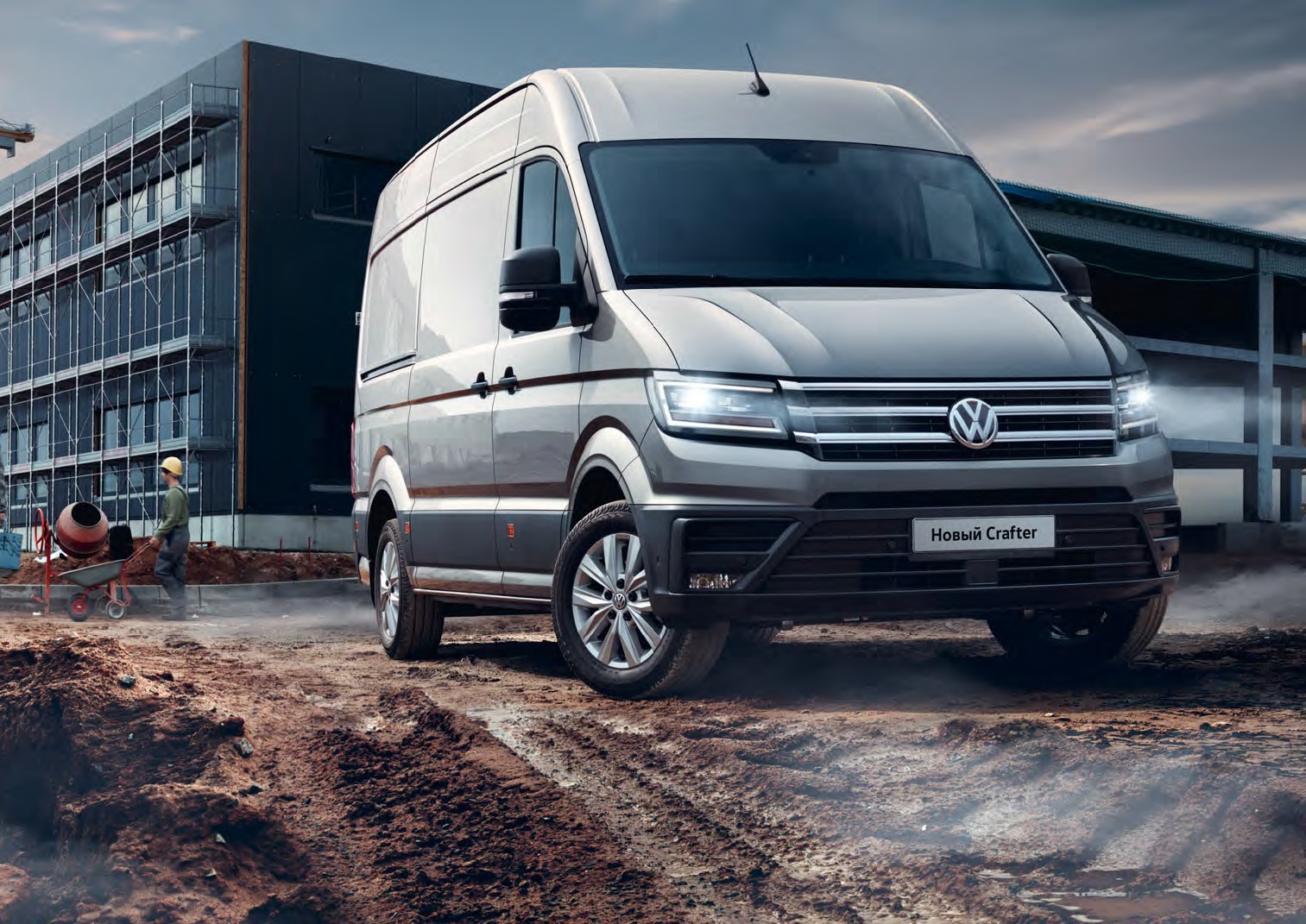
The Volkswagen Crafter is Volkswagen Commercial Vehicles' large van, sitting above the Transporter. Launched in 2006 to replace the LT, the first generation was developed with Mercedes-Benz as a twin of the Sprinter. The second generation, unveiled in September 2016 at the IAA Commercial Vehicles show in Hanover, was designed by Volkswagen from scratch and is built at a dedicated new plant in Września, Poland. It is offered as a panel van, minibus, chassis cab and double cab, as an electric e-Crafter and as the basis of the Grand California motorhome, and it is also sold as the MAN TGE.
In short
- First generation (2006–2016): Mercedes-Benz Sprinter twin built in Germany, with 2.5 and later 2.0 TDI diesels.
- Second generation (since 2016): Volkswagen's own design with front-, rear- or four-wheel drive (4MOTION).
- 2.0 TDI diesels with 80–132 kW (109–179 PS) and an eight-speed automatic option.
- Load volume of 9.9 to 18.3 m³ and room for four to six Euro pallets.
Volkswagen Crafter at a glance
The Crafter is a large diesel or electric van, available in several lengths, heights and weight classes up to 5.3 tonnes. More Volkswagen models are listed in our Volkswagen catalogue.
Volkswagen Crafter generations
| Generation | Years | Built at | Engines |
|---|---|---|---|
| First | 2006–2016 | Ludwigsfelde and Düsseldorf, Germany (Mercedes-Benz) | 2.5 TDI, 65–120 kW (88–163 PS); from 2011 2.0 TDI and BiTDI, 80–120 kW (109–163 PS) |
| Second | 2016 onwards | Września, Poland | 2.0 TDI and BiTDI, 80–132 kW (109–179 PS); e-Crafter 100 kW (136 PS) |
First generation (2006–2016)
The first Crafter shared its body and chassis with the Mercedes-Benz Sprinter but used Volkswagen engines. It was built by Mercedes-Benz at Ludwigsfelde and Düsseldorf, with wheelbases of 3,250, 3,665 and 4,325 mm, overall lengths from 5,245 to 6,930 mm and heights from 2,365 to 3,050 mm. Until 2011 it used a five-cylinder 2.5 TDI common-rail diesel with 65 to 120 kW (88 to 163 PS). An April 2011 facelift introduced four-cylinder 2.0 TDI engines with 80 or 100 kW (109 or 136 PS) and a twin-turbo 2.0 BiTDI with 120 kW (163 PS) and 400 Nm. Gearboxes were a six-speed manual and a six-speed automated Shiftmatic, and from March 2012 a 4MOTION all-wheel-drive option was available with the BiTDI engine.
Second generation (2016 onwards)
For the second generation Volkswagen built a new factory in Września, Poland, designed for up to 85,000 vans a year. The new Crafter was developed by Volkswagen itself and offers a choice of front-wheel drive, rear-wheel drive and 4MOTION all-wheel drive. The front-wheel-drive version has a lower load floor and therefore a larger cargo space.
Body versions and load space
The second-generation panel van comes in three lengths: 5,986 mm standard and 6,836 or 7,391 mm extended. It is offered in three heights of 2,355, 2,590 and 2,798 mm. Depending on length and height, the load compartment offers 9.9 to 18.3 m³ and takes four to six standard Euro pallets measuring 800 × 1,200 mm. They can be loaded through the rear doors or through the sliding side door, whose opening is 1,311 mm wide.
The Crafter is also available as a chassis cab with a single or double cab and a dropside body, whose load area measures 5.5 to 9.6 m² depending on length. Chassis cab and double cab versions carry payloads from 1,472 to 3,026 kg, with gross vehicle weights of 3.5 or 5.3 tonnes. The Grand California motorhome, first shown at the Düsseldorf caravan show in 2018, is built on the Crafter.
Engines and transmissions (second generation)
| Engine | Power (kW / PS) | Torque |
|---|---|---|
| 2.0 TDI | 80 kW / 109 PS | 300 Nm |
| 2.0 TDI | 84 kW / 114 PS | 300 Nm |
| 2.0 TDI | 103 kW / 140 PS | 340 Nm |
| 2.0 BiTDI | 132 kW / 179 PS | 400 Nm |
| e-Crafter (electric) | 100 kW / 136 PS | 290 Nm |
All diesels are 2.0-litre four-cylinder TDI engines with common-rail injection, and they meet the Euro 6 standard. According to published figures, they use up to 8 l/100 km in town and 9–10 l/100 km in mixed driving under typical van loads. A six-speed manual gearbox is standard, and front-wheel-drive models can have an eight-speed automatic.
e-Crafter
The electric e-Crafter was unveiled alongside the new Crafter in September 2016. The 43 kWh battery and 208 km range announced in 2016 were cut for series production, which began in 2018. The production van has a 35.8 kWh battery and a range of 173 km in the NEDC cycle. The 100 kW (136 PS) motor produces 290 Nm, top speed is limited to 90 km/h and payload is 1.0–1.75 tonnes depending on version. With 11.3 m³ of load space, the van suits urban delivery work. The MAN eTGE is its twin.
Chassis and safety
The Crafter's suspension is tuned to give good handling at higher speeds while remaining compliant on rough roads. Electronic stability control with seven integrated sub-functions is standard, according to published figures.
Key specifications (second generation)
| Parameter | Value |
|---|---|
| Lengths | 5,986 / 6,836 / 7,391 mm |
| Heights | 2,355 / 2,590 / 2,798 mm |
| Load volume | 9.9–18.3 m³ |
| Euro pallets | 4–6 |
| Side-door opening | 1,311 mm |
| Payload (chassis versions) | 1,472–3,026 kg |
| Gross vehicle weight | 3.5 or 5.3 t |
| Diesel power | 80–132 kW (109–179 PS) |
| Drive | FWD, RWD, 4MOTION |
Strengths and weaknesses
The Crafter's strengths are its wide choice of lengths, heights and body types, a large and well-shaped load space, the choice of front-, rear- or all-wheel drive, efficient diesels, an eight-speed automatic and standard stability control. The e-Crafter's limited range and speed restrict it to urban use, and the largest versions need care in tight city streets. Its main rivals are the Mercedes-Benz Sprinter, Ford Transit, Renault Master, Fiat Ducato, Peugeot Boxer, Citroën Jumper and Iveco Daily, and its twin, the MAN TGE.
Image credits · Photos from Wikimedia Commons under free licences
- Volkswagen Crafter I · Photo: Rudolf Stricker / Wikimedia Commons, CC BY-SA 3.0
- Volkswagen Crafter II · Photo: Vauxford / Wikimedia Commons, CC BY-SA 4.0
FAQ
Is the Volkswagen Crafter the same as the Mercedes-Benz Sprinter?
The first generation (2006–2016) was a Sprinter twin built by Mercedes-Benz; the second generation is Volkswagen's own design.
Where is the Volkswagen Crafter built?
The second generation is built at Volkswagen's plant in Września, Poland.
What engines does the Volkswagen Crafter have?
The current Crafter uses 2.0 TDI diesels with 80–132 kW (109–179 PS); the e-Crafter has a 100 kW (136 PS) electric motor.
How many pallets fit in a Volkswagen Crafter?
Between four and six Euro pallets, depending on length and height.
Data sources
Data checked by an editor against the sources below.
- Wikipedia — Volkswagen Crafter
- Wikipedia — VW Crafter