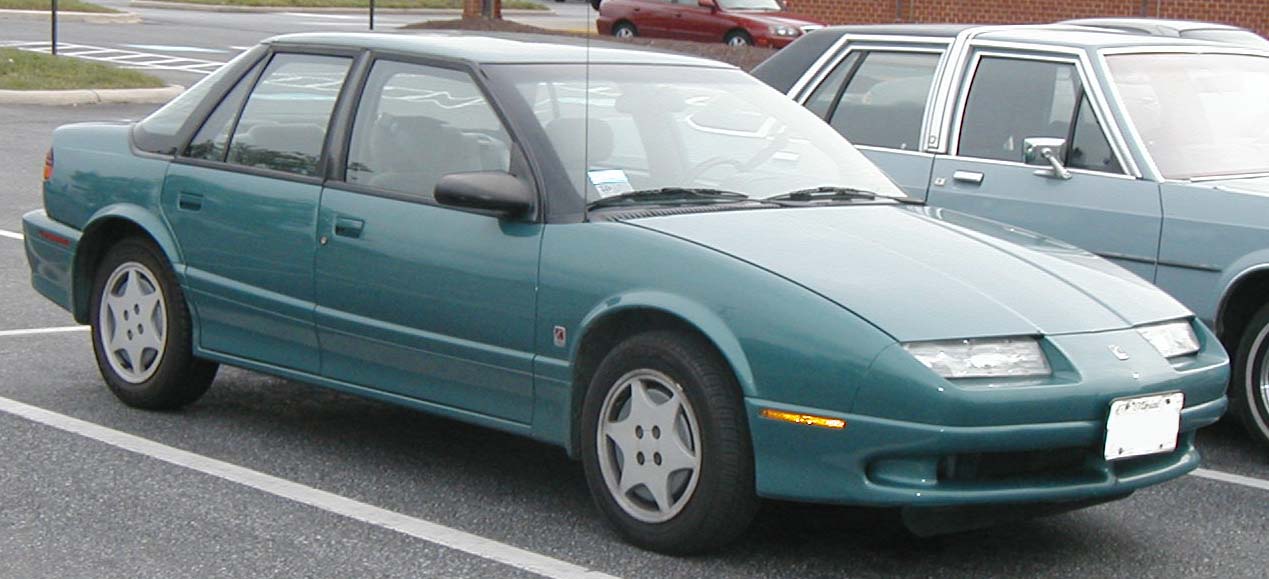
Saturn — The GM Brand Built in Spring Hill, 1985–2010
Saturn was an American car brand created by General Motors in 1985 to build small cars in a new way. It had its own factory in Spring Hill, Tennessee, its own dealers and fixed "no-haggle" prices. Its first car, the S-Series, used dent-resistant plastic body panels on a space frame and sold up to 286,003 Saturns in the peak year of 1994. In the 2000s the range grew with the Vue, Ion and Sky and then turned to rebadged Opel models. After a planned sale to Penske Automotive collapsed in 2009, GM closed the brand, and the last franchises ended on 31 October 2010.
Key takeaways
- Founded on 7 January 1985 as a General Motors subsidiary; first president Roger B. Smith.
- The first Saturn, a red SL2, was built at Spring Hill on 30 July 1990; the one millionth car followed in May 1995.
- The Vue compact SUV (2002–2010) was the best-selling Saturn model; the Sky roadster shared the Kappa platform with the Pontiac Solstice.
- GM ended production on 7 October 2009 after Penske dropped its purchase plan.
Saturn at a glance
| Fact | Value |
|---|---|
| Founded | 7 January 1985, subsidiary of General Motors |
| Main plant | Spring Hill, Tennessee |
| First car | Red 1991 model-year SL2, built 30 July 1990 |
| Sales approach | Own dealer network, fixed no-haggle prices |
| Best year | 286,003 vehicles sold (1994) |
| Best-known models | S-Series, L-Series, Vue, Ion, Sky, Aura, Outlook |
| Production ended | 7 October 2009 |
| Franchises ended | 31 October 2010 |
Origins: a new small car for General Motors
Saturn started as an internal project. In June 1982 Alex C. Mair began talks on a new small car codenamed Saturn, and in November 1983 GM chairman Roger B. Smith and president F. James McDonald made the idea public. A first demonstration vehicle followed in about November 1984, and on 7 January 1985 Saturn Corporation was founded as a subsidiary of General Motors, with Smith as its first president. The same year GM decided to make Saturn a separate brand rather than a model line inside an existing division.
The new company was meant to break with GM's usual practice. It had its own plant in Spring Hill, Tennessee, its own retailers and a sales approach based on fixed prices without haggling. The Wall Street Journal called the project overly ambitious in 1992 because "everything at Saturn is new".
The S-Series and Spring Hill
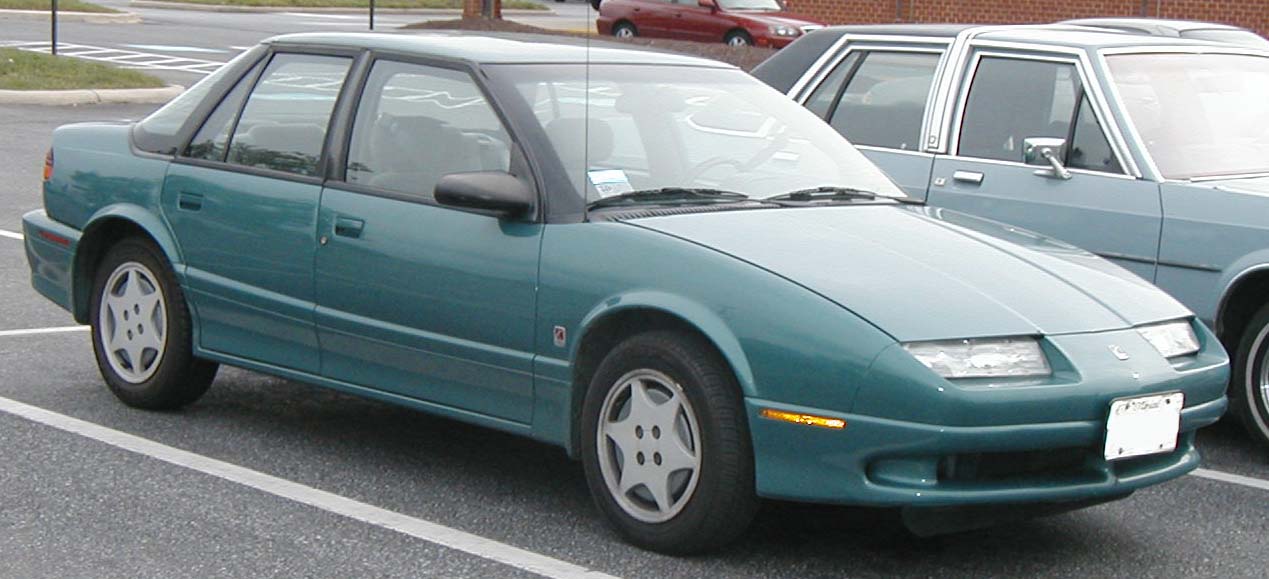
The first Saturn, a red SL2 of the 1991 model year, was built on 30 July 1990, and the first dealer opened in Memphis, Tennessee. The S-Series was offered as the SL saloon and SC coupé, with the SW estate added for 1993. It used a space frame developed in-house and side panels of non-load-carrying polymer that resisted dents, a feature that remained a Saturn selling point almost until the end.
The 1.9-litre four-cylinder came in three main forms. The SL1 and SC1 had a SOHC engine of 63 kW (85 hp), later 75 kW (100 hp) with multi-point injection. The SL2 and SC2 used a DOHC version of 92 kW (123 hp). Early sales fell short of plans, partly because of the recession of the early 1990s, but the 500,000th car was built in 1993 and annual sales peaked at 286,003 in 1994. Estimated S-Series output was highest in 1997, at about 314,992 cars. The Saturn S-Series article describes the three generations.
Saturn also looked abroad. Exports to Taiwan began in June 1992, Canada followed, and in July 1996 the brand signed agreements with six Japanese makers, including Honda and Nissan, to sell its cars in Japan. In 1997 it became the first GM North American product built with right-hand drive on the same line as left-hand-drive cars. Sales in Japan stayed small, at about 1,400 cars in 16 months. Saturn dealers also distributed the GM EV1 electric car from 1996, and the two millionth Saturn was completed in January 1999.

L-Series, Vue and Ion
From 2000 the brand grew beyond small cars. The mid-size L-Series shared the GM2900 platform with the Opel Vectra and was built in Wilmington, Delaware. The Vue of the 2002 model year was the first vehicle on GM's Theta platform and became Saturn's best-selling model; its US sales reached 91,972 in 2005. Engines ranged from a 2.2-litre four of 107 kW (143 hp) to a Honda-built 3.5-litre V6 of 186 kW (250 hp). The Green Line mild hybrid of 2007 raised the EPA rating from 22/27 to 27/32 mpg in city and highway driving.
The Ion replaced the S-Series for 2003. Built on the Delta platform, it was offered as a saloon and as a Quad Coupe with small rear-hinged doors. The supercharged 2.0-litre Red Line had 153 kW (205 hp), and 5,827 were built from 2004 to 2007. On 17 October 2003 an Ion Red Line set a speed record of 212.684 mph (342.3 km/h) at Bonneville. The last Saturn built at Spring Hill was a 2007 Ion. In 2004 GM and the UAW ended the separate Spring Hill labour contract.

Sky, Aura and the Opel years
The Sky roadster arrived for the 2007 model year. It was a softer, more luxurious version of the Pontiac Solstice on the Kappa platform, built in Wilmington alongside the Opel GT, its European sister. The Red Line version, shown in New York on 11 April 2006, used a 2.0-litre turbo engine of 194 kW (260 hp) and started at US$29,795 in the United States in 2006. The Sky's best year was 2007, with 11,263 sold.
In 2007 the Aura mid-size saloon and the Outlook crossover joined the range, and late that year the Astra, a rebadged Opel Astra built in Antwerp, Belgium, went on sale, replacing the Ion. The second-generation Vue of 2008 was a rebadged Opel Antara built in Ramos Arizpe, Mexico.

The end: Penske and the closure
GM's restructuring decided Saturn's fate. On 2 December 2008, in hearings before the US Congress, GM said it would focus on four core brands. In February 2009 it declared its intention to sell or close Saturn as part of a restructuring linked to government loans. In June 2009 GM agreed to sell the brand to Penske Automotive Group. On 30 September 2009 Penske ended the deal because it could not find another manufacturer to build the cars.
GM ended Saturn production on 7 October 2009 and closed all 46 Canadian dealers. In February 2010 it offered owners up to US$2,000 in incentives, valid until 31 March 2010, to switch to other GM brands. On 31 October 2010 the franchises ended, 25 years after the company began. The models are listed in the Saturn catalogue, and the timing of Saturn against other makes can be seen on the brands timeline.

Saturn timeline
| Year | Event |
|---|---|
| 1982 | Small-car project codenamed Saturn begins |
| 1985 | Saturn Corporation founded (7 January) |
| 1990 | First Saturn, an SL2, built (30 July) |
| 1993 | SW estate; 500,000th car |
| 1994 | Record sales of 286,003 vehicles |
| 1995 | One millionth Saturn (May) |
| 1996 | Agreements to sell in Japan; EV1 at Saturn dealers |
| 1999 | Two millionth Saturn |
| 2000 | L-Series mid-size car |
| 2002 | Vue compact SUV |
| 2003 | Ion replaces the S-Series |
| 2006 | Sky roadster (2007 model year) |
| 2008 | Astra and Opel-based Vue |
| 2009 | Penske deal collapses; production ends (7 October) |
| 2010 | Franchises end (31 October) |
Landmark Saturn models
| Model | Years | Why it matters |
|---|---|---|
| S-Series | 1990–2002 | Plastic body panels, space frame, no-haggle sales |
| L-Series | 2000–mid-2000s | First mid-size Saturn, Opel Vectra platform |
| Vue | 2002–2010 | Best-selling Saturn, first Theta platform vehicle |
| Ion Red Line | 2004–2007 | Supercharged Quad Coupe, Bonneville record |
| Sky | 2007 model year onwards | Kappa roadster, Red Line with 194 kW |
| Astra | 2008–2009 | Rebadged Opel Astra from Antwerp |
Photo gallery

FAQ
Why did GM create Saturn?
To build small cars in a new way. The project began in 1982, and Saturn was founded in 1985 with its own plant in Spring Hill, Tennessee, its own dealers and fixed prices.
What was special about Saturn cars?
The S-Series had dent-resistant polymer side panels on a space frame, and Saturn sold its cars at fixed prices without haggling.
What was the best-selling Saturn?
The Vue compact SUV, sold from the 2002 to the 2010 model year, with peak US sales of 91,972 in 2005.
Why did Saturn close?
GM decided to sell or close the brand during its 2009 restructuring. A sale to Penske Automotive Group collapsed in September 2009, and GM ended production on 7 October 2009.
Were later Saturns based on Opel models?
Yes. The Astra was a rebadged Opel Astra, the second Vue was based on the Opel Antara, and the Sky had a European twin in the Opel GT.
Sources
- Wikipedia — Saturn Corporation (accessed 24 Oct 2026)
- Wikipedia — Saturn S-Series (accessed 24 Oct 2026)
- Wikipedia — Saturn Ion (accessed 24 Oct 2026)
- Wikipedia — Saturn Vue (accessed 24 Oct 2026)
- Wikipedia — Saturn Sky (accessed 24 Oct 2026)
Found a mistake? Report an error