Matra — the aerospace group that built the Bagheera and the Espace
Matra was a French aerospace and defence group that also built some of the most unusual French cars of the 1960s to 1990s. Its car division at Romorantin made the mid-engined 530, the three-seat Bagheera and Murena, the Rancho leisure vehicle and, for Renault, the first three generations of the Espace people carrier. In motor sport Matra won the Formula One drivers' and constructors' championships in 1969 and the 24 Hours of Le Mans three times in a row from 1972. After the slow-selling Renault Avantime, Matra Automobiles closed its factory in 2003.
Key takeaways
- Matra (Mécanique Aviation Traction) was founded in 1945; Jean-Luc Lagardère became chief executive in 1963.
- Matra took over the sports car maker René Bonnet in 1964 and showed its own 530 at the Geneva Motor Show on 7 March 1967.
- The Bagheera of 1973 seated three abreast; 47,802 were built, followed by 10,680 Murenas with the first fully galvanised chassis.
- Matra built 316,419 Espace II and 357,120 Espace III before Renault took over the Espace in 2002.
Matra at a glance
| Fact | Value |
|---|---|
| Founded | 1945 (Mécanique Aviation Traction) |
| Leader | Jean-Luc Lagardère, chief executive from 1963 |
| Car plant | Romorantin |
| Partners | Chrysler Europe / Simca, Talbot, Renault |
| Best-known cars | 530, Bagheera, Rancho, Murena, Renault Espace, Avantime |
| Formula One | 1969 drivers' and constructors' champion |
| Le Mans | Overall wins in 1972, 1973 and 1974 |
| End of cars | Romorantin factory closed in 2003 |
Aircraft, missiles and a move into cars
Matra was established in 1945 and began work on a twin-engined propeller aircraft. In 1951 an aircraft with a Matra-built engine was the first in Europe to break the sound barrier in level flight. In 1961 Matra became the first prime contractor for European satellites. In 1963 Jean-Luc Lagardère was appointed chief executive of a company with 1,450 workers.
The step into cars came in 1964, when Matra bought Automobiles René Bonnet, a small maker of sports cars. The Matra article gives 1963 in its car section. The firm became the base of Matra's car division.
The 530 and the racing years
Matra's first own design, the M530, appeared at the Geneva Motor Show on 7 March 1967. It was designed by Philippe Guédon, a former Simca designer, with a body styled by Jacques Nochet. The car had a targa roof and a Ford Taunus V4 engine mounted in the middle. The first version had 54.4 kW (74 PS), and the M530 A of 1969 had 58.2 kW (79 PS). Giovanni Michelotti redesigned the car in 1970 as the LX. A total of 9,609 were built from 1967 to 1973.
At the same time Matra became a serious racing team. Equipe Matra Sports entered French Formula 3 in 1965, and Matra was a Formula One constructor from 1967 to 1972. In 1969 it won both the drivers' and the constructors' championships. Later its sports prototypes won the 24 Hours of Le Mans outright in 1972, 1973 and 1974. Matra withdrew from motor sport at the end of 1974.
Matra-Simca: Bagheera, Rancho and Murena
In the early 1970s Matra sold its car division to Chrysler Europe, the owner of Simca.
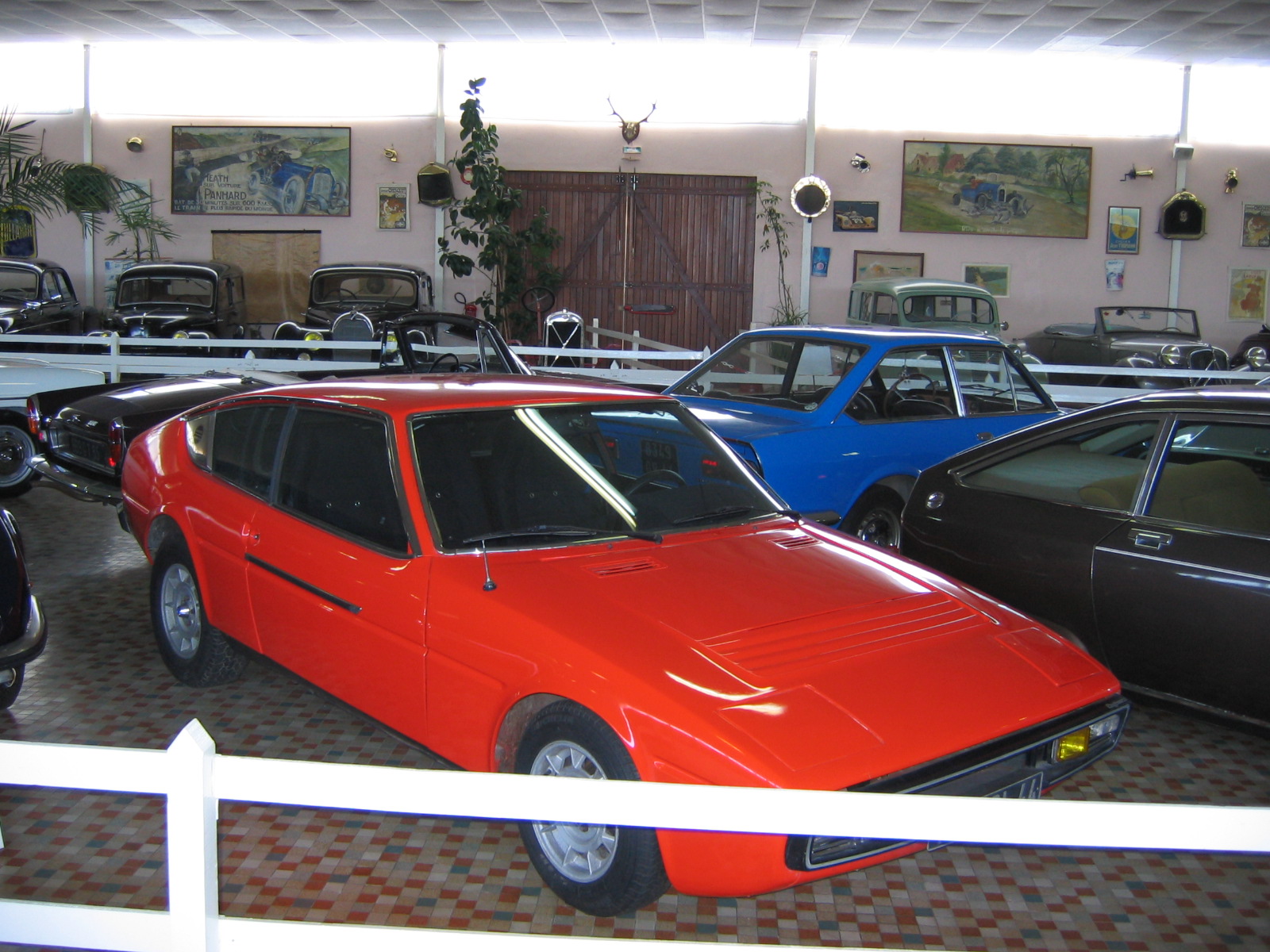
The Bagheera was unveiled to the press at Lake Annecy on 14 April 1973 and shown to the public at the 24 Hours of Le Mans that year. It had a mid-mounted Simca engine and a remarkable seating layout: three seats side by side, a driver's seat plus a two-place bench. The 19 body panels were made of glass-fibre-reinforced polyester on a pressed-steel chassis. Engines were the 1,294 cc Simca unit with 62.6 kW (84 hp) and, in the S, the 1,442 cc unit from the Simca 1308 GT with 67.1 kW (90 hp).
The steel chassis had almost no rust protection, and many cars corroded badly. A prototype with an eight-cylinder "U" engine made from two Simca blocks was not approved by Chrysler, and only three were built. Production ended in April 1980 after 47,802 cars.
The Rancho of 1977 was a different idea: a leisure vehicle in the style of the Range Rover, built on the front structure and stretched chassis of the Simca 1100 pick-up. It used a 1,442 cc engine with 59 kW (80 hp), and 57,792 were built until 1984.
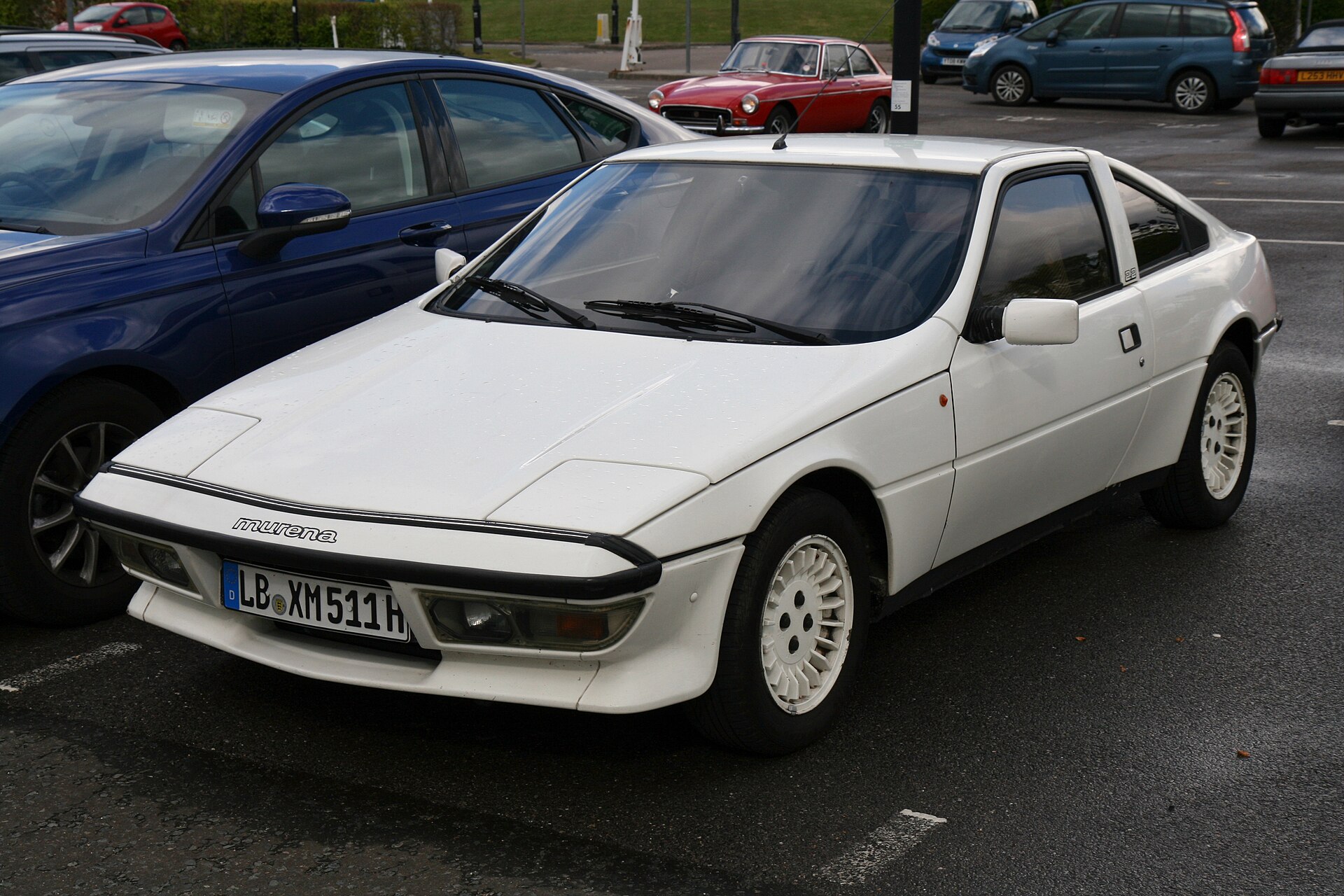
The Murena replaced the Bagheera in November 1980. It kept three seats but had a fully galvanised chassis, the first production car with galvanised steel for every chassis part:
| Murena | Engine | Power | Built |
|---|---|---|---|
| 1.6 | 1.6-litre Poissy four | 68 kW (92 PS) | 5,640 |
| 2.2 | 2.2-litre Type 180 four | 87 kW (118 PS) | 4,560 |
| Murena S | 2.2-litre, "Préparation 142" | 104 kW (142 PS) | 480 |
Production ended in July 1983, when the factory changed over to a new kind of car.

The Renault Espace
The Espace began in the 1970s as an idea of Fergus Pollock at Chrysler UK. Matra developed it for Simca, which was then part of Chrysler, to sell as a Talbot. PSA Peugeot Citroën, which had bought Chrysler's European business in 1978, judged it "too expensive and too risky a design to put into production". Matra took the design, called P23, to Renault. In 1983 Lagardère bought the car division back, and a partnership with Renault followed.
Renault launched the Espace in July 1984. Only nine were sold in the first month, but it went on to become a long-running success. Matra built the first three generations at Romorantin:
| Espace | Main production | Built by Matra |
|---|---|---|
| Espace I | 1984–1991 | Total not given in the sources |
| Espace II | 1991–1996 | 316,419 |
| Espace III | 1996–2002 | 357,120 |
The Espace IV of November 2002 was the first one developed and built entirely by Renault.
Avantime and the end of Matra Automobiles
Matra's last car was the Renault Avantime, which went into production in 2001. It sold poorly. On 27 February 2003 Matra Automobiles, declared bankrupt, announced that the Romorantin factory would close a month later.
In September 2003 Pininfarina bought Matra's engineering, testing and prototype businesses, which became Matra Automobile Engineering. Pininfarina sold its stake to Segula Technologies on 13 January 2009. The aerospace side had already moved on: Matra Hautes Technologies merged with Aérospatiale in February 1999, and Aérospatiale-Matra became part of EADS, now Airbus, on 10 July 2000.
The Matra models listed on 1cars are in the Matra catalogue, and the three-seat sports car has its own page on the Matra Bagheera. The partner brand is in the Simca catalogue, with the Simca 1000. The people carrier Matra built for Renault is covered on the Renault Espace generations page and in the history of Renault.
Matra timeline
| Year | Event |
|---|---|
| 1945 | Matra founded |
| 1963 | Jean-Luc Lagardère becomes chief executive |
| 1964 | René Bonnet taken over |
| 1967 | M530 shown in Geneva (7 March); Formula One debut |
| 1969 | Formula One drivers' and constructors' titles |
| 1972–1974 | Three Le Mans wins in a row |
| 1973 | Bagheera launched (14 April) |
| 1977 | Rancho launched |
| 1980 | Murena replaces the Bagheera |
| 1983 | Lagardère buys back the car division; Murena ends |
| 1984 | Renault Espace launched (July) |
| 2001 | Renault Avantime production begins |
| 2002 | Last Matra-built Espace III (September) |
| 2003 | Romorantin factory closes; engineering sold to Pininfarina |
Landmark Matra models
| Model | Years | Why it matters |
|---|---|---|
| M530 | 1967–1973 | First Matra design, mid-engined with a Ford V4; 9,609 built |
| Bagheera | 1973–1980 | Three seats abreast; 47,802 built |
| Rancho | 1977–1984 | Leisure vehicle on Simca 1100 basis; 57,792 built |
| Murena | 1980–1983 | First fully galvanised production chassis |
| Renault Espace I–III | 1984–2002 | People carrier built for Renault at Romorantin |
Photo gallery

FAQ
What did Matra build?
Aircraft parts, missiles and satellites, and from 1964 cars: the 530, Bagheera, Rancho and Murena under its own name, and the Espace and Avantime for Renault.
Did Matra design the Renault Espace?
Matra developed it from an idea by Fergus Pollock of Chrysler UK. After PSA turned it down, Matra took the design to Renault, which launched it in July 1984.
Why did the Matra Bagheera have three seats?
It used a driver's seat and a two-place bench side by side, so three people sat in one row of a mid-engined coupé.
Did Matra win in Formula One?
Yes. Matra won the drivers' and constructors' championships in 1969, and its sports cars won Le Mans in 1972, 1973 and 1974.
When did Matra stop making cars?
The Romorantin factory closed in 2003 after the Avantime sold poorly.
Sources
- Wikipedia — Matra (accessed 24 Oct 2026)
- Wikipedia — Matra Bagheera (accessed 24 Oct 2026)
- Wikipedia — Matra Murena (accessed 24 Oct 2026)
- Wikipedia — Matra 530 (accessed 24 Oct 2026)
- Wikipedia — Matra Rancho (accessed 24 Oct 2026)
- Wikipedia — Renault Espace (accessed 24 Oct 2026)
Found a mistake? Report an error