Li Auto — Li Xiang's range-extender SUVs, from the Li One to the L9
Li Auto is a Chinese maker of large family SUVs, founded in 2015 by Li Xiang, the entrepreneur behind the car website Autohome. Its formula has been unusual: most of its cars are "range extenders", driven only by electric motors but carrying a small petrol engine that recharges the battery. From the Li One of 2019 to the L-series of 2022, this made Li Auto one of the fastest-growing car makers in China. It sold 500,508 cars in 2024 and earned a net profit of CN¥8.04 billion (2024). Battery-electric models followed with the Mega people carrier and the i-series.
Key takeaways
- Li Xiang founded the company in Beijing in 2015 as Beijing Chehejia ("Car and Home"); it became Leading Ideal in 2019 and Li Auto in 2020.
- The Li One range-extender SUV was built in Changzhou from November 2019, with 240 kW and a 1.2-litre three-cylinder generator.
- Li Auto listed on Nasdaq in July 2020 and raised US$1.1 billion in its first round.
- Sales rose from 33,457 in 2020 to 376,030 in 2023 and 500,508 in 2024.
Li Auto at a glance
| Fact | Value |
|---|---|
| Founded | 2015, Beijing |
| Founder | Li Xiang (founder of PCPop and Autohome) |
| Former names | Chehejia / CHJ Auto; Leading Ideal (2019) |
| Listing | Nasdaq "LI", July 2020 |
| Plants | Changzhou; Beijing (Shunyi District, from 2021) |
| Technology | Range-extender electric drive; battery-electric from 2024 |
| Models | Li One, L6, L7, L8, L9, Mega, i8, i6 |
| Sales | 500,508 (2024); 406,343 (2025) |
Li Xiang and the founding
Li Xiang had built two internet businesses before turning to cars: the technology website PCPop and the car website Autohome.com.cn. In 2015 Li set up Beijing Chehejia Information Technology; the name means "Car and Home". The company's first idea was a small low-speed electric car. Early in 2018 Chehejia dropped that project, because the central government did not support legalising the vehicle class. A planned joint venture with the ride-hailing company DiDi, agreed the same year, collapsed soon after.
The company changed course to a large SUV with a range extender. In 2019 the Cayman Islands holding company Chehejia Technologies was renamed Leading Ideal, and in 2020 the name was shortened to Li Auto.
The Li One: a range-extender SUV
The Li One was presented at the Shanghai Auto Show in April 2019. Series production in Changzhou started in November 2019, and the first cars reached Chinese buyers in early 2020.
| Li One | Value |
|---|---|
| Drive | Two electric motors, all-wheel drive |
| Power | 100 kW front + 140 kW rear = 240 kW (326 PS) |
| Generator | 1.2-litre turbocharged three-cylinder from Dong'an Automotive |
| Battery | 40.6 kWh gross (37.2 kWh usable), NMC, from CATL |
| Electric range | 188 km NEDC; 155 km WLTP |
| Total range | 890 km; 1,080 km with the larger 55-litre tank |
The petrol engine never drives the wheels; it only charges the battery. The Li One sold 32,624 cars in China in 2020 and more than 45,000 by 1 April 2021. It was discontinued in October 2022 to make room for the L8.
In July 2020 Li Auto listed on the Nasdaq exchange under the symbol "LI" and raised US$1.1 billion in its first round. In October 2021 construction of a second plant began in Shunyi District, Beijing, on a site previously owned by Beijing Hyundai.

The L-series: L9, L8, L7 and L6
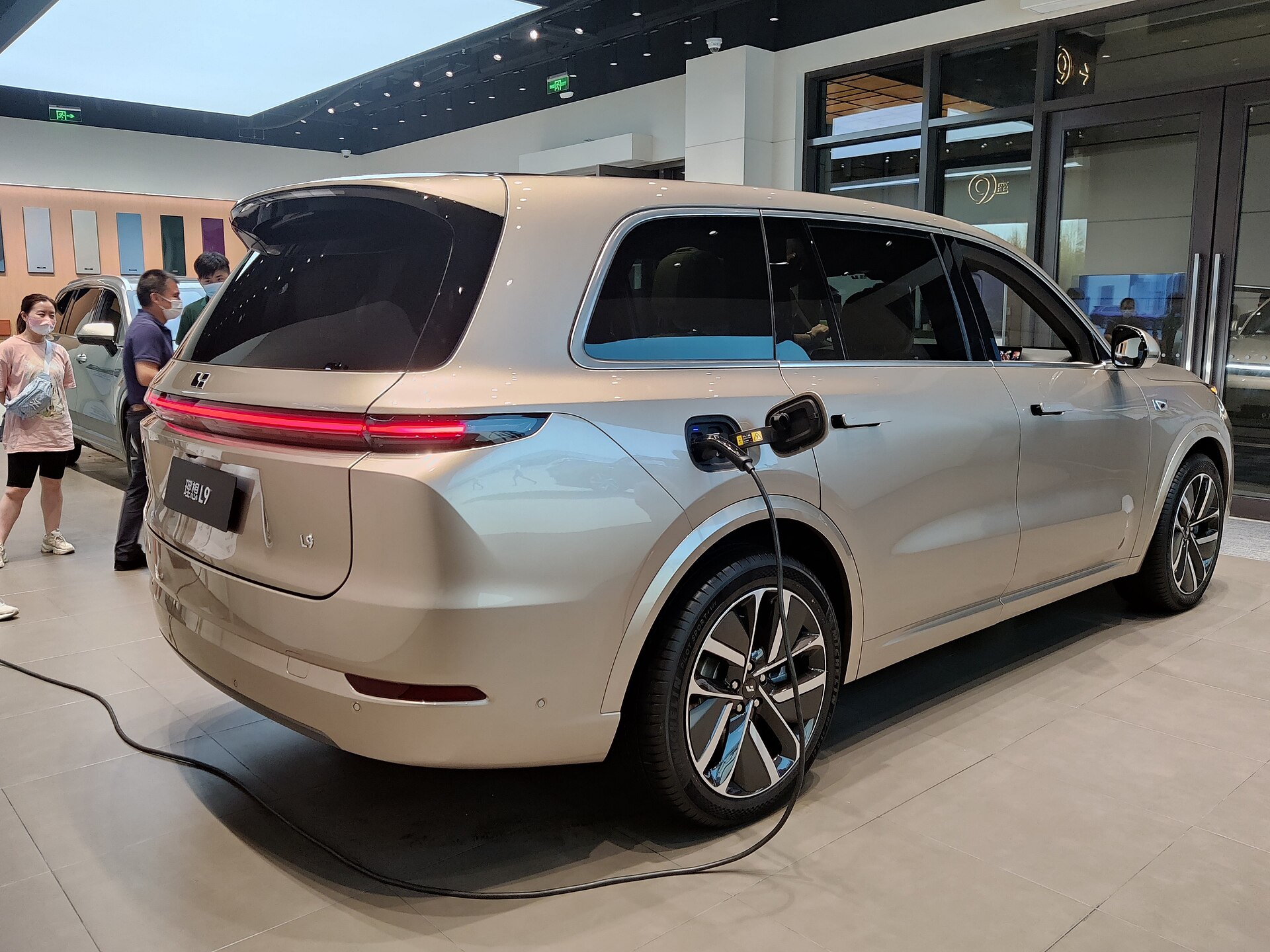
The L9 became the new flagship. It was unveiled online on 8 March 2022 and officially launched on 21 June 2022. It has six seats in three rows, a 1.5-litre turbocharged four-cylinder generator and two motors, 130 kW at the front and 200 kW at the rear, with a system output of 240 kW (326 PS). Its electric range is 180 to 235 km WLTP. The L9 sold 38,973 in China in 2022. A second generation, with a 72.7 kWh battery and up to 340 km WLTP on electricity alone, was unveiled on 6 February 2026.
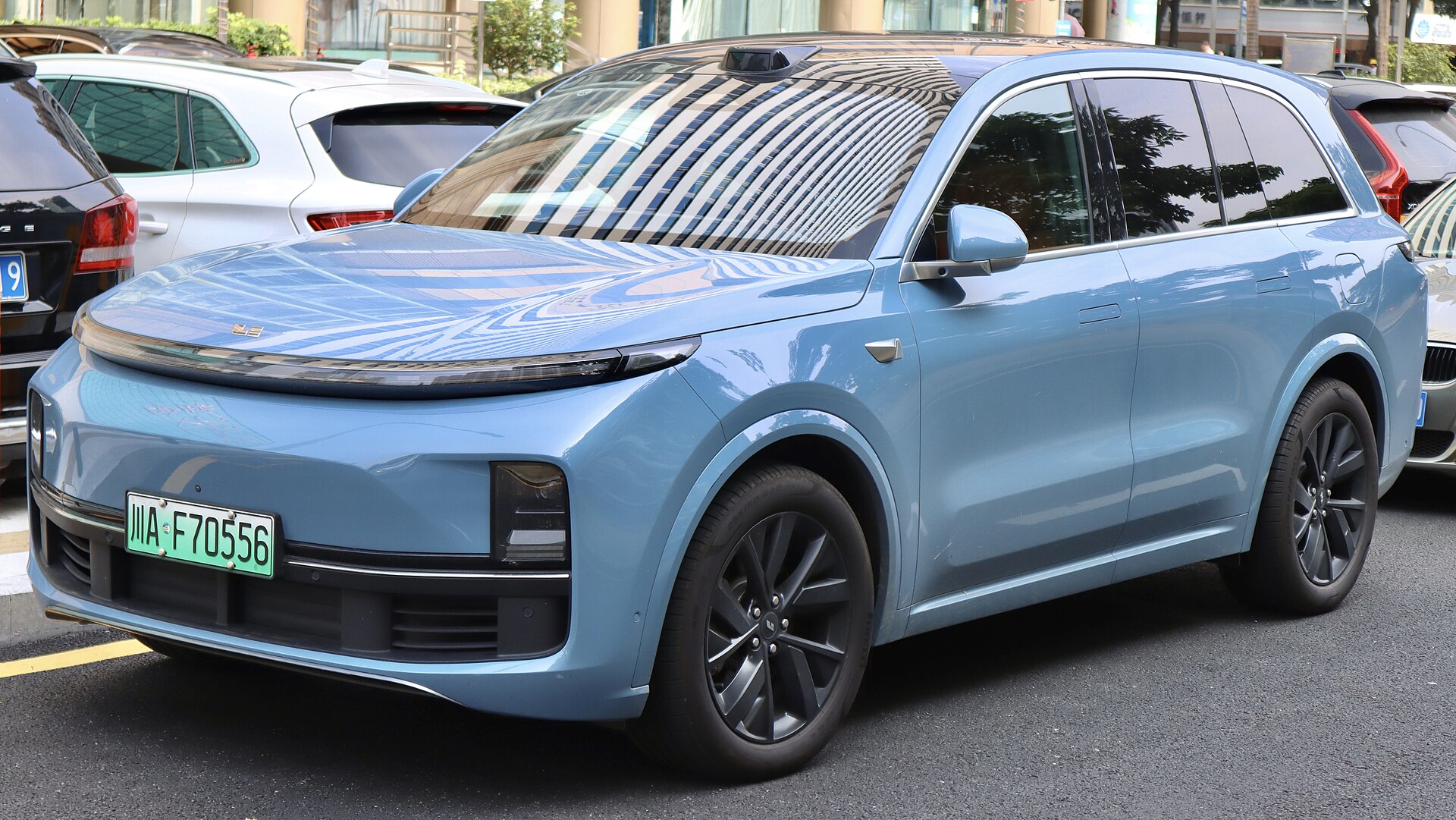
The L8 followed the L9, and the five-seat L7 was presented in September 2022. Its range-extender system reaches 330 kW (449 PS), and the Ultra version has a 52.3 kWh battery for 240 km of electric range on the WLTC cycle. The L7 sold 134,089 in China in 2023. The smaller L6 mid-size SUV joined the range in 2024.
| Year | Li Auto sales |
|---|---|
| 2019 | 1,000 |
| 2020 | 33,457 |
| 2021 | 90,491 |
| 2022 | 133,246 |
| 2023 | 376,030 |
| 2024 | 500,508 |
| 2025 | 406,343 |
In 2024 Li Auto had revenue of CN¥144.46 billion, an operating income of CN¥7.02 billion and 32,248 employees.

Mega and the battery-electric i-series
Li Auto's first battery-electric car, the Mega, was presented at Auto Guangzhou in November 2023 and built from 2024. It is a full-size people carrier with an 800 V system, two 245 kW motors for 400 kW (544 PS) in total and a 102.7 kWh CATL Qilin battery. The CLTC range is 710 km. Charging at up to 520 kW takes it from 10 to 80 per cent in 10.5 minutes. The Mega sold 10,798 in China in 2024.
The i-series of battery-electric SUVs followed: the i8 in February 2025 and the i6 in September 2025. Sales in 2025 fell to 406,343, below the 2024 record. In a May 2025 earnings call Li Xiang said saloons would be considered later and would depend on demand in future overseas markets in Europe and Asia.
The Li Auto models on 1cars are listed in the Li Auto catalogue, and the flagship has its own page on the Li Auto L9 range-extender SUV and its generations. Another range-extender SUV from China is the Voyah Free. For family cars with three rows of seats, see the best 7-seater cars and the best plug-in hybrid SUVs.

Li Auto timeline
| Year | Event |
|---|---|
| 2015 | Beijing Chehejia founded by Li Xiang |
| 2018 | Low-speed car project dropped; DiDi joint venture collapses |
| 2019 | Li One shown in Shanghai (April); production in Changzhou (November); renamed Leading Ideal |
| 2020 | Renamed Li Auto; Nasdaq listing (July) |
| 2021 | Beijing plant construction begins (October) |
| 2022 | L9 launched (21 June); L7 presented (September); Li One discontinued (October) |
| 2023 | Mega presented (November); 376,030 sales |
| 2024 | L6 and Mega on sale; record 500,508 sales |
| 2025 | i8 (February) and i6 (September) |
| 2026 | Second-generation L9 unveiled (6 February) |
Landmark Li Auto models
| Model | Years | Why it matters |
|---|---|---|
| Li One | 2019–2022 | First car; range extender with 240 kW and 1,080 km total range |
| L9 | From 2022 | Six-seat flagship, 240 kW (326 PS) |
| L7 | From 2022 | Five-seat L-series model; 134,089 sold in 2023 |
| Mega | From 2024 | First battery-electric car, 400 kW and 5C charging |
| i8 | From 2025 | First battery-electric SUV of the i-series |
Photo gallery


FAQ
Who founded Li Auto?
Li Xiang, the founder of the websites PCPop and Autohome, in 2015 in Beijing.
What is a Li Auto range extender?
The wheels are always driven by electric motors. A small petrol engine works only as a generator: a 1.2-litre three-cylinder in the Li One and a 1.5-litre four-cylinder in the L9.
Where are Li Auto cars built?
In Changzhou, where production began in November 2019, and in a second plant in Shunyi District, Beijing.
Does Li Auto make battery-electric cars?
Yes. The Mega people carrier of 2024 was the first, followed by the i8 and i6 SUVs in 2025.
How many cars does Li Auto sell?
500,508 in 2024, its record year, and 406,343 in 2025.
Sources
- Wikipedia — Li Auto (accessed 24 Oct 2026)
- Wikipedia — Li Auto One (accessed 24 Oct 2026)
- Wikipedia — Li Auto L9 (accessed 24 Oct 2026)
- Wikipedia — Li Auto L7 (accessed 24 Oct 2026)
- Wikipedia — Li Auto Mega (accessed 24 Oct 2026)
Found a mistake? Report an error