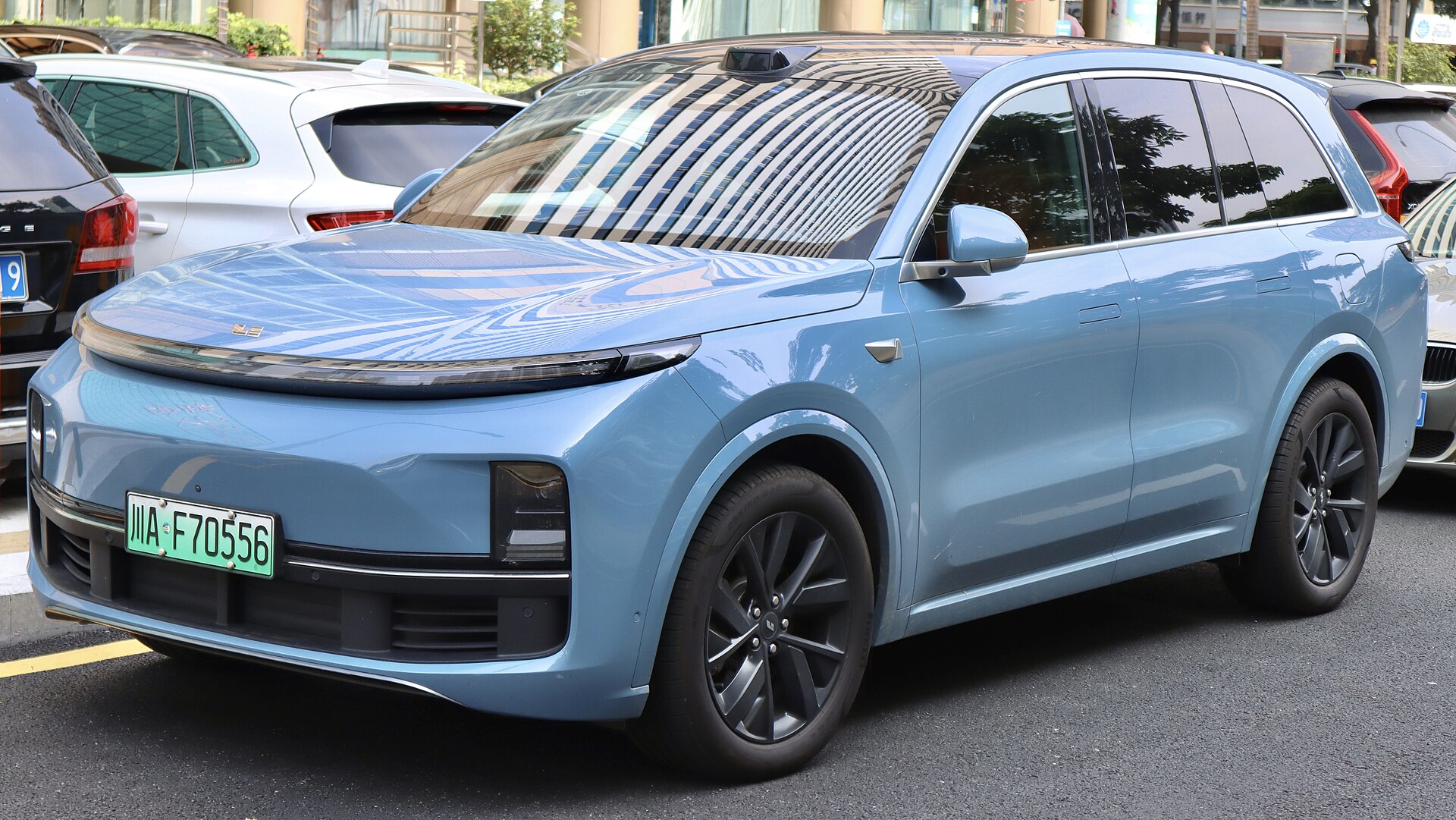
Li Auto L9
Specs, engines and history
Published Sources (1) Report an error
By Felix Hartmann, Automotive Technology & EV Contributor
- Built
- 2022–present
- Top power
- 330 kW (449 PS)
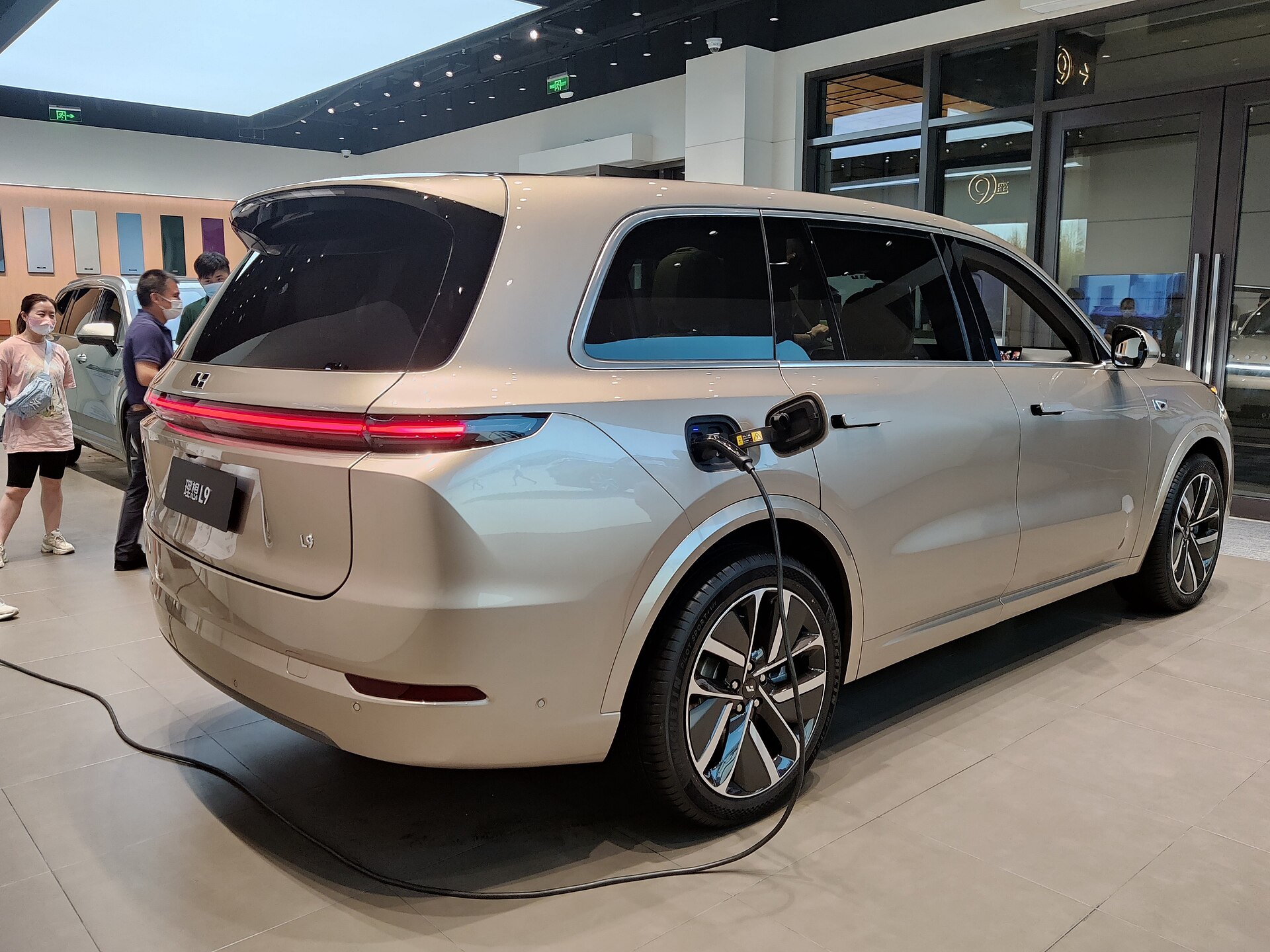
The Li Auto L9 is a full-size six-seat SUV with a range-extender drive: two electric motors move the car, and a 1.5-litre turbo petrol engine only generates electricity. The first generation was unveiled on 8 March 2022, launched on 21 June 2022 and delivered in China from August 2022, with 330 kW and 620 Nm from its two motors. A second generation, larger and with a 72.7 kWh battery, went on sale in China on 15 May 2026. The L9 is sold mainly in China and has no official European prices.
Li Auto was founded in 2015 by Li Xiang, who had earlier set up the websites PCPop and Autohome. The company started under the name Chehejia, renamed its holding company Leading Ideal in 2019 and became Li Auto in 2020. Its first car, the Li One, was unveiled in April 2019 and delivered from early 2020: a range-extended SUV with a 1.2-litre three-cylinder engine and a 40 kWh battery. Li Auto listed on Nasdaq in July 2020. It builds cars in Changzhou, Jiangsu, and has its head office in Beijing, where a second plant has been under construction since October 2021. Annual sales grew from 33,457 in 2020 to 500,508 in 2024 before falling to 406,343 in 2025.
Specs by version
Engines
| Version | Engine | Power | Drive | Production years |
|---|---|---|---|---|
| 1.5T EREV 42.6 kWh | 4 cyl · Plug-in hybrid | 330 kW 449 PS443 hp | All-wheel drive | 2022–2023 |
| 1.5T EREV 52.3 kWh | 4 cyl · Plug-in hybrid | 330 kW 449 PS443 hp | All-wheel drive | 2024–2025 |
Dimensions and weight
Show all 2 versions
| Version | Battery |
|---|---|
| 1.5T EREV 42.6 kWh | 43 kWh |
| 1.5T EREV 52.3 kWh | 52 kWh |
Verified Manufacturer and type-approval data from our catalog · Sources and methodology
In short
- Six seats in three rows; range-extender layout with a 1.5-litre turbo generator engine that does not drive the wheels.
- First generation (2022–2025): front motor 130 kW, rear motor 200 kW; 0–100 km/h in 5.3 s; battery 42.6 kWh, from 2024 52.3 kWh.
- Chinese claims: 215 km electric and 1,315 km total range on the NEDC cycle.
- Second generation (from May 2026): 72.7 kWh battery, charging at up to 420 kW, up to 340 km electric WLTP range.
Li Auto L9 at a glance
| Parameter | Li L9, first generation | Li L9, second generation |
|---|---|---|
| Production | 2022–2025 | since May 2026 |
| Body | five-door full-size SUV, six seats | five-door full-size SUV |
| Drive | two motors, all-wheel drive | — |
| Motors | 130 kW front, 200 kW rear | — |
| Range extender | 1.5-litre turbo four, generator only | new 1.5-litre turbo four, 112 kW |
| Battery | 42.6 kWh NMC, from 2024 52.3 kWh NMC | 72.7 kWh NMC |
| Fuel tank | 65 l, 55 l after the facelift | — |
| 0–100 km/h | 5.3 s | — |
| Kerb weight | — | 2,755–2,835 kg |
How the range extender works
Unlike in a parallel plug-in hybrid, the L9's petrol engine is never connected to the wheels. The two electric motors always drive the car, and the 1.5-litre turbo four-cylinder runs as a generator that keeps the battery charged when it runs low. The driver can also plug the car in: on a fast charger the battery reaches 80 % in about 40 minutes, while a full charge on a domestic supply takes about six hours, according to Wikipedia EN.
Li Auto's Chinese figures are given on the NEDC cycle: 215 km on electricity alone and a total of 1,315 km with a full tank and battery. These are much more generous than real driving or the European WLTP cycle, so they work better for comparing Chinese models than as an everyday guide.

First generation (2022–2025)
The L9 was unveiled online on 8 March 2022 and launched on 21 June 2022. Li Auto ended production of the Li One in October 2022, a few months after the L9 arrived. In 2022, its first part-year, 38,973 L9s were sold in China.
The front motor gives 130 kW and the rear motor 200 kW. Wikipedia EN states the combined system output as 330 kW and 620 Nm in its data table, while its text gives 240 kW and 530 Nm; the catalogue uses 330 kW. The 0–100 km/h time is 5.3 seconds.
The original battery was a 42.6 kWh nickel-manganese-cobalt pack weighing 254.3 kg. In 2024 Li Auto replaced it with a 52.3 kWh pack of the same chemistry, weighing 282.3 kg. With the bigger battery the fuel tank shrank from 65 to 55 litres.

The 2025 update
Li Auto revealed an updated L9 on 8 May 2025, opened orders the same day and began deliveries the following week. Most changes concern electronics and comfort:
- A new lidar from ATL, 60 % smaller and using 55 % less power, with a detection range of up to 200 m.
- Pro trim: a Horizon Robotics Journey 6M chip with 128 TOPS; Ultra trim: an Nvidia Thor-U chip with 700 TOPS.
- Emergency braking for stationary traffic at night from up to 120 km/h and emergency steering around a child on an unlit road from up to 130 km/h, according to Li Auto.
- Retuned air suspension with 24 % less body roll and 12 % less pitch; a moose-test speed of 80.34 km/h.
- A 21.4-inch 3K rear-seat screen, 86 % larger than the previous 15.7-inch screen, and a digital rear-view mirror with a 4K camera.
Second generation (from 2026)
The second-generation L9 was unveiled on 6 February 2026, together with a more upmarket L9 Livis. The Livis appeared in public at the Beijing motor show on 24 April 2026, and both went on sale in China on 15 May 2026, with deliveries from the same day.
| Item | Second-generation L9 |
|---|---|
| Battery | 72.7 kWh NMC, pack weight 411 kg |
| Charging | up to 420 kW (5C) |
| Range-extender engine | new 1.5-litre turbo, 112 kW (150 hp) |
| Fuel consumption (range-extender mode) | 6.3 l/100 km, down from 7.6 l/100 km |
| Electric range | up to 340 km WLTP; 420 km CLTC |
| Chassis | 800-volt active suspension, steer-by-wire, four-wheel steering, 5.4 m turning circle |
| Computing | two in-house M100 Ultra chips, 2,560 TOPS; four lidars |
| Kerb weight | 2,755–2,835 kg |
The new car is larger in every dimension and has a longer wheelbase, but Wikipedia EN does not give the figures. The much bigger battery turns the L9 into a car that can cover most daily driving on electricity, with the petrol generator kept for long trips.

Where the L9 is sold
The L9 is built for the Chinese market, and the sources give no official European prices or Euro NCAP result. At a results call in May 2025, chief executive Li Xiang said that any future saloon would depend on demand in overseas markets.
Who the L9 suits and comparable cars
The L9 suits families who want three rows of seats and electric driving most of the time, without depending on fast chargers on long trips. For another approach to electric driving with a petrol back-up, see the Chevrolet Volt. Large electric SUVs of similar size include the BMW iX and the Rivian R1S. The compare section puts large SUVs side by side, and Li Auto's models are listed in the Li Auto catalogue.
Photo gallery

Li Auto L9 in our rankings
- No. 48 of 197 · Most powerful SUVs and crossovers (330 kW · top 25%)
- No. 242 of 859 · Most powerful cars (330 kW · top 29%)
- No. 103 of 239 · Most powerful cars of the 2020s (330 kW · top 44%)
- No. 796 of 912 · Longest-running car nameplates (3 years · top 89%)
More powerful than 75% of ranked SUVs and crossovers in the 1CARS catalog (No. 48 of 197).
FAQ
Is the Li Auto L9 a hybrid or an electric car?
It is a range-extended electric vehicle: electric motors drive the wheels, and a 1.5-litre petrol engine only generates electricity.
How many seats does the Li Auto L9 have?
Six, in three rows.
What is the electric range of the Li Auto L9?
215 km on the NEDC cycle for the first generation; up to 340 km WLTP for the second generation from 2026.
How fast is the Li Auto L9?
The first generation reaches 100 km/h in 5.3 seconds.
Is the Li Auto L9 sold in Europe?
The sources give no official European sale or prices; the L9 is sold mainly in China.
Data sources
Data checked by an editor against the sources below.