 Chevrolet Volt
All generations, specs and history
Published Sources (6) Report an error
By Felix Hartmann, Automotive Technology & EV Contributor
- Built
- 2010–2019
- Generations
- 2
Timeline
Volt generations
Click a generation for its own page


Newest first · 2 generations since 2010
All generations by year: Volt II (2015–2019) · Volt I (2010–2015)
Which one is mine?
Pick the year of first registration to see which generation it is.
Check by VINThe Chevrolet Volt is a compact five-door plug-in hybrid from General Motors, often seen as the spiritual successor to GM's EV1 electric car. The concept was shown at the Detroit motor show in January 2007, the production model was unveiled in September 2008, and sales began in the United States in December 2010. Two generations were built at the Detroit-Hamtramck plant until production ended in February 2019. The name refers to the unit of electrical voltage.
In short
- Two generations: 2011–2015 and 2016–2019 model years; production November 2010 to February 2019.
- Voltec drive: the car runs on electricity, and a petrol engine (1.4 litres, later 1.5) mainly acts as a range extender.
- Battery: 16 kWh in the first generation, 18.4 kWh in the second; EPA electric range 61 km and 85 km respectively.
- Sold in Europe as the Opel and Vauxhall Ampera; the Volt/Ampera family reached about 177,000 units by October 2018.
Running cost
Fuel · Volt 1.5 L 4 cyl Automatic (variable gear ratios) · 2017 (EPA)
about 1,450 EUR fuel a year at 15,000 km
5.6 l/100 km · petrol at 1.75 EUR/l · change mileage, fuel price or version
Specs by version
Engines
| Version | Engine | Gearbox | Drive | Production years |
|---|---|---|---|---|
| Volt I · 1.4 L 4 cyl Automatic (variable gear ratios) · 2014 (EPA) | 1.4 l · 4 cyl · Plug-in hybrid 1,400 cc | CVT | Front-wheel drive | 2014 |
| Volt I · 1.4 L 4 cyl Automatic (variable gear ratios) · 2013 (EPA) | 1.4 l · 4 cyl · Plug-in hybrid 1,400 cc | CVT | Front-wheel drive | 2013 |
| Volt I · 1.4 L 4 cyl Automatic (variable gear ratios) · 2012 (EPA) | 1.4 l · 4 cyl · Plug-in hybrid 1,400 cc | CVT | Front-wheel drive | 2012 |
| Volt II · 1.4 L 4 cyl Automatic (variable gear ratios) · 2015 (EPA) | 1.4 l · 4 cyl · Plug-in hybrid 1,400 cc | CVT | Front-wheel drive | 2015 |
| Volt II · 1.5 L 4 cyl Automatic (variable gear ratios) · 2019 (EPA) | 1.5 l · 4 cyl · Plug-in hybrid 1,500 cc | CVT | Front-wheel drive | 2019 |
| Volt II · 1.5 L 4 cyl Automatic (variable gear ratios) · 2018 (EPA) | 1.5 l · 4 cyl · Plug-in hybrid 1,500 cc | CVT | Front-wheel drive | 2018 |
| Volt II · 1.5 L 4 cyl Automatic (variable gear ratios) · 2017 (EPA) | 1.5 l · 4 cyl · Plug-in hybrid 1,500 cc | CVT | Front-wheel drive | 2017 |
| Volt II · 1.5 L 4 cyl Automatic (variable gear ratios) · 2016 (EPA) | 1.5 l · 4 cyl · Plug-in hybrid 1,500 cc | CVT | Front-wheel drive | 2016 |
Performance
Show all 8 versions
| Version | Fuel consumption |
|---|---|
| Volt I · 1.4 L 4 cyl Automatic (variable gear ratios) · 2014 (EPA) | 6.4 l/100 km36.8 mpg US · 44.1 mpg UK |
| Volt I · 1.4 L 4 cyl Automatic (variable gear ratios) · 2013 (EPA) | 6.4 l/100 km36.8 mpg US · 44.1 mpg UK |
| Volt I · 1.4 L 4 cyl Automatic (variable gear ratios) · 2012 (EPA) | 6.4 l/100 km36.8 mpg US · 44.1 mpg UK |
| Volt II · 1.4 L 4 cyl Automatic (variable gear ratios) · 2015 (EPA) | 6.4 l/100 km36.8 mpg US · 44.1 mpg UK |
| Volt II · 1.5 L 4 cyl Automatic (variable gear ratios) · 2019 (EPA) | 5.6 l/100 km42.0 mpg US · 50.4 mpg UK |
| Volt II · 1.5 L 4 cyl Automatic (variable gear ratios) · 2018 (EPA) | 5.6 l/100 km42.0 mpg US · 50.4 mpg UK |
| Volt II · 1.5 L 4 cyl Automatic (variable gear ratios) · 2017 (EPA) | 5.6 l/100 km42.0 mpg US · 50.4 mpg UK |
| Volt II · 1.5 L 4 cyl Automatic (variable gear ratios) · 2016 (EPA) | 5.6 l/100 km42.0 mpg US · 50.4 mpg UK |
Verified Manufacturer and type-approval data from our catalog · Sources and methodology
Safety
-
Volt II · NHTSA 2019
US NCAP (NHTSA)
Stars from different years and organisations are not directly comparable: test protocols change every few years.
Chevrolet Volt at a glance
The Volt is a compact five-door liftback with front-wheel drive. Unlike a conventional hybrid, it drives on battery power first and uses its petrol engine to generate electricity once the battery is depleted. More Chevrolet models are listed in our Chevrolet catalogue.
First generation (2010–2015)
The first Volt went on sale in the United States in mid-December 2010 as a 2011 model. It seated four, used a 16 kWh lithium-ion battery of which only about half was used to protect its life, and a 1.4-litre four-cylinder range extender. Its EPA-rated electric range was 61 km. It was also sold as the Opel Ampera in Europe, the Vauxhall Ampera in the UK and, from December 2012, as the Holden Volt in Australia and New Zealand.
The first Volt collected many awards: in 2011 it was North American Car of the Year, World Green Car, Green Car of the Year, Motor Trend Car of the Year and Automobile of the Year, and in 2012 it shared the European Car of the Year title with the Opel/Vauxhall Ampera. About 88,750 were sold in the United States and just over 10,000 Amperas in Europe.
Second generation (2015–2019)
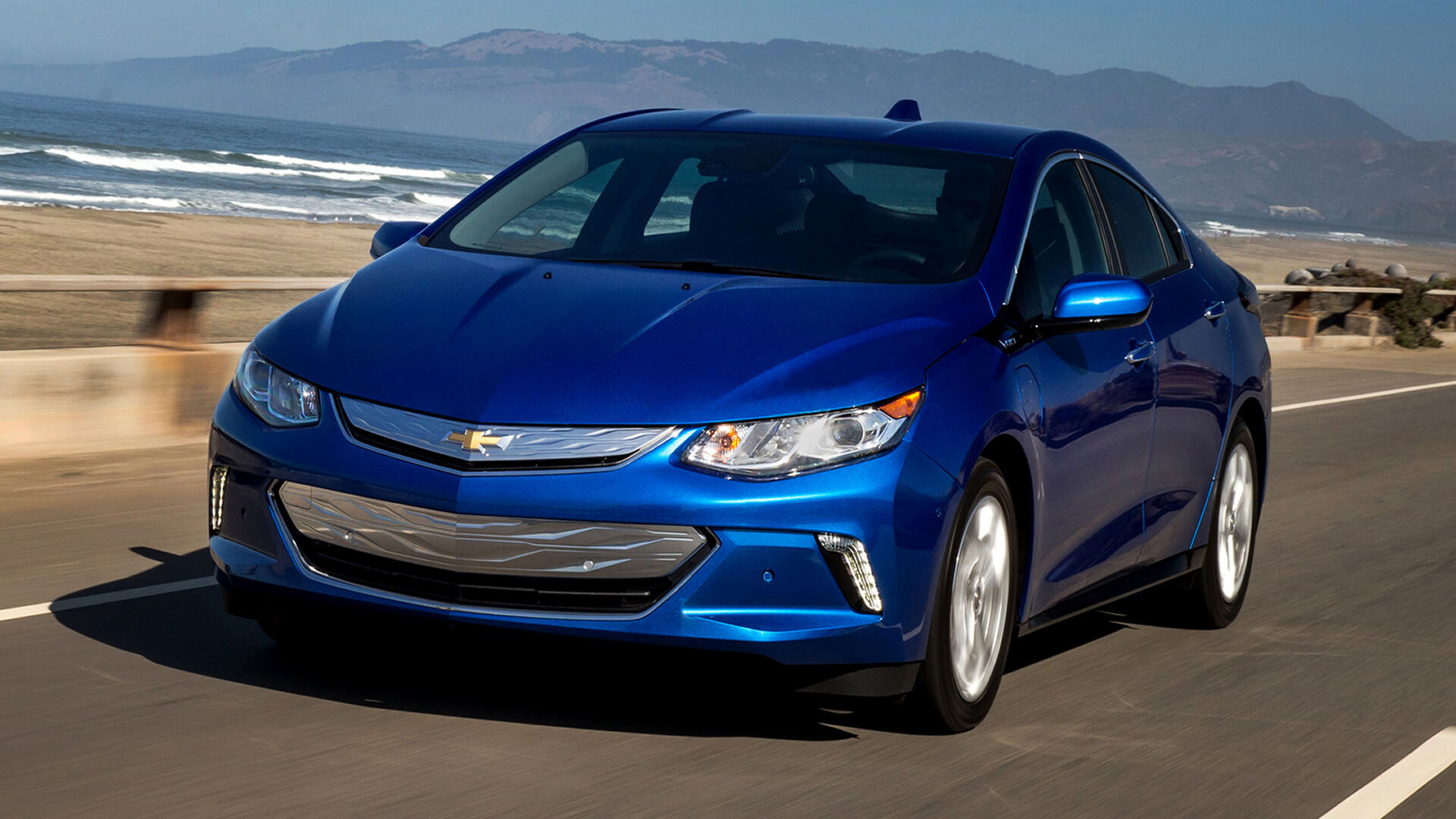
The second Volt was unveiled at the Detroit motor show in January 2015, and retail deliveries began in October 2015 as a 2016 model. It moved closer to a true electric car, with a larger body, five seats, better efficiency and a more powerful drivetrain, and it won Green Car of the Year again in 2016.
Exterior
The second Volt looks more modern and unconventional, as befits an electric car. A short, sharply sculpted bonnet, slim LED headlights and a chrome trapezoidal "grille" that is largely decorative give it a sporty face; the front is designed mainly for aerodynamics, which improved considerably over the first generation. Small vertical fog lamps sit in the bumper. The profile has dynamic, almost sporty lines, a deep lower crease and a thin character line running to the tail lights. A flap ahead of the driver's door hides the charging socket rather than a fuel filler. Ground clearance is an average 150 mm, and the car rides on 17-inch alloys. The tail forms a small spoiler, the redesigned lights blend into the boot lid, and a gloss-black plastic panel with slim reflectors sits low on the bumper; there are no visible exhaust pipes.
Interior
The cabin became friendlier and less futuristic. The dashboard resembles the latest Chevrolet Cruze, but materials and fit are better. A three-spoke multifunction wheel faces a digital instrument display framed in chrome, and a paddle behind the wheel activates Regen on Demand, which increases regenerative braking. The front seats are comfortable for most body types and have good side support. An 8-inch MyLink touchscreen with navigation and Apple CarPlay sits in the centre console, flanked by vertical air vents and above an intuitive climate panel. The tunnel has a recess with two USB ports, a chrome-trimmed gear selector and a parking brake switch. Materials include soft plastics and leather, with blue ambient lighting.
The rear now seats three instead of two, but space is tight because the battery runs under the cabin, and legroom is limited. The luggage area holds 301 litres.
Voltec drivetrain
| Parameter | 1st generation | 2nd generation |
|---|---|---|
| Range extender | 1.4 I4 | 1.5 I4, direct injection, 75 kW (102 PS) |
| Battery | 16 kWh | 18.4 kWh (192 cells instead of 288) |
| EPA electric range | 61 km | 85 km |
| Seats | 4 | 5 |
The second-generation drivetrain combines the 1.5-litre petrol engine, which runs on regular petrol and mainly charges the battery, with two electric motors, one of which also works as a generator. Drive-unit torque rose from 370 to 398 Nm, and the motors are about 45 kg lighter. Published figures give 0–100 km/h in 8.5 seconds, a top speed of 157 km/h, about 6.9 l/100 km in hybrid mode, a total range of up to 676 km and about 4.5 hours for a full charge. The battery was developed with LG Chem.
Chassis and safety
The second-generation body is stiffer, with a reinforced structure, more high-strength steel and front crumple zones, yet the car is 114 kg lighter. Suspension remains MacPherson at the front with an anti-roll bar and a torsion beam at the rear. Rack-and-pinion steering has electromechanical assistance with several modes, and the brakes are discs all round (ventilated at the front). The Volt achieved top safety ratings from the IIHS and NHTSA. Equipment includes ten airbags, ABS, blind-spot monitoring, automatic parking, lane monitoring, forward automatic braking, a rear camera, ISOFIX anchorages, stability control, LED lights front and rear, heated seats, climate control and the 8-inch infotainment system.
End of production
Because of low demand, GM ended Volt production in February 2019. About 68,375 second-generation cars were sold in the United States. In China, a related model was sold as the Buick Velite 5.
Key specifications
| Parameter | Value |
|---|---|
| Production | November 2010 – February 2019 |
| Plant | Detroit-Hamtramck, USA |
| Body | 5-door liftback |
| Battery | 16 kWh (1st) / 18.4 kWh (2nd) |
| Electric range (EPA) | 61 km / 85 km |
| Ground clearance | 150 mm (2nd) |
| Luggage space | 301 l (2nd) |
Strengths and weaknesses
Owners like the Volt's looks, good performance, economy and electric range, good sound insulation, comfortable seats and audio quality; the second generation adds a digital instrument panel, better trim and excellent safety. On the downside, ground clearance can be limiting, the rear camera gets dirty, there is no spare wheel, the rear backrests do not fold and the standard halogen headlights are not very bright. Rivals included the Toyota Prius Plug-in, BMW i3 with range extender, Nissan Leaf, Ford C-Max Energi and Hyundai Ioniq Plug-in.
Image credits · Photos from Wikimedia Commons under free licences
- Chevrolet Volt I · Photo: U.S. National Highway Traffic Safety Administration / Wikimedia Commons, Public domain
- Chevrolet Volt II · Photo: Kevauto / Wikimedia Commons, CC BY-SA 4.0
Chevrolet Volt in our rankings
- No. 416 of 912 · Longest-running car nameplates (9 years · top 49%)
- No. 47 of 70 · Biggest engines: hatchbacks (1,500 cc · top 73%)
- No. 486 of 557 · Biggest engines: cars (1,500 cc · top 91%)
- No. 296 of 345 · Cars with the most generations (2 generations)
In production longer than 51% of ranked nameplates in the 1CARS catalog (No. 416 of 912).
FAQ
Is the Chevrolet Volt a hybrid or an electric car?
It is a plug-in hybrid: it drives on electricity and uses a petrol engine mainly as a range extender.
How far can the Chevrolet Volt drive on electricity?
The EPA rated it at 61 km for the first generation and 85 km for the second.
When was the Chevrolet Volt discontinued?
Production ended in February 2019.
What was the Chevrolet Volt called in Europe?
It was sold as the Opel Ampera and Vauxhall Ampera.
Data sources
Data checked by an editor against the sources below.
- Wikipedia - Chevrolet Volt
- Automoto - Chevrolet Volt E Malibu 5 Stelle Euroncap
- US EPA fueleconomy.gov - 33900.shtml
- US EPA fueleconomy.gov - 32655.shtml
- US EPA fueleconomy.gov - 31618.shtml
- NHTSA 5-Star Safety Ratings (US NCAP) — U.S. Government work, public domain