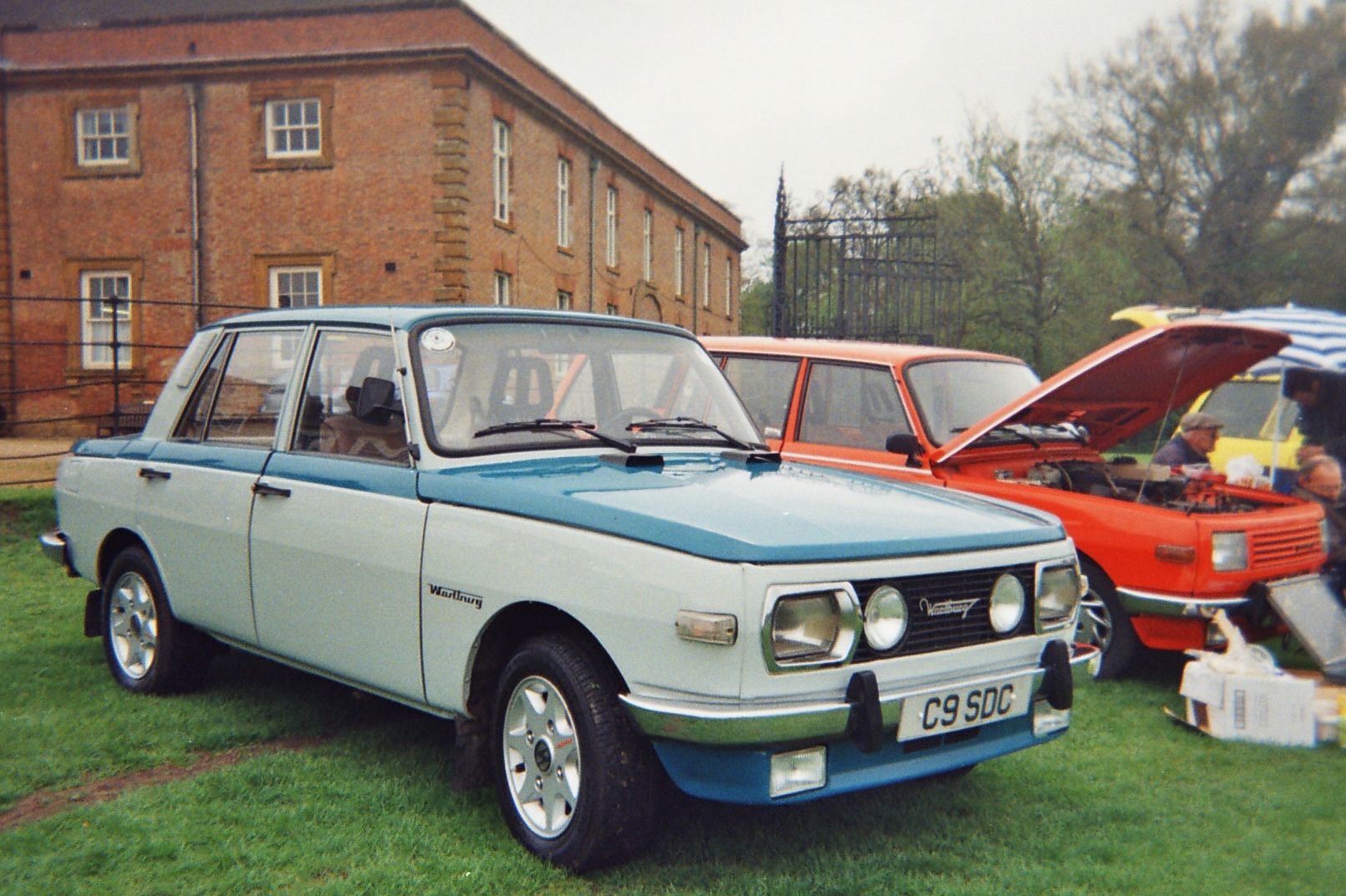
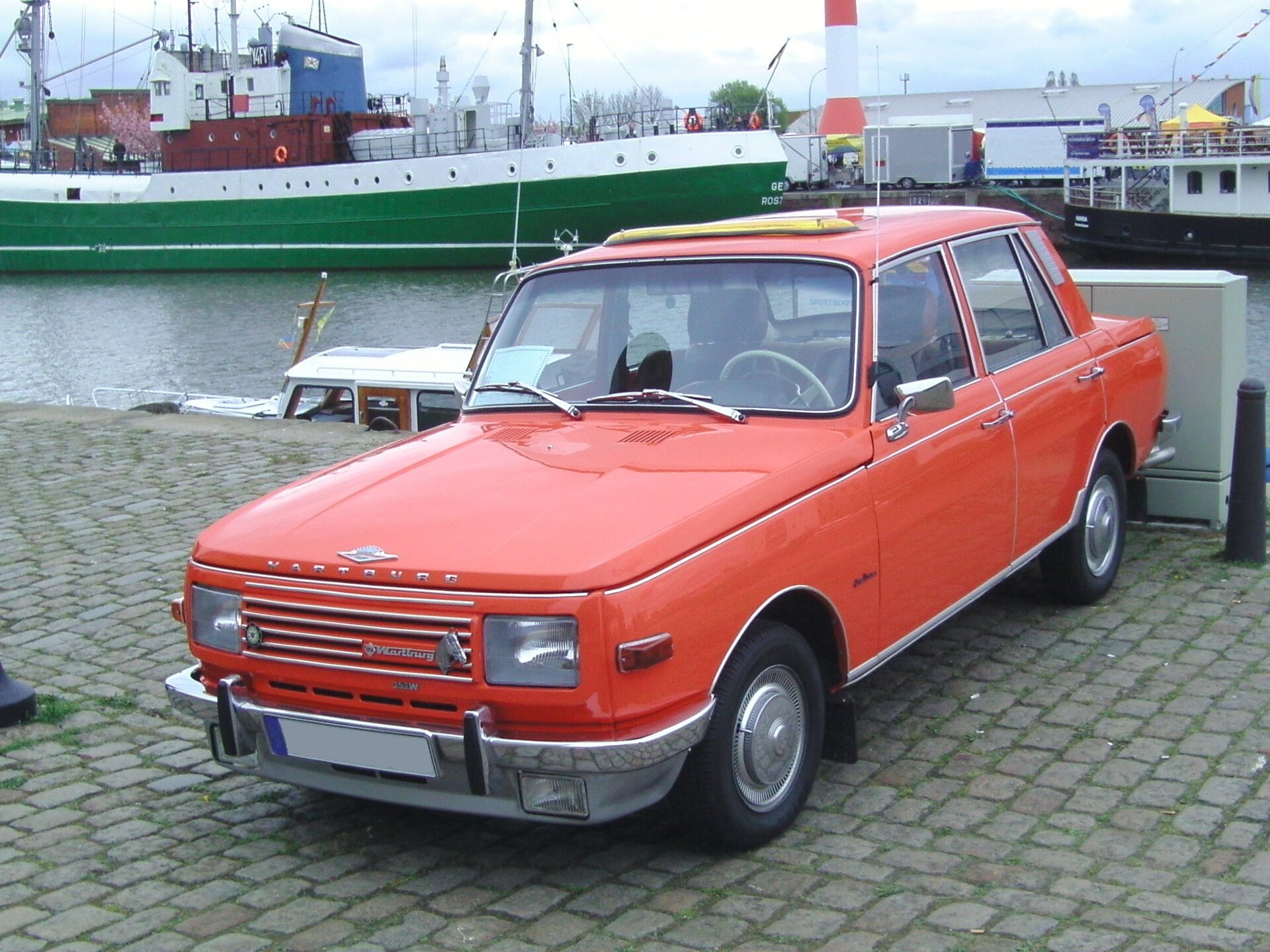
 Wartburg 353
Specs, engines and history
Published Sources (1) Report an error
By Felix Hartmann, Automotive Technology & EV Contributor
- Built
- 1966–1988
- Top power
- 42 kW (57 PS)
Wartburg was the car brand of VEB Automobilwerk Eisenach (AWE) in East Germany. The name comes from the Wartburg castle above Eisenach and was first used in 1898 on the Wartburgwagen, a two-cylinder car of 765 cc with a top speed of 40 km/h. AWE revived it in 1956 on the Wartburg 311, an updated IFA F9 with a three-cylinder two-stroke engine driving the front wheels. Wartburg was the second best-selling car brand in East Germany after Trabant, and English Wikipedia puts total output in Eisenach at about 1.6 million vehicles. Production ended on 10 April 1991, and Opel took over the plant.
The Wartburg 353 is the brand's best-known and longest-running model. Built in Eisenach from June 1966 to 1988–1989, it reached more than 1.2 million cars, and more than half of them were exported. It kept the brand's three-cylinder two-stroke and front-wheel drive, but gave them a modern, slab-sided four-door body with a 525-litre boot. The later 353 W of 1975 added front disc brakes and dual-circuit brakes.
Specs by version
| Version | Engine | Power | Gearbox | Drive | Production years |
|---|---|---|---|---|---|
| 1.0 two-stroke | 1.0 l · 3 cyl · Petrol 993 cc | 37 kW 50 PS50 hp | 4-sp Manual | Front-wheel drive | 1969 |
| 1.0 two-stroke (1986) | 1.0 l · 3 cyl · Petrol 993 cc | 42 kW 57 PS56 hp | 4-sp Manual | Front-wheel drive | 1986–1988 |
Verified Manufacturer and type-approval data from our catalog · Sources and methodology
In short
- Built by VEB Automobilwerk Eisenach from June 1966 to 1988–1989; 1,225,190 cars according to German Wikipedia, 868,860 of them 353 W.
- 993 cc three-cylinder two-stroke, water-cooled: 37 kW (50 PS) from 1969, 42 kW (57 PS) on late cars.
- Bodies: four-door saloon, five-door Tourist estate (from 1968) and two-door Trans pick-up for export.
- Price in 1967: 16,950 East German marks for the saloon, unchanged until 1986; 5,500 DM in West Germany.
Wartburg 353 at a glance: maker, production years (1966–1989), purpose
| Parameter | Value |
|---|---|
| Maker | VEB Automobilwerk Eisenach (AWE), Eisenach, East Germany |
| Production | June 1966 – 1988 (saloon); last two-stroke cars in 1989 |
| Built | 1,225,190 (German Wikipedia; another passage gives 1,225,429); 356,330 Wartburg 353 and 868,860 353 W (English Wikipedia) |
| Purpose | family car for the home market and for export |
| Body | four-door saloon, five-door Tourist estate, two-door Trans pick-up |
| Layout | front engine, front-wheel drive |
| Engine | three-cylinder two-stroke, 993 cc, water-cooled |
| Power | 37 kW (50 PS) from May 1969; 42 kW (57 PS) on the last cars |
| Torque | over 100 Nm; 106 Nm in the final version (English Wikipedia) |
| Gearbox | four-speed manual with freewheel |
| Wheelbase | 2,450 mm |
| Length × width × height | 4,220 × 1,640 × 1,490 mm (saloon); Tourist 4,380 mm long |
| Kerb weight | 920 kg (saloon), 970 kg (Tourist) |
| Predecessor / successor | Wartburg 311 and 312 / Wartburg 1.3 |
Development and production history
The 353 grew out of the Wartburg 311 of 1956. Its engine and running gear went back to a DKW design of 1938. A transition model, the Wartburg 312, arrived on 1 September 1965: it had the old 311 body on the new running gear. The new body with the 353 name followed on 1 June 1966. Hans Fleischer led the design, with Clauss Dietel and Lutz Rudolph.
The first series ran until 1975, with 356,330 cars. On 3 March 1975 the improved 353 W arrived, the W standing for Weiterentwicklung, or "further development". It brought front disc brakes, dual-circuit brakes and other safety changes, and 868,860 were built. German Wikipedia lists the yearly output for 1975 as 54,050 cars, of which 34,250 were exported. The 30,000th Wartburg 353 for Yugoslavia left the plant in 1973.
AWE planned several successors that never went into production. The Wartburg 355 coupé with a Renault 1.4-litre engine was cancelled in 1973 after about six cars. The 610M, a joint project with Škoda and Trabant, was dropped after the oil crisis. A 1.6-litre four-stroke engine of 1972 was also cancelled. In the end the 353 body stayed in production until 1988, when the Wartburg 1.3 with a licensed Volkswagen engine replaced it.

Design and engineering
The 353 replaced the rounded 311 with a modern three-box body. Early cars had a chrome grille and chrome bumpers; later cars had a black grille and black bumpers, and from January 1984 the chrome gave way to black plastic. The saloon has a boot of 525 litres. The Tourist estate offers up to 1,800 litres with the rear seats folded.
The front suspension uses double wishbones, and the rear has a live rigid axle. Brakes were drums at first. Front discs came with the 353 W in 1975. The turning circle is 5.1 m. The electrics were modest: a 220 W generator on early cars and a 588 W alternator from 1986. The ignition has three coils and contact breakers but no distributor.
On 30 June 1985 the front end was redesigned. The radiator moved to the conventional position in front of the engine, and the car got rectangular headlights.

Engine and drivetrain: the three-cylinder two-stroke
The engine is a water-cooled three-cylinder two-stroke of 993 cc. Owners mix petrol and oil at 1:50 and use 88 RON fuel. Output depended on year and carburettor. English Wikipedia gives 37–40 kW (50–55 PS) for most cars and 42 kW for the last version from 1986. German Wikipedia dates the 37 kW (50 PS) engine, called 353-1, to May 1969. It gave 36.8 kW at 4,250 rpm and had a new carburettor and a torsional vibration damper. A Jikov 32 SEDR carburettor and H4 headlights followed on 14 June 1982.
Drive goes to the front wheels through a four-speed manual gearbox. A typical Wartburg feature is the freewheel on all gears. It removes engine braking unless the driver locks it out. Early cars had a column change. A floor-mounted lever arrived in 1972 but sold poorly. A five-speed gearbox existed but was rare.
With 42 kW and 920 kg, the late saloon has about 46 kW per tonne. The power-to-weight calculator compares that with modern small cars, and the power converter turns the old PS figures into kW and hp.

Wartburg 353 specifications
| Data | Value |
|---|---|
| Cylinders / cycle | 3 / two-stroke |
| Displacement | 993 cc (992 cc in the spec table of English Wikipedia) |
| Power | 37–40 kW (50–55 PS); 42 kW from 1986 |
| Torque | over 100 Nm; 106 Nm final version |
| Fuel | petrol-oil mix 1:50, 88 RON |
| Top speed | factory claim 130 km/h (German Wikipedia); a 1971 test measured 131 km/h |
| 0–100 km/h | about 12 s (English Wikipedia) |
| Fuel use | 10.2–10.3 l/100 km in tests of 1966 and 1970 |
| Brakes | drums; front discs from 1975 (353 W) |
| Tyres | 165 SR-13, 175/70 R13 or 185 SR-13 |
| Payload | 400 kg (saloon), 440 kg (Tourist) |
The two Wikipedia articles disagree on top speed. English Wikipedia gives 170 km/h for Western markets, while German Wikipedia quotes a factory figure of 130 km/h and test results of 126 and 131 km/h. The lower, measured figures are the safer guide.
Variants and derivatives: Tourist, Trans and the rally cars
| Version | Years | Notes |
|---|---|---|
| 353 Limousine | 1966–1988 | four-door saloon, 4,220 mm |
| 353 Tourist | 1968–1989 | five-door estate, 4,380 mm, built at Halle and Dresden |
| 353 Trans | — | two-door pick-up, export only, 450 kg payload |
| 353 W | 1975–1988 | front discs, dual-circuit brakes |
| 353 S | from 2 January 1984 | top trim, replaced the de luxe |
| 353 WR | rally car | 1,147 cc, 81 kW (110 PS) at 5,500 rpm, 142 Nm |
| Melkus RS 1000 | 1969–1979 | small-series sports car on 353 parts |
The car also served as a Volkspolizei patrol car, as a government car and as an ambulance. German Wikipedia counts about 100 emergency-doctor cars. In Britain the 353 was sold as the Wartburg Knight in right-hand-drive form from early 1967.

In service: operation, reliability and legacy
Most cars went abroad. German Wikipedia counts 676,837 exported cars, mainly to Hungary, Poland, Czechoslovakia, Yugoslavia and Bulgaria. Other buyers were in Belgium, Finland, Greece and Britain. In the Benelux countries many served as taxis, and some passed 250,000 km. At home the wait for a new car bought with East German marks was long, while buyers paying in Western currency through the Genex service got cars without waiting. Sales in West Germany were weak: only 334 Wartburgs found buyers there in 1967. From 1979 European ECE rules made the car hard to sell in other non-socialist markets.
The 353 had rally successes for its class. The works team finished second in class at the 1973 Monte Carlo Rally and second at the 1973 Polish Rally. All four works cars finished the 1978 RAC Rally. Its reputation was mixed. Finnish register data gave it an average life of 9 years and 3 months, the shortest of the makes listed. Owners called it "Trustworthy Hans", and less kindly "Farty Hans", after the two-stroke smoke.
The Wartburg 1.3 with a 1,272 cc Volkswagen four-cylinder, licensed in 1984, replaced the saloon from October 1988. After reunification sales collapsed, and production ended in 1991 when Opel bought the plant. Opel's side of the story is in the history of Opel.
Preservation and collecting today
The Wartburg 353 is now a classic. Museums in Germany and Finland show the car, and German Wikipedia notes that the right-hand-drive Knight is sought after in Britain. The Tourist estate and the Trans pick-up are the practical body styles, while the Melkus RS 1000 and the 353 WR rally car are the sporting relatives. No reliable public price data was found for this article, so no market values are given.
Which Wartburg 353 to choose:
- For originality: an early 353 (1966–1975) with chrome grille and bumpers.
- For everyday classic use: a late 353 W with front discs and the 1985 front end.
- For space: the Tourist estate.
- For rarity: the Trans pick-up or a Knight built for Britain.
More East German and Western cars of the period are in the classic cars section, in the 1960s classics and in the 1980s classics. All models of the brand are in the Wartburg catalogue.
Photo gallery

FAQ
How many Wartburg 353s were built?
German Wikipedia gives 1,225,190 between 1966 and 1989; English Wikipedia splits the total into 356,330 cars of the first series and 868,860 353 W.
What engine does the Wartburg 353 have?
A water-cooled three-cylinder two-stroke of 993 cc with 37–40 kW (50–55 PS), and 42 kW on the last cars from 1986.
What does the W in Wartburg 353 W mean?
Weiterentwicklung, or "further development". The 353 W of March 1975 added front disc brakes and dual-circuit brakes.
How much did a Wartburg 353 cost?
In 1967 the saloon cost 16,950 East German marks and the Tourist 17,700 marks; in West Germany the saloon cost 5,500 DM.
What replaced the Wartburg 353?
The Wartburg 1.3 with a Volkswagen four-stroke engine, from October 1988.
Data sources
Data checked by an editor against the sources below.