Wartburg: The Two-Stroke Saloons From Eisenach
Wartburg was a car brand from Eisenach in Thuringia. The name was first used in 1898 on a licence-built car of the Fahrzeugfabrik Eisenach, the company that later made the Dixi and became BMW's first car factory. In 1956 the East German VEB Automobilwerk Eisenach revived it for a front-wheel-drive saloon with a three-cylinder two-stroke engine. The 311, the 353 and finally the Volkswagen-engined 1.3 followed, about 1.6 million cars were built in Eisenach, and production ended on 10 April 1991.
Key takeaways
- Fahrzeugfabrik Eisenach was founded by Heinrich Ehrhardt on 3 December 1896; its first car, the Wartburgwagen of 1898, was a licensed Decauville.
- BMW bought the Eisenach works in November 1928; after the war the plant became VEB Automobilwerk Eisenach.
- The Wartburg 311 (1956–1965) and 353 (1966–1988) used DKW-derived three-cylinder two-strokes of 900 to 993 cc.
- The Wartburg 1.3 with a licence-built Volkswagen engine ran from October 1988 to 10 April 1991; Opel then built a new plant in Eisenach.
Wartburg at a glance
| Fact | Value |
|---|---|
| First use of the name | 1898, Fahrzeugfabrik Eisenach |
| Founder of the works | Heinrich Ehrhardt (1896) |
| Post-war maker | VEB Automobilwerk Eisenach (AWE) |
| Revival of the name | 1956, Wartburg 311 |
| Engine | Three-cylinder two-stroke, later VW-based four-stroke |
| Best-known models | 311, 313 Sport, 353 (Knight), 1.3 |
| Total output | About 1.6 million cars in Eisenach |
| End of production | 10 April 1991 |
Origins: Fahrzeugfabrik Eisenach and the first Wartburg
Heinrich Ehrhardt founded Fahrzeugfabrik Eisenach on 3 December 1896 as a joint-stock company that first made bicycles and guns. Around 1898 it began building cars under the name Wartburg, a licensed version of the French Decauville. The Wartburgwagen had two seats, a two-cylinder engine of 765 cc and a top speed of 40 km/h.
The business did not make money for the founder. After losses the Ehrhardt family withdrew from management in 1903 and the Decauville licence was withdrawn, and from 1904 the cars were sold as Dixi, with Willi Seck as chief engineer. The Wartburg name was dropped.

Dixi, BMW and the post-war years
The company became Dixi-Werke AG in 1920 and was later merged with Gothaer Waggonfabrik. In 1927 it built the DA-1 3/15, a licensed version of the British Austin 7. In November 1928 BMW bought the business, and Eisenach became BMW's first car factory. In the early 1930s the Wartburg name briefly returned on the BMW 3/15 DA-3 Wartburg, described as BMW's first sports car. The history of BMW covers this period from the Munich side.
In 1942 BMW moved motorcycle production to Eisenach, car production stopped, and the factory built aircraft engines; about 60% of it was destroyed by the end of the war. From 1945 the works operated as SAG Awtowelo and restarted with the BMW 321, and for a time these Eisenach-built cars were the only BMW-badged cars in production. In 1952 the company passed to the German Democratic Republic as Eisenacher Motorenwerk (EMW), and in 1954 it received its final name, VEB Automobilwerk Eisenach (AWE). Its IFA F9 of 1950 was derived from the DKW F9 of 1940.

The Wartburg 311 and 313
In 1956 AWE revived the Wartburg name for an updated F9 with a new body and a more powerful three-cylinder two-stroke engine. The Wartburg 311, designed by Hans Fleischer, had front-wheel drive on a separate chassis derived from the pre-war Auto Union design, which was lengthened by 10 cm. The engine had 901 cc until 1962 and 992 cc afterwards, the car was 4,300 mm long and weighed 960 kg, and a four-speed gearbox replaced the original three-speed one in 1958.
Many versions were built: a two-door coupé, the Camping estate, a cabriolet, a pickup and an off-road Kübelwagen, of which 891 were made. The 313/1 Sport roadster of 1957–1960 was built 469 times, and about a third of them went to the United States. Exports to West Germany began in 1958, right-hand-drive cars were built from 1961, and in Argentina the 311 was assembled as the Graciela. In all, 288,535 Wartburg 311s were built until 1965, and the interim 312 followed until 1967. The separate chassis, however, was starting to look dated as other European makers moved to self-supporting bodies.


The 353 Knight
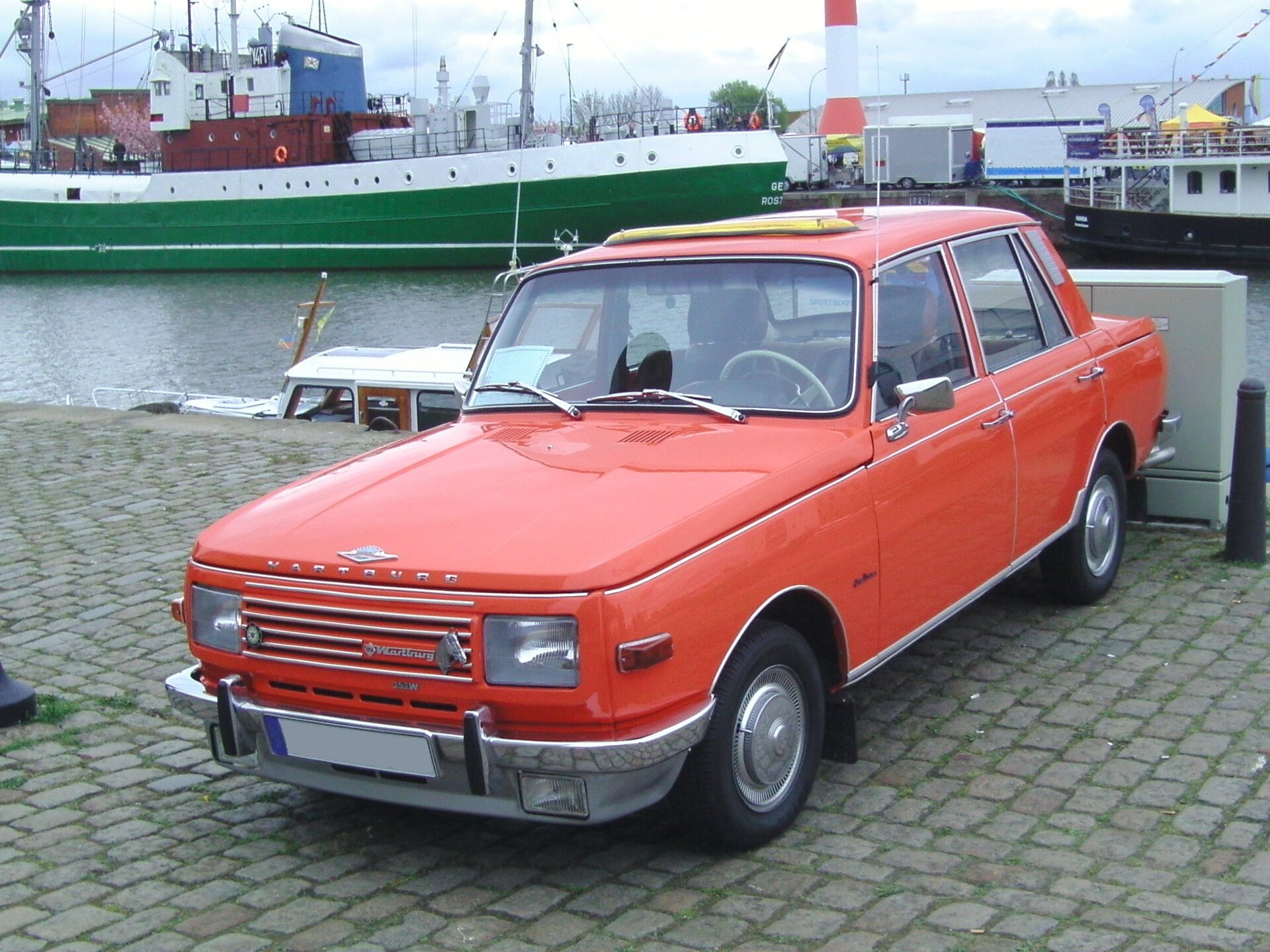
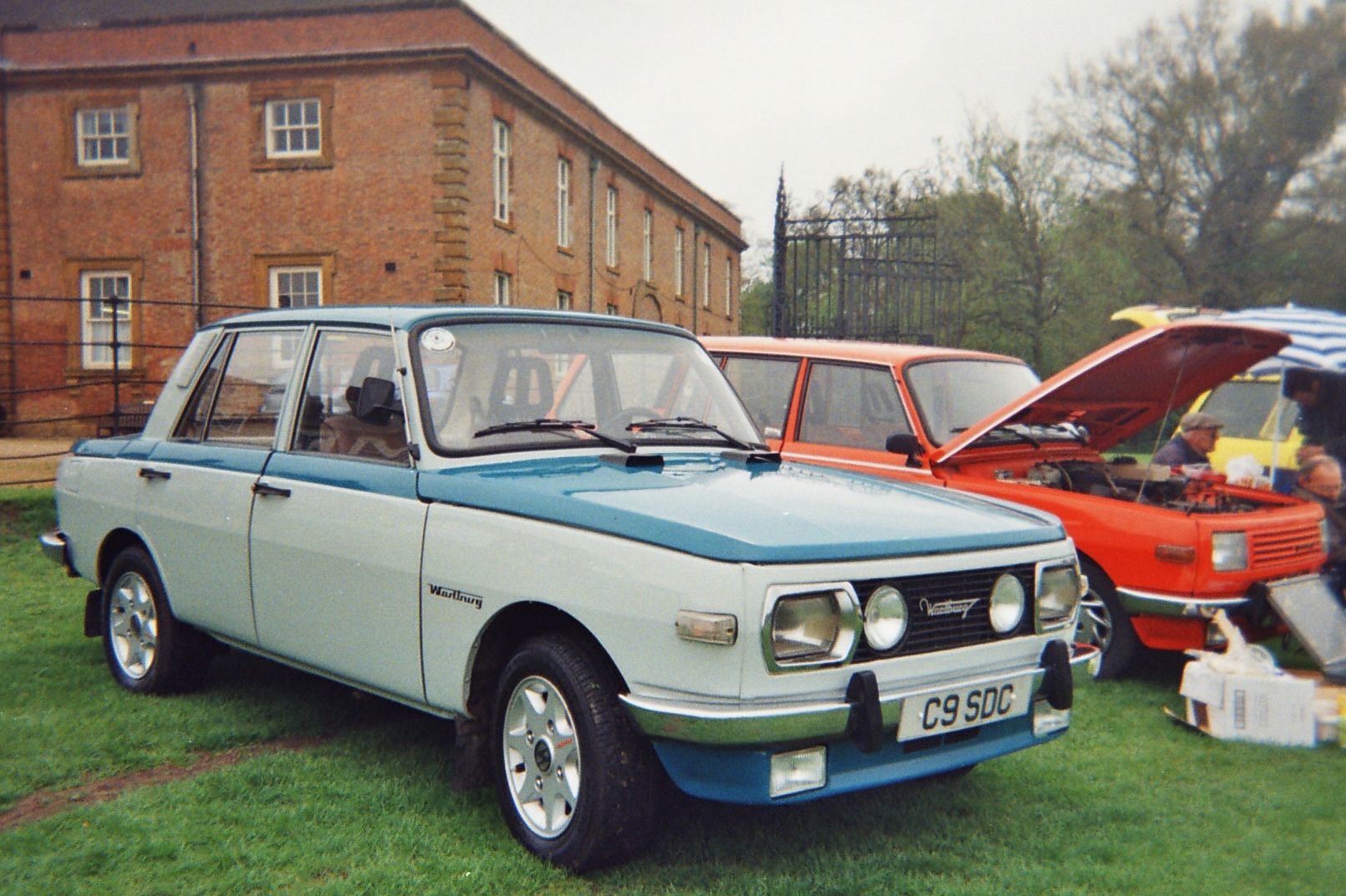
The Wartburg 353, built from June 1966 to October 1988, had a new body and became the Wartburg with the longest production run. Its three-cylinder two-stroke of 992–993 cc produced 36.8 kW (50 PS) in 1969, later up to 42 kW (57 PS), and the gearbox gained synchromesh on all gears and a freewheel. The saloon was joined in 1968 by the Tourist estate and by a Trans pickup, mainly for export.
The 353 was sold in most European markets and in South Africa. In Britain it arrived in early 1967 as the Wartburg Knight, and western European versions were quoted at a top speed of 170 km/h. In East Germany, deliveries to private owners could take ten to fifteen years because of the planned economy. The 353 sold 356,330 cars from 1966 to 1975, and the updated 353 W, launched in 1975 and facelifted in 1983, another 868,860 by 1988. The Wartburg 353 article covers the car in detail.
The 1.3, the end and Opel
In October 1988 the Wartburg 1.3 replaced the two-stroke car. It used a 1,272 cc four-cylinder four-stroke based on the Volkswagen EA111 engine and built under licence, with 43 kW (58 PS), raised to 47 kW (64 PS) after July 1990. The car cost nearly twice as much as the 353 W, and 152,757 were built, about half of them for export.
Production did not continue long after German reunification. On 5 October 1990 AWE and Adam Opel AG opened an assembly line for the Opel Vectra in Eisenach. The last Wartburg was built on 10 April 1991, and in April 1991 the Treuhand agency closed AWE. In 1992 Opel opened a new plant in a western suburb of Eisenach, where many former AWE workers found jobs. In 2009 Opel reportedly considered reviving the Wartburg name for low-cost cars based on the Corsa at about €7,000 in 2009, but the plan was not carried out. Wartburg models are listed in the Wartburg catalogue, and the two-stroke cars from Zwickau in the Trabant catalogue.
Wartburg timeline
| Year | Event |
|---|---|
| 1896 | Heinrich Ehrhardt founds Fahrzeugfabrik Eisenach (3 December) |
| 1898 | First Wartburg car, a licensed Decauville |
| 1904 | Cars renamed Dixi |
| 1928 | BMW buys the Eisenach works (November) |
| 1945 | Production restarts with the BMW 321 |
| 1952 | Eisenacher Motorenwerk (EMW) |
| 1954 | VEB Automobilwerk Eisenach |
| 1956 | Wartburg 311 |
| 1957 | 313 Sport roadster |
| 1966 | Wartburg 353 |
| 1975 | 353 W |
| 1988 | Wartburg 1.3 with VW-based engine (October) |
| 1991 | Last Wartburg built (10 April); AWE closed |
| 1992 | Opel plant opens in Eisenach |
Landmark Wartburg models
| Model | Years | Why it matters |
|---|---|---|
| Wartburgwagen | 1898–1903 | First car with the name, licensed Decauville |
| BMW 3/15 DA-3 Wartburg | early 1930s | BMW's first sports car |
| 311 | 1956–1965 | Revival of the name, 288,535 built |
| 313/1 Sport | 1957–1960 | Two-seat roadster, 469 built |
| 353 / 353 W | 1966–1988 | Longest-running Wartburg, over a million built |
| 1.3 | 1988–1991 | VW-based four-stroke, last Wartburg |
Photo gallery

FAQ
When was the Wartburg name first used?
In 1898, on the cars of Fahrzeugfabrik Eisenach. It was revived by VEB Automobilwerk Eisenach in 1956.
What engine did the Wartburg have?
A three-cylinder two-stroke derived from DKW practice, of 901 to 993 cc. The final Wartburg 1.3 used a licence-built Volkswagen four-stroke of 1,272 cc.
Was Wartburg related to BMW?
Yes, through the factory. BMW owned the Eisenach works from 1928, and in the early 1930s it sold the BMW 3/15 DA-3 Wartburg.
How many Wartburgs were built?
About 1.6 million cars in Eisenach; the 353 and 353 W alone accounted for over 1.2 million.
When did Wartburg production end?
The last Wartburg was built on 10 April 1991. Opel opened a new plant in Eisenach in 1992.
Sources
- Wikipedia - Wartburg (car) (accessed 24 Oct 2026)
- Wikipedia - Automobilwerk Eisenach (accessed 24 Oct 2026)
- Wikipedia - Wartburg 311 (accessed 24 Oct 2026)
- Wikipedia - Wartburg 353 (accessed 24 Oct 2026)
- Wikipedia - Wartburg 1.3 (accessed 24 Oct 2026)
Found a mistake? Report an error