 TVR Griffith
Specs, engines and history
Published Sources (1) Report an error
By Felix Hartmann, Automotive Technology & EV Contributor
- Built
- 1991–2002
- Top power
- 254 kW (345 PS)
Which Griffith to choose
Our verdict · Felix Hartmann
- For the strongest performance: the Griffith 500 with 254 kW and 475 Nm.
- For a rarer middle version: the 4.3 or 4.5-litre car with 209–213 kW.
- For collectors: one of the 100 Special Edition cars from 2000–2002.
- For the history: a 1960s Griffith 200 or 400, the cars that gave the name.
Other open two-seaters are listed among the best sports cars, and models can be put side by side in our car comparisons.
TVR is a British sports car maker from Blackpool. Trevor Wilkinson set up a workshop there in 1946 and founded Trevcar Motors; the TVR name comes from the letters on his first garage sign. The first TVR coupé was shown in a Manchester showroom on 10 January 1958. After a liquidation in 1964, Martin Lilley and his father Arthur took over in 1965, and from December 1981 Peter Wheeler ran the company. Under Wheeler TVR built the Griffith, Chimaera, Cerbera, Tuscan and Sagaris and became, at one time, the world's third-largest specialist sports car maker. Production in Blackpool ended in 2006.
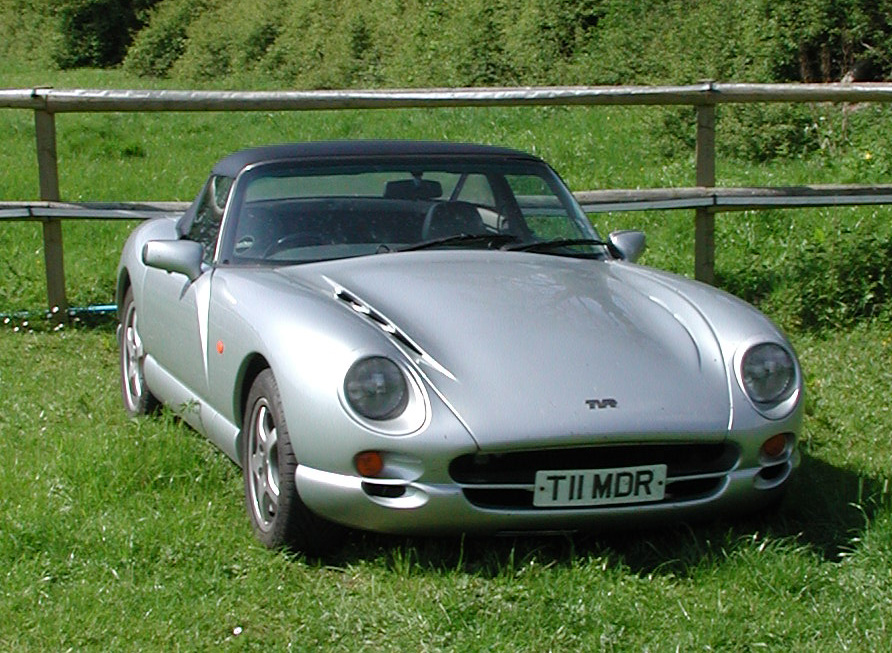
The TVR Griffith is a two-seat convertible with a glass-fibre body, a front-mounted Rover V8 and rear-wheel drive, built in Blackpool from the early 1990s to 2002. It revived the name of the Griffith 200 and 400 of the 1960s. Output ranged from 179 kW (243 PS) with the 4.0-litre engine to 254 kW (345 PS) in the 5.0-litre Griffith 500, with a dry weight of about 1,060 kg. A second-generation Griffith designed with Gordon Murray was shown in 2017 but has not reached production.
Specs by version
Verified Manufacturer and type-approval data from our catalog · Sources and methodology
In short
- Built in Blackpool, production listed from 1991 to 2002; Wikipedia gives 2,351 cars in total.
- Rover V8 engines from 4.0 to 5.0 litres, from 179 kW (243 PS) to 254 kW (345 PS), five-speed manual gearbox.
- Dry weight 1,060 kg; the Griffith 500 reaches 272 km/h.
- A Special Edition of 100 cars marked the end of production in 2000–2002.
TVR Griffith at a glance
| Specification | Value |
|---|---|
| Production | 1991–2002 (prototype 1990), Blackpool, England |
| Body | two-seat convertible, glass-fibre panels |
| Layout | front engine, rear-wheel drive |
| Engines | Rover V8, 4.0, 4.3, 4.5 and 5.0 litres, two valves per cylinder |
| Power | 179–254 kW (243–345 PS) |
| Torque | 366–475 Nm |
| Gearbox | five-speed manual (Rover LT77 or Tremec T5) |
| Suspension | double wishbones front and rear, coil-over dampers, anti-roll bars |
| Brakes | 260 mm ventilated discs front and rear |
| Dry weight | 1,060 kg |
| Top speed | 245–272 km/h |
| Built | 2,351 (Wikipedia total) |
The Griffith name: from the 1960s to the 1990s
TVR used the Griffith name first in the 1960s. The Griffith 200 was built from 1963 to 1964 and the Griffith 400 from 1964 to 1967. Under Peter Wheeler, TVR revived the name for a new roadster.
The new Griffith was first shown in 1990, and series production followed. It combined a glass-fibre body over a chassis with double-wishbone suspension at all four corners, coil-over gas dampers and anti-roll bars at both ends. TVR fitted 260 mm ventilated disc brakes all round. The gearbox was a five-speed manual, either the Rover LT77 or the Tremec T5.

Engines and performance
All Griffiths used versions of the Rover aluminium V8 with overhead valves and two valves per cylinder. English Wikipedia lists five versions:
| Version | Power | Torque | 0–100 mph | Top speed |
|---|---|---|---|---|
| 4.0 | 179 kW (243 PS) | 366 Nm | 12.1 s | 245 km/h |
| 4.0 HC | 205 kW (279 PS) | 414 Nm | 12.1 s | 254 km/h |
| 4.3 | 209 kW (284 PS) | 414 Nm | 11.3 s | 254 km/h |
| 4.5 | 213 kW (289 PS) | 420 Nm | - | 254 km/h |
| 5.0 (Griffith 500) | 254 kW (345 PS) | 475 Nm (434 Nm with catalyst) | 10.5 s | 272 km/h |
With 254 kW and a dry weight of 1,060 kg, the Griffith 500 has about 240 kW per tonne. Even the 4.0-litre car reaches about 169 kW per tonne. Our car rankings compare power-to-weight figures across models.
The Griffith 500 was the 5.0-litre car. For Japan, TVR also built a special edition called the Blackpool B340.

Production by year
| Year | Cars built |
|---|---|
| 1992 | 602 |
| 1993 | 230 |
| 1994 | 292 |
| 1995 | 284 |
| 1996 | 288 |
| 1997 | 232 |
| 1998 | 231 |
| 1999 | 187 |
| 2000 | 90 |
| 2001 | 82 |
| 2002 | 64 |
The yearly figures in English Wikipedia add up to 2,582, while the infobox of the same article gives 2,351 cars in total. The difference has no explanation in the source, so both numbers are shown here. The first full year, 1992, was by far the strongest. Output fell below 100 cars a year from 2000.
Special Edition and the end of the first Griffith
In 2000 TVR announced the Griffith Special Edition (SE), a run of 100 cars to mark the end of production. The SEs were built between 2000 and 2002, and the last one was registered in 2003. By then TVR's range also included the Chimaera (1992–2001), the Cerbera (1996–2005) and the Tuscan (1999–2006).
TVR also developed its own engines in those years. The AJP8, a light alloy V8 named after its designers Al Melling, John Ravenscroft and Peter Wheeler, powered the Cerbera. The Speed Six, a straight-six derived from it, was used in most later TVRs. The Griffith, however, stayed with the Rover V8 throughout.
The Griffith sits in a long line of Blackpool sports cars:
| TVR model | Years | Note |
|---|---|---|
| Grantura | from 1958 | first TVR with a fastback body |
| Griffith 200 / 400 | 1963–1967 | first use of the Griffith name |
| Vixen | from 1967 | unveiled in October 1967 |
| Tasmin | from 1980 | released in 1980 |
| Griffith | 1991–2002 | Rover V8 roadster |
| Chimaera | 1992–2001 | roadster sold alongside the Griffith |
| Cerbera | 1996–2005 | AJP8 V8 or Speed Six |
| Tuscan | 1999–2006 | Speed Six |
| Sagaris | 2004–2006 | one of the last Blackpool cars |
The new Griffith of 2017
After TVR changed hands in 2004 and Blackpool production ended in 2006, a group led by Les Edgar bought the company in 2013. On 8 September 2017 it revealed a new Griffith at the Goodwood Revival. The car was designed with Gordon Murray, whose career is covered on our page about Gordon Murray, and it has a 5.0-litre Ford V8 developed by Cosworth.
Production was planned for 2019 in a factory in Ebbw Vale, Wales, announced by the Welsh First Minister on 22 March 2016. It did not start. In December 2023 TVR reportedly lost its exclusive rights to the Ebbw Vale site, and in July 2024 EVO magazine wrote that it was "a matter of if – rather than when" the car would be built. In November 2025 the TVR brand was reported to have been bought by Charge Holdings.

Photo gallery


TVR Griffith in our rankings
- No. 21 of 91 · Most powerful cars of the 1990s (254 kW · top 24%)
- No. 147 of 557 · Biggest engines: cars (4,988 cc · top 27%)
- No. 15 of 49 · Biggest engines: convertibles and roadsters (4,988 cc · top 31%)
- No. 30 of 79 · Most powerful convertibles and roadsters (254 kW · top 38%)
- No. 329 of 912 · Longest-running car nameplates (11 years · top 39%)
- No. 358 of 859 · Most powerful cars (254 kW · top 42%)
More powerful than 76% of ranked cars of the 1990s in the 1CARS catalog (No. 21 of 91).
FAQ
What engine does the TVR Griffith have?
A Rover aluminium V8, in 4.0, 4.3, 4.5 or 5.0-litre form, with 179 to 254 kW.
How fast is the TVR Griffith 500?
English Wikipedia lists a top speed of 272 km/h and 0–100 mph in 10.5 seconds.
How many TVR Griffiths were made?
English Wikipedia gives 2,351 in total, although its yearly figures add up to 2,582.
How much does a TVR Griffith weigh?
About 1,060 kg dry.
Is the new TVR Griffith in production?
No. It was revealed in 2017, but production had not started, and the project's future was uncertain in 2024.
Data sources
Data checked by an editor against the sources below.