TVR — The Blackpool Sports Car Maker and Its Many Owners
TVR is a British maker of sports cars with glass-fibre bodies, founded in Blackpool in 1946 by Trevor Wilkinson. Its cars combined light bodies, tubular steel chassis and large engines, from the Grantura of 1958 to the Rover V8 Griffith and Chimaera of the 1990s and the Cerbera with TVR's own V8. The company has changed hands many times, stopped production in Blackpool in 2006 and has since worked on a new Griffith designed with Gordon Murray, which had not reached production by 2024.
Key takeaways
- Founded in 1946 by Trevor Wilkinson in a former wheelwright's workshop in Blackpool; the first TVR chassis was built in 1949.
- The Grantura (1958–1967) was the first production TVR; 796 were built with Coventry Climax, Ford and BMC engines.
- Under Peter Wheeler (1981–2004) TVR moved to Rover V8 engines and later its own AJP8 V8 and Speed Six; the Chimaera sold 5,256 cars.
- Production ended in Blackpool in 2006; a new Griffith was unveiled at the Goodwood Revival on 8 September 2017.
TVR at a glance
| Fact | Value |
|---|---|
| Founded | 1946, Blackpool, as Trevcar Motors |
| Founder | Trevor Wilkinson |
| First production model | Grantura, 1958 |
| Construction | Glass-fibre body on a tubular steel backbone chassis |
| Best-known models | Griffith, Vixen, 3000M, Tasmin, Chimaera, Cerbera, Tuscan, Sagaris |
| Key owners | Martin Lilley (1965–1981), Peter Wheeler (1981–2004), Les Edgar (from 2013) |
| Own engines | AJP8 V8 and Speed Six (1990s–2006) |
| Blackpool production ended | 2006 |
Origins: Trevor Wilkinson and the Grantura
In 1946 Trevor Wilkinson bought a former wheelwright's workshop in Blackpool and founded Trevcar Motors, later renamed TVR Engineering. Jack Pickard joined in 1947. The first TVR chassis of 1949 used a Ford 1,172 cc side-valve engine tuned to about 26 kW (35 hp) and sold for £325 in the United Kingdom in 1949. The Sports Saloon kit of 1954, priced at £650 that year, weighed 635 kg and reached 97 km/h in 13 seconds. In 1956 the Jomar cars were built for the American importer Ray Saidel.
The Grantura of 1958 was the first production TVR. Its glass-fibre body sat on a tubular steel backbone chassis, and engines ranged from the 1,098 cc Coventry Climax FWA to Ford side-valve units and BMC engines from the MGA. About 100 Mark Is were built, and the later Mark III and IV used a longer, stiffer chassis by John Thurner with coil-sprung independent suspension and BMC B-series engines of 1,622 or 1,798 cc. In all, 796 Granturas were made until 1967.

Griffith, receiverships and the Lilleys
The early company was unstable. Layton Sports Cars replaced the original business in 1959, Aitchison-Hopton took a controlling share in 1961 and renamed it TVR Cars, and in 1962 Trevor Wilkinson left. Receivership followed later that year. Jack Griffith and Dick Monnich then developed the Griffith 200 of 1963 with a 4,727 cc Ford Windsor V8; 300 were made, followed by the Griffith 400 of 1964–1967. In November 1964 TVR went into liquidation, after four Trident prototypes had been built by Carrozzeria Fissore.
Late in 1965 Arthur Lilley and his son Martin bought the assets, and TVR Engineering Ltd was formed on 30 November 1965. The Tuscan V8 and the Vixen followed in 1967, the Vixen S2 of 1968–1969 with a Ford Kent 1,599 cc engine sold 438 cars, and in 1970 the company moved to a larger factory in Bristol Avenue, Blackpool.

The M Series and the Tasmin
The M Series of 1972–1980 included turbocharged versions of the 3000M and Taimar. The 2500M sold 947 cars and the 3000M 654, and the Taimar hatchback added 395 coupés and 258 convertibles. A fire at the factory on 3 January 1975 caused damage estimated at £200,000 at the time.
The Tasmin of 1980 used a 2,792 cc Ford Cologne V6, and the 280i version sold 118 coupés and 862 convertibles. Sales were weak at first, and the company came close to collapse. In December 1981 Martin Lilley handed control to Peter Wheeler.


Peter Wheeler, Rover V8s and own engines
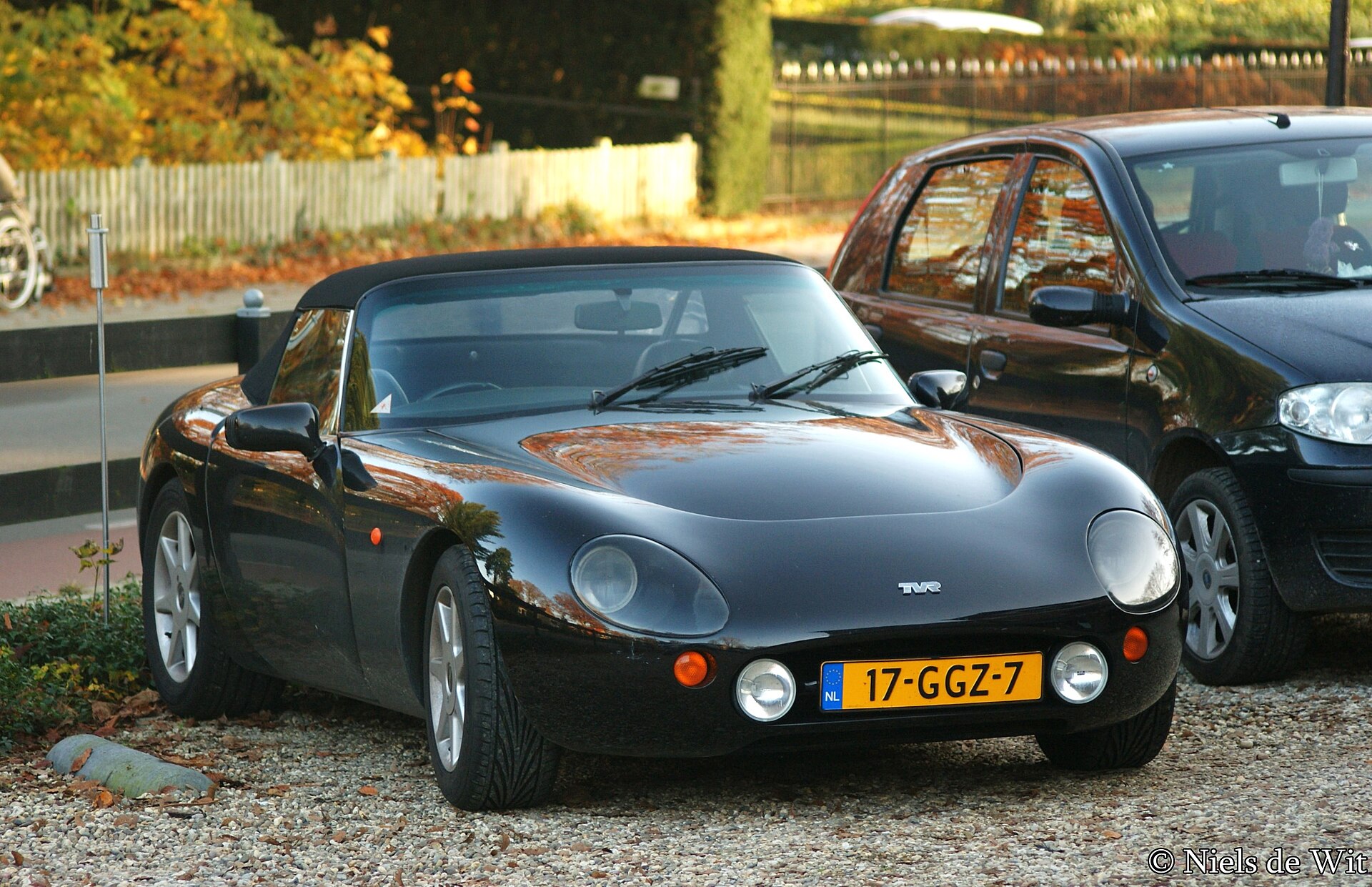
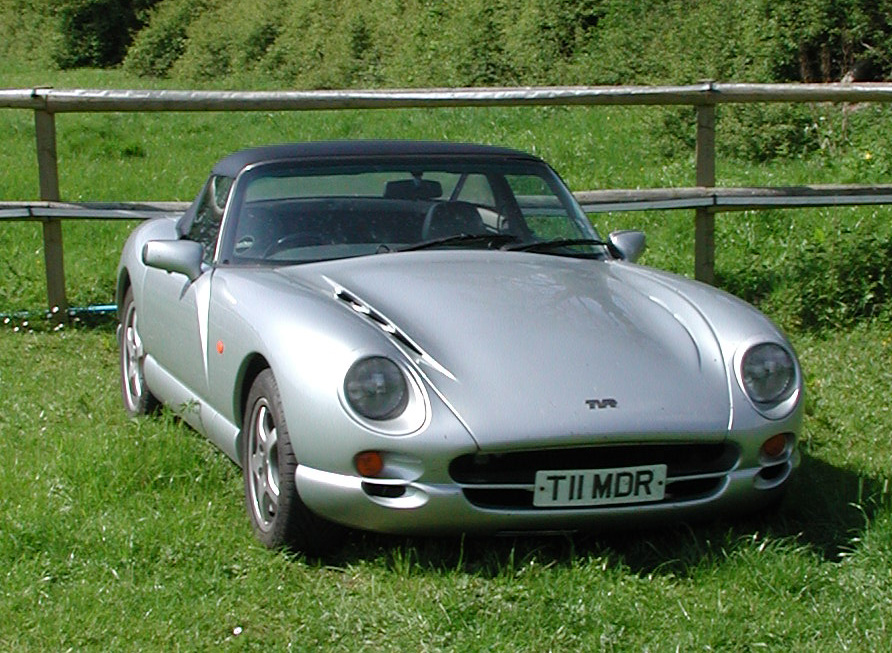
Under Wheeler engine sizes grew from 3.5 to 5 litres, and TVR switched from V6 engines to the Rover V8. The S Series of 1986 sold 605, 668 and 887 cars in its first three versions. The TVR Griffith of the 1990s had a Rover V8 of 179 kW (240 hp) at first and 254 kW (340 hp) in the 5.0-litre Griffith 500 of 1993. With a dry weight of 1,060 kg, that gave about 240 W per kg, which the power-to-weight calculator can compare with any modern sports car. About 2,300 Griffiths were sold until 2002. The longer, softer Chimaera of 1992–2003 used the same chassis and engines, was meant to replace the Griffith but sold alongside it, and reached 5,256 cars.
Wheeler then made TVR an engine maker. The AJP8 V8 was named after its designer Al Melling, John Ravenscroft and Peter Wheeler. It powered the Cerbera 2+2 coupé from 1996 with 268 kW (360 hp) from 4.2 litres or 313 kW (420 hp) from 4.5 litres. The Speed Six straight-six of 4.0 litres produced 261 kW (355 PS), although early engines proved unreliable and many needed rebuilding. The TVR article counts 1,196 Cerberas, the Cerbera article 1,490. The Speed Six also powered the Tuscan of 1999–2006 (1,677 cars), the Tamora, the T350 and the Sagaris.

New owners and the new Griffith
In July 2004 Nikolay Smolensky bought TVR from Peter Wheeler. Demand fell, 300 staff were laid off in April 2006, and in October that year body production and assembly were moved to Turin, Italy. On 24 December 2006 Blackpool Automotive entered administration, and the Sagaris (211 cars) was among the last Blackpool models.
On 6 June 2013 TVR was sold to TVR Automotive Ltd, led by Les Edgar and John Chasey. A new car codenamed T37 was announced in June 2015 with Gordon Murray and Cosworth as partners. In March 2016 the Welsh Government announced a factory in Ebbw Vale and took a 3% stake for £500,000. The new Griffith was unveiled at the Goodwood Revival on 8 September 2017. It has a carbon-fibre ground-effect chassis and a 5.0-litre Ford V8 modified by Cosworth to about 336 to 373 kW (450 to 500 hp).
A Launch Edition of 500 cars at £89,995 was planned for 2019, but the car did not enter production. TVR lost its exclusive rights to the Ebbw Vale factory in December 2023, and in November 2025 Charge Holdings bought the company. TVR models are listed in the TVR catalogue, and the engine supplier of the 1980s and 1990s in the Rover catalogue.
TVR timeline
| Year | Event |
|---|---|
| 1946 | Trevor Wilkinson founds Trevcar Motors in Blackpool |
| 1949 | First TVR chassis |
| 1958 | Grantura, the first production TVR |
| 1962 | Wilkinson leaves; receivership |
| 1963 | Griffith 200 with Ford V8 |
| 1965 | Arthur and Martin Lilley take over |
| 1972 | M Series |
| 1980 | Tasmin |
| 1981 | Peter Wheeler takes control (December) |
| 1991 | Rover V8 Griffith |
| 1992 | Chimaera |
| 1996 | Cerbera with TVR's own AJP8 V8 |
| 2004 | Nikolay Smolensky buys TVR (July) |
| 2006 | Production halt; administration (24 December) |
| 2013 | Les Edgar's TVR Automotive takes over |
| 2017 | New Griffith unveiled at Goodwood (8 September) |
Landmark TVR models
| Model | Years | Why it matters |
|---|---|---|
| Grantura | 1958–1967 | First production TVR, 796 built |
| Griffith 200/400 | 1963–1967 | First TVR with a Ford V8 |
| 3000M | 1972–1980 | Core car of the M Series |
| Tasmin | 1980 onwards | Ford V6 model of the late Lilley era |
| Griffith | 1991–2002 | Rover V8 roadster, up to 254 kW |
| Chimaera | 1992–2003 | Most produced TVR in the sources, 5,256 built |
| Cerbera | 1996–2006 | First car with TVR's own V8 |
| Sagaris | 2004–2006 | One of the last Blackpool TVRs |
Photo gallery

FAQ
Who founded TVR?
Trevor Wilkinson, who set up Trevcar Motors in a former wheelwright's workshop in Blackpool in 1946; it was later renamed TVR Engineering.
Where were TVR cars built?
In Blackpool, England, from 1946 until production stopped in 2006. A new factory in Ebbw Vale, Wales, was announced in 2016 for the new Griffith.
What engines did TVR use?
Ford, Coventry Climax, BMC and Triumph engines in early cars, Rover V8s from the 1980s, and its own AJP8 V8 and Speed Six straight-six from the mid-1990s.
Is TVR still making cars?
Not in series. The new Griffith was unveiled in 2017, but by 2024 it had not entered production, and the company changed owners again in November 2025.
Which was the most popular TVR?
Of the models with figures in the sources, the Chimaera, with 5,256 cars built between 1992 and 2003.
Sources
- Wikipedia — TVR (accessed 24 Oct 2026)
- Wikipedia — TVR Grantura (accessed 24 Oct 2026)
- Wikipedia — TVR Griffith (accessed 24 Oct 2026)
- Wikipedia — TVR Chimaera (accessed 24 Oct 2026)
- Wikipedia — TVR Cerbera (accessed 24 Oct 2026)
Found a mistake? Report an error