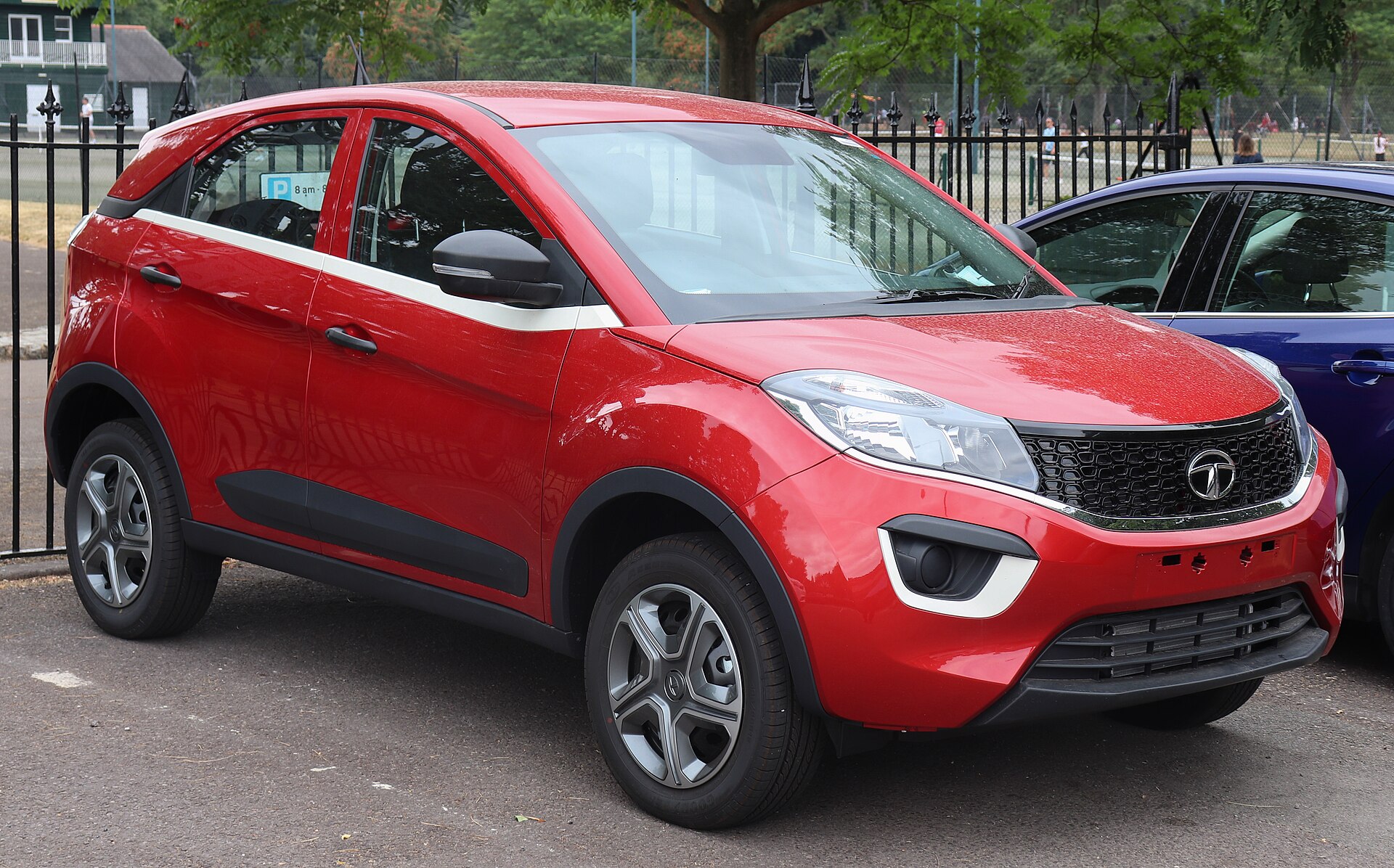
Tata Nexon
Specs, engines and history
Published Sources (1) Report an error
By Felix Hartmann, Automotive Technology & EV Contributor
- Built
- 2017–present
- Top power
- 107 kW (145 PS)
Which Nexon to choose
Our verdict · Felix Hartmann
- For low running costs in town: the Nexon EV, or the EV Max for the 40.5 kWh battery and longer range.
- For long distances: the 1.5 diesel with 260 Nm.
- For easy city driving with petrol: the 1.2 turbo with the dual-clutch automatic from 2023.
- For a used car: facelifted cars from 2023 have six airbags as standard.
Tata Motors is the car maker of India's Tata Group, founded on 1 September 1945 and based in Mumbai. It entered the passenger car market with the Tata Sierra SUV in 1991 and launched the Indica in 1998 as the first fully Indian-developed passenger car. Its best-known projects include the low-cost Nano of 2008 and the purchase of Jaguar Land Rover from Ford in June 2008. Since the demerger of October 2025 the car business has traded as Tata Motors Passenger Vehicles, and in 2025 it was India's third-largest car maker by sales.
The Tata Nexon is a compact crossover SUV under four metres long, built in Ranjangaon near Pune since July 2017. It is offered with turbocharged petrol and diesel engines and as the electric Nexon EV. In 2018 it became the first car sold in India to receive five stars for adult protection from Global NCAP. It is built for the Indian market.
Specs by version
Engines
Dimensions and weight
Show all 1 versions
| Version | Battery |
|---|---|
| Nexon EV 30.2 kWh | 30 kWh |
Verified Manufacturer and type-approval data from our catalog · Sources and methodology
In short
- On sale in India since September 2017; 800,000 built by March 2025.
- 1.2 Revotron turbo petrol with 81 kW (110 PS), later 88 kW (120 PS); 1.5 Revotorq diesel with 81 kW (110 PS) and 260 Nm.
- Nexon EV: 94.7 kW (129 PS) with a 30.2 kWh battery, and the EV Max with 106.64 kW (145 PS) and 40.5 kWh.
- Five stars from Global NCAP in 2018 and 2024 and from Bharat NCAP in 2024.
Tata Nexon at a glance
| Specification | Value |
|---|---|
| Production | since July 2017, Ranjangaon (Pune), India |
| Platform | revised Tata X1, first used in 1998 by the Indica |
| Body | five-door compact crossover SUV |
| Length | 3,994–3,995 mm |
| Width / height | 1,804–1,811 / 1,607–1,620 mm |
| Wheelbase | 2,498 mm |
| Petrol | 1.2 Revotron turbo three-cylinder, 81–88 kW (110–120 PS) |
| Diesel | 1.5 Revotorq turbo four-cylinder, 81 kW (110 PS), 260 Nm |
| Electric | 94.7 kW (30.2 kWh) and 106.64 kW (40.5 kWh, EV Max) |
| Gearboxes | five- and six-speed manual, six-speed AMT, seven-speed DCT (from 2023) |
| Drive | front-wheel drive |
| Safety | five stars, Global NCAP (2018 adult, 2024) and Bharat NCAP (2024) |
From concept to the sub-four-metre segment
Tata first showed the Nexon as a concept at the Auto Expo in 2014. The production model was presented in February 2016. Production began at Ranjangaon in July 2017, and sales started in September 2017.
The Nexon competes in India's sub-four-metre crossover segment, and its length of 3,994–3,995 mm keeps it just inside that limit. It uses a reworked version of the X1 platform that first carried the Indica in 1998, with a 2,498 mm wheelbase and a width of about 1.8 metres.

Engines and gearboxes
| Version | Engine | Power | Torque |
|---|---|---|---|
| Petrol (2017–2019) | 1.2 Revotron turbo, three-cylinder | 81 kW (110 PS) | 170 Nm |
| Petrol (from 2020) | 1.2 Revotron turbo, three-cylinder | 88 kW (120 PS) | - |
| Diesel | 1.5 Revotorq turbo, four-cylinder | 81 kW (110 PS) | 260 Nm |
At launch both engines came with a six-speed manual or a six-speed automated manual (AMT). The 2023 update added a five-speed manual and a seven-speed dual-clutch automatic. All versions drive the front wheels. The diesel gives 90 Nm more torque than the early petrol engine at the same 81 kW.
Nexon EV: battery, power and range
Tata revealed the Nexon EV on 19 December 2019. It uses the company's Ziptron electric drive components.
| Version | Battery | Power | Torque | Range (ARAI) |
|---|---|---|---|---|
| Nexon EV (2019) | 30.2 kWh | 94.7 kW (129 PS) | 245 Nm | up to 312 km |
| Nexon EV Max (May 2022) | 40.5 kWh | 106.64 kW (145 PS) | 250 Nm | up to 437 km |
The range figures follow India's ARAI test procedure, which is not the same as the European WLTP cycle. The EV Max adds 10.3 kWh of battery for 125 km more rated range. Our car rankings compare battery size and range across electric models.

Facelifts of 2020 and 2023
The first facelift arrived in January 2020. It brought new front and rear styling in Tata's Impact 2.0 design language and engines that met India's BS6 emission rules; the petrol engine rose to 88 kW (120 PS).
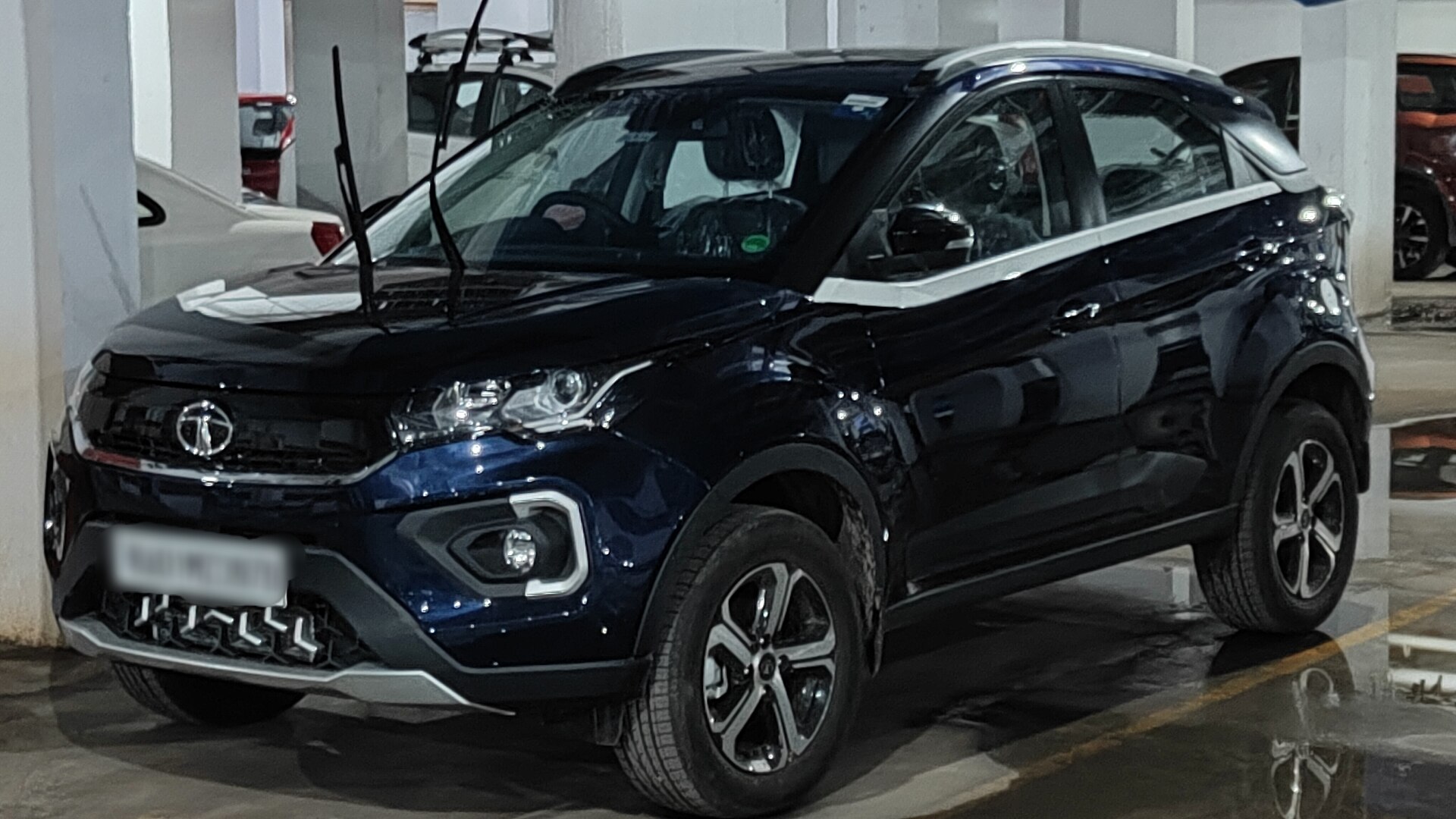
The second update followed in September 2023. Its front end was inspired by the Tata Curvv concept, and a full-width LED light bar runs across the tailgate. Inside, the car gained a 10.25-inch touchscreen and a two-spoke steering wheel with an illuminated logo. Six airbags became standard.


Safety ratings
Global NCAP tested it in August 2018 with two airbags. After a reassessment in December 2018 it scored 16.06 of 17 points for adult protection. That gave it five stars, the first maximum adult rating for a car sold in India. Child protection scored 25.0 of 49 points, or three stars.
| Test | Year | Adult | Child | Stars |
|---|---|---|---|---|
| Global NCAP (old protocol) | 2018 | 16.06/17 | 25.0/49 | five adult, three child |
| Global NCAP (new protocol, facelift) | 2024 | 32.22/34 | 44.52/49 | five and five |
| Bharat NCAP, Nexon petrol | 2024 | 29.41/32 | 43.83/49 | five and five |
| Bharat NCAP, Nexon.ev | 2024 | 29.86/32 | 44.95/49 | five and five |
Global NCAP and Bharat NCAP use their own protocols, so these scores cannot be compared directly with Euro NCAP results. More on how crash tests work is in our car safety section.
Sales and production
| Year | Sales in India |
|---|---|
| 2017 | 14,062 |
| 2018 | 52,519 |
| 2019 | 49,312 |
| 2020 | 49,842 |
| 2021 | 108,577 |
| 2022 | 168,278 |
| 2023 | 170,311 |
| 2024 | 161,611 |
| 2025 | 200,561 |
The 50,000th Nexon was built in August 2018. By March 2025 Tata had made 800,000, and the Nexon became the first Tata SUV to pass that number. Sales more than doubled in 2021 and passed 200,000 for the first time in 2025.
Tata, Jaguar and Land Rover
Tata Motors has owned Jaguar Land Rover since June 2008. It bought the company from Ford during the financial crisis, and JLR stayed with the passenger-car company after the 2025 demerger. The two British brands are covered in our history of Land Rover and our history of Jaguar.
Photo gallery


Tata Nexon in our rankings
- No. 440 of 912 · Longest-running car nameplates (9 years · top 49%)
- No. 179 of 305 · Oldest car models still on sale (9 years · top 60%)
- No. 696 of 859 · Most powerful cars (107 kW · top 82%)
- No. 265 of 312 · Most powerful cars of the 2010s (95 kW · top 85%)
- No. 174 of 197 · Most powerful SUVs and crossovers (107 kW · top 89%)
- No. 86 of 97 · Most powerful electric cars (95 kW · top 89%)
In production longer than 51% of ranked nameplates in the 1CARS catalog (No. 440 of 912).
FAQ
Is the Tata Nexon sold in Europe?
No. It is built and sold for the Indian market, and English Wikipedia records no European export.
How safe is the Tata Nexon?
It was the first car sold in India to get five stars for adult protection from Global NCAP, in 2018, and it scored five stars for adults and children in 2024.
What is the range of the Tata Nexon EV?
Up to 312 km for the 30.2 kWh version and up to 437 km for the 40.5 kWh EV Max, both on India's ARAI cycle.
What engines does the Nexon have?
A 1.2-litre turbo petrol three-cylinder, a 1.5-litre turbo diesel four-cylinder and an electric motor.
Who owns Tata Motors?
It is part of the Tata Group of India, which also owns Jaguar Land Rover.
Data sources
Data checked by an editor against the sources below.