Pierce-Arrow Silver Arrow
Specs, engines and history
Published Sources (1) Report an error
By Sarah Whitmore, Senior Automotive Writer
- Built
- 1933
- Top power
- 130 kW (177 PS)
Pierce-Arrow was a luxury car maker from Buffalo, New York, one of the "Three P's of Motordom" with Peerless and Packard. Its roots go back to 1865, when Heinz, Pierce and Munschauer was founded to make gilded birdcages. George Norman Pierce bought out his partners in 1872, added bicycles in 1896 and built a single-cylinder Motorette by 1901. The four-cylinder Great Arrow of 1904 was the company's biggest success, and Percy Pierce drove one to victory in the 1905 Glidden Tour. The firm became the Pierce-Arrow Motor Car Company in 1908. In 1909 President William Howard Taft ordered two Pierce-Arrows, the first official cars of the White House.
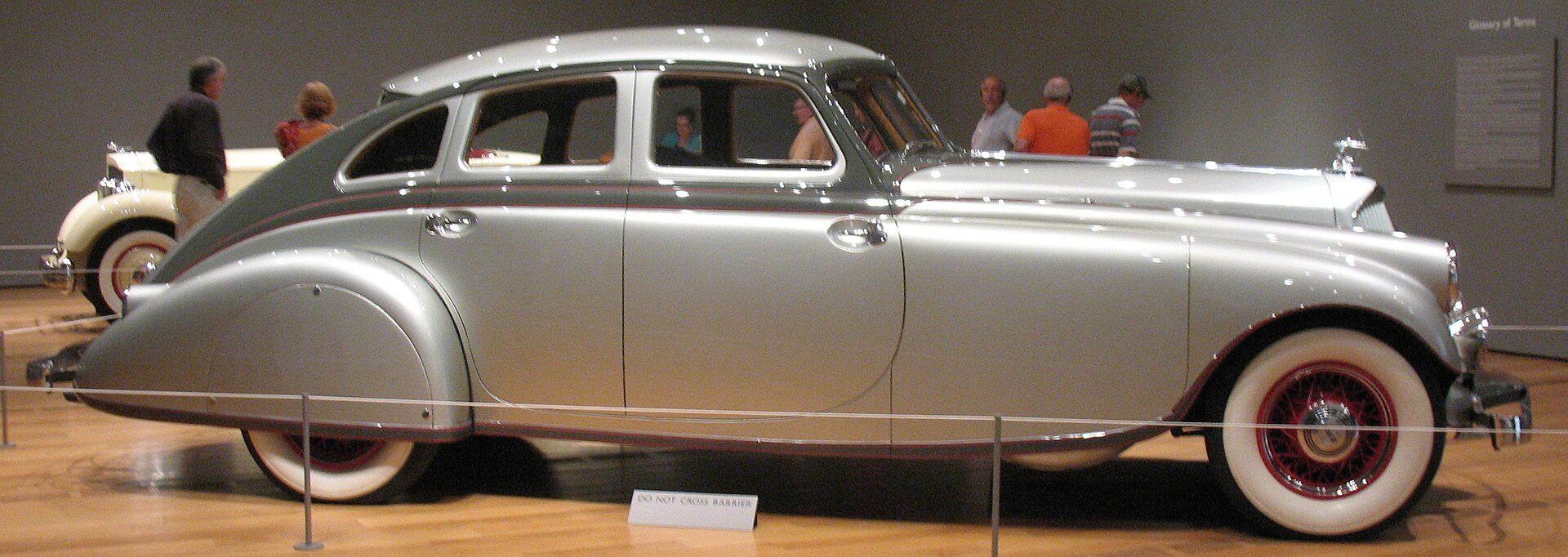
The Silver Arrow is Pierce-Arrow's most famous car and one of the boldest American designs of the 1930s. It was a streamlined four-door fastback built in only five examples for the 1933 show season. Each cost US$10,000, and Pierce-Arrow advertised it as "the car of 1940 in 1933", with the slogan "Suddenly it's 1940!". Three of the five are known to survive.
Specs by version
Verified Manufacturer and type-approval data from our catalog · Sources and methodology
In short
- Five hand-built cars, made in 1933 in Studebaker's prototype shop in South Bend, Indiana, to a design by Phillip O. Wright.
- Side-valve V12 of 7,568 cc (English Wikipedia also gives 7,571 cc) with 130 kW (175 bhp) at 3,600 rpm; advertised top speed 185 km/h (115 mph).
- Standard Pierce-Arrow chassis with a 139 in (3,531 mm) wheelbase; kerb weight about 2,314 kg.
- Price US$10,000 in 1933; car no. 1 sold for US$2,310,000 at RM Sotheby's in Hershey on 6 October 2017.
Pierce-Arrow Silver Arrow at a glance
| Parameter | Metric | Imperial |
|---|---|---|
| Maker | Pierce-Arrow Motor Car Company, Buffalo, New York (Studebaker-owned until 1933) | — |
| Bodies built | Studebaker prototype shop, South Bend, Indiana | — |
| Year | 1933 | — |
| Number built | five; three known to survive | — |
| Designer | Phillip O. Wright; adapted by James R. Hughes | — |
| Body | four-door fastback sedan | — |
| Engine | side-valve (L-head) V12, 7,568 cc | 461.8 cu in |
| Power | 130 kW (175 bhp) at 3,600 rpm | — |
| Gearbox | three-speed manual; some reports mention an automatic clutch | — |
| Brakes | vacuum-assisted mechanical drums on all four wheels | — |
| Wheelbase | 3,531 mm | 139 in |
| Kerb weight | 2,314 kg (infobox); 2,315–2,590 kg (text) | 5,101 lb; 5,100–5,700 lb |
| Advertised top speed | 185 km/h | 115 mph |
| Price | US$10,000 (1933) | — |
Pierce-Arrow before the Silver Arrow
Pierce-Arrow built six-cylinder cars only from 1910 to 1929. In 1918 it adopted the four-valve-per-cylinder Dual Valve Six. Herbert M. Dawley joined in 1912 and designed almost every model until 1938. From 1914 the headlamps sat in flared housings on the front wings. Pierce patented this layout and kept it until 1938, and it became the make's trademark.
Studebaker gained control of Pierce-Arrow in 1928. The two engineering departments stayed separate, but Pierce-Arrow gained Studebaker's dealer network. An eight-cylinder engine arrived with the 1929 Model 126 and a V12 in 1931. The Depression hit sales hard:
| Year | Cars | Trucks |
|---|---|---|
| 1928 | 5,492 | 999 |
| 1929 | 9,840 | 507 |
| 1930 | 6,916 | 6 |
| 1931 | 4,210 | 114 |
| 1932 | 2,241 | 70 |
Pierce-Arrow needed attention, and an expensive show car was one way to get it.
Development and production history
The idea came from Phillip O. Wright, a young stylist who had just left the Art & Colour Section of General Motors under Harley Earl. In 1932 he showed a 1/8-scale clay model and drawings to Roy Faulkner, Pierce-Arrow's sales executive. Studebaker approved the project and rushed it through for the New York Auto Show in January 1933. The plan first called for a 147 in wheelbase. Studebaker's chief body engineer, James R. Hughes, adapted the design to the standard 139 in chassis. He also reused elements of a rejected Studebaker fastback.
About 30 craftsmen hand-formed the steel bodies in roughly three months in Studebaker's prototype shop in South Bend. The cars were shown at the New York show in January 1933, then in Boston and at the Century of Progress World's Fair in Chicago. There the Silver Arrow outshone the Cadillac Aero-Dynamic coupé, the Duesenberg "Twenty Grand" and Packard's "Car of the Dome". A cast-iron toy replica became a popular souvenir of the fair.
| Date | Event |
|---|---|
| 1932 | Wright shows the clay model to Roy Faulkner; Studebaker approves the project |
| 1932–1933 | five bodies hand-built in South Bend in about three months |
| January 1933 | debut at the New York Auto Show |
| 1933 | Boston show and Century of Progress World's Fair, Chicago |
| 1933 | Pierce-Arrow returns to independent ownership |
| 1934–1935 | production "Silver Arrow" models with the fastback tail |
| 1938 | Pierce-Arrow declares insolvency and closes |
Each car was priced at US$10,000, which English Wikipedia compares with three or four suburban houses of the time. The Studebaker National Museum notes that Pierce-Arrow still lost money on each one.
Design and engineering
The Silver Arrow looked lower and smoother than any rival luxury sedan of 1933. Its main features were:
- Fastback roof: one continuous line from the windscreen to the tail, ending in a slit-like rear window.
- Front wings: envelope-style, with the headlamps faired in, an evolution of Pierce-Arrow's patented wing-mounted lamps.
- Hidden spare wheels: two spares in lockers inside the long front wings, opened from the dashboard.
- No running boards: the body sides were smooth, with flush doors and recessed handles.
- Rear wings: tapering pontoon shapes.
The style drew on aircraft streamlining and Art Deco. Inside, a step-down floor carried trim in broadcloth, leather and curly maple, with a rear speedometer, clock and radio speaker for the passengers.
Engine and drivetrain
Under the long bonnet sat Pierce-Arrow's side-valve V12. The infobox gives 461.8 cu in (7,568 cc), the text 462 cu in (7,571 cc). It produced 130 kW (175 bhp) at 3,600 rpm, and the text gives a range of 3,600–4,000 rpm. Drive went to the rear wheels through a three-speed manual gearbox, and some reports mention an automatic clutch. Vacuum-assisted mechanical drum brakes worked on all four wheels.
Pierce-Arrow advertised a top speed of 115 mph (185 km/h), a figure English Wikipedia calls ambitious for a car of this weight. With 130 kW and about 2,314 kg, the Silver Arrow had roughly 56 kW per tonne. The power-to-weight calculator shows how far modern luxury cars have moved on. After the company closed, Seagrave Fire Apparatus bought the tooling for the V12.

Variants and the production Silver Arrow
The name lived on in a cheaper form. For 1934 and 1935 Pierce-Arrow sold production cars called "Silver Arrow" on standard chassis. They kept the fastback tail, but lacked the show car's full streamlining and were built in larger numbers. They should not be confused with the five 1933 cars.
| Variant | Years | Body / purpose | Engine | Notes |
|---|---|---|---|---|
| Silver Arrow (show car) | 1933 | hand-built four-door fastback | V12, 7.6 l, 130 kW (175 bhp) | five built, three survive |
| Silver Arrow (production) | 1934–1935 | fastback-tail sedan on standard chassis | Pierce-Arrow engines | larger numbers, less streamlined |

Legacy and the end of Pierce-Arrow
English Wikipedia ranks the Silver Arrow among the most influential pre-war American designs, because it foreshadowed post-war shapes. It could not save the company. Pierce-Arrow sales kept falling; from 1936 it also built Travelodge camper trailers. It declared insolvency in 1938, and the chief engineer, Karl Wise, assembled the last car from parts held by the receiver. The remaining assets were auctioned on 13 May 1938.
Pierce-Arrows lived on in other forms. Five were rebuilt, along with some Buicks, into the Rio Grande Southern "Galloping Goose" railcars, three of which are preserved at the Colorado Railroad Museum. Other second-hand cars became fire engines, some serving for up to 20 years.
Survivors and collecting today
Three of the five 1933 cars survive. The best documented is body no. 1 (chassis 2575015, engine 360001), the first Silver Arrow built. RM Sotheby's describes it as the most complete and original of the three. It was shown at the 1933 New York and Boston shows and probably painted two-tone tan, not silver. Its first owner was M. C. Hudson, a San Francisco distributor who used it to promote Crazy Water. F. Robert Greene found it in Texas around 1954.
The car later belonged to James Brucker Sr., whose Movieworld Cars of the Stars displayed it in silver with blue mouldings. Dr Don Vesley owned it in the late 1970s, and the Blackhawk Collection in the 1980s, when Mike Fennel of Saugus, California, restored it. Thomas Derro bought it in 1996 and showed it for about two decades. On 6 October 2017 it sold at RM Sotheby's Hershey auction for US$2,310,000 including fees. In 2019 another Silver Arrow from the Richard H. Driehaus Collection appeared in the Studebaker National Museum's 2019 exhibition on streamlined cars.
Other American cars of the decade are in the 1930s classics section, and Pierce-Arrow's owner of those years is in the Studebaker catalogue. For the rest of the make, see the Pierce-Arrow catalogue.

Pierce-Arrow Silver Arrow in our rankings
- No. 1 of 131 · Biggest engines: sedans (7,568 cc)
- No. 12 of 557 · Biggest engines: cars (7,568 cc · top 3%)
- No. 80 of 149 · Most powerful sedans (130 kW · top 54%)
- No. 624 of 859 · Most powerful cars (130 kW · top 73%)
- No. 131 of 154 · Most powerful American cars (130 kW · top 86%)
- No. 27 of 28 · Most powerful V12 cars (130 kW · top 97%)
Bigger engine than 99% of ranked sedans in the 1CARS catalog (No. 1 of 131).
FAQ
How many Pierce-Arrow Silver Arrows were made?
Five hand-built cars were made in 1933 for the show season, and three of them are known to survive. Pierce-Arrow also used the name for production cars in 1934 and 1935.
What engine does the Pierce-Arrow Silver Arrow have?
A side-valve V12 of about 7.6 litres (461.8 cu in), rated at 130 kW (175 bhp) at 3,600 rpm, with a three-speed manual gearbox.
How much did the Silver Arrow cost in 1933?
Each of the five cars was priced at US$10,000, and the Studebaker National Museum says Pierce-Arrow still lost money on every one.
How much is a Pierce-Arrow Silver Arrow worth?
The first car built, body no. 1, sold for US$2,310,000 including fees at RM Sotheby's Hershey auction on 6 October 2017.
Who designed the Silver Arrow?
Phillip O. Wright, a former stylist in Harley Earl's Art & Colour Section at General Motors. Studebaker's chief body engineer, James R. Hughes, adapted the design to the 139 in chassis.
Data sources
Data checked by an editor against the sources below.