Pierce-Arrow — The Buffalo Maker of Presidential Cars
Pierce-Arrow was an American maker of luxury cars and trucks from Buffalo, New York. The business began in 1865 as a maker of gilded birdcages, added bicycles in 1896 and built its first car in 1901. With the Great Arrow, the first official White House cars and its trademark headlamps set into the front wings, it became one of the most respected American luxury makes. Studebaker controlled it from 1928, the streamlined Silver Arrow of 1933 failed to save it, and the company closed in 1938.
Key takeaways
- Origins in 1865 as Heinz, Pierce and Munschauer; George N. Pierce took over in 1872. The first car, the Motorette, followed in 1901.
- The Great Arrow won the 1905 Glidden Tour, and President Taft ordered two Pierce-Arrows in 1909 for the first White House car fleet.
- Headlamps in flared wings became the company's styling hallmark from 1914; Herbert M. Dawley designed almost every model from 1912 to 1938.
- Studebaker took control in 1928; the company declared insolvency in 1938 and its assets were auctioned on 13 May 1938.
Pierce-Arrow at a glance
| Fact | Value |
|---|---|
| Origins | 1865, Buffalo, New York (Heinz, Pierce and Munschauer) |
| Founder | George Norman Pierce |
| First car | Motorette, 1901 |
| Company name | Pierce-Arrow Motor Car Company from 1908 |
| Factory | Elmwood and Great Arrow Avenues, designed by Albert Kahn (1906) |
| Best-known models | Great Arrow, 48 and 66, straight-eight and V12 cars, Silver Arrow |
| Owner 1928–1933/34 | Studebaker |
| Closed | 1938 |
Birdcages, bicycles and the Motorette
The firm that became Pierce-Arrow was set up in Buffalo in 1865 as Heinz, Pierce and Munschauer and was best known for delicate, gilded birdcages and other household goods. In 1872 George Norman Pierce bought out his two partners and renamed it the George N. Pierce Company. Bicycles were added in 1896.
The move to cars began with a false start: in 1900 an attempt to build a steam car under licence from Overman failed. In 1901 the company built its first car, the Motorette, a single-cylinder model with two speeds and no reverse. A two-cylinder car called the Arrow followed in 1903, and the name stayed with the company.

The Great Arrow and the Glidden Tour
From 1904 Pierce concentrated on a larger, more luxurious four-cylinder car, the Great Arrow, which became its most successful product. In 1905 it won the Glidden Tour, a 350-mile event from New York City to Bretton Woods, New Hampshire, in which 33 cars took part; Percy Pierce drove the winning car.
Success called for a new plant. Around 1906 Albert Kahn designed the factory complex at Elmwood Avenue and Great Arrow Avenue in Buffalo, which covered about 14 hectares and included a three-storey administration building of 12,353 m². It served as headquarters and works until 1938 and was added to the National Register of Historic Places on 1 October 1974. George Pierce sold his rights in the company in 1907, and in 1908 the Pierce Motor Company was renamed the Pierce-Arrow Motor Car Company. Pierce himself died in 1910.
White House cars and fender headlamps
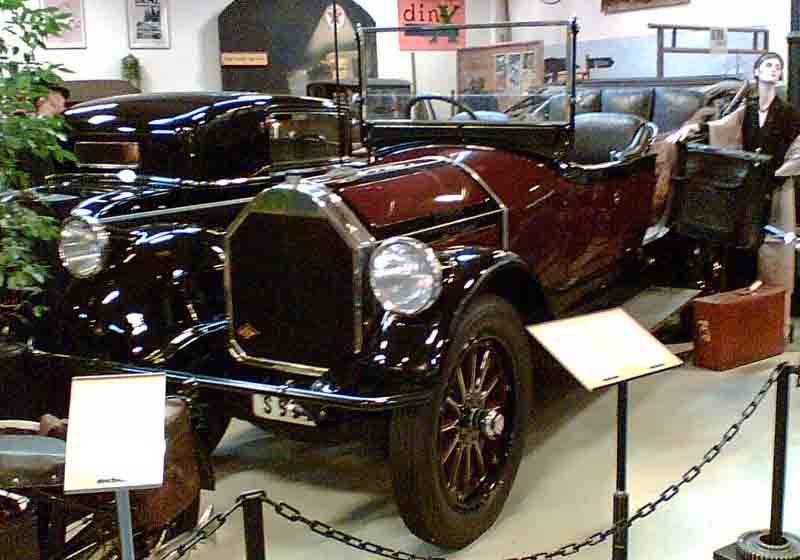
In 1909 President William Howard Taft ordered two Pierce-Arrows, along with two White Model M tourers, for state occasions. These were the first official White House cars. From 1910 the company dropped its other four-cylinder cars and built only sixes until 1929, among them the 36, 48 and 66 models. Engine sizes were enormous by later standards, from 7.4 litres to 11.7 litres, and the largest engine, with a 5-inch bore and 7-inch stroke, displaced 13.5 litres (825 cu in). The engine size by decade chart shows how far average engines later shrank.
Herbert M. Dawley joined in 1912 and designed almost every Pierce-Arrow until 1938. In 1914 the headlamps moved into flared housings on the front wings, a feature that became the company's signature. In 1918 Pierce-Arrow adopted the Dual Valve Six, a T-head straight-six with four valves and three spark plugs per cylinder, and from 1919 a four-speed manual gearbox. The company also built trucks and, until 1914, motorcycles.

Studebaker, straight-eights and the V12
In 1928 Studebaker gained control of the Buffalo firm, for a planned period of five years, and a Canadian subsidiary built cars in Walkerville, Ontario, from 1928 to 1934. That year Pierce-Arrow built 5,492 cars and 999 trucks. In 1929 a 6.0-litre side-valve straight-eight replaced the six, and production rose to 9,840 cars and 507 trucks.
Production then fell: 6,916 cars in 1930, 4,210 in 1931 and only 2,241 in 1932. A V12 engine was offered from 1931. Studebaker itself went into receivership on 18 March 1933, and its ownership of Pierce-Arrow ended by 1934. The Studebaker catalogue covers the former parent company.

The Silver Arrow and the end in 1938
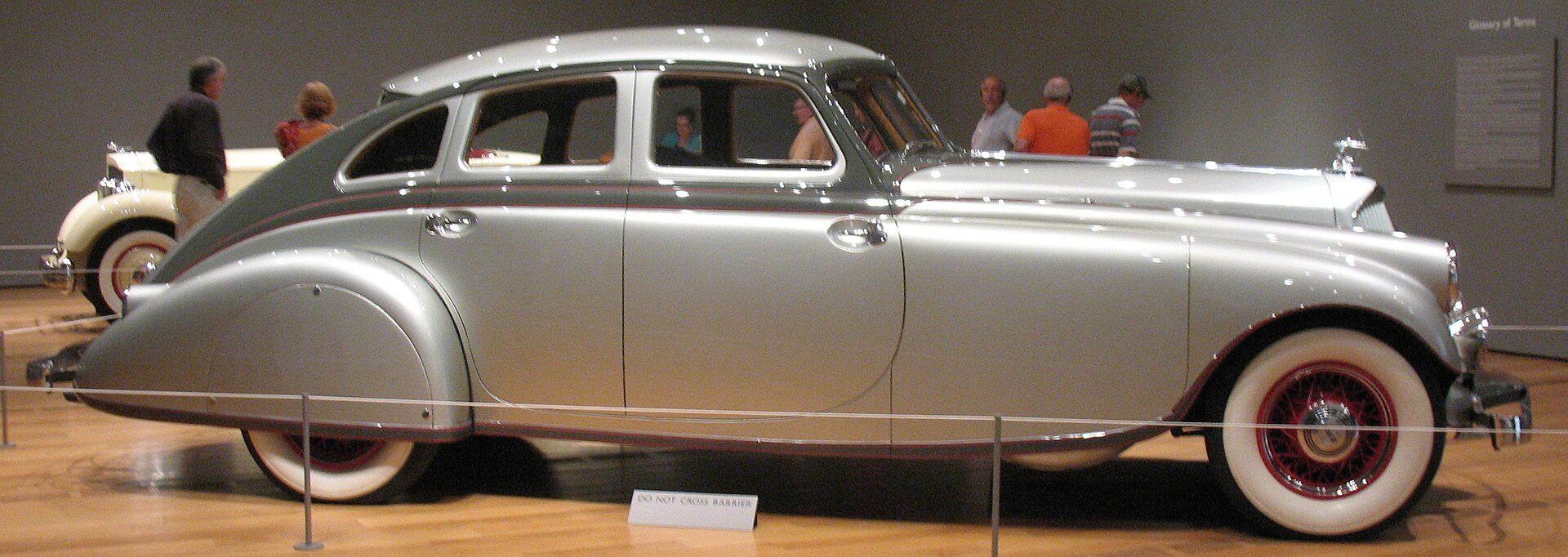
The Silver Arrow show car appeared at the New York Auto Show in January 1933 with the slogan "Suddenly it's 1940!" It was designed by Phillip O. Wright, a young stylist who had been laid off from the Art and Colour Section of General Motors. The fastback saloon used a side-valve V12 of about 7.6 litres with 130 kW (175 hp) at 3,600 rpm. Five were built by hand and sold at US$10,000 each in 1933; three are known to survive. The production Silver Arrows of 1934–1935 kept the fastback tail but not the radical streamlining. The Pierce-Arrow Silver Arrow article covers the car in detail.
The company tried new products: in 1936 it introduced the Travelodge camper trailers and a redesigned V12 saloon. Pierce-Arrow bodies also lived on in the Galloping Goose railcars of the Rio Grande Southern Railroad. None of this was enough. In 1938 the company declared insolvency and closed. Chief engineer Karl Wise assembled the last car from parts secured by the receiver, and the remaining assets were auctioned on Friday, 13 May 1938. After 1938 the Buffalo complex was divided into space for many small companies. The make's surviving cars are listed in the Pierce-Arrow catalogue, and more cars of the era are in the classic cars section.
Pierce-Arrow timeline
| Year | Event |
|---|---|
| 1865 | Heinz, Pierce and Munschauer founded in Buffalo |
| 1872 | George N. Pierce takes over |
| 1896 | Bicycles added |
| 1901 | First car, the Motorette |
| 1904 | Great Arrow |
| 1905 | Great Arrow wins the Glidden Tour |
| 1906 | Albert Kahn's Elmwood Avenue factory |
| 1908 | Pierce-Arrow Motor Car Company |
| 1909 | First official White House cars |
| 1914 | Headlamps in the front wings |
| 1928 | Studebaker takes control |
| 1929 | Straight-eight; 9,840 cars built |
| 1931 | V12 engine |
| 1933 | Silver Arrow show car |
| 1938 | Insolvency; assets auctioned on 13 May |
Landmark Pierce-Arrow models
| Model | Years | Why it matters |
|---|---|---|
| Motorette | 1901 | First car, single-cylinder |
| Great Arrow | 1904 onwards | Glidden Tour winner, the company's breakthrough |
| Model 48 / 66 | 1910s | Large sixes; the 66 had a 13.5-litre engine |
| Dual Valve Six | 1918 | Four valves and three plugs per cylinder |
| Straight-eight | 1929 | 6.0-litre side-valve engine replaced the six |
| Silver Arrow | 1933 | Streamlined V12 show car, five built |
Photo gallery

FAQ
Why did Pierce-Arrow headlights sit on the fenders?
From 1914 the headlamps were moved into flared housings on the front wings. It became the company's styling hallmark in the years when Herbert M. Dawley designed its cars.
Did Pierce-Arrow build White House cars?
Yes. In 1909 President William Howard Taft ordered two Pierce-Arrows for state occasions, the first official White House cars.
Who owned Pierce-Arrow?
It was independent until 1928, when Studebaker gained control. Studebaker's ownership ended after its own receivership in 1933.
When did Pierce-Arrow go out of business?
In 1938. The company declared insolvency, and its assets were auctioned on 13 May 1938.
How many Silver Arrows were made?
Five show cars were built by hand in 1933, and three survive. The 1934–1935 production cars also used the Silver Arrow name.
Sources
- Wikipedia — Pierce-Arrow (accessed 24 Oct 2026)
- Wikipedia — Pierce Silver Arrow (accessed 24 Oct 2026)
- Wikipedia — Pierce Arrow Factory Complex (accessed 24 Oct 2026)
- Wikipedia — Studebaker (accessed 24 Oct 2026)
- Wikipedia — Galloping Goose (railcar) (accessed 24 Oct 2026)
Found a mistake? Report an error