 Panhard 24
Specs, engines and history
Published Sources (1) Report an error
By Oleksandr Hnatiuk, Automotive Editor & Used Car Specialist
- Built
- 1963–1967
- Top power
- 37 kW (50 PS)
Panhard et Levassor is one of the founding names of the car industry. René Panhard, Émile Levassor and the Belgian lawyer Edouard Sarazin set up the company in 1887 and sold their first car in 1890 under a Daimler engine licence. In 1891 they introduced the layout with the engine at the front driving the rear wheels through a sliding-gear transmission, known as the Système Panhard; that car cost 3,500 francs (1891). In 1895 Panhard et Levassor cars finished first and second in the Paris–Bordeaux–Paris race, Levassor driving one alone for 48 hours 45 minutes. After the Second World War the firm, now simply Panhard, built small front-wheel-drive cars with air-cooled flat-twin engines, ended car production in 1967, and continued as a maker of armoured vehicles.
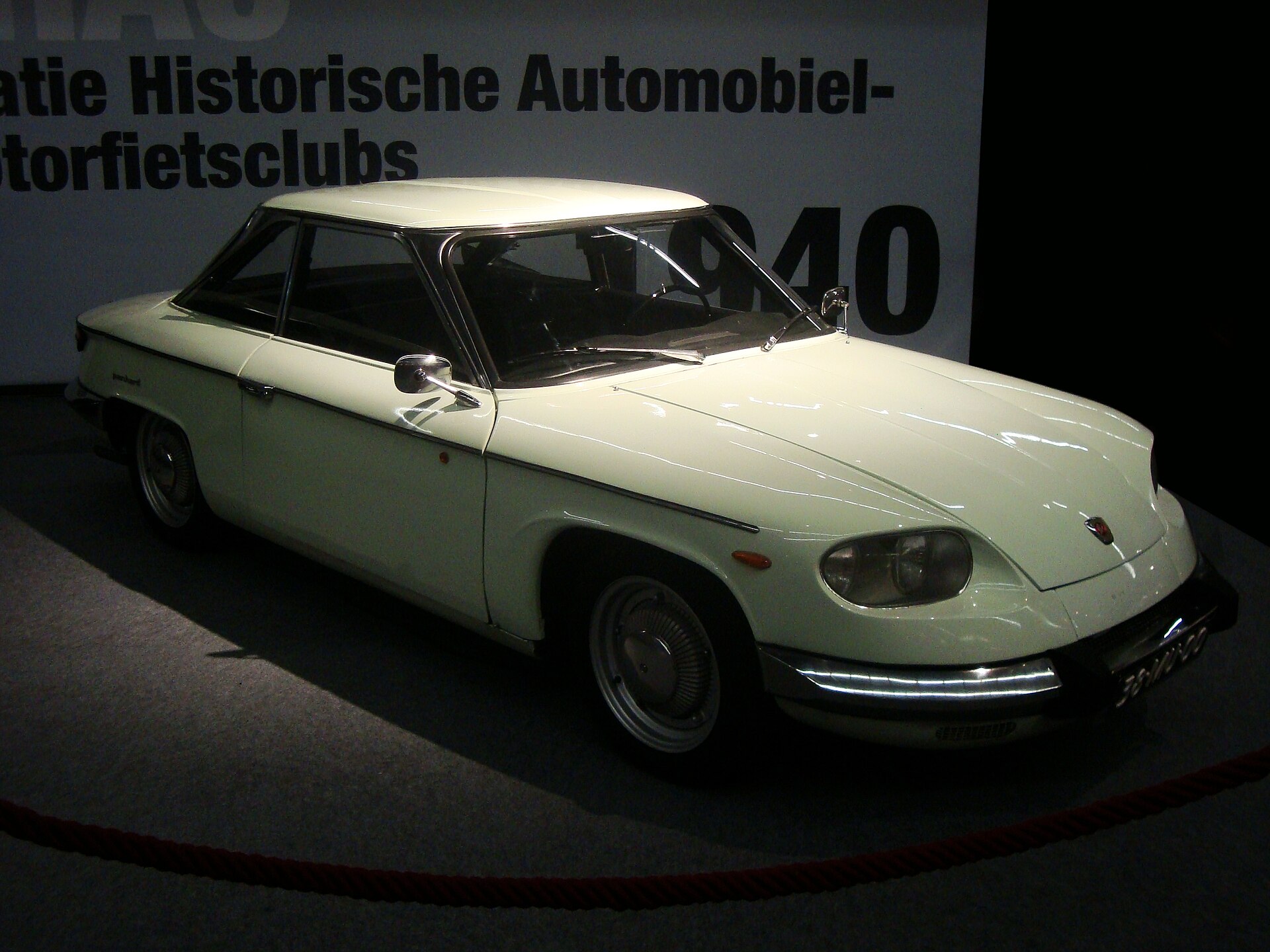
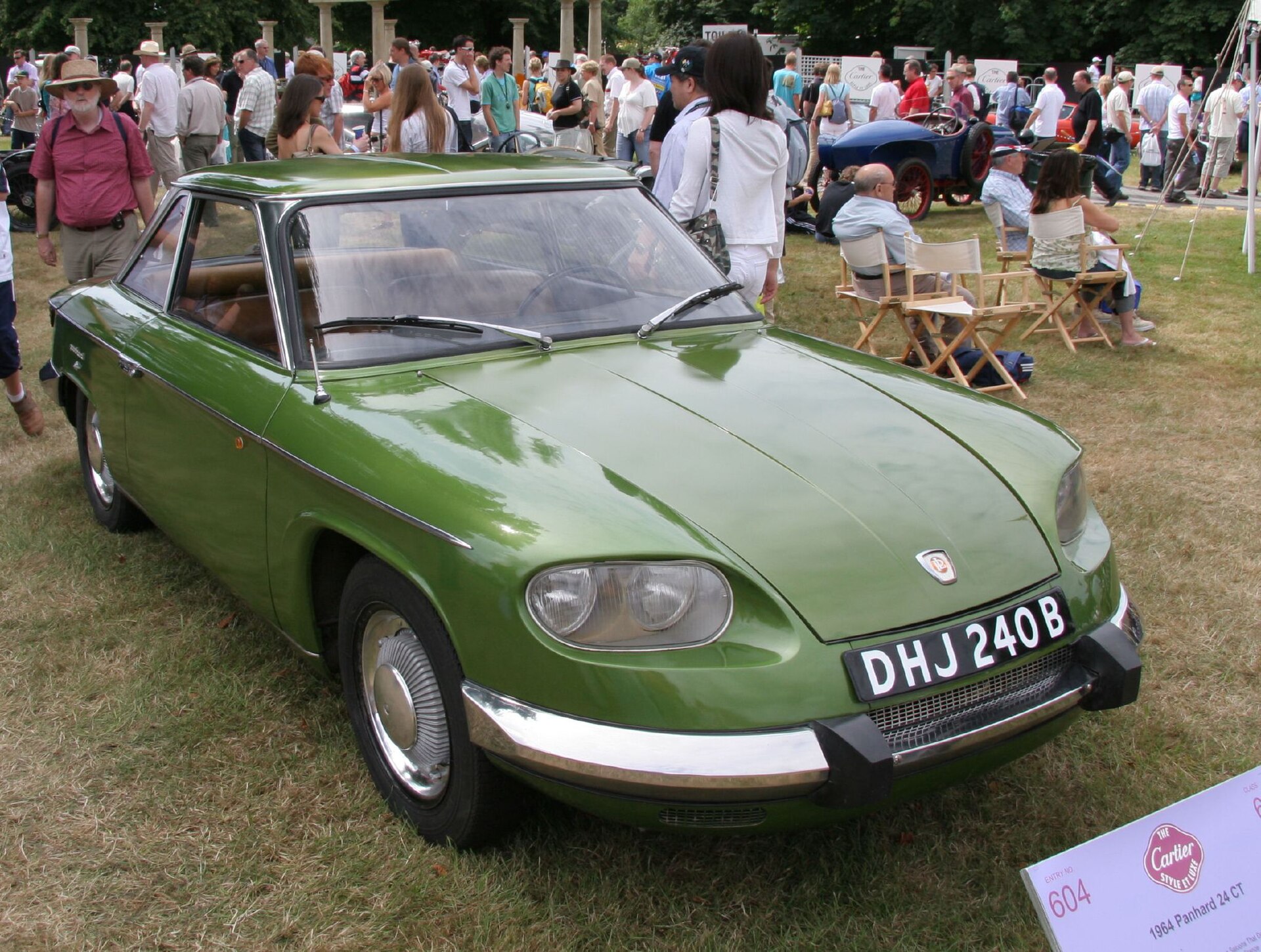
The 24 is the last Panhard car: a low, streamlined coupé and saloon with an 848 cc air-cooled flat-twin, front-wheel drive and twin headlamps behind glass. It was shown to the press on 23 June 1963 near Montlhéry and built until 20 July 1967, when Citroën, which had taken full control of Panhard's car business in April 1965, ended the marque. A total of 28,651 were made in five versions.
Specs by version
Verified Manufacturer and type-approval data from our catalog · Sources and methodology
In short
- Built from 1963 to 20 July 1967; 28,651 made, mostly as the 24 CT coupé and 24 BT saloon.
- 848 cc air-cooled flat-twin: 31 kW (42 CV DIN) in the 24 C and B, 37 kW (50 CV DIN) in the 24 CT and BT.
- Front-wheel drive, four-speed all-synchromesh gearbox, separate tubular steel chassis.
- Designed by Louis Bionier, with twin headlamps under a transparent cover that Citroën's DS adopted in 1967.
Panhard 24 at a glance
| Parameter | Metric | Imperial |
|---|---|---|
| Maker | Panhard, Paris; from April 1965 under Citroën | — |
| Production | 1963 – 20 July 1967 | — |
| Built | 28,651 | — |
| Designer | Louis Bionier | — |
| Bodies | two-door coupé (short wheelbase), four-door saloon (long wheelbase) | — |
| Engine | 848 cc air-cooled flat-twin, bore × stroke 84.85 × 75 mm | 51.7 cu in |
| Power | 31 kW (42 CV DIN) or 37 kW (50 CV DIN) | — |
| Drive | front-wheel drive, four-speed all-synchromesh manual | — |
| Wheelbase | 2,286 mm (short); 2,550 mm (long) | 90.0 / 100.4 in |
| Length | 4,267 mm (short); 4,490 mm (long) | 168.0 / 176.8 in |
| Width × height | 1,620 × 1,220 mm | 63.8 × 48.0 in |
| Weight | about 840 kg | about 1,852 lb |
| Fuel tank | 42 l | 9.2 imp gal |
Panhard from 1887 to the 1960s
Panhard's early decades were marked by racing and engineering firsts. Levassor was fatally injured in a crash during the 1896 Paris–Marseille–Paris race and died in 1897. From 1910 Panhard used the Knight sleeve-valve principle under licence, and from 1924 to 1940 every Panhard car had a sleeve-valve engine. In 1925 a 4.8-litre Panhard set a world record for the fastest hour, averaging 185.51 km/h.
After the war the range changed completely: the Dyna X of 1945–1954, the Dyna Z of 1953–1959, the PL 17 of 1959–1965 and finally the 24. Early aluminium bodies nearly bankrupted the company, and production went back to steel with the Dyna Z from September 1955. As its own sales fell, Panhard also built 2CV panel vans for Citroën, the car told in the history of the Citroën 2CV.
| Year | Event |
|---|---|
| 1887 | Panhard et Levassor founded |
| 1891 | Système Panhard layout |
| 1895 | 1st and 2nd in Paris–Bordeaux–Paris |
| 1924–1940 | sleeve-valve engines in every car |
| 1945 | Dyna X |
| 1953 | Dyna Z; steel bodies from September 1955 |
| 1959 | PL 17 |
| 23 June 1963 | Panhard 24 press launch near Montlhéry |
| April 1965 | Citroën takes full control of the car business |
| 20 July 1967 | last Panhard 24 built |
| from 1968 | armoured vehicles only |
The PL 17 that came before
The 24's predecessor sold in much larger numbers. The PL 17, presented on 29 June 1959 and built until 1965, was essentially a facelifted Dyna Z with six seats. About 166,000 were made: 136,000 standard saloons, 23,500 Tigre saloons, 398 convertibles, 2,998 Break estates and 3,191 commercial vehicles. Its engine was cut from 851 cc to 848 cc in July 1960 to meet the tax limits. It gave 31 kW (42 hp DIN) in standard form and 37 kW (50 hp DIN) in the Tigre, the same two ratings later used in the 24. A PL 17 won the 1961 Monte Carlo Rally, driven by Maurice Martin and Roger Bateau, with PL 17s also second and third.
Price did not help. In France in 1962 a PL 17 saloon cost 6,990 to 8,240 francs, while the smaller Simca Aronde cost 6,340 to 7,450 francs. English Wikipedia links the PL 17's modest sales partly to its pricing.
A low nose for a flat-twin
Louis Bionier's body made the most of the engine. Because the flat-twin was low and air-cooled, with no radiator in front, the nose could be very low and streamlined. Twin headlamps were recessed into it under a transparent cover, a motif Citroën gave the DS in 1967.
The 24 had a separate tubular steel chassis with a steel body rather than a monocoque. Inside, the front seatbacks and seat height were adjustable, the steering wheel could be adjusted for position, seat belts were optional, and the heating and ventilation system included demisters.


The 848 cc flat-twin and front-wheel drive
The engine was Panhard's air-cooled boxer twin of 848 cc, with an 84.85 mm bore and a 75 mm stroke, mounted at the front and driving the front wheels through a four-speed all-synchromesh gearbox. It came in two outputs:
| Engine tune | Used in | DIN rating | SAE rating | Compression |
|---|---|---|---|---|
| Standard | 24 C, 24 B, 24 BA | 31 kW (42 CV) at 5,250 rpm | 37 kW (50 CV) | — |
| Uprated | 24 CT, 24 BT | 37 kW (50 CV) at 5,750 rpm | 44 kW (60 CV) | 8.3:1 |
Claimed top speeds were 135 km/h for the long-wheelbase car with the 42 CV engine and 150 km/h for the short-wheelbase car with 50 CV. A slightly faster version with the Tiger 10 S engine is reported to have reached 160 km/h. With 37 kW and about 840 kg, a 24 CT has about 44 kW per tonne; the power-to-weight calculator sets that against modern small cars.
Brakes were drums on all four wheels at first, and they were criticised for weak stopping power and vibration. After 1965 the 24 BT and 24 CT received front disc brakes.
Five versions of the 24
| Version | Years | Body / purpose | Wheelbase | Built |
|---|---|---|---|---|
| 24 C | 1963–1964 | coupé | short | 1,623 |
| 24 CT | 1963–1967 | coupé, uprated engine | short | 14,181 |
| 24 B | 1964–1967 | four-door saloon | long | 2,037 |
| 24 BT | 1964–1967 | saloon, uprated engine | long | 10,649 |
| 24 BA | 1965–1966 | basic saloon | long | 161 |
The coupé was the more popular body: the C and CT together account for 15,804 cars, more than half of all 24s. An unofficial fibreglass-bodied 24 CT was also built in Uruguay, and the last of these were sold as 1968 models.

Citroën and the end of Panhard cars
In April 1965 Citroën took full control of Panhard's car business. The 24 stayed in production for two more years, and the last car was built on 20 July 1967; in autumn 1967 the civilian branch was absorbed into Citroën and the marque was retired. The medium-sized gap in Citroën's range was filled in 1970 by the GS, which is said to pay tribute to the Panhard heritage. Citroën's own story is told in the history of Citroën.
The Panhard company itself carried on with military vehicles. Auverland bought it in 2005, Renault Trucks Defense acquired it in October 2012 for €62.5 million (2012), and the Panhard company is listed as defunct in 2018.
Owning a Panhard 24 today
- Version: a 24 CT or BT has the stronger engine and, after 1965, front disc brakes.
- Rarity: the 24 C (1,623 built), 24 B (2,037) and the basic 24 BA (161) are the scarce ones.
- Brakes: an early drum-braked car stops less well than the later disc-braked versions.
- Chassis: the 24 has a separate tubular steel frame under the steel body, so both need inspection.
The 24 sits with the other French cars of the decade in the 1960s classics section.
Photo gallery


Panhard 24 in our rankings
- No. 706 of 912 · Longest-running car nameplates (4 years · top 83%)
- No. 90 of 94 · Most powerful cars of the 1960s (37 kW · top 96%)
- No. 55 of 56 · Most powerful French cars (37 kW · top 99%)
- No. 844 of 859 · Most powerful cars (37 kW · top 99%)
- No. 555 of 557 · Biggest engines: cars (848 cc)
In production longer than 17% of ranked nameplates in the 1CARS catalog (No. 706 of 912).
FAQ
How many Panhard 24s were made?
28,651 between 1963 and 1967, in the C, CT, B, BT and BA versions.
What engine does the Panhard 24 have?
An 848 cc air-cooled flat-twin driving the front wheels, rated at 31 kW (42 CV DIN) or, in the CT and BT, 37 kW (50 CV DIN).
Who designed the Panhard 24?
Louis Bionier.
Why did Panhard stop making cars?
Citroën took full control of Panhard's car business in April 1965 and ended production in July 1967; Panhard continued with military vehicles.
What is the difference between the Panhard 24 CT and 24 BT?
The CT is the short-wheelbase two-door coupé and the BT the long-wheelbase four-door saloon; both have the 37 kW (50 CV DIN) engine.
Data sources
Data checked by an editor against the sources below.