Panhard — The Paris Car Pioneer That Ended Up Building Armour
Panhard was a French maker of cars and military vehicles from Paris, and one of the oldest car companies in the world. Founded as Panhard et Levassor in 1887, it sold its first car in 1890 and in 1891 introduced the Système Panhard: an engine at the front driving the rear wheels through a clutch and gearbox. After the Second World War it built light, aluminium-bodied economy cars with flat-twin engines, until Citroën took control in 1965 and ended car production in 1967. The name survives in armoured vehicles.
Key takeaways
- Founded in 1887 by René Panhard and Émile Levassor, with Edouard Sarazin, a lawyer who held a Daimler engine licence.
- The 1891 Système Panhard put the engine at the front and drove the rear wheels; Panhards finished first and second in the 1895 Paris–Bordeaux–Paris race.
- Used Knight sleeve-valve engines in all its cars by 1925; after 1945 built the Dyna X, Dyna Z, PL 17 and 24 with air-cooled flat-twins.
- Citroën took a 25% stake in 1955 and full control in April 1965; the last Panhard car was built on 20 July 1967.
Panhard at a glance
| Fact | Value |
|---|---|
| Founded | 1887, Paris, as Panhard et Levassor |
| Founders | René Panhard, Émile Levassor, Edouard Sarazin |
| First car sold | 1890, with a Daimler engine built under licence |
| Engineering firsts | Système Panhard layout (1891), early steering wheel (1894) |
| Best-known cars | Type X sleeve-valve models, Dynamic, Dyna X, Dyna Z, PL 17, 24 |
| Citroën | 25% stake in 1955, full control in April 1965 |
| Last car | Panhard 24, 20 July 1967 |
| Today | Armoured vehicles, part of Renault Trucks Defense from 2012 |
Origins: Levassor and the Daimler licence
René Panhard and Émile Levassor met at a maker of woodworking equipment that Levassor joined in 1872. Levassor, born on 21 January 1843 in Marolles-en-Hurepoix, was an engineer from the École Centrale Paris. In 1886 Edouard Sarazin, a lawyer from Belgium, obtained a licence to build Gottlieb Daimler's engines in France and chose Levassor to build them. In 1887 Panhard, Levassor and Sarazin set up Panhard et Levassor as a car maker. Sarazin died the same year, and Levassor later married his widow, Louise, who had completed the licence agreement.
The firm sold its first car in 1890. A year later Levassor finished his own design, priced at 3,500 francs in 1891. He moved the engine to the front, cooled it with a front-mounted radiator, and drove the rear wheels through a clutch and a sliding-gear transmission with the gear lever between the seats. This arrangement became known as the Système Panhard. The company shared its Daimler licence with Armand Peugeot.
Racing and the early lead
The new cars proved themselves in the first motor races. In the Paris–Rouen trial of 1894 Alfred Vacheron's 3 kW (4 hp) car used a steering wheel instead of a tiller, one of the earliest uses of the principle. In the Paris–Bordeaux–Paris race of 1895 cars with 1,205 cc engines finished first and second; Levassor drove one alone for 48 hours and 45 minutes. He arrived first but was not declared the winner.
Levassor was badly hurt in the Paris–Marseille–Paris race of 1896 when he swerved to avoid a dog. He never recovered and died in Paris on 14 April 1897. Arthur Krebs became general manager the same year and ran the company until 1916.
Sleeve valves and luxury cars (1910–1940)
From 1910 the company developed engines with the sleeve-valve system licensed from Charles Yale Knight. By 1925 every car in the range used them, with steel sleeves in place of cast iron. The 18CV and 20CV were the official cars of President Raymond Poincaré from 1913 to 1920, and in the First World War the company built military trucks, V12 aero engines and shells, while General Joffre used two 35CV Type X35s with 7,360 cc engines.
Passenger car production resumed in March 1919 with the Type X19, a 10HP model with a 2,140 cc four-cylinder. The eight-cylinder "Huit" of 1921 had 6,350 cc, and in 1925 a 4.8-litre model set a world hour record at 185.51 km/h. The 16CV "Six" of October 1926 cost 58,000 francs as a bare chassis in 1926, and the eight-cylinder 5.1-litre Type X67 of 1931 cost 85,000 francs in chassis form. The streamlined Dynamic of 1936, with a monocoque body, was the last new pre-war design, and production of sleeve-valve engines ended in 1940.


The light cars: Dyna X, Dyna Z and PL 17
After the war the company, now called Panhard, changed course completely. The Dyna X, designed by Jean-Albert Grégoire and first shown as the AFG Dyna in October 1946, was a small four-door saloon with an aluminium body on a tubular steel frame and an air-cooled flat-twin designed by Louis Delagarde. Engine size grew from 610 cc to 745 cc in 1950 and 851 cc in 1952, when the Dyna 130 produced 29 kW (40 hp). At a kerb weight of 550 to 615 kg, that gave roughly 47 to 53 W per kg, a ratio the power-to-weight calculator can compare with any modern car. At least 47,049 were built from 1948 to 1954.
Aluminium proved far more costly than planned: the company quoted 55,700 francs for an aluminium shell against 15,600 for steel. The larger Dyna Z switched to steel bodies from mid-September 1955. Monopole racers with unofficial factory support won the Index of Performance class at Le Mans in 1950, 1951 and 1952.
The PL 17, presented on 29 June 1959, was a facelifted Dyna Z. Its name combined 5 CV of fiscal horsepower, six seats and fuel use of 6 litres per 100 km. The 851 cc flat-twin gave 31 kW (42 hp DIN), or 37 kW (50 hp DIN) in the Tigre, and the car reached 130 km/h, or 145 km/h as a Tigre. PL 17s took the first three places in the 1961 Monte Carlo Rally, with Maurice Martin and Roger Bateau winning. In France in 1962 the saloons cost from 6,990 to 8,240 francs. About 166,000 were built until 1965.

Citroën and the end of car production
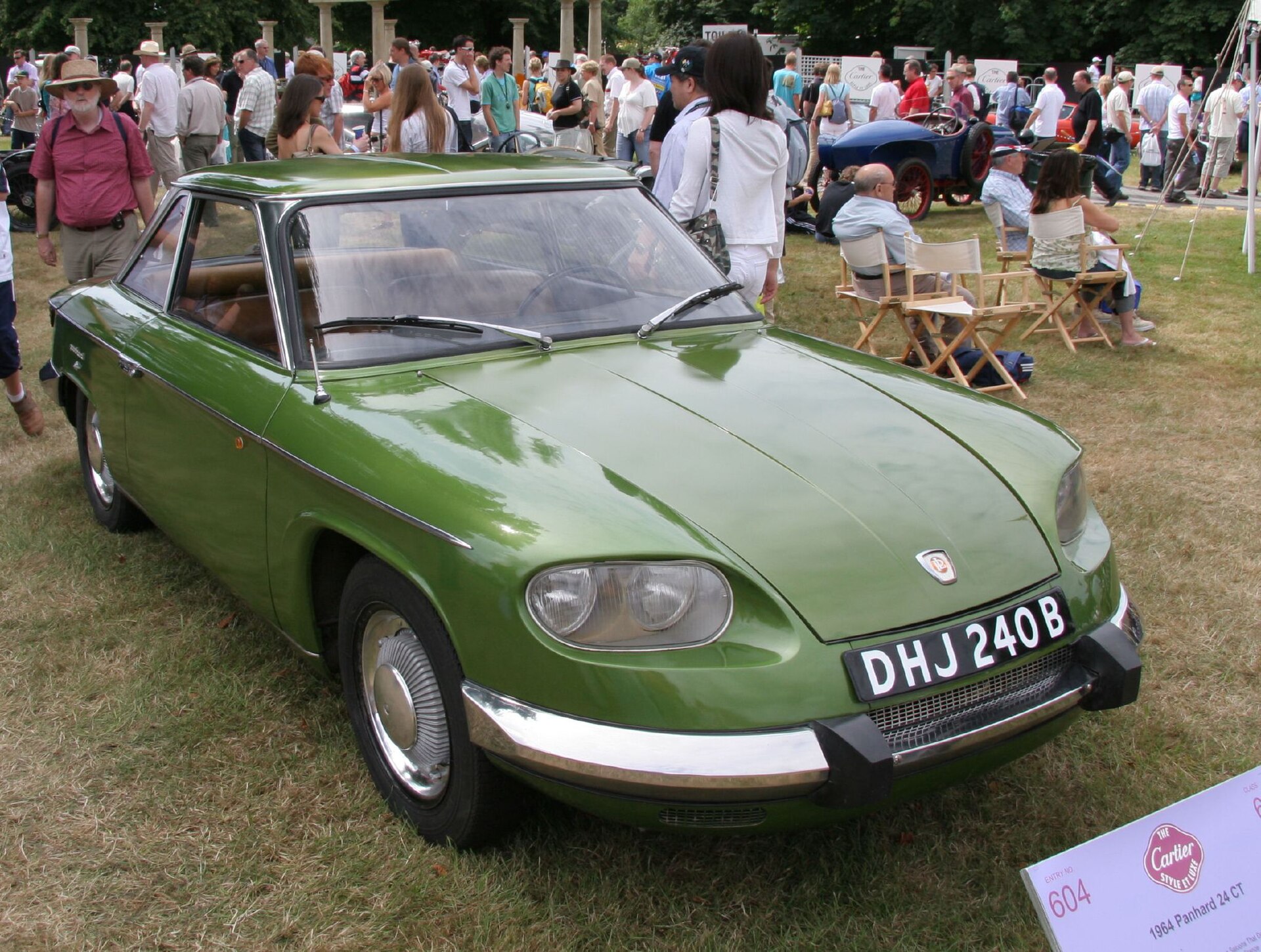
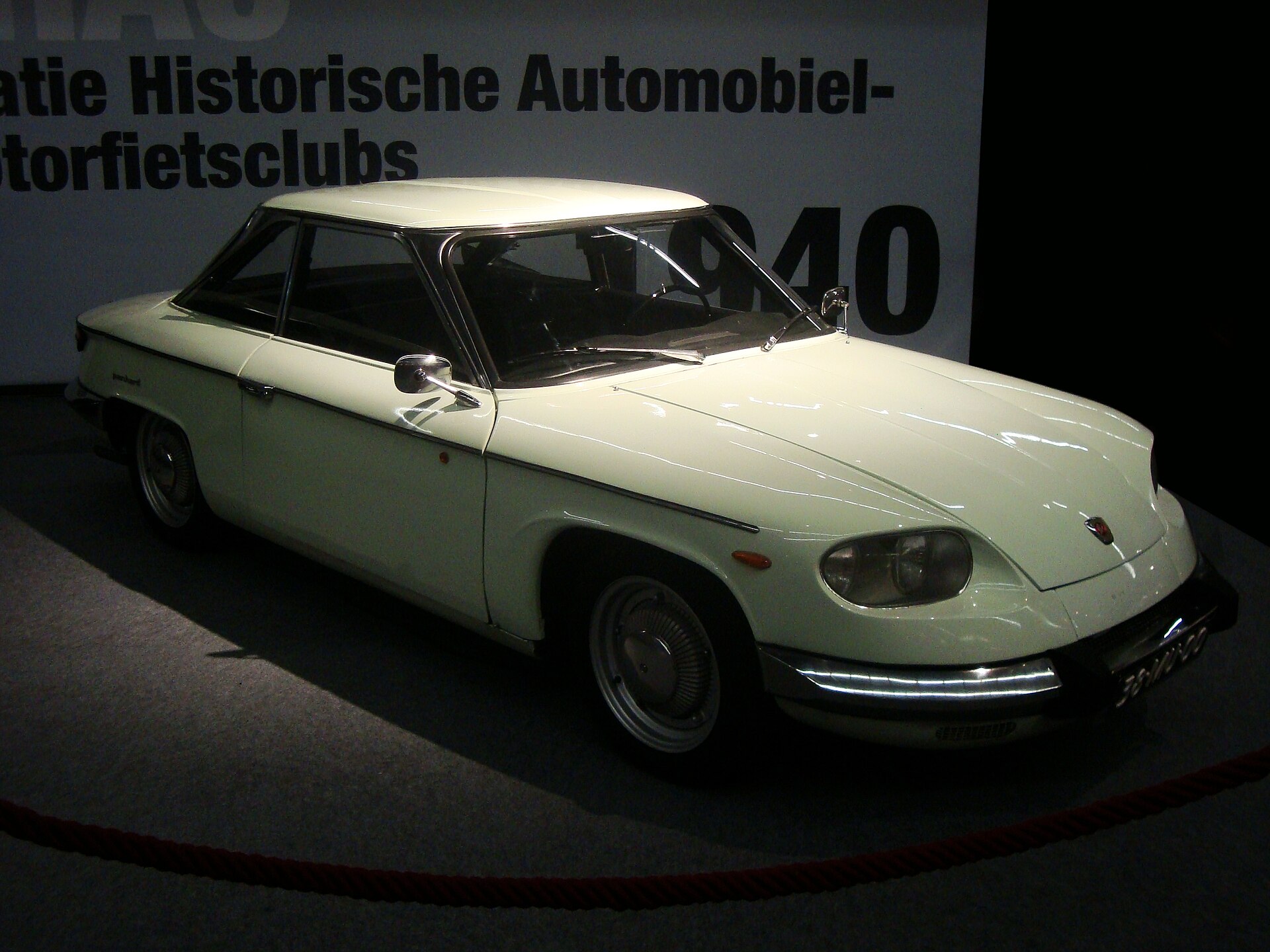
Citroën bought a 25% stake in the company in 1955. The last new model was the Panhard 24, launched to the press on 23 June 1963 and styled by Louis Bionier. The coupés and saloons used an 848 cc flat-twin with 31 kW (42 CV DIN) or 37 kW (50 CV DIN), and 28,651 were built.
In April 1965 Citroën took full control of the car business. It lacked production capacity elsewhere and decided not to develop the 24 further; instead the Panhard plant was used to build more 2CV vans, which were in greater demand. Production of the 24 ended on 20 July 1967, and the brand disappeared from cars. The Citroën side of the story is in the Citroën catalogue.
From 1968 the company built only armoured vehicles. In 2005 Auverland bought it from PSA Peugeot Citroën and kept the Panhard name, and in October 2012 Renault Trucks Defense, part of the Volvo Group, completed its purchase of Panhard for €62.5 million. The cars are listed in the Panhard catalogue.
Panhard timeline
| Year | Event |
|---|---|
| 1887 | Panhard et Levassor founded in Paris |
| 1890 | First car sold, with a Daimler engine |
| 1891 | Système Panhard: front engine, rear-wheel drive |
| 1895 | First and second in Paris–Bordeaux–Paris |
| 1897 | Death of Émile Levassor (14 April) |
| 1910 | Knight sleeve-valve engines under development |
| 1925 | All cars sleeve-valve; world hour record at 185.51 km/h |
| 1936 | Dynamic with monocoque body |
| 1946 | Dyna X shown as the AFG Dyna |
| 1955 | Dyna Z in steel; Citroën takes 25% |
| 1959 | PL 17 presented (29 June) |
| 1961 | PL 17s first, second and third in Monte Carlo Rally |
| 1963 | Panhard 24 |
| 1965 | Citroën takes full control (April) |
| 1967 | Last Panhard car (20 July) |
| 2012 | Renault Trucks Defense buys Panhard |
Landmark Panhard models
| Model | Years | Why it matters |
|---|---|---|
| Système Panhard car | 1891 | Front engine and rear drive, the classic layout |
| Paris–Bordeaux car | 1895 | First and second in the early race |
| Type X35 | 1910s | 7.4-litre car of the First World War command |
| Dynamic | 1936–1940 | Streamlined monocoque, last pre-war design |
| Dyna X | 1948–1954 | Aluminium-bodied light car with a flat-twin |
| PL 17 | 1959–1965 | About 166,000 built; 1961 Monte Carlo winner |
| 24 | 1963–1967 | Last Panhard, styled by Louis Bionier |
FAQ
What is the Système Panhard?
The layout Émile Levassor introduced in 1891: an engine at the front, a front radiator, and drive to the rear wheels through a clutch and sliding-gear transmission.
Who founded Panhard?
René Panhard and Émile Levassor, together with Edouard Sarazin, who held the licence to build Daimler engines in France. The company was founded in Paris in 1887.
Why did Panhard stop making cars?
Citroën took full control of the car business in April 1965, had no capacity to develop the Panhard 24, and turned the plant over to 2CV vans. The last Panhard car was built on 20 July 1967.
Does Panhard still exist?
Yes, as a maker of armoured vehicles. Renault Trucks Defense, part of the Volvo Group, bought it in 2012.
What engine did post-war Panhards use?
An air-cooled two-cylinder boxer engine of 610 to 851 cc, mounted at the front and designed by Louis Delagarde.
Sources
- Wikipedia — Panhard (accessed 24 Oct 2026)
- Wikipedia — Émile Levassor (accessed 24 Oct 2026)
- Wikipedia — Panhard Dyna X (accessed 24 Oct 2026)
- Wikipedia — Panhard PL 17 (accessed 24 Oct 2026)
- Wikipedia — Panhard 24 (accessed 24 Oct 2026)
Found a mistake? Report an error