 Packard Twelve
Specs, engines and history
Published Sources (1) Report an error
By Sarah Whitmore, Senior Automotive Writer
- Built
- 1916–1939
- Top power
- 134 kW (182 PS)
Which Packard Twelve to choose
Our verdict · Sarah Whitmore
- For history: a Twin Six, Packard's first V12 and its only model from 1915 to 1920; one paced the 1919 Indianapolis 500.
- For power: a 1935–1939 Twelve with the 7,756 cc engine, 130 kW (175 hp) or 134 kW (180 hp).
- For coachwork: a Dietrich or LeBaron custom body, or a Brunn All Weather Cabriolet.
- For rarity: a 1938 16th Series (566 built) or a 1939 17th Series (446 built).
Packard was founded in Warren, Ohio, in 1899 by the brothers James Ward Packard and William Doud Packard with their partner George Lewis Weiss. The first car was built on 6 November 1899, and about 400 followed in Warren. On 2 October 1902 an investor group renamed the business the Packard Motor Car Company, and it moved to Detroit soon after. Under the slogan "Ask the Man Who Owns One", credited to its long-time leader Alvan Macauley, Packard became the best-selling American luxury brand from 1924 to 1930. In the Second World War it built 55,523 Merlin aero engines under contract with Rolls-Royce. It merged with Studebaker in 1954, built its last Detroit car on 25 June 1956, and the last Packard of all left the line on 16 July 1958.
The Twelve is the name of Packard's V12 cars. The first, the Twin Six of 1916–1923, was the company's only model for several years, and 30,941 were built. The second, sold as the Twelve from 1933 to 1939, was a coachbuilt luxury car with up to 134 kW (180 hp), and 5,262 were made.
Specs by version
| Version | Engine | Power | Gearbox | Drive | Production years |
|---|---|---|---|---|---|
| 7.3 V12 | 12 cyl · Petrol | 119 kW 162 PS160 hp | 3-sp Manual | Rear-wheel drive | 1933–1934 |
| 7.8 V12 | 12 cyl · Petrol | 130 kW 177 PS174 hp | — | Rear-wheel drive | 1935–1939 |
Verified Manufacturer and type-approval data from our catalog · Sources and methodology
In short
- Two V12 eras: the Twin Six (May 1915 to June 1923 production) and the Twelve (1933–1939 model years).
- Twin Six: 6,950 cc L-head V12 with 66 kW (88 hp); 30,941 built.
- Twelve: 7,300 cc V12 with 119 kW (160 hp), enlarged to 7,756 cc and 130 kW (175 hp) for 1935; 5,262 built.
- Bodies from Packard and from coachbuilders such as Dietrich, LeBaron and Brunn.
Packard Twelve at a glance
| Parameter | Twin Six (1916–1923) | Twelve (1933–1939) |
|---|---|---|
| Maker | Packard, Detroit, Michigan | Packard, Detroit, Michigan |
| Built | 30,941 | 5,262 |
| Engine | 60-degree L-head V12, 6,950 cc (424.1 cu in) | V12, 7,300 cc (445.5 cu in); 7,756 cc (473.3 cu in) from 1935 |
| Power | 66 kW (88 hp) at 2,600 rpm | 119 kW (160 hp) at 3,200 rpm; 130 kW (175 hp), 134 kW (180 hp) high-compression |
| Wheelbase | 3,175 or 3,429 mm (125 or 135 in) | 3,235–3,734 mm (127 3/8 to 147 in), by year |
| Bodies | coachbuilt to order: coupé, convertible, sedan | coupé, convertible, sedan, limousine; custom bodies |
| Layout | front engine, rear-wheel drive | front engine, rear-wheel drive |
| Predecessor / successor | Packard Six / — | — / Packard Custom Super Eight |
The Twin Six: Packard's first V12, 1916–1923
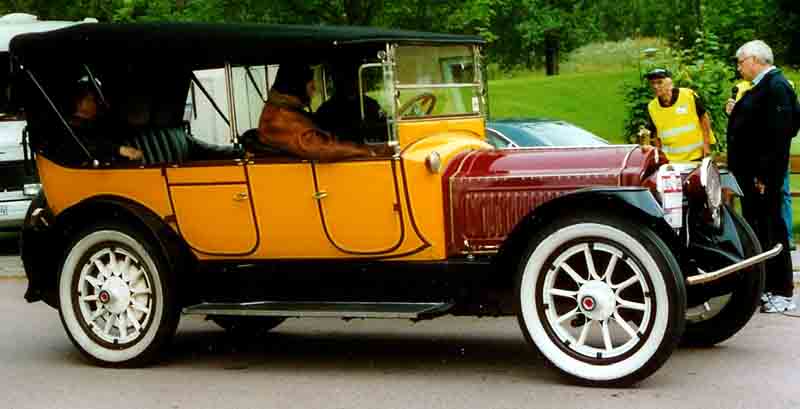
Packard's first twelve-cylinder car was sold as the Twin Six, in the 1-25 and 1-35 series on wheelbases of 125 and 135 inches. Its 60-degree V12 had side valves (L-head), 6,950 cc and 66 kW (88 hp) at 2,600 rpm. It was Packard's only model from 1915 to 1920. Three series were built between May 1915 and June 1923, and production reached 30,941 cars.
The car was improved as it went. Detachable cylinder heads and larger radiators came in 1916, and a centre-mounted gear lever and handbrake in 1917. List prices during the 1915–1923 run ranged from US$3,050 to US$5,150 for the Imperial Limousine. A 1919 Third Series Twin Six 3-25 Runabout paced the 1919 Indianapolis 500.

The Twelve returns, 1933–1939
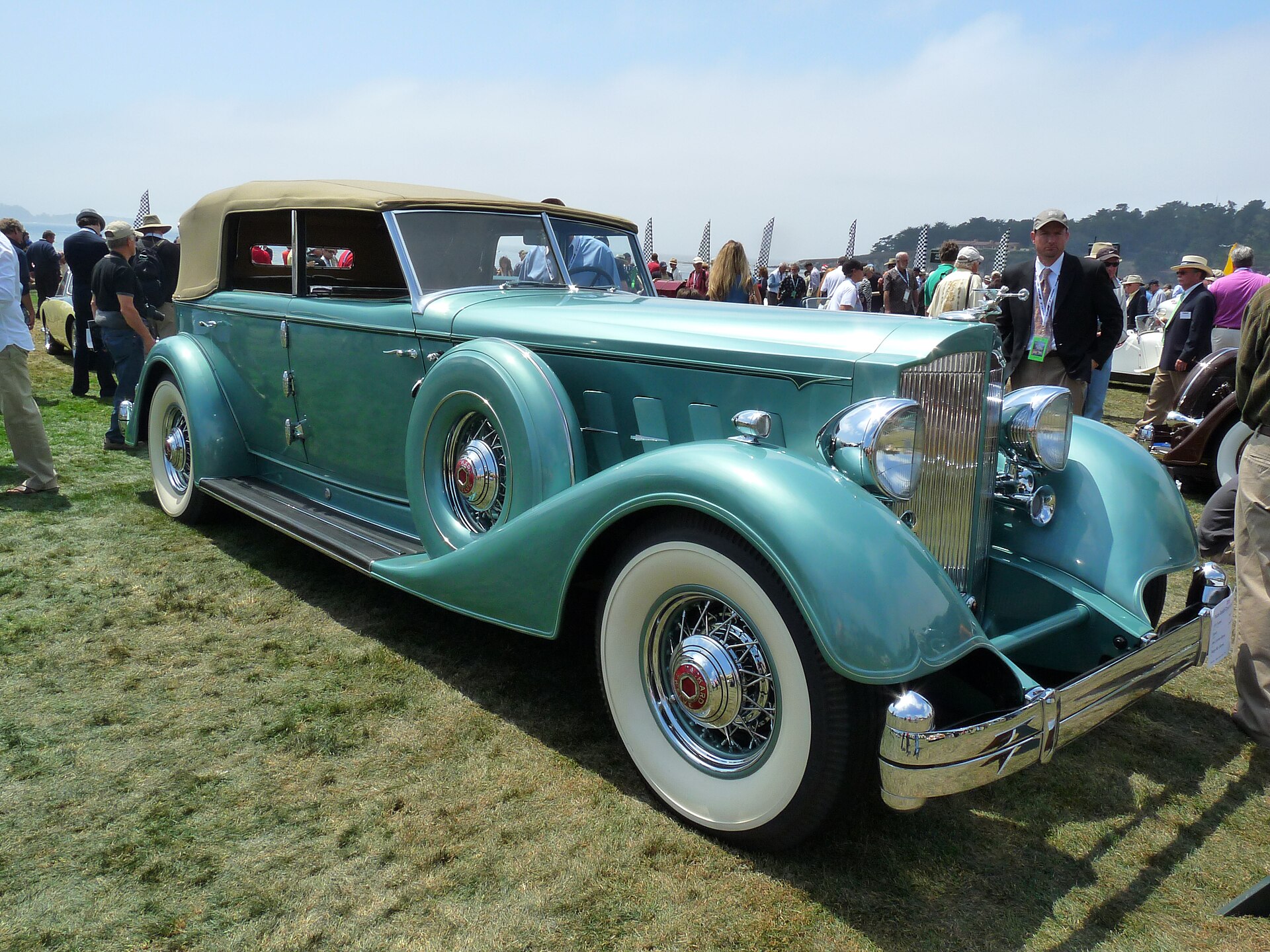
Packard brought the V12 back for 1933, first under the old Twin Six name and then as the Packard Twelve. English Wikipedia's infobox gives 1932 as the start of this second run; its text gives 1933. The new engine had 7,300 cc, a bore and stroke of 3 7/16 by 4 inches, and 119 kW (160 hp) at 3,200 rpm. For 1935 it grew to 7,756 cc and 130 kW (175 hp), or 134 kW (180 hp) in high-compression form.
| Years | Displacement | Power |
|---|---|---|
| 1916–1923 (Twin Six) | 6,950 cc | 66 kW (88 hp) at 2,600 rpm |
| 1933–1934 | 7,300 cc | 119 kW (160 hp) at 3,200 rpm |
| 1935–1939 | 7,756 cc | 130 kW (175 hp) at 3,200 rpm; 134 kW (180 hp) high-compression |
The Twelve was built in several lengths. In 1933 and 1934 the Model 1005 had a 142-inch wheelbase and the Model 1006 a 147-inch one, and 1934 added the 135-inch Model 1106. For 1935 the wheelbases were 132 1/2, 139 1/4 and 144 1/4 inches; by 1938 they had become 127 3/8, 134 3/8 and 139 3/8 inches.


Bodies and coachbuilders
The short-wheelbase Twelve was offered with about ten factory body styles. The long chassis normally carried five- or seven-seat sedans and limousines. Custom bodies came mostly from Dietrich and LeBaron, and in 1937 Dietrich offered six custom designs. Brunn & Company built the All Weather Cabriolet; the All Weather Cabriolet sedan of the 1933–1939 Twelve was listed at US$8,510.

Production by year
| Year | Production |
|---|---|
| 1934 | 960 |
| 1937 | 1,300, the best year |
| 1938 (16th Series) | 566 |
| 1939 (17th Series) | 446 |
| 1933–1939 total | 5,262 |
In 1935 Packard also launched the One-Twenty, its first car under US$1,000, and the company's sales more than tripled that year. The Twelve remained the top of the range and ended with the 17th Series in 1939. For 1940 the Custom Super Eight took its place at the head of the line.

Engine development and the Packard V12 tradition
Both Twelves were slow-revving engines: the Twin Six gave its maximum power at 2,600 rpm, the 1930s Twelve at 3,200 rpm. Between 1934 and 1935 the second engine grew by 456 cc, from 7,300 to 7,756 cc, and gained 11 kW. Packard's V12 work continued after the car. In the Second World War it built 55,523 supercharged Merlin V12 aero engines for the P-51 Mustang under contract with Rolls-Royce, whose story is told in the history of Rolls-Royce. It also made V12 marine engines for PT boats. The rival American luxury brands of the period are covered in the histories of Cadillac and Lincoln.
The Packard Twelve today
The Twelve is a car for collectors of pre-war luxury cars, and its numbers make the rarity easy to judge. Only 5,262 were built in seven years, against 30,941 Twin Sixes, and the last two series were small: 566 cars in 1938 and 446 in 1939. A custom body by Dietrich, LeBaron or Brunn adds a second layer of history to trace, alongside the series and model number. More cars of the decade are in the 1930s classics section.
Packard after the Twelve
The Twelve ended in 1939, and the brand itself lasted less than two decades longer. Packard had been the export leader of its price class in the 1920s; in 1930 it sold almost twice as many cars abroad as any other make priced above US$2,000. The cheaper One-Twenty of 1935 then multiplied its volume. After the war, Packard bought Studebaker with effect from 1 October 1954, forming Studebaker-Packard, but the combined company was close to bankruptcy by 1956, and Curtiss-Wright managed it under a three-year contract from that year.
| Date | Event |
|---|---|
| 6 November 1899 | first Packard car built in Warren, Ohio |
| 2 October 1902 | Packard Motor Car Company formed; move to Detroit follows |
| May 1915 – June 1923 | Twin Six V12 production, 30,941 cars |
| 1933–1939 | second V12 era, the Twelve, 5,262 cars |
| 1935 | One-Twenty, the first Packard under US$1,000 |
| 1 October 1954 | Packard buys Studebaker; Studebaker-Packard formed |
| 25 June 1956 | last Packard-designed car, a Patrician sedan, leaves the Conner Avenue line in Detroit |
| 16 July 1958 | last Studebaker-Packard Packard built |
| 1962 | "Packard" dropped from the corporate name |
The Packards of 1957 and 1958 were Clippers built on Studebaker bodies, and critics called them "Packardbakers". The 1958 models were sold simply as "Packard", and 2,622 found buyers that model year. The brand was phased out in 1959, and in 1962, the year the Studebaker Avanti appeared, the company removed "Packard" from its name.
Photo gallery

Packard Twelve in our rankings
- No. 546 of 912 · Longest-running car nameplates (6 years · top 69%)
- No. 617 of 859 · Most powerful cars (134 kW · top 72%)
- No. 129 of 154 · Most powerful American cars (134 kW · top 85%)
- No. 26 of 28 · Most powerful V12 cars (130 kW · top 97%)
In production longer than 31% of ranked nameplates in the 1CARS catalog (No. 546 of 912).
FAQ
How many Packard Twelves were built?
5,262 of the 1933–1939 Twelve; the earlier Twin Six of 1916–1923 reached 30,941.
What engine does the Packard Twelve have?
A V12 of 7,300 cc with 119 kW (160 hp) in 1933–1934. From 1935 it had 7,756 cc and 130 kW (175 hp), or 134 kW (180 hp) in high-compression form.
What is the difference between the Twin Six and the Twelve?
The Twin Six was Packard's first V12, built from 1915 to 1923 with a 6,950 cc side-valve engine. The Twelve was the second V12 era, from 1933 to 1939, with larger engines and longer chassis.
Who built the bodies of the Packard Twelve?
Packard offered factory bodies; custom bodies came mainly from Dietrich and LeBaron, and the All Weather Cabriolet from Brunn & Company.
When did Packard stop making cars?
The last Packard-designed car left the Detroit line on 25 June 1956. Studebaker-based Packards followed until 16 July 1958, and the brand was phased out in 1959.
Data sources
Data checked by an editor against the sources below.