 Austin 7
Specs, engines and history
Published Sources (1) Report an error
By Felix Hartmann, Automotive Technology & EV Contributor
- Built
- 1922–1939
- Top power
- 9 kW (12 PS)
Which Austin 7 to choose
Our verdict · Felix Hartmann
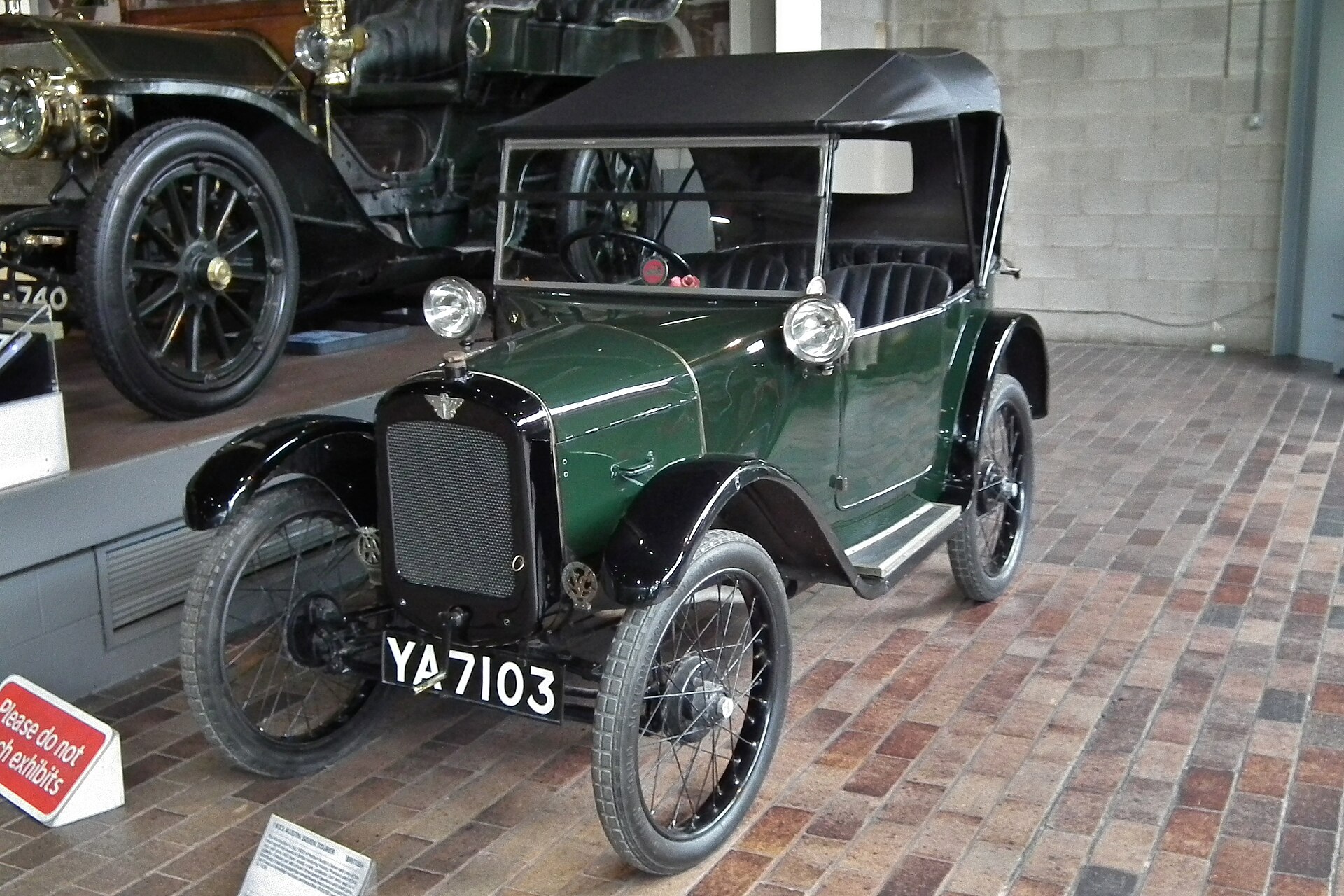
- For the vintage experience: an early tourer of the 1920s, light and simple, with uncoupled brakes that need care.
- For everyday classic use: a Ruby or New Ruby saloon of 1934–1939, with a four-speed synchromesh gearbox and coupled brakes.
- For sport: an Ulster or Nippy, or a well-documented post-war special.
- For rarity: a Swallow or Gordon England body, or a licence-built Dixi or Rosengart.
Compare the scale with the [Ford Model T]](/33791-ford-model-t-history-specs-production.html), the car the Austin 7 is usually measured against: with 15 kW it had twice the power, from an engine almost four times as large.
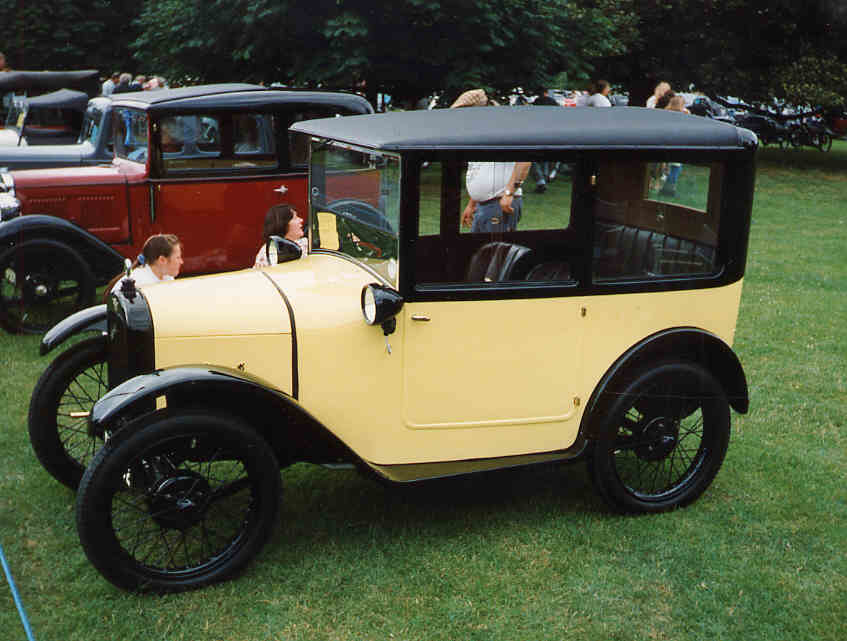
The Austin 7 was the small family car that the Austin Motor Company built at Longbridge from 1922 to 1939. Herbert Austin designed it for young families and as an answer to Britain's horsepower tax of 1921. Its 747 cc four-cylinder engine was meant to replace the motorcycle-and-sidecar combinations and three-wheelers that many families used. About 290,000 cars and vans were built, and licensed or copied versions started the car production of BMW and Nissan. It is often called the "British Model T".
In short
- Announced in July 1922; about 2,500 cars in 1923 and some 290,000 by 1939.
- Side-valve four of 696 cc, enlarged to 747 cc in March 1923; about 7.5 kW, and 8.8 kW from 1933.
- Brakes on all four wheels from the start; four-speed gearbox from 1932 and synchromesh from 1933.
- Built under licence as the Dixi (later BMW) in Germany, the Rosengart in France and the American Austin in the United States.
Austin 7 at a glance
| Parameter | Metric | Imperial |
|---|---|---|
| Maker | Austin Motor Company, Longbridge | - |
| Production | 1922–1939 | - |
| Built | about 290,000 cars and vans (German Wikipedia table: 290,806) | - |
| Engine | side-valve straight-four, 696 cc (1922), 747 cc (from 1923) | 42.5 / 45.6 cu in |
| Bore × stroke | 54 × 76 mm, then 56 × 76 mm | 2.125 / 2.2 × 3 in |
| Power | about 7.5 kW; 8.8 kW from 1933 | - |
| Gearbox | three-speed; four-speed from 1932 | - |
| Brakes | drums on all four wheels, coupled from 1930 | - |
| Wheelbase | 1,905 mm (lengthened by 6 in in late 1931) | 75 in |
| Track | 1,020 mm | 40 in |
| Length × width | 2,800 × 1,200 mm | 110 × 46 in |
| Weight | 360 kg (text), 375 kg (infobox) | 794 lb |
| Successors | Austin 8, Austin Big 7 | - |
Herbert Austin's small-car gamble
The Austin company was in receivership in 1921, and Herbert Austin's board and creditors opposed a small car. He went ahead on his own, investing his own money, and worked on the design in the billiard room of his house, Lickey Grange. In 1921 he hired an 18-year-old draughtsman, Stanley Edge, to produce the detailed drawings. Edge later said that he had argued for a four-cylinder engine and designed the gearbox and clutch. The styling is reported to have been influenced by the Peugeot Quadrilette.
Three prototypes were built, and the car was announced in July 1922. Austin had patented many of its features in his own name and received a royalty on every car sold. The car was about three quarters the size of the Ford Model T and weighed less than half as much.
| Year | Event |
|---|---|
| 1921 | design begins at Lickey Grange; Stanley Edge joins |
| July 1922 | Austin 7 announced, with a 696 cc engine |
| March 1923 | engine enlarged to 747 cc |
| November 1923 | electric starter added |
| 1926 | first steel saloon (September) |
| 1927 | first Swallow body; Dixi licence production in Germany |
| 1928 | coil ignition replaces the magneto; Rosengart starts in France |
| 1930 | coupled four-wheel brakes; American Austin in the United States |
| 1932 | four-speed gearbox |
| 1933–1934 | synchromesh on third and top, then second |
| 1936 | three-bearing crankshaft |
| 1939 | production ends |
Engine and chassis
The first engine had a bore of 54 mm and a stroke of 76 mm for 696 cc. From March 1923 the bore grew to 56 mm, giving the 747 cc that most cars use. The block and head were cast iron and the crankcase aluminium. Cooling worked by thermosiphon, with no water pump, and the big ends were splash-fed, although some sports models had pressure feed. The crankshaft ran in two bearings, a ball bearing at the front and a roller at the rear, until 1936, when a three-bearing crank arrived. An electric starter was added in November 1923, and coil ignition replaced the magneto in 1928.
English Wikipedia gives the actual output as about 7.5 kW (10 hp); German Wikipedia lists 7.7 kW for the 1922–1932 cars and 8.8 kW (12 bhp) for the later ones. With about 7.5 kW and 360 kg, the car had roughly 21 kW per tonne. Our power-to-weight calculator shows how that compares with a modern city car. Economy was the point of the design: English Wikipedia quotes 5.9 l/100 km (40 mpg US) for the American Austin version, and about 1.9 litres of oil every 1,600 km (1,000 miles).
The chassis was an A-shaped frame with a beam front axle on a central transverse leaf spring and cantilevered quarter-elliptic springs at the rear. Drive went to the rear wheels. Steering used a worm and wheel, and the spiral-bevel rear axle had ratios from 4.4:1 to 5.6:1, with 4.9:1 the most common until the 1930s. The car had brakes on all four wheels from the start, but at first the pedal worked only the rear brakes and the hand lever the front ones; the system became fully coupled in 1930.


Body styles: tourers, saloons and Ruby
The Austin 7 came in a long list of factory types. The table groups the main ones by English and German Wikipedia.
| Variant | Years | Body / purpose | Engine | Notes |
|---|---|---|---|---|
| AB, AC, AD, AE tourers | 1922–1930 | open four-seaters | 747 cc | AB with aluminium body |
| R, RK, RL, RG saloons | 1926–1932 | fabric or steel saloons | 747 cc | first steel saloon from September 1926 |
| ARQ Ruby, ARR New Ruby | 1934–1939 | saloon | 747 cc | the last saloon types |
| Pearl, New Pearl | from 1934 | cabriolet of the Ruby | 747 cc | - |
| Opal, New Opal | from 1934 | two-seater | 747 cc | - |
| Super Sports, Ulster, Nippy, Speedy | 1927–1937 | sports two-seaters | 747 cc, some with pressure-fed big ends | Ulster named after the 1929 Tourist Trophy |
| Vans | - | commercial | 747 cc | three-door van |
Coachbuilders added their own bodies. In 1927 William Lyons's Swallow Sidecar Company commissioned a new tourer body on the Austin chassis, and a saloon followed in 1928. About 3,500 Swallow bodies were made by 1932, when Lyons began building complete SS cars, the forerunner of Jaguar; that story is told in our history of Swallow and SS Cars. E. C. Gordon England built the first Austin 7 saloon, with a fabric body 28 lb (13 kg) lighter than the tourer.

Racing and the Ulster
Racing began early. Arthur Waite, Herbert Austin's son-in-law, competed at Brooklands in March 1923 and at Monza a month later. Gordon England set six class records at Brooklands. He also took second place in the 1,100 cc class of the JCC 200-mile race in October 1923; by 1925 he held 19 class records in the 750 cc class. From January 1924 the factory sold Sports and Brooklands Super-Sports models, the latter with a certificate for 80 mph (129 km/h). The Ulster name came from the strong showing at the 1929 RAC Tourist Trophy at Ards in County Down, where Archie Frazer-Nash finished third. Waite won the 1928 100 Miles Road Race in Australia, and C. E. A. Westcott won the 1936 RAC Rally.

Licence builds around the world
- Germany: the Dixi built the car under licence from 1927; it became BMW's first car, as told in our BMW history.
- France: Rosengart produced its version from 1928.
- United States: the American Austin company, founded in 1929 in Butler, Pennsylvania, built cars from 1930 and went bankrupt in 1934; its successor was American Bantam.
- Japan: Nissan used the Austin 7 as the model for its first Datsun cars; sources differ on whether there was a licence.
- Australia: rolling chassis were imported and fitted with local bodies, including tourers and roadsters by Holden.
After the Second World War many Austin 7s were rebuilt as specials. Bruce McLaren's first racing car was based on one, and so was the first Lotus, the Mark I; Lotus's next steps are covered in our Lotus Mark VI article. Reliant used an engine derived from the Austin 7 in its early three-wheelers. Austin later reused the Seven name for the A30 of 1951 and the Mini of 1959, whose story is in our history of the Mini.
FAQ
How many Austin 7 were built?
About 290,000 cars and vans between 1922 and 1939; the production table in German Wikipedia gives 290,806.
What engine did the Austin 7 have?
A side-valve four-cylinder engine of 696 cc at launch and 747 cc from March 1923, with about 7.5 kW at first and later 8.8 kW.
Why is the Austin 7 important?
It brought car ownership to families who could not afford a larger car, and licensed or copied versions became the first cars of BMW (as the Dixi) and Datsun.
What is an Austin 7 Ruby?
The ARQ Ruby of 1934 and the ARR New Ruby of 1936–1939 were the last saloon versions of the Austin 7.
Which famous cars started from an Austin 7?
The first Lotus, the Mark I, and Bruce McLaren's first racing car were both based on the Austin 7.
Data sources
Data checked by an editor against the sources below.