Austin — Herbert Austin's Longbridge Car Maker, 1905–1988
Austin was the British car maker founded by Herbert Austin at Longbridge, near Birmingham, in December 1905. It built luxury cars before the First World War and survived a receivership in 1921. The Austin Seven of 1922 made it a mass producer, and versions of the car were built in Germany, France, the United States and Japan. In 1952 Austin merged with Morris to form British Motor Corporation. As a marque, Austin gave its name to the Mini of 1959, the 1100, the Allegro and the Metro. The Austin badge was phased out in 1988, and the trademark now belongs to SAIC.
Key takeaways
- Herbert Austin bought a disused printing works at Longbridge in November 1905; the Austin Motor Company Limited was incorporated in December 1905.
- The Austin Seven of 1922 sold about 290,000 cars and vans and was licence-built by BMW (Dixi), Rosengart, American Austin and, in some form, Datsun.
- Austin and Morris merged in 1952 to form BMC, led by Austin's Leonard Lord.
- The Metro of 1980 sold 2,078,218 of all types; the Austin name was dropped in 1988, a year before the company became Rover Group.
Austin at a glance
| Fact | Value |
|---|---|
| Founded | December 1905, Longbridge, near Birmingham |
| Founder | Herbert Austin (Baron Austin of Longbridge from 1936) |
| Company | Austin Motor Company Limited, public from 1914 |
| Merged | 1952, with Morris into British Motor Corporation (BMC) |
| Later groups | BMH (1966), British Leyland (1968), Austin Rover (1982), Rover Group (1986) |
| Best-known models | Seven, Twelve, A30, A40, Mini (Austin Seven), 1100, 1800, Allegro, Metro, Maestro, Montego |
| Marque ended | Badge phased out in 1988 |
| Trademark today | SAIC Motor |
Herbert Austin and the Wolseley years
Herbert Austin was born on 8 November 1866 at Little Missenden in Buckinghamshire. In 1884 he went to Australia with an uncle and worked for engineering firms in Melbourne. In December 1887 he became manager of a workshop developing sheep-shearing equipment for Frederick Wolseley. He patented improvements of his own, sold them to Wolseley's sheep-shearing company in March 1893 for shares and moved the business to Birmingham the same year.
At Wolseley he built cars in his spare time from 1895; the third, a four-wheeler, was finished in 1899. When Wolseley's directors dropped motor vehicles in 1901, a separate car business backed by Vickers continued under the Wolseley name with Austin in charge. In 1905 Austin left after a dispute with the Vickers brothers, who wanted a conventional vertical engine he refused to use.

Longbridge and the early Austin cars
In November 1905 Austin bought a disused printing works at Longbridge, about seven miles south-west of Birmingham, and the Austin Motor Company Limited was incorporated in December 1905. The steel industrialist Frank Kayser helped with finance, and Harvey du Cros of Dunlop also supported the venture. The first Austin, shown in April 1906, was a four-cylinder car with chain drive, offered as a 15/20 hp at £500 and a 25/30 hp at £650. Output grew from 31 cars in 1906 to 1,500 in 1913, when the works employed 2,300 people. The company became public in 1914 with a capital of £650,000 and was probably the fifth-largest British car maker by volume.
The First World War turned Longbridge into a large munitions works. Austin built aircraft, including the S.E.5a under licence, shells, heavy guns, generating sets and about 1,600 three-ton trucks, and the workforce grew from about 2,500 to 22,000. Herbert Austin was knighted in 1917 and was also honoured by Belgium for employing 3,000 Belgian refugees. His only son, Vernon, was killed in action in France on 26 January 1915. From 1918 to 1924 Austin sat as Conservative MP for Birmingham King's Norton.

Receivership and the Austin Seven
After the war Austin adopted a one-model policy built around the 3,620 cc Austin Twenty, but sales never filled the enlarged factory. The company went into receivership in 1921. After a financial restructuring it recovered under a committee in which Austin remained chairman, with Ernest Payton as finance director and Carl Engelbach as works director from 1922.
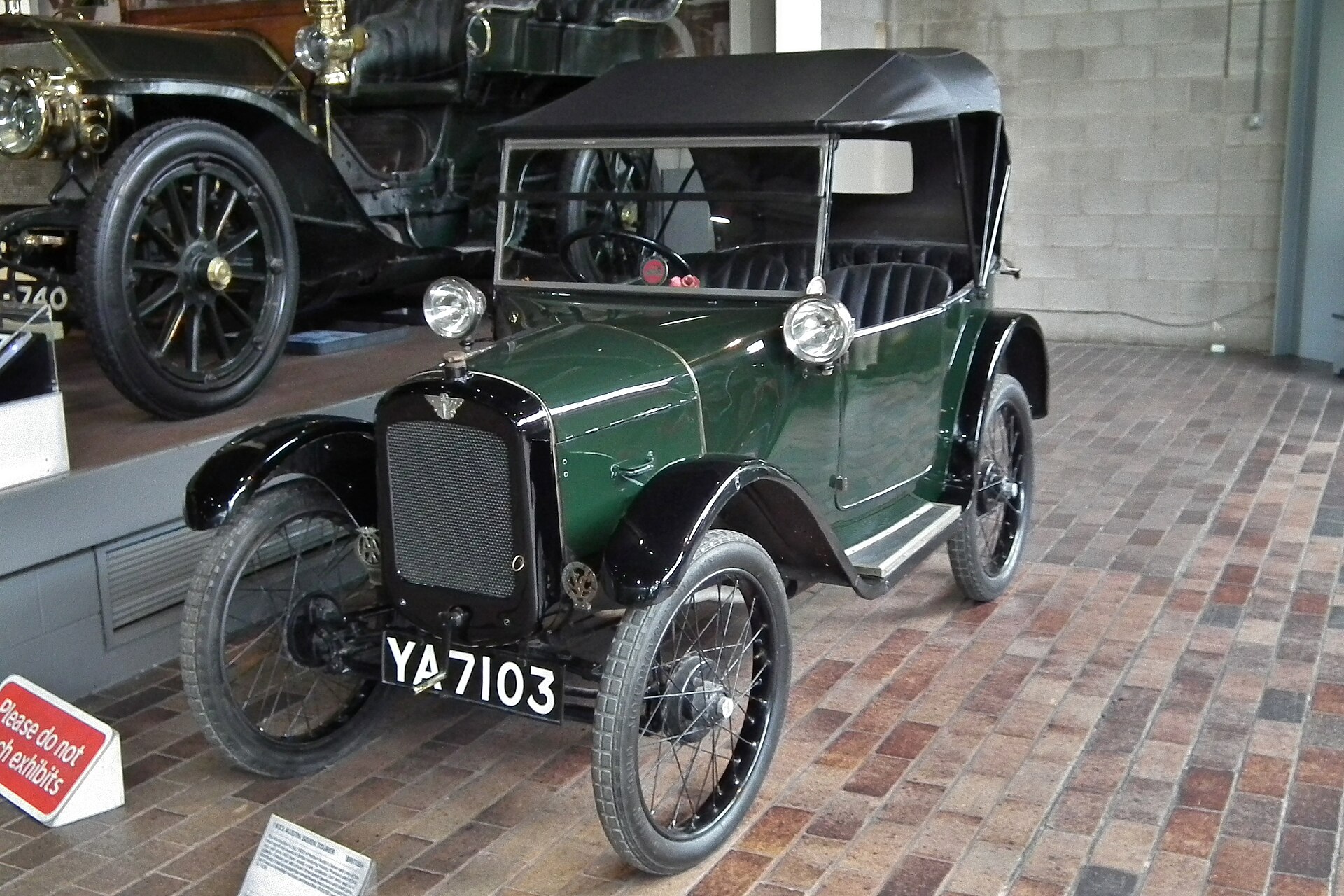
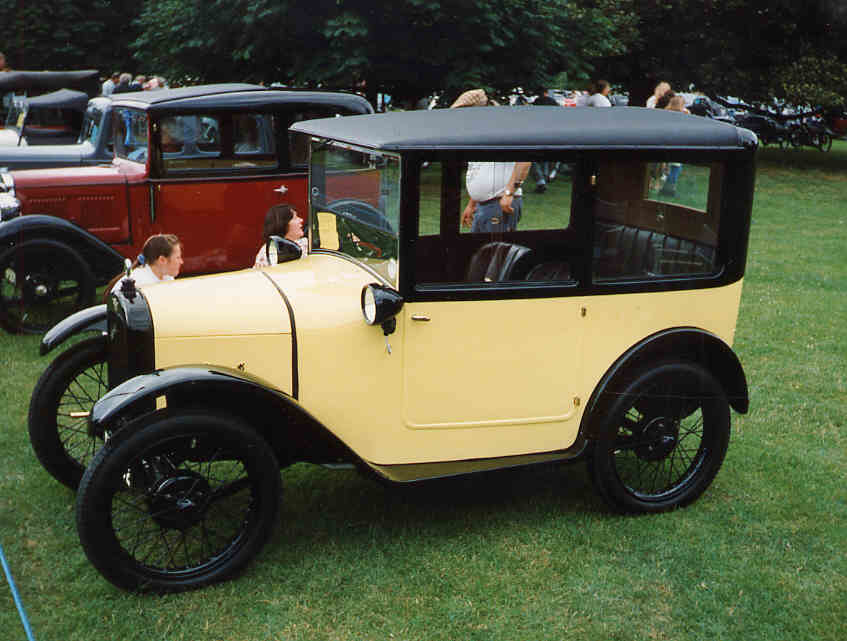
Two new cars saved it. The 1,661 cc Twelve arrived in 1922, followed in July by the Seven, a cheap and simple small car for first-time buyers. Herbert Austin led the concept and styling; Stanley Edge, an 18-year-old draughtsman, drew the detailed plans. The Seven was about three-quarters the size of a Ford Model T and weighed less than half as much. Its side-valve engine grew from 696 cc to 747 cc in March 1923. A steel saloon cost £165 from September 1926. About 290,000 Sevens were built up to 1939, and it was the most-produced car of 1930.
The Seven spread across the world. BMW built it from 1927 as the Dixi, the first BMW car, later badged 3/15; Rosengart built it in France from 1928. The American Austin Car Company produced it from 1930, reborn as American Bantam from 1937. Sources disagree on whether the early Datsun was licensed or copied. Bantam's reconnaissance car prototype used Austin nose and wing parts. Its design went to Willys and Ford, which built it as the Jeep, described in the Willys MB history. In Britain, Swallow-bodied Sevens from William Lyons' firm helped lay the foundations of Jaguar, and the first Lotus and Bruce McLaren's first racing car were built from Sevens. The car's own story is in the Austin 7 history.
Leonard Lord, the war and BMC
Austin stayed profitable through the Depression, adding all-steel bodies, Girling brakes and synchromesh gearboxes. Leonard Lord, formerly of Morris, joined the board in 1938. Herbert Austin, created Baron Austin of Longbridge in 1936, died in Birmingham on 23 May 1941. Payton succeeded him as chairman, and on Payton's death in 1946 Lord took over. During the Second World War Longbridge built trucks and aircraft, including parts for the Short Stirling and Avro Lancaster bombers.
The post-war range, announced in 1944, introduced the company's first overhead-valve engine. It included the A40 Devon and Dorset of 1947–1952 and the small A30 of 1951. In 1952 Austin did a deal with Donald Healey that created the Austin-Healey sports cars, listed in the Austin-Healey catalogue. It also agreed with Nissan to assemble Austins in Japan, where 20,855 were built between 1953 and 1959. The same year Austin merged ownership, though not identity, with Morris Motors to form British Motor Corporation under Lord. Austin was the dominant partner, and its overhead-valve engines went into most BMC models.

Mini, front-wheel drive and British Leyland
After the Suez Crisis of 1956 raised fears of fuel shortages, Lord asked Alec Issigonis to design a small car. It was launched in 1959 as the Austin Seven alongside the Morris Mini-Minor; because the Morris version sold better, the Austin was renamed Mini. BMC followed with front-wheel-drive family cars: the 1100 (Austin version 1963), the 1800 of 1964 and the Maxi of 1969. The rear-drive Austin 3-Litre of 1968 sold fewer than 10,000.
BMC bought Pressed Steel in 1965 and Jaguar in 1966, renaming itself British Motor Holdings. In 1968, under government pressure, it merged with Leyland Motors to form British Leyland. The Austin Allegro of 1973 was criticised for its styling and build quality. The wedge-shaped 18/22 of 1975 was launched as an Austin, Morris and Wolseley and within six months became the separate Princess marque.

Metro, Maestro, Montego and the end of the name
In 1982 most of BL's car business became the Austin Rover Group, with Austin as the mainstream brand and Rover as the luxury one. The Austin Mini Metro was launched on 8 October 1980 and named by a ballot of employees. Built on a robotised line at Longbridge, it became one of Britain's most popular cars of the 1980s. In its best year, 1983, it sold more than 130,000 in Britain, behind only the Ford Escort and Sierra. Nearly 1.5 million were sold in Britain, and 2,078,218 Metros of all types were built up to 1997. The Maestro of March 1983 replaced the Allegro and Maxi, and the Montego of April 1984 replaced the Morris Ital.
The company wanted to move upmarket under the Rover name. A planned Austin replacement for the Metro was cancelled in early 1987, and the Austin badge was phased out in 1988. The company became Rover Group in 1989; the Metro continued as the Rover Metro from May 1990. The Austin name passed with the group to British Aerospace, BMW and MG Rover, and in July 2005 Nanjing Automobile acquired it with the Longbridge plant. It now belongs to SAIC Motor, which uses Longbridge as a research and development site for MG. Separately, a newly registered Austin Motor Company began building the small Austin Arrow electric car in Rajkot, India, in October 2023. Austin models on 1cars are listed in the Austin catalogue.

Austin timeline
| Year | Event |
|---|---|
| 1866 | Herbert Austin born (8 November) |
| 1905 | Longbridge works bought (November); company incorporated (December) |
| 1906 | First Austin car shown (April) |
| 1914 | Austin becomes a public company |
| 1921 | Receivership |
| 1922 | Twelve and Seven launched |
| 1936 | Herbert Austin becomes Baron Austin of Longbridge |
| 1941 | Herbert Austin dies (23 May) |
| 1952 | Austin-Healey; merger with Morris to form BMC |
| 1959 | Austin Seven (Mini) |
| 1968 | British Leyland formed |
| 1980 | Austin Mini Metro (8 October) |
| 1982 | Austin Rover Group |
| 1988 | Austin badge phased out |
| 2005 | Nanjing Automobile acquires the name (July); later SAIC |
Landmark Austin models
| Model | Years | Why it matters |
|---|---|---|
| 15/20 and 25/30 hp | 1906 | First Austin cars |
| Seven | 1922–1939 | Mass-market small car, licence-built abroad |
| Twelve | 1922 onwards | Mid-size car of the recovery |
| A40 Devon / Dorset | 1947–1952 | Post-war car with overhead-valve engine |
| Austin Seven (Mini) | 1959 | Issigonis design, later renamed Mini |
| 1100 / 1800 | 1963 / 1964 | Front-wheel-drive BMC family cars |
| Metro | 1980–1997 | Best-selling Austin of the 1980s |
FAQ
Who founded Austin?
Herbert Austin, a former manager of Wolseley, who incorporated the Austin Motor Company at Longbridge in December 1905.
Is the Austin Seven related to BMW?
Yes. BMW's first car, the Dixi of 1927, was a licence-built Austin Seven, later badged BMW 3/15.
When did Austin merge with Morris?
In 1952, forming British Motor Corporation (BMC) under Leonard Lord.
When did the Austin brand end?
The Austin badge was phased out in 1988, and the company became Rover Group in 1989.
Who owns the Austin name today?
SAIC Motor, which took it over from Nanjing Automobile.
Sources
- Wikipedia — Austin Motor Company (accessed 24 Oct 2026)
- Wikipedia — Herbert Austin, 1st Baron Austin (accessed 24 Oct 2026)
- Wikipedia — Austin 7 (accessed 24 Oct 2026)
- Wikipedia — Austin Metro (accessed 24 Oct 2026)
- Wikipedia — British Motor Corporation (accessed 24 Oct 2026)
Found a mistake? Report an error