All-Season vs Winter vs Summer Tyres: Which Do You Need?
If you drive in snow, on mountain roads or in a country with a winter tyre law, fit dedicated winter tyres from late autumn and summer tyres for the rest of the year. Are your winters mild, with little snow, and do you mostly drive in towns or on lowland roads? Then a good all-season tyre with the Alpine (3PMSF) symbol is a reasonable single set, but it gives up some grip in summer heat and on deep snow. The German automobile club ADAC sums up its own tests the same way: a summer and winter combination is still superior, and all-season tyres are not yet universal all-rounders.
Key takeaways
- Winter tyres use a softer compound and deeper, siped tread that work best below about 7 °C, on snow, slush and ice.
- Summer tyres stop shortest and steer most precisely on warm dry and wet roads, but lose much of their grip on snow.
- All-season tyres are a compromise; in ADAC's 2024 test of 16 all-season tyres only one earned an overall "good" rating.
- Where winter tyres are compulsory, the three-peak mountain snowflake (3PMSF) is now the symbol that counts in most countries, and M+S alone is no longer enough in Germany, France, Sweden, Finland, Estonia and Latvia.
How the three tyre types differ
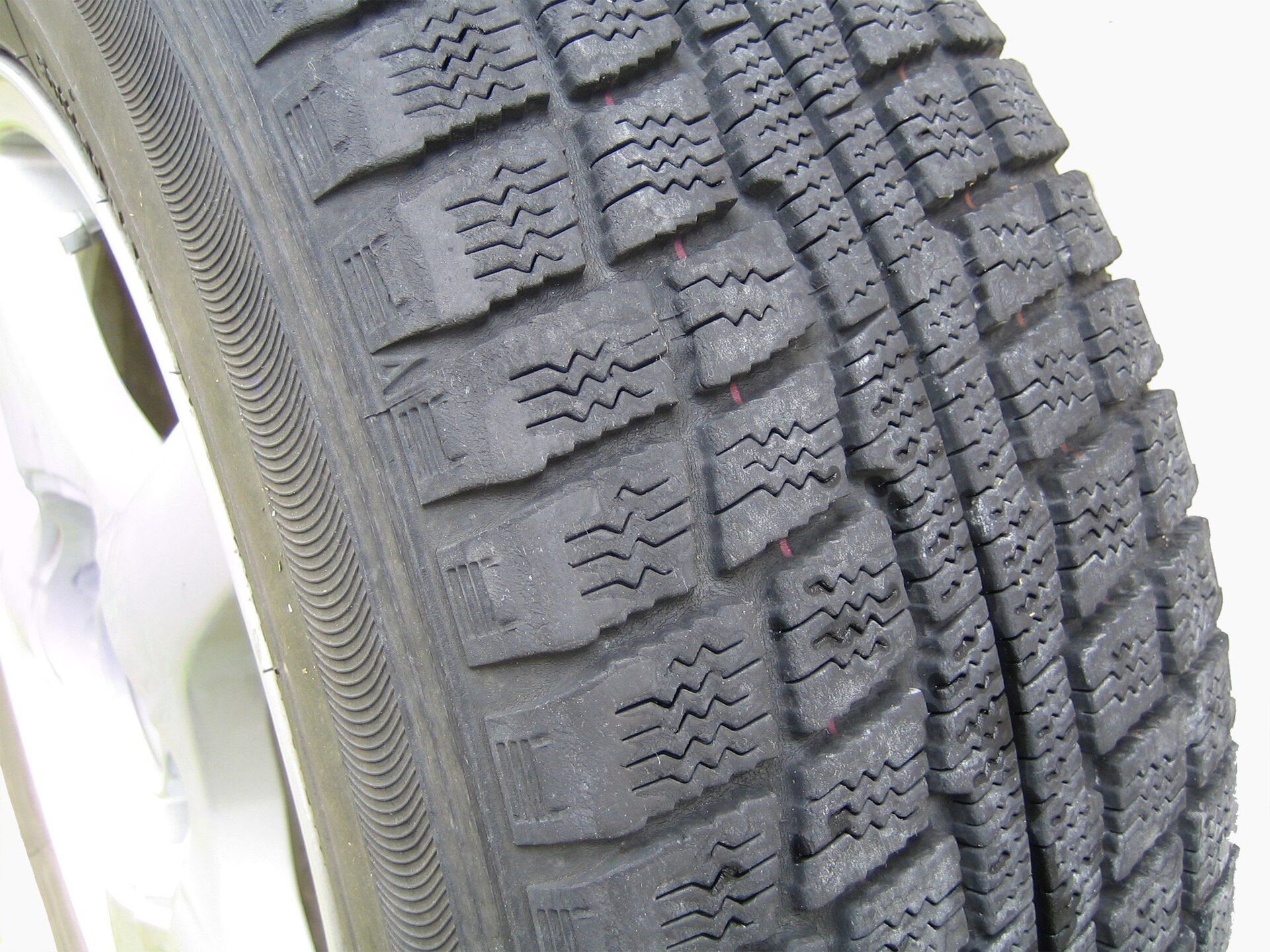
The difference starts with the rubber. A summer tyre's compound is relatively firm, which keeps the tread blocks stable and the steering precise when the road is warm. As the temperature drops, that rubber hardens and grip falls. Winter tyres are generally optimised for temperatures below 7 °C. Their softer, more flexible compound stays pliable in the cold, and the tread has a high share of open grooves plus thousands of thin slits (sipes) that give extra biting edges on snow and ice.
All-season tyres sit in between. Their tread gaps are smaller than a winter tyre's and larger than a summer tyre's, and the compound has to work across a wide temperature range. That makes them quieter than winter tyres on clear roads but less capable in deep snow or on ice.
| Specification | Summer tyres | All-season tyres | Winter tyres |
|---|---|---|---|
| Best conditions | Warm dry and wet roads | Mild winters, mixed weather, mostly cleared roads | Below about 7 °C, snow, slush, ice |
| Compound | Firmer, stable when warm | Mid-range | Soft, flexible in the cold |
| Tread | Fewer grooves, large blocks | Medium grooves, some sipes | Deep grooves, many sipes |
| Typical marking | None for snow | M+S and, on most current tyres, 3PMSF | M+S and 3PMSF |
| Weak point | Snow and ice | Hot dry roads and deep snow | Hot dry roads, faster wear in summer |
| Sets per car | Two (with winter set) | One | Two (with summer set) |
What the tests show
ADAC's 2024 all-season tyre test in the common size 205/55 R16 covered 16 tyres. Only the Goodyear Vector 4Seasons Gen 3 earned an overall "good" rating; seven tyres were recommended, seven were "adequate" and two were rated "poor". The spread between the best and worst tyres was large. Braking from 100 km/h on a dry road took 39.5 m with the best tyre and 46.6 m with the worst, a gap of more than 7 m. Projected tread life ranged from about 33,000 km to about 60,700 km. ADAC noted that dry performance, especially at high temperatures, was a common weakness of the category.
On snow, the gap between a summer tyre and a winter tyre is even larger. In an ADAC test, a summer tyre delivered about a quarter of the traction of a new winter tyre on snow and needed 7.5 m more to stop from just 30 km/h. Even a worn winter tyre does better than a summer tyre, but wear matters too. At 4 mm of tread the same winter tyre needed 3.2 m more than when new to stop on snow from 30 km/h.
Three conclusions follow:
- The quality of the individual tyre matters as much as the category. A top all-season tyre can beat a weak winter tyre on some surfaces.
- A summer tyre is the wrong choice for any road where snow is possible.
- All-season tyres trade a little in summer for a lot more safety in winter, compared with keeping summer tyres all year.

M+S or 3PMSF: the symbols that decide what is legal
M+S (mud and snow) is a manufacturer's own marking. There is no standard test behind it.
3PMSF, the three-peak mountain snowflake or Alpine symbol, shows that the tyre has passed a standardised snow grip test. Under UNECE Regulation 117, a passenger car tyre must reach a snow grip index of at least 1.07 against a reference tyre in a braking test. Since January 2018 new winter and all-weather tyres sold for the German market have had to carry the symbol. Since 1 October 2024 tyres marked only M+S may no longer be used in wintry conditions in Germany. Tyres with both markings remain legal.
Read the full sidewall code, including load index, speed rating and production date, before you buy. Our guide to choosing winter tyres covers what to look for on the shop shelf, and older winter tyre test results show how far models can differ.
Winter tyre rules in Europe (2026 table)
The rules below are for cars up to 3.5 tonnes. They are taken from the European Consumer Centre Germany (EVZ) overview updated in September 2026 and the ADAC country guide (status October 2025). "Situational" means winter equipment is required when the road conditions are wintry, not on fixed dates. Local signs, for example on Alpine passes, can require chains or winter tyres at any time.
| Country | When winter tyres are required | Tyres that count | Minimum tread for winter use |
|---|---|---|---|
| Austria | 1 Nov–15 Apr, in wintry conditions | M+S or Alpine symbol | 4 mm |
| Belgium | No general rule | - | 1.6 mm (4 mm recommended) |
| Croatia | 15 Nov–15 Apr on many signed roads | M+S or Alpine; or summer tyres plus chains | 4 mm |
| Czech Republic | 1 Nov–31 Mar when snow or ice is present or expected | Winter or all-season | 4 mm |
| Denmark | Since 1 Jul 2025: no unsuitable tyres in winter conditions | Winter or all-season; snowflake recommended | 1.6 mm |
| Estonia | 1 Dec–1 Mar | Non-studded tyres need the Alpine symbol | 3 mm |
| Finland | 1 Nov–31 Mar when conditions require | Studded, or non-studded with 3PMSF (since Dec 2024) | 3 mm |
| France | 1 Nov–31 Mar in designated mountain areas (34 departments) | Four Alpine-symbol tyres, or chains or approved snow socks carried | - |
| Germany | Situational, no fixed dates | Alpine symbol; M+S-only banned in winter since Oct 2024 | 1.6 mm (ADAC advises 4 mm) |
| Italy | No national rule; where signed, usually 15 Nov–15 Apr (Aosta Valley 15 Oct–15 Apr) | Winter or all-season, or chains on board | - |
| Latvia | 1 Dec–1 Mar | Alpine symbol | 4 mm |
| Lithuania | 10 Nov–31 Mar | Winter or all-season | 3 mm |
| Luxembourg | Situational | M+S or Alpine | 1.6 mm |
| Netherlands | No rule; studs and chains not allowed | - | - |
| Norway | No general rule for cars; tyres must suit conditions | Winter tyres or chains | 3 mm in the winter season |
| Poland | Not compulsory; recommended 1 Nov–1 Apr | - | - |
| Slovakia | Situational: snow, ice or frost on the road | M+S or Alpine | 3 mm |
| Slovenia | 15 Nov–15 Mar and in wintry conditions | Winter or all-season, or summer tyres plus chains | 3 mm |
| Spain | No general rule; can be ordered by signs | Winter tyres, chains or approved socks | - |
| Sweden | 1 Dec–31 Mar in winter conditions | Alpine symbol (since Dec 2024) or studded | 3 mm |
| Switzerland | No general rule; the car must stay controllable | Winter or all-season in practice | 1.6 mm (4 mm recommended) |
Fines differ widely. EVZ's September 2026 overview lists €60 and a penalty point in Germany for unsuitable tyres, €135 in France and about €130 in Croatia. The rules apply to visitors too: the RAC's Germany guide, for example, stresses that cars registered abroad must be fitted with suitable tyres in winter conditions. More trip-planning and ownership guides are collected in our car advice section.
All-season, winter or summer: which should you choose?
Work through these questions in order:
- Do you live in, or regularly drive to, a country or region with a winter tyre law? Austria, the Nordic and Baltic states, the Alps and the Balkans all have one. If yes, you need at least 3PMSF all-season tyres, and dedicated winter tyres are the safer choice.
- How often do you see snow on your roads? Several times a winter, or on hills and untreated side roads, points to winter tyres. Snow a few days a year in a city with ploughed roads makes all-season tyres sensible.
- How hot are your summers and how fast do you drive? All-season tyres are at their weakest on hot, dry roads. If you cover long motorway distances in summer, a summer set gives shorter stopping distances.
- Can you store a second set? Two sets need storage space or a hotel service at the tyre shop, plus two fitting appointments a year. A single all-season set avoids that.
- Which sizes does your car allow? Check the load index and speed rating in the car's papers before buying any set; the tyre size calculator helps if you want a narrower or smaller-rim winter size.
Continental suggests switching to winter tyres between October and April as temperatures drop. Book the fitting before the first frost rather than after the first snowfall.
Common mistakes
- Mixing types on one car. Fit four tyres of the same type. Austria, Romania and Slovakia expressly require winter equipment on all wheels, and Croatia and Slovenia speak of four winter or all-season tyres.
- Relying on M+S. Many older all-season and winter tyres carry M+S only. They may no longer count in Germany, France, Sweden, Finland, Estonia or Latvia.
- Running winter tyres to the legal minimum. Grip on snow falls fast as the tread wears. ADAC advises replacing winter and all-season tyres at about 4 mm, and Austria, the Czech Republic and Croatia set 4 mm as the legal minimum for winter use.
- Keeping old tyres too long. Rubber hardens with age even when there is tread left. ADAC recommends using winter tyres for no more than eight years.
Try our calculator
Tyre size calculatorFAQ
Are all-season tyres legal in winter?
Yes, if they carry the right markings. All-season tyres with the three-peak mountain snowflake (3PMSF) count as winter tyres in every European country with a winter tyre rule. Tyres marked only M+S no longer qualify in several countries, including Germany since 1 October 2024 and Sweden and Finland since December 2024.
At what temperature should I switch to winter tyres?
Winter tyres are designed for temperatures below about 7 °C, so switching when daytime temperatures settle below that point is a common guide. In practice, most of central Europe sees this in October or November.
Can I use winter tyres all year round?
It is legal in most countries but not recommended. On warm, dry roads winter tyres wear faster, stop longer and feel less precise than summer tyres. Fit a summer set or 3PMSF all-season tyres for the warm months.
Do I need winter tyres in a rental or foreign car?
The rules of the country you drive in apply, whatever the registration. In Austria, Germany and the Nordic states a car without suitable tyres in winter conditions can be fined and stopped. Ask the rental company for a car with winter tyres when booking.
Are snow chains a substitute for winter tyres?
In some countries, yes. France, Croatia, Slovenia and Italy accept summer tyres combined with chains or approved snow socks carried on board, fitted when the road requires it. With chains fitted, the speed limit is 50 km/h in Germany, France and Italy, and Austria allows them only on roads almost fully covered in snow or ice.
Sources
- Europäisches Verbraucherzentrum Deutschland (EVZ) - Winterreifen: Das gilt in Deutschland und Europa (updated 25.09.2026) (accessed 22 Oct 2026)
- ADAC - Winterreifen- und Schneeketten-Pflicht in 21 europäischen Ländern (status October 2025) (accessed 22 Oct 2026)
- ADAC - Mindestprofiltiefe Reifen: Wann es gefährlich wird (accessed 22 Oct 2026)
- Tyre Reviews - 2024 ADAC All Season Tyre Test (results summary) (accessed 22 Oct 2026)
- Continental - Winter tyre laws (3PMSF since 2018, M+S transition to 30.09.2024) (accessed 22 Oct 2026)
- Wikipedia - Winter tire (accessed 22 Oct 2026)
- RAC - Driving in Germany (winter tyres for foreign-registered cars, chains 50 km/h) (accessed 22 Oct 2026)
- RAC - Driving in Italy (winter tyres 15 Nov–15 Apr, Aosta Valley) (accessed 22 Oct 2026)
Found a mistake? Report an error